


Blight Disease in Paddy: Identification, Symptoms & Control
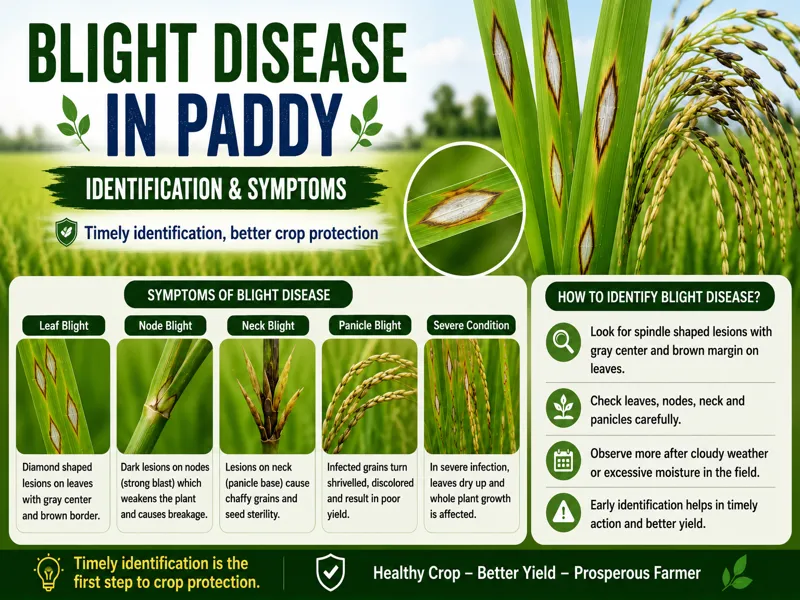
Blight Disease in Paddy: Identification, Symptoms, Causes and Effective Control
Paddy is one of the most important food crops in India. However, several diseases can seriously affect its yield, among which blight disease in paddy is considered one of the most dangerous. If it is not identified and managed at the right time, this disease can reduce crop yield by 30% to 70%.
In paddy, the term “blight disease” is used for different types of diseases. Farmers mainly encounter the following three types of blight diseases:
- Bacterial Leaf Blight (BLB)
- Sheath Blight
- Rice Blast
In this article, you will learn about the symptoms, causes, damage, prevention, and effective control methods of all these three diseases in simple and easy Indian English.
🌾 1. What is Blight Disease in Paddy?
Blight disease in paddy is a disease that affects the leaves, stems, nodes, and panicles of the rice plant. Each type of blight disease is caused by a different bacterium or fungus.
- Bacterial Leaf Blight is a bacterial disease.
- Sheath Blight is a fungal disease.
- Rice Blast is also a fungal disease and is considered the most destructive blight disease in paddy.
If the field has high moisture, continuous rainfall, excessive use of urea, and infected crop residues, these diseases can spread rapidly.
🔍 2. Types of Blight Disease in Paddy
1. Bacterial Leaf Blight (BLB)
This bacterial disease mainly affects the leaves of the paddy crop.
Main Symptoms
- Leaves start drying from the edges.
- The dried leaf margins appear irregular and wavy.
- Leaves look scorched or blighted.
- Yellow bacterial ooze or small droplets can be seen on the leaves in the early morning.
- In severe infection, the entire leaf may dry up.
2. Sheath Blight
This fungal disease mainly affects the stems and the lower leaf sheaths of the plant.
Main Symptoms
- Round or oval spots appear on the stems.
- The spots are purple, brown, or greyish in color.
- Later, these spots merge with each other.
- The entire leaf starts drying.
- Severe infection affects the overall growth of the plant.
3. Rice Blast
Rice Blast is the most serious fungal blight disease of paddy. It is caused by the fungus Pyricularia oryzae (Magnaporthe oryzae).
This disease appears in different forms at different stages of the crop.
(a) Leaf Blast
- Boat-shaped or eye-shaped spots appear on the leaves.
- The center of the spots is ash-grey or white, while the edges are dark brown.
- Several spots join together and dry the entire leaf.
(b) Node Blast
- The node of the plant turns black.
- The node becomes weak and breaks easily.
- Plants begin to lodge or fall down.
(c) Neck Blast
This is the most damaging form of Rice Blast.
- The neck of the panicle turns black.
- The neck dries up.
- Grains do not develop in the panicle.
- White and empty panicles can be seen in the field.
🔄 3. Disease Cycle of Blight Disease in Paddy
The Rice Blast fungus survives in the field through old infected straw, crop residues, wind, and water.
Under favorable weather conditions:
- Spores stick to the leaves.
- The fungus enters the plant.
- Spots begin to appear within about 3–7 days.
- Thousands of new spores are produced from each spot.
- The disease spreads rapidly throughout the field.
For this reason, prevention is considered more effective than treatment for blight disease.
⚠️ 4. Causes of Blight Disease in Paddy
The main causes of blight disease are:
- Water remaining in the field for a long time.
- High humidity and continuous rainfall.
- Leaves remaining wet due to dew or moisture for a long period.
- High daytime temperature and comparatively lower night temperature.
- Excessive use of urea (nitrogen fertilizer).
- Dense planting.
- Use of infected seeds.
- Presence of old infected straw and crop residues in the field.
- Cultivation of disease-susceptible varieties.
🍂 5. Symptoms of Blight Disease in Paddy
If you notice the following symptoms in your field, there may be a possibility of blight disease:
- Brown or ash-colored spots on the leaves.
- Boat-shaped or eye-shaped lesions.
- Drying of leaves from the edges.
- Round brown spots on the stems.
- Blackening of the nodes.
- Drying of the neck of the panicle.
- Poor or no grain filling in the panicles.
- Groups of dried plants appearing at different places in the field.
If you’d like, I can also translate the remaining sections in the same format while keeping the language simple, SEO-friendly, and suitable for Indian farmers.
📉 6. Damage Caused by Blight Disease in Paddy
If the disease is not controlled at the right time, it can cause serious economic losses.
- Crop yield may reduce by 30% to 50%.
- In severe Rice Blast infection, losses of 50% to 70% are possible.
- Grain quality becomes poor.
- Panicles remain empty.
- Farmers get a lower market price for the produce.
- The cost of disease management increases.
💊 7. Medicine for Blight Disease in Paddy
For Bacterial Leaf Blight
- Streptocycline – 6 grams per acre
- Copper Oxychloride – 500 grams per acre
Mix both medicines in water and spray uniformly on the crop.
For Sheath Blight
- Validamycin (3% L) – 30 ml per 15 litres of water
- Tricyclazole (75% WP) – Use as per the recommended dosage.
For Rice Blast
Depending on the stage of the disease, the following medicines can be used:
- Pseudomonas fluorescens (for seed and nursery treatment)
- Azoxystrobin + Tebuconazole
- Azoxystrobin + Difenoconazole
- Tricyclazole 75% WP
- Propiconazole 25% EC (if Sheath Blight is also present)
Important: Always use any medicine according to the label recommendation and the advice of an agricultural expert.
🩺 8. Treatment of Blight Disease in Paddy
✅ Seed Treatment
Before sowing, treat the seeds with:
- Carbendazim
- Streptocycline
✅ Biological Treatment
Using Pseudomonas fluorescens for seed and nursery treatment provides early protection against the disease.
✅ Chemical Spray
As soon as the disease is identified, spray the appropriate fungicide or bactericide.
✅ Rotate the Medicines
Repeated use of the same group of medicines can lead to disease resistance. Therefore, it is better to rotate different groups of medicines.
🛡️ 9. Prevention of Blight Disease in Paddy
Follow these measures to prevent the disease:
- Use healthy and certified seeds.
- Always treat the seeds before sowing.
- Monitor the field regularly.
- Remove and destroy infected plants and crop residues.
- Keep the field bunds free from weeds and grasses.
- Apply urea in split doses instead of applying it all at once.
- Use potash in a balanced quantity.
- Avoid excessive use of nitrogen fertilizer.
- Maintain proper water management in the field.
- Spray pesticides or fungicides during the morning or evening.
- Apply the required fungicide before panicle emergence.
🚜 10. Useful Articles Related to Paddy Farming
- Paddy Farming In India
- Pests and Diseases in Crops: Definition, Significance & Impact
- Pest and Disease Control
- How to Do Organic Farming
- Benefits of Natural Farming
- How to Make Organic Vermicompost from Cow Dung in 30 Days
- Vermicompost Preparation Method
- Benefits of Drip Irrigation
- Pest and Disease Management
- Soil Health Card Scheme
❓11. Frequently Asked Questions (FAQs) About Blight Disease in Paddy
Q1. How to identify blight disease in paddy?
Blight disease in paddy can be identified easily by its early symptoms. If boat-shaped or eye-shaped brown spots appear on the leaves, the leaves start drying from the edges, brown or purple spots develop on the stems, or the neck of the panicle turns black and dries up, it may be a sign of blight disease. Early identification helps prevent the disease from spreading.
Q2. Why does blight disease occur in paddy?
Blight disease in paddy spreads due to high humidity, continuous rainfall, waterlogging in the field for a long time, excessive use of urea (nitrogen), use of infected seeds, and the presence of infected crop residues in the field. The monsoon season is considered the most favorable period for the development of this disease.
Q3. What are the symptoms of blight disease in paddy?
The main symptoms of blight disease in paddy are:
- Brown or ash-colored spots on the leaves.
- Boat-shaped or eye-shaped lesions on the leaves.
- Drying of leaves from the edges.
- Round brown spots on the stems.
- Blackening of the nodes.
- Drying of the neck of the panicle.
- Poor or no grain filling in the panicles.
- Groups of dried plants appearing at different places in the field.
Q4. How to treat blight disease in paddy?
To treat blight disease in paddy, first carry out seed treatment, regularly monitor the field, and spray the recommended fungicide or bactericide as soon as the disease is detected. Along with this, follow balanced fertilizer management, avoid excessive use of urea, and rotate the medicines to prevent the development of disease resistance.
Q5. Which medicine is used for blight disease in paddy?
The choice of medicine depends on the type of disease.
- For Bacterial Leaf Blight, Streptocycline and Copper Oxychloride are commonly used.
- For Sheath Blight, Validamycin and Tricyclazole are considered effective.
- For Rice Blast, Tricyclazole 75% WP is one of the most effective medicines. Depending on the situation, medicines based on Azoxystrobin, Tebuconazole, Difenoconazole, and Propiconazole can also be used.
Q6. What is the price of medicine for blight disease in paddy?
The price of medicine for blight disease in paddy may vary depending on the brand, active ingredient, pack size, and manufacturer. Therefore, before purchasing any medicine, always check the current market price, available pack size, and the recommendations given on the product label. Always choose the right medicine according to the type and severity of the disease.
Q7. What is the difference between Brown Spot disease and Blight disease in paddy?
No, Brown Spot Disease and Blight Disease (Rice Blast/Blight) are not the same disease. Both diseases cause spots on the leaves, but their causes, symptoms, and control methods are different. Therefore, it is important to correctly identify the disease before selecting the appropriate medicine.
Q8. Does excessive use of urea increase blight disease in paddy?
Yes. Applying more urea (nitrogen) than required makes the plants softer and more susceptible to disease. Therefore, apply urea in split doses instead of applying it all at once, and use potash in a balanced quantity.
Q9. When does blight disease spread the most in paddy?
Blight disease spreads most rapidly during the monsoon season. Continuous rainfall, high humidity, prolonged leaf wetness, and warm days with comparatively cooler nights create the most favorable conditions for the disease.
Q10. Can blight disease completely damage the paddy crop?
If not controlled at the right time, blight disease can cause severe damage to the paddy crop. Generally, it can reduce yield by 30% to 50%, while severe Rice Blast infection can result in 50% to 70% yield loss.
📝 Conclusion
Blight disease in paddy is a serious challenge for farmers, but it can be effectively managed through timely identification, balanced fertilizer management, proper seed treatment, and the use of the right medicines.
Whether the problem is Bacterial Leaf Blight, Sheath Blight, or Rice Blast, the most important step is to identify the early symptoms and take immediate action. Regular field monitoring, maintaining field hygiene, balanced plant nutrition, and timely application of recommended medicines can help protect the crop from heavy losses and ensure better yield.
Need any assistance? 👉 Feel free to contact us.