


Fig Farming: Complete Guide to Costs, Profit, and Plant Care
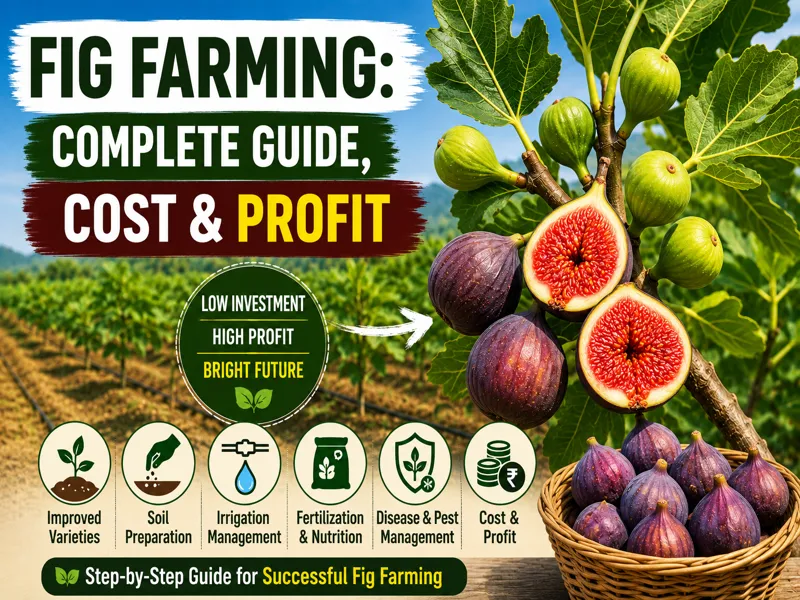
Fig Farming: A Fruit Crop That Can Earn Lakhs with Low Investment
If you are looking for a fruit crop that gives good yield with less water, sells at a high price in the market, and provides continuous income for many years, then fig farming can be an excellent option for you. In the last few years, the demand for figs has been increasing continuously in India. Along with fresh figs, dry figs (Dry Fig) are also in high demand in both domestic and international markets.
Fig is a perennial fruit plant that can produce fruits for around 25–30 years after a single plantation. It is widely cultivated in Maharashtra, Gujarat, Karnataka, Tamil Nadu, and some parts of Uttar Pradesh. With proper care and the use of modern farming techniques, farmers can earn lakhs of rupees per hectare.
In this article, we will explain every important aspect of fig farming in detail so that both new and experienced farmers can benefit from it.
🌍 Where is Fig Farming Done in India?
Commercial fig cultivation in India is mainly carried out in Maharashtra. Apart from this, its cultivation is also growing rapidly in Karnataka, Gujarat, Tamil Nadu, Uttar Pradesh, and some parts of Rajasthan. Regions with hot and dry climates are considered the most suitable for fig production.
Fig Farming in Rajasthan
Fig farming can be done in low waterlogging areas such as Udaipur, Sirohi, Pali, Jodhpur, Ajmer, and Bhilwara in Rajasthan. By adopting drip irrigation, farmers can produce high-quality fruits.
Fig Farming in Uttar Pradesh
In Uttar Pradesh, fig cultivation is being successfully carried out in Lucknow, Prayagraj, Jhansi, Agra, Kanpur, Varanasi, and some parts of the Bundelkhand region. Farmers can achieve better production with well-drained loamy soil and controlled irrigation.
🌱 1. Introduction to Fig
Fig (Fig) is considered one of the oldest fruit-bearing plants in the world. Its fruit is not only delicious but also highly nutritious. Fig cultivation is becoming increasingly popular in India because its market price is generally higher than many other fruits.
The fig plant is medium-sized and usually grows to a height of 3 to 10 metres. Its roots grow deep into the soil, allowing it to develop well even with limited water.
Fig is considered an excellent option for commercial farming because:
- Once planted, the trees produce fruits for many years.
- There is always good demand in the market.
- It can be sold as both fresh and dried fruit.
- It is widely used in Ayurveda, the food industry, and the dry fruit industry.
- It gives good yield even with limited irrigation.
Where is Fig Farming Done in India?
The highest fig cultivation in India is done in Maharashtra. Besides this, commercial cultivation is also carried out in the following states:
- Maharashtra
- Gujarat
- Karnataka
- Tamil Nadu
- Some parts of Uttar Pradesh
- Some dry regions of Rajasthan
The climate of these states is considered suitable for fig production.
Why Choose Fig Farming?
Nowadays, farmers are moving towards horticulture along with traditional crops. Fig farming is a profitable option because it offers:
- Low water requirement
- Long production period
- High market value
- Export opportunities
- Low competition
- High profits
If farmers use modern techniques such as drip irrigation and proper pruning, both production and fruit quality can be improved.
🌼 2. Health Benefits and Uses of Fig
Fig is not only a tasty fruit but also an excellent source of nutrition.
Major Nutrients Found in Fig
| Nutrient | Benefit |
|---|---|
| Fibre | Improves digestion |
| Calcium | Strengthens bones |
| Iron | Helps reduce iron deficiency |
| Vitamin A | Beneficial for eye health |
| Vitamin B | Supports energy production |
| Vitamin C | Boosts immunity |
| Potassium | Helps control blood pressure |
Benefits of Eating Fig
Regular consumption of figs provides several health benefits:
- Keeps the digestive system healthy.
- Provides relief from constipation.
- Strengthens bones.
- Helps reduce iron deficiency in the body.
- Useful for diabetic patients when consumed in limited quantities.
- Supports better heart health.
- Helps in weight management.
- Boosts the body’s immunity.
Uses of Fig
Fig is used in many industries.
Fresh Fruit
For direct consumption.
Dry Fig
Used as a dry fruit.
Ayurveda
Used in the preparation of many herbal medicines.
In Sweets
Used in cakes, sweets, chocolates, and bakery products.
Health Food
Used in energy bars and healthy snacks.
🔬 3. Scientific Classification of Fig
| Details | Information |
|---|---|
| Common Name | Fig |
| English Name | Fig |
| Scientific Name | Ficus carica |
| Family | Moraceae |
| Genus | Ficus |
| Plant Type | Perennial fruit-bearing tree |
Characteristics of the Fig Plant
- It has a long lifespan.
- Produces fruits even with limited water.
- The plant grows quickly.
- It can start bearing fruits from the second year.
- Commercial production starts from the third or fourth year.
- With proper management, it continues producing fruits for 25–30 years.
🌦️ 4. Suitable Climate and Temperature for Fig Farming
Choosing the right climate is very important for successful fig farming.
This plant grows best in dry and temperate climates.
Ideal Temperature
| Stage | Temperature |
|---|---|
| Plant Growth | 25–35°C |
| Normal Tolerance | 20–40°C |
| Maximum Tolerance | 45–48°C |
Although the plant can tolerate high temperatures, extreme cold and frost can affect its growth and fruit production.
Rainfall
In areas with heavy rainfall, waterlogging can cause the plant roots to rot. Therefore, choose a location where excess water can drain easily.
Sunlight
Fig plants should receive at least 6–8 hours of direct sunlight every day. Adequate sunlight helps to:
- Increase fruit size.
- Improve sweetness.
- Increase production.
- Reduce disease incidence.
Climate-Related Precautions
- Protect the plants from waterlogging.
- Protect the plants from frost.
- Provide support to the plants in areas with strong winds.
- Adopt drip irrigation.
🌍 5. Suitable Soil for Fig Farming
Selecting the right soil directly affects crop production.
Best Soil
Well-drained, fertile loamy soil is considered the most suitable for fig farming.
Soil pH
6.0 to 7.0
This pH range is considered ideal for fig plants.
Suitable Soil Types
- Loamy soil
- Sandy loam soil
- Light black soil
Soil Types to Avoid
- Waterlogged land
- Heavy clay soil
- Alkaline soil
- Highly acidic soil
Before Preparing the Soil
Always get the soil tested before preparing the field.
A soil test helps you know:
- Which nutrients are deficient.
- How much manure or fertilizer should be applied.
- Which fertilizer is most suitable.
- Whether soil pH needs improvement.
🌱 6. Improved Varieties of Fig
Choosing the right variety can increase both production and profit.
The following fig varieties are the most popular in India.
1. Poona Fig
It is one of the most popular commercial fig varieties in India.
Features
- Medium-sized fruits
- Yellow colour
- Starts bearing fruits early
- Good market demand
- Suitable for export
2. Punjab Fig
Features
- Large-sized fruits
- Yellow colour
- Starts fruiting from the second year
- Produces 15–18 kg per plant in the fifth year
3. Black Mission
- Deep purple coloured fruits
- Very sweet taste
- Suitable for both fresh and dried use
- Popular in the export market
4. Brown Turkey
- Adapts well to different climates
- Regular production
- Also suitable for home gardening
5. Marshlees
Features
- Hybrid variety
- Long storage life
- Produces 20–25 kg per plant
- Good transportation capacity
6. Puneri
- Delicious purple coloured fruits
- Produces 21–25 kg per plant
- Suitable for commercial cultivation
7. Kadota
- Light-coloured fruits
- Suitable for the processing industry
- Good quality
Which Variety Should You Choose?
If your goal is to sell fresh fruits in the market, Poona Fig, Black Mission, and Brown Turkey are better choices. However, if you are targeting the processing industry or the dry fig market, then Marshlees, Kadota, and Puneri varieties can be more profitable.
🌱 7. Seed and Planting Material for Fig Farming
Unlike normal crops, fig cultivation is not done through seeds. It is propagated through stem cuttings, air layering, grafting, or nursery-grown plants. For commercial cultivation, purchasing healthy and disease-free plants from a certified nursery is considered the best option.
Plants grown from seeds take more time to bear fruits, and the fruit quality is also not uniform. Therefore, farmers generally use ready-to-plant improved varieties for establishing commercial orchards.
Characteristics of a Good Plant
While purchasing plants, keep the following points in mind:
- The plant should be healthy and green.
- The roots should be well developed.
- The plant should be free from diseases and pests.
- The stem should be strong.
- The plant height should be around 50–80 cm.
- It should be purchased from a certified nursery.
Major Methods of Plant Propagation
1. Stem Cutting
This is the most commonly used propagation method.
- Select a healthy branch of 20–30 cm length.
- Choose a branch that is 8–12 months old.
- Applying rooting hormone helps the roots develop faster.
- The plants are first raised in polybags and later transplanted to the field.
2. Air Layering
In this method, roots are developed on the branch before separating it from the mother plant.
Benefits
- Plants are prepared quickly.
- Higher success rate.
- Plants retain the characteristics of the mother plant.
3. Grafting
This technique is also widely used in commercial nurseries.
Benefits
- Early fruiting.
- Uniform quality.
- Higher production.
🌾 8. Plant Requirement and Plant Population in Fig Farming
Since fig cultivation is done using plants instead of seeds, plant population per acre or per hectare is more important than seed rate.
Plant Population
| Area | Number of Plants |
|---|---|
| 1 Acre | Approximately 200–210 plants |
| 1 Hectare | Approximately 500 plants (250–500 depending on planting density) |
If a spacing of 5 × 4 metres is maintained, about 202 plants per acre can be planted.
Plant Spacing
Normal Density (Low Density)
- Row-to-row distance: 5 metres
- Plant-to-plant distance: 4 metres
This spacing is considered suitable for proper plant growth, sunlight, air circulation, and fruit production.
Suitable Planting Time
The following two seasons are considered the best for planting fig plants:
February–March
- When irrigation facilities are available.
- Better establishment of plants.
July–August
- Before the onset of the monsoon or during the early rainy season.
- Plant roots develop quickly.
- Irrigation requirement remains low.
🚜 9. Field Preparation for Fig Farming
Fig is a perennial horticultural crop, so proper field preparation is essential.
If the field is prepared correctly in the beginning, the plants will produce good yields for many years.
First Ploughing
Carry out deep ploughing using a mouldboard plough.
This helps to:
- Destroy weeds.
- Destroy insect eggs.
- Make the soil loose and friable.
Second and Third Ploughing
Plough the field 2–3 times diagonally using a cultivator.
This helps to:
- Prepare the soil properly.
- Remove crop residues.
- Improve root development.
Use of Rotavator
Use a rotavator to make the soil loose and friable.
In loose soil:
- Plants grow faster.
- Roots spread easily.
- Moisture is retained for a longer time.
Field Levelling
Finally, level the field using a leveller.
In a level field:
- Irrigation is distributed evenly.
- Waterlogging is prevented.
- Plant growth remains uniform.
Pit Preparation
Prepare the pits about 20–30 days before planting.
Recommended Pit Size
- Length: 60 cm
- Width: 60 cm
- Depth: 60 cm
In some regions, pits of 75 × 75 × 75 cm are also prepared.
Materials to Fill the Pits
Mix the following materials in each pit:
- 15–20 kg of well-decomposed farmyard manure
- 2–5 kg of vermicompost
- Top fertile soil
- Neem cake, if required
- Biofertilizers
After filling the pits, leave them open for a few days.
🌱 10. Correct Method of Fig Planting
The correct planting method in fig cultivation plays an important role in determining future production.
Planting Procedure
- Place the plant in the centre of the pit.
- Spread the roots carefully.
- Fill the pit with soil and press it gently.
- Make a basin around the plant.
- Give light irrigation immediately after planting.
Providing Support to the Plants
During the initial stage, support the plant with a wooden stake or bamboo stick.
This helps to:
- Keep the plant growing straight.
- Protect it from damage caused by strong winds.
Mulching
Use dry grass, straw, or plastic mulch around the plants.
Benefits
- Maintains soil moisture.
- Reduces weed growth.
- Keeps the soil temperature balanced.
- Saves irrigation water.
Initial Care of the Plants
After planting:
- Remove dry branches.
- Inspect the plants regularly.
- Protect the plants from animals.
- Provide light irrigation whenever required.
🌿 11. Manure and Fertilizer Management in Fig Farming
Fig plants produce fruits for many years, so a regular supply of nutrients is essential.
The use of organic manure and balanced fertilizers improves both plant growth and fruit quality.
Organic Manure
Apply the following materials to each plant from time to time:
- Well-decomposed farmyard manure
- Vermicompost
- Neem cake
- Compost manure
Chemical Fertilizers
It is best to apply fertilizers based on a soil test report.
Generally, a balanced application of Nitrogen (N), Phosphorus (P), and Potassium (K) helps in healthy plant growth.
Time of Fertilizer Application
First Application
At the time of planting.
Second Application
Before the start of the monsoon.
Third Application
During the fruit development stage.
Micronutrients
If the plants show the following symptoms:
- Yellowing of leaves
- Stunted growth
- Small-sized fruits
Then, micronutrients can be applied through foliar spray.
Suggestions for Organic Farming
If you want to practice organic farming, regularly use:
- Jeevamrit
- Ghan Jeevamrit
- Vermicompost
- Panchagavya
- Neem cake
💧 12. Irrigation Management in Fig Farming
One of the biggest advantages of fig cultivation is that it requires less water compared to many other fruit crops.
However, timely irrigation is very important.
Drip Irrigation
The drip irrigation system is considered the most suitable for fig cultivation.
Benefits
- Saves 40–60% of irrigation water.
- Delivers fertilizers directly to the roots.
- Reduces weed growth.
- Increases production.
- Improves fruit quality.
Irrigation According to Season
Summer
During summer, plants require more water.
- Irrigate approximately twice a week.
- Monitor soil moisture during extremely hot weather.
Winter
During winter:
- Irrigation at an interval of 14–20 days is generally sufficient.
Rainy Season
If there is good rainfall, additional irrigation is not required.
However, if rainfall is insufficient, provide irrigation as needed.
Important Points to Remember
- Do not allow waterlogging.
- Excess irrigation can cause root rot.
- Maintain proper soil moisture during fruit development.
- Give preference to drip irrigation.
🌾 13. Weed Management in Fig Farming
Weeds compete with plants for nutrients, water, and sunlight.
If they are not controlled on time, crop production may be affected.
Mechanical Control
The safest methods are:
- Weeding
- Hoeing
- Manual removal of weeds
How Many Times Should Weeding Be Done?
Generally:
- First weeding should be done 30–40 days after planting.
- Second weeding should be done 60–70 days after planting.
- After that, remove weeds whenever required.
Weed Control Through Mulching
Mulching helps to:
- Reduce weed growth.
- Maintain soil moisture.
- Improve soil quality.
Chemical Control
If weed infestation is severe, a suitable herbicide can be used after consulting an agricultural expert. Do not use any chemical without expert advice, as it may damage the plants.
🐛 14. Pest and Disease Management in Fig Farming
Fig is considered a crop that is relatively less affected by pests and diseases. However, if regular monitoring and proper management are not carried out, both production and fruit quality can be affected. Therefore, regular orchard inspection and the adoption of Integrated Pest and Disease Management (IPM) are essential.
General Principles of Pest and Disease Management
- Use certified and disease-free planting material.
- Do not allow waterlogging in the field.
- Prune the plants regularly.
- Remove and destroy dry and diseased branches.
- Keep the orchard clean.
- Apply balanced manure and fertilizers.
- Use drip irrigation to avoid excessive moisture.
- Use chemical pesticides only after consulting an agricultural expert.
1. Stem Borer
Identification
This insect damages the plant internally by making holes in the stem and branches.
Symptoms
- Small holes appear on the stem.
- Powder-like material comes out of the holes.
- Branches start drying.
- Plant growth slows down.
Control
- Prune the affected branches immediately.
- Clean the holes properly.
- Maintain field sanitation.
- Consult an agricultural expert if necessary.
2. Mealy Bug
Identification
These are small white cotton-like insects that suck the sap from the plants.
Symptoms
- Yellowing of leaves.
- New growth stops.
- Fruits remain small.
- Plants become weak.
Control
- Remove the infected parts.
- Control ants.
- Inspect the plants regularly.
3. Fruit Fly
This is a major pest that damages the crop during the fruiting stage.
Symptoms
- Small holes appear on the fruits.
- Fruits rot internally.
- Premature fruit drop.
Prevention
- Destroy fallen fruits immediately.
- Harvest fruits on time.
- Maintain proper orchard sanitation.
Major Diseases of Fig
1. Root Rot
This disease is more common in areas with excessive waterlogging.
Symptoms
- Plant wilting.
- Roots turn black.
- Drying of the entire plant.
Prevention
- Ensure proper drainage.
- Avoid excessive irrigation.
- Plant healthy seedlings.
2. Leaf Spot
Symptoms
- Brown spots appear on the leaves.
- Leaves gradually dry up.
- Photosynthesis is affected.
Prevention
- Remove infected leaves.
- Maintain proper air circulation in the orchard.
- Avoid excessive moisture.
3. Fruit Rot
Causes
- Continuous rainfall.
- Excessive moisture.
- Delayed harvesting.
Prevention
- Harvest fruits on time.
- Separate damaged fruits.
- Sort the fruits before storage.
Integrated Pest and Disease Management (IPM)
For successful fig farming, depending only on chemical pesticides is not recommended. Adopting an integrated management approach reduces production costs and improves yield.
Major IPM Practices
- Use certified planting material.
- Carry out timely pruning.
- Follow balanced fertilizer management.
- Adopt drip irrigation.
- Control weeds in the field.
- Monitor the orchard regularly.
- Give priority to organic management practices.
✂️ 15. Complete Guide to Canopy Management and Pruning in Fig Farming
Pruning is one of the most important cultural practices in fig cultivation. If plants are not pruned on time, branches become overcrowded, sunlight penetration decreases, and fruit production may decline.
First Pruning
Carry out the first pruning about one year after planting.
Keep in Mind
- Do not allow unnecessary branches up to a height of about 1 metre.
- Remove weak branches.
- Allow only strong branches to develop.
Annual Pruning
After fruiting, pruning every year during summer is considered beneficial.
Benefits
- Promotes new branch development.
- Produces more flowers.
- Increases fruit production.
- Produces larger fruits.
- Reduces disease incidence.
- Allows sunlight to reach all branches.
Precautions During Pruning
- Use sharp and clean tools.
- Remove and destroy diseased branches separately.
- Avoid heavy pruning during the rainy season.
- Protect the cut surfaces after pruning.
⏳ 16. Crop Duration of Fig
Fig is a perennial fruit-bearing plant. Therefore, its crop duration is different from that of regular crops.
When Do the Plants Start Bearing Fruits?
Improved varieties generally:
- Start bearing fruits from the first or second year.
- However, production remains low during the initial years.
Commercial Production
In most varieties:
- Full commercial production starts from the third or fourth year.
- This period is considered the beginning of good income for farmers.
Productive Life of the Plant
With proper care:
- A fig plant can continue producing fruits for about 25–30 years.
- Some old orchards continue production for even longer.
Major Factors That Increase Production
- Improved variety
- Proper spacing
- Timely pruning
- Drip irrigation
- Balanced nutrition
- Pest and disease management
✂️ 17. Harvesting of Fig Fruits
The quality of fig fruits largely depends on harvesting them at the right time.
If the fruits are harvested before they are fully mature, they do not ripen properly and do not fetch a good market price.
When Should the Fruits Be Harvested?
Harvest the fruits when:
- The fruits are fully developed.
- The colour changes according to the variety.
- The fruits feel slightly soft.
- The sweetness is fully developed.
Harvesting Method
- Harvest the fruits carefully by hand.
- Pick the fruits along with the stalk.
- Do not allow the fruits to fall.
- Harvest during the morning or evening hours.
Grading After Harvesting
After harvesting, separate the fruits according to their quality.
Grade A
- Large-sized fruits
- Free from blemishes
- Suitable for export
Grade B
- Suitable for the regular market
Grade C
- Suitable for processing and drying
Proper grading helps in getting a better market price.
Fruit Packing
Fig is a highly delicate fruit.
Therefore, use:
- Plastic crates
- Cushion-lined trays
- Cardboard boxes
Do not place excessive weight on the fruits by stacking them too heavily.
🌸 18. Yield Per Plant, Per Acre, and Per Hectare in Fig Farming
The yield of fig depends on the variety, plant age, management practices, and climate.
Yield Per Plant
A well-developed plant generally produces:
- 15–25 kg of fruits per year.
Some high-yielding varieties may produce even more.
Yield Per Acre
If around 200 plants are planted:
- An average production of 3,000–5,000 kg (3–5 tonnes) can be obtained.
With better management, production can be increased further.
Yield Per Hectare
Depending on the plant population of 250–500 plants and management practices:
- A production of 8–12 tonnes or more can be achieved.
Ways to Increase Production
- Plant certified nursery plants.
- Adopt drip irrigation.
- Carry out regular pruning.
- Use mulching.
- Increase the use of organic manure.
- Control pests and diseases on time.
💰 19. Fig Market Price, Cost of Cultivation, and Profit
Fig farming is considered highly profitable because its market value is generally higher than many other fruits.
Initial Cost
The estimated cost of establishing a one-hectare orchard is generally as follows:
| Item | Estimated Cost |
|---|---|
| Plants | ₹40,000–₹70,000 |
| Field Preparation | ₹20,000–₹30,000 |
| Pit Preparation and Planting | ₹15,000–₹25,000 |
| Manure and Fertilizers | ₹20,000–₹30,000 |
| Irrigation System | ₹20,000–₹40,000 |
| Other Expenses | ₹10,000–₹20,000 |
Total Initial Cost
Approximately ₹1.2 lakh to ₹1.5 lakh per hectare.
Market Price
The market price of figs varies depending on quality, season, and demand.
Fresh Fig
Approximately ₹200–₹400 per kg.
High-quality fruits may fetch even higher prices in many markets.
Dry Fig
The price of dry figs is generally much higher than fresh figs. Depending on processing and quality, its value can increase significantly.
Total Income
With good management:
- An annual turnover of around ₹25–₹30 lakh per hectare may be possible.
This income depends on production, quality, market conditions, sales channels, and value addition.
Net Profit
With proper management and marketing, farmers can earn approximately:
- ₹3 lakh to ₹5 lakh per hectare per year as net profit.
If farmers sell directly to consumers, supermarkets, hotels, online platforms, or the dry fruit processing industry, profits may increase further.
Tips to Make Fig Farming More Profitable
- Use certified planting material.
- Adopt drip irrigation and mulching.
- Carry out regular canopy management.
- Grade the fruits properly.
- Connect directly with the market.
- Market both fresh and dried figs.
- Sell through a Farmer Producer Organisation (FPO) or farmer groups.
- Focus on value addition through processing to get better prices.
🏪 20. Storage of Fig
Fig is a highly perishable fruit, so proper storage after harvesting is essential. If proper care is not taken during storage, the fruits may spoil quickly, resulting in financial loss to farmers.
What Should Be Done After Harvesting?
Immediately after harvesting, follow these steps:
- Grade the fruits.
- Separate damaged or rotten fruits.
- Keep them in clean and dry crates.
- Do not expose them to direct sunlight for a long time.
- Pack the fruits before transportation.
Importance of Grading
Grading helps in getting better prices in the market.
| Grade | Use |
|---|---|
| Grade A | Supermarkets, export, and premium markets |
| Grade B | Local wholesale market |
| Grade C | Dry fig production and processing industry |
Packing
While packing figs, use:
- Plastic crates
- Ventilated cardboard boxes
- Food-grade trays
- Cushion-lined packing materials
Do not overload a single box, as excessive weight may damage the fruits.
Storage Temperature
If cold storage is available, figs can be stored under the following conditions:
- Temperature: 0°C to 4°C
- Relative Humidity: 90–95%
Under these conditions, fresh fruits can maintain their quality for a longer period.
Storage of Dry Figs
If farmers dry the figs before selling them:
- Store them in a moisture-free place.
- Use airtight packaging.
- Protect them from direct sunlight.
- Follow food safety standards.
Dry figs can be stored for a much longer period than fresh figs.
🚚 21. How to Get Better Prices for Fig?
Good production becomes profitable only when the crop is sold in the right market.
Farmers can sell their figs through the following channels:
- Local fruit markets
- Wholesale traders
- Supermarkets
- Hotels and restaurants
- Dry fruit traders
- Online fruit sellers
- Farmer Producer Organisations (FPOs)
- Direct sale to consumers
If farmers create their own brand and sell properly packed fruits, they can earn higher profits.
🏛️ 22. Government Schemes for Fig Farming
The Central and State Governments regularly implement various schemes to promote horticultural crops. By taking advantage of these schemes, farmers can reduce their initial cultivation costs.
Note: Eligibility, subsidy amount, and application process may vary from state to state. For the latest information, contact your District Horticulture Department, Agriculture Department, or Krishi Vigyan Kendra (KVK).
1. Mission for Integrated Development of Horticulture (MIDH)
The objective of this scheme is to promote fruit, vegetable, and other horticultural crops.
Possible Benefits
- Assistance for planting material
- Orchard establishment
- Training
- Technical guidance
2. National Horticulture Board (NHB)
Financial assistance is provided for various projects to farmers establishing commercial orchards.
3. Pradhan Mantri Krishi Sinchayee Yojana (PMKSY)
Farmers adopting drip irrigation can receive subsidies in many states.
Benefits
- Saves water.
- Increases production.
- Improves fertilizer use efficiency.
4. Soil Health Card Scheme
Farmers can manage fertilizers properly through soil testing.
Benefits
- Reduces cultivation costs.
- Provides balanced plant nutrition.
- Increases production.
5. Kisan Credit Card (KCC)
Farmers can obtain agricultural loans at low interest rates.
Documents Required to Avail Government Schemes
- Aadhaar Card
- Land-related documents
- Bank passbook
- Mobile number
- Passport-size photograph
- Other documents as required
👨🌾 23. Expert Tips
If you are starting fig farming for the first time, pay special attention to the following points:
- Purchase plants from a certified nursery.
- Always get the soil tested.
- Ensure proper drainage in the field.
- Adopt drip irrigation.
- Prune the plants regularly.
- Use more organic manure.
- Inspect the plants regularly.
- Harvest only fully ripe fruits.
- Grade the fruits before sending them to the market.
❌ 24. Common Mistakes in Fig Farming
New farmers often make some common mistakes that reduce production.
Avoid the following mistakes:
- Selecting land with poor drainage or waterlogging.
- Applying excessive irrigation.
- Using fertilizers without soil testing.
- Not pruning the plants on time.
- Purchasing diseased plants.
- Planting at incorrect spacing.
- Harvesting immature fruits.
- Not studying market demand before cultivation.
🍊 25. Important Information Related to Fruit Farming
- Jackfruit Farming: Earn Lakhs with Income for 50 Years
- How to Grow Blackberry Farming for High Profit at Low Cost
- Orange Farming: Higher Yield & Better Profit Tips
- Strawberry Farming Guide: High Profit Ki Kheti
- Litchi Farming Guide: High Yield Cultivation Tips
- Gooseberry Farming Guide: High Yield & Profit Tips
- Muskmelon Cultivation Guide: Time & Tips
- Watermelon Farming in India: Complete Guide
- Coconut Farming in India: Profit Per Acre, Cost, Yield & Complete Business Guide
- Avocado Farming in India: Profit Guide
- Chiku Farming: High Profit Fruit Farming Guide
- Dragon Fruit Farming
- Pineapple Farming in India
- Banana Farming
- Apple Farming
- Grape Farming In India
- Lemon Farming
- Pomegranate Farming
- Guava Farming
- Mango Farming
- Papaya Farming in India
- Pests and Diseases in Crops: Definition, Significance & Impact
- Pest and Disease Control
- How to Do Organic Farming
- Benefits of Natural Farming
- How to Make Organic Vermicompost from Cow Dung in 30 Days
- Vermicompost Preparation Method
- Benefits of Drip Irrigation
- Pest and Disease Management
- Soil Health Card Scheme
❓26. Frequently Asked Questions (FAQs) About Fig Farming
Q1. Which is the most suitable season for fig farming?
The best time for planting fig plants is February–March and July–August. During these months, the roots develop quickly, and plant growth is better.
Q2. Which soil is best for fig farming?
Well-drained and fertile loamy soil is considered the best for fig cultivation. The soil pH should be between 6.0 and 7.0. Fig farming should not be done in waterlogged land.
Q3. For how many years does a fig plant produce fruits?
With proper care, regular pruning, and balanced nutrition, a fig plant can continuously produce fruits for 25–30 years.
Q4. How much yield does one fig plant produce annually?
A healthy and well-developed fig plant produces an average of 15–25 kg of fruits per year. Higher production can be achieved with improved varieties and scientific management.
Q5. How many fig plants can be planted in one acre?
If a spacing of 5 × 4 metres is maintained, about 200–210 plants can be planted in one acre.
Q6. Why is drip irrigation important in fig farming?
Drip irrigation saves water, provides the required moisture to plants, improves fertilizer use efficiency, and enhances both fruit quality and production.
Q7. After how many years does a fig plant start bearing fruits?
Improved fig varieties generally start bearing fruits from the second year, while full commercial production begins in the third or fourth year.
Q8. When does commercial production start in fig farming?
A fig orchard generally reaches its full production capacity in the third to fourth year. After that, it continues to produce regularly for many years.
Q9. What is the market price of figs?
The market price of fresh figs generally ranges from ₹200 to ₹400 per kg, depending on quality, season, and demand. High-quality fruits may fetch even higher prices in many markets.
Q10. Does fig farming require a lot of water?
No. Fig is a fruit crop that grows well with relatively less water. However, irrigation should be provided as required, and waterlogging should be avoided for better production.
Q11. Can fig farming be done organically?
Yes. Fig farming can be successfully practiced using organic manure, vermicompost, well-decomposed farmyard manure, and other organic methods.
Q12. Can small farmers earn good profits from fig farming?
Yes. If farmers select improved varieties, adopt scientific cultivation practices, and sell their produce in suitable markets, even small farmers can earn good profits from fig farming.
Q13. Which is the best and most popular variety of fig?
In India, Poona Fig is one of the most popular commercial varieties. Besides this, Black Mission, Brown Turkey, Kadota, Punjab Fig, and Puneri are also good yielding varieties.
Q14. Is there good market demand for dry figs?
Yes. Dry figs have good demand in both the Indian and international markets. Their price is generally higher than fresh figs, providing additional profits to farmers.
Q15. Can figs be cultivated in low-water areas?
Yes. Fig is a fruit crop that performs well even with relatively less water. If drip irrigation is adopted and proper drainage is maintained, successful cultivation is possible even in low-rainfall areas.
🌼 Conclusion
Fig farming is one of the fast-growing and profitable horticultural crops in India. Due to its low water requirement, long productive life, strong market demand for both fresh and dried figs, and comparatively better market prices, it can become a good option for increasing farmers’ income.
However, success does not come from simply planting the trees. It is important to adopt scientific practices such as selecting the right variety, conducting soil testing, maintaining proper planting distance, using drip irrigation, providing balanced nutrition, carrying out timely pruning, and following effective pest and disease management. In addition, if farmers focus on grading, packing, branding, or value-added products such as dry figs instead of selling only raw produce, their income can increase significantly.
If you want to develop a long-term and stable source of income through horticulture, fig farming can be a practical and profitable option.
📢 Suggestion for Farmers
If you are planning to start fig farming, first consult your local Krishi Vigyan Kendra (KVK), District Horticulture Department, or an agricultural expert to select the most suitable variety according to your local climate and soil conditions. With proper planning and scientific farming practices, a fig orchard can become a regular source of income for many years.
Need any assistance? 👉 Feel free to contact us.