

How to Get Organic Farming Certificate in India
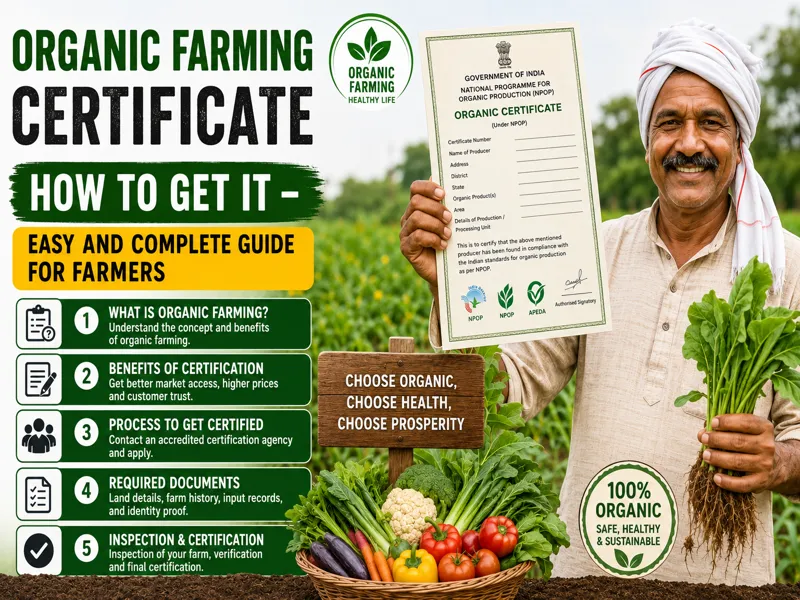
How to Get an Organic Farming Certificate – Easy and Complete Guide for Farmers
Nowadays, farmers in India are rapidly moving towards organic farming and natural farming. The reason is clear – the cost of chemical farming is continuously increasing and the strength of the soil is decreasing day by day. Because of this, farmers now want to adopt farming methods that keep the soil healthy, provide good production, and also give better market prices for crops.
But one big question comes to every farmer’s mind – how to get an Organic Farming Certificate? Because without Organic Certification, farmers cannot fully prove that their crops are organic.
In this article, we will explain in very simple language:
- What is an Organic Farming Certificate
- How to get it
- Which documents are required
- How much cost is involved
- How much time it takes
- And what benefits farmers get from it
Along with this, we will also understand some important farming points that are necessary for every farmer.
1.🌱 What is Organic Farming?
Organic farming means farming in which chemical fertilizers and chemicals are not used. In this method, cow dung manure, Jeevamrit, biofertilizers, compost, and natural methods are used.
Many states in India have promoted organic farming. Sikkim is the biggest example of this. The whole state has been declared organic. But only stopping chemicals is not enough, it is also important to follow proper scientific methods.
2. 📜 What is an Organic Farming Certificate?
An Organic Farming Certificate is an official certificate that proves the farmer’s crop has been produced completely through organic methods.
After getting this certificate, farmers can:
- Sell their crops as organic products
- Get better prices in the market
- Export their products
- Take benefits of government schemes
3. ✅ Benefits of Organic Farming Certificate
3.1. Better Price for Crops
Organic crops have a higher market value compared to normal crops.
3.2. Improves Soil Strength
Organic farming helps maintain the organic carbon in the soil.
3.3. Safe for Health
Food remains safer because chemical residues are very low.
3.4. Government Support
Under many farmer schemes, subsidies and support are provided.
3.5. Opportunity for Export
With Organic Certification, farmers can also sell their produce in foreign countries.
4. 👨🌾 What Things Should Farmers Keep in Mind?
Many farmers only stop using chemicals, but they do not follow proper organic practices. Because of this, production sometimes becomes low.
As farming experts explain, many farmers do not use biofertilizers and organic manure correctly. Some farmers do not even know how much and how to use them in different crops.
5. ⚠️ Problems Faced in Organic Farming
5.1. Increase in Cost
If farmers buy organic manure and biofertilizers from outside, the farming cost increases.
5.2. Lack of Proper Knowledge
Many farmers do not know:
- How to do seed treatment
- When to use biofertilizers
- How much quantity should be used
5.3. Weed Control
In organic farming, weed control is a labor-intensive work.
6. 🐄 Difference Between Natural Farming and Organic Farming
In natural farming, farmers use the resources available in their farms and nearby areas such as:
- Cow dung
- Cow urine
- Jeevamrit
- Beejamrit
Because of this, the farming cost becomes very low. Many experts also consider it as almost zero budget farming.
7. 📄 Important Documents Required for Organic Farming Certificate
List of Required Documents
- Aadhaar Card
- Land documents
- Farm map
- Bank passbook
- Passport size photo
- Mobile number
- Farming records
- Crop information
8.📝 How to Get an Organic Farming Certificate?
If you want to officially prove your crop as organic, then it is necessary to get an Organic Farming Certificate (Organic Certification). Understand the complete process below in simple language.
8.1. ✅ Make the Farm Chemical Free
First of all, stop using the following in your farm:
- Chemical fertilizers
- Chemical pesticides
- Weed killers
In organic farming, it is necessary to keep the farm completely chemical free.
8.2. 🌱 Follow Organic Practices
Now you have to adopt natural and organic methods in the farm such as:
- Cow dung manure
- Compost manure
- Jeevamrit
- Beejamrit
- Mulching
- Green cover
According to experts, only stopping chemicals is not enough. It is also important to follow proper scientific practices so that both soil strength and production remain good.
8.3. 📒 Prepare Farming Records
Keeping records is very important for Organic Certification.
Farmers should write and maintain the following information:
- Which crop was planted
- Which manure was used
- When irrigation was done
- Which biofertilizer was used
- What activities were done in the farm
These records are useful during inspection.
8.4. 🌐 Apply on Government Portal
Applications can be submitted through the PGS portal of the Government of India.
Official Portal:
Here farmers can apply individually or by forming a group.
8.5. 👨🌾 Farm Inspection Will Be Done
The certification agency inspects your farm.
During this process, they check:
- Whether chemicals are being used in the farm or not
- Whether organic farming rules are being followed or not
- Whether records are correct or not
8.6. 📜 Organic Farming Certificate Will Be Issued
If all rules are found correct, then the Organic Farming Certificate is issued to the farmer.
After this, farmers can officially sell their crops as organic products.
9. 🌐 Government Portal
The Government of India runs the PGS system for Organic Certification.
Important Portal:
This portal provides farmers with facilities like:
- Online application
- Group registration
- Certificate tracking
- Farming related information
10.💰 Cost of Organic Farming Certificate
The cost of certification depends on many things such as:
- Size of the farm
- Individual application or group application
- Certification agency
If farmers apply in groups, then the cost becomes lower.
In natural farming, the cost can become even lower because farmers use farm resources such as:
- Cow dung
- Cow urine
- Jeevamrit
11.⏳ How Much Time Does It Take to Get the Certificate?
In most cases:
- 2 to 3 years conversion period
- Regular inspections
- Record verification
are required before getting Organic Certification.
This time is given to make sure that the farm has become completely chemical free.
12. 🔬 Why Are Scientific Methods Important?
Many farmers only stop using chemicals but do not follow proper organic techniques. Because of this, production becomes low.
Experts say that for good production, it is important to:
- Maintain organic carbon in the soil
- Keep microbes active
- Do proper seed treatment
- Do mulching
- Do not leave the farm empty
If green cover remains continuously in the farm, then both soil moisture and soil strength remain maintained.
13. 🌾 Importance of Green Cover and Mulching in Organic Farming
✅ Benefits of Green Cover
- Soil moisture remains maintained
- Carbon conservation happens
- Soil erosion becomes less
- Fewer weeds grow
✅ Benefits of Mulching
- Water saving
- Soil remains protected
- Heat effect becomes less
- Production becomes better
According to experts, the farm should always remain covered so that the organic carbon of the soil remains protected and the effect of climate change becomes less.
❓ FAQ – Frequently Asked Questions
Q1. Who Issues the Organic Farming Certificate?
Government-recognized agencies and the PGS system issue the certificate.
Q2. Can Small Farmers Also Get Organic Certification?
Yes, small farmers can easily apply by forming groups.
Q3. Can Organic Crops Be Sold Without a Certificate?
Yes, they can be sold, but they will not officially be called Organic Certified.
Q4. What Is the Most Important Thing in Organic Farming?
Proper scientific practices, maintaining records, and chemical-free farming.
Q5. Are Natural Farming and Organic Farming the Same?
Both are different, but in both methods chemical fertilizers and chemicals are not used.
🏁 Conclusion
Nowadays, the Organic Farming Certificate has become very important for farmers. Through this, farmers can sell their crops at better prices and build trust in the market.
But only stopping chemicals is not enough. Farmers also need to focus on proper scientific methods, biofertilizers, mulching, Jeevamrit, and soil improvement. Only then can organic farming remain successful for a long time.
If you found this information useful, then share it with your fellow farmer brothers.
👉 For more information on government schemes, click here