


IoT and AI-Based Smart Irrigation: Transforming the Future of Farming
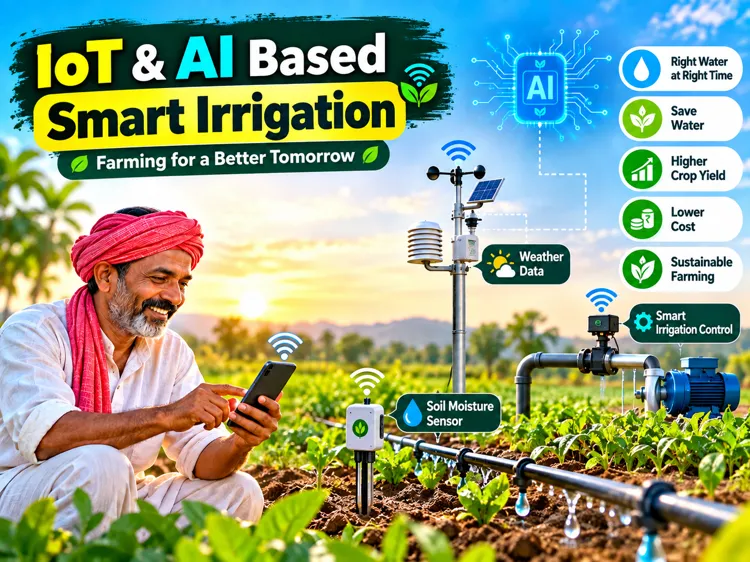
🌱 IoT and AI-Based Smart Irrigation: The Future of Farming
“Every drop of water in the field is not just water; it carries the farmer’s hard work, hope, and the future of the whole family.”
India is an agriculture-based country. Crores of farmers here depend on farming for their livelihood. Soil, seeds, fertilizers, weather, and hard work all play an important role in the success of farming, but among all these, irrigation water is one of the most important resources.
Today, climate change, irregular rainfall, declining groundwater levels, increasing energy costs, and growing demand for water have created new challenges for farming. At such a time, Internet of Things (IoT) and Artificial Intelligence (AI)-based smart irrigation is emerging as an important technology solution for farming.
The purpose of smart irrigation is not only to automatically turn the farm motor ON or OFF. Its real purpose is:
“To provide the crop with the right amount of water, at the right time, according to its needs.”
This thinking can become the foundation of sustainable and profitable farming in the future.
💧 1. What is Smart Irrigation?
Smart irrigation is a modern irrigation system in which data such as soil moisture, temperature, weather, crop stage, and water usage is used to make irrigation decisions more accurately.
In this system, sensors installed in the field can collect information about the soil and environment. Through the Internet of Things, this information can reach a mobile app or digital system.
After this, Artificial Intelligence can analyse this data and help provide irrigation-related advice to the farmer.
For example, the farmer can get information about:
- 🌱 How much moisture is present in the soil?
- 💧 Is irrigation needed right now or not?
- 🌦️ What is the possibility of rainfall in the coming time?
- 🌡️ What is the temperature?
- 🌾 At which stage is the crop?
- 🚰 Is the water flow in the irrigation system normal or not?
- ⚡ How much energy is being used to deliver the water?
In this way, irrigation decisions can be based on available data instead of depending only on estimation.
🌾 2. What is the Role of IoT in Farming?
Internet of Things, commonly called IoT, is a technology in which sensors and devices are connected to each other, and the information collected from them is sent to a digital system.
IoT can have a very important role in smart irrigation.
🌱 Soil Moisture Sensor
This sensor helps measure the moisture level present in the soil. It can help the farmer understand how much moisture is present around the roots.
🌡️ Temperature Sensor
Temperature information can be useful for planning irrigation because the water requirement of a crop can be different at high and low temperatures.
💦 Water Flow Sensor
It can help identify whether water is passing through the irrigation pipe in the normal quantity or not.
🚰 Automatic Water Valve
With a suitable setup, water valves can be controlled through a digital system.
⚡ Pump Control
In a smart system, irrigation pumps can also be controlled through suitable equipment.
The Indian Council of Agricultural Research has also worked on internet-connected soil monitoring systems for real-time soil moisture monitoring and water management. Its purpose is to help make water management more effective.
🤖 3. How Does Artificial Intelligence (AI) Improve Smart Irrigation?
Internet of Things helps collect data from the field, while Artificial Intelligence can help analyse this data.
Suppose the following information is being received from a farm:
- Soil moisture
- Temperature
- Air humidity
- Rainfall data
- Crop type
- Crop stage
- Previous irrigation
- Quantity of water
- Soil type
- Weather information
Artificial Intelligence can look at all this data together and help in making irrigation-related decisions.
For example, the system can indicate that immediate irrigation is not required because of the current soil moisture level, or that it is time to plan irrigation based on the available data.
This does not mean that Artificial Intelligence will replace the farmer.
Instead, its purpose is to help the farmer make better decisions by providing better information.
🌦️ 4. Weather Information and Smart Irrigation
An irrigation decision cannot be separated from the weather.
If there is a possibility of rainfall, the farmer can change the irrigation timing. On the other hand, if the temperature is high and the possibility of rainfall is low, the crop’s water requirement may be different.
In a smart irrigation system, weather information can be combined with soil moisture and crop conditions.
For example:
Soil Moisture + Temperature + Crop Stage + Weather Information = Better Irrigation Decision
In the future, information can reach the farmer’s mobile in simple language:
“Based on the available moisture in your field, reassess whether irrigation is required now. Keep possible changes in the weather in mind.”
Such advice will always depend on local data and the reliability of the system.
💧 5. Can Smart Irrigation Save Water?
Yes, properly implemented sensor-based irrigation can help in using water more efficiently.
However, it would not be correct to say that smart irrigation will save a fixed percentage of water on every farm.
Actual results depend on many factors:
- Soil type
- Crop
- Weather
- Irrigation method
- Sensor quality
- Correct placement of sensors
- Condition of the irrigation system
- Correct use of the system by the farmer
The Indian Council of Agricultural Research has published examples of water savings through technologies related to sensor-based micro-irrigation scheduling. One technical example reports the potential to save around 10–15 percent water compared with traditional irrigation scheduling. Another example reports around 20 percent water saving and 15 percent increase in production in banana crops.
Therefore, the purpose of smart irrigation is not only to “reduce water.”
Its purpose is:
“More accurate use of water according to the needs of the crop.”
🚜 6. Combining Micro Irrigation and Artificial Intelligence (AI)
It is not enough to look at smart irrigation only from the point of view of Artificial Intelligence.
Drip Irrigation and Sprinkler Irrigation, such as micro irrigation systems, are also an important foundation.
The Government of India’s Per Drop More Crop initiative aims to increase water-use efficiency at the farm level through micro irrigation.
Therefore, the smart irrigation system of the future can look something like this:
Drip Irrigation + Soil Moisture Sensors + Internet-Based Monitoring + Weather Information + Artificial Intelligence + Farmer Advisory
In this system, water is first delivered to the farm efficiently, and then data is used to help decide when and how much irrigation should be done.
📱 7. Irrigation Information Will Come to the Farmer’s Mobile
Future agricultural technology will be successful only when it is easy for farmers to use.
Every farmer does not need to understand a complex computer system.
Information can be provided through a simple mobile app or message-based system.
💧 Today’s Irrigation Information
Crop: Tomato
Farm: 2 acres
Soil: According to available sensor data
Weather: Local weather information
Irrigation: Help in making decisions based on available data
Or the farmer may receive this warning:
⚠️ Check the Irrigation System
“A difference from the normal water flow has been detected. Check the pipes, filters, and water outlets.”
In this way, Artificial Intelligence can work like a digital farming assistant for the farmer.
❤️ 8. Why Is Smart Irrigation Important for Farmers?
For a farmer, water is not just a resource.
There are months of hard work behind every crop.
From sowing the seed to preparing the crop for harvest, the farmer:
Prepares the soil → Sows the seeds → Applies fertilizer → Irrigates the crop → Protects the crop from diseases and pests → Faces the weather → Finally harvests the crop.
Water plays a very important role throughout this journey.
If water is given at the wrong time, it can cause losses.
If too much water is given, it can also cause losses.
And if water is not available when it is needed, the entire crop can be affected.
Therefore, the real importance of smart irrigation is much greater than just technology.
It can help the farmer understand what the actual water condition of the field is.
⚡ 9. Smart Irrigation and Electricity Saving
Many farmers use electricity or other energy sources to pump water for irrigation.
If irrigation is done more than required, it can lead to extra energy consumption along with extra water use.
A more accurate irrigation plan can create the possibility of reducing unnecessary pumping.
However, actual energy savings will depend on the farm conditions, pump, water depth, irrigation method, and operation.
Therefore, smart irrigation can be seen not only as a water-saving technology but also as a water and energy management technology.
🌍 10. Role of Smart Irrigation in Saving Groundwater
Groundwater is extremely important for farming in India.
In many areas, farmers depend on groundwater for irrigation. If more water than required is extracted, it can increase pressure on groundwater resources over the long term.
The purpose of smart irrigation can be to provide water to the crop according to its needs and reduce unnecessary irrigation.
In simple words:
“Try to provide only as much water as the crop needs.”
This approach can be important for both the farmer’s cost and natural water resources.
🧠 11. What Can Artificial Intelligence (AI) Tell Farmers in the Future?
In the future, an advanced farming system can understand many types of data together.
🌱 Soil Information
Monitoring soil moisture and other available parameters.
🌦️ Weather Information
Including rainfall, temperature, and other weather-related data in irrigation planning.
🌾 Crop Stage
Helping to understand the water requirement according to the crop’s growth stage.
💧 Irrigation History
Keeping a record of when and how much irrigation was done earlier.
🛰️ Satellite-Based Information
Using satellite or remote sensing data related to the condition of the farm.
📊 Agricultural Analysis
Helping with future decisions based on previous data.
In this way, the farming platform of the future may develop beyond irrigation and move towards digital management of the entire farm.
🔮 12. What Could Smart Farming Look Like in 2030?
Imagine that in the year 2030, a farmer opens the farming system on his mobile before going to the field in the morning.
He can see everything in one place:
🌱 Crop Condition
💧 Soil Moisture
🌦️ Weather
🚰 Irrigation Status
⚡ Energy Usage
📊 Water Usage
The farmer can ask in his local language:
“What is the irrigation status of my farm today?”
The system can provide information in simple language based on the available farm and weather-related data.
If an automatic irrigation system is installed on the farm, it may also be possible to control water valves or pumps according to the farmer’s permission and predefined rules.
This means that in the future, the distance between farmers and technology can become smaller.
👨🌾 13. Biggest Challenge for Small Farmers
The benefits of smart irrigation are important, but its challenges are also equally real.
Small farmers may have questions such as:
- How much does the sensor cost?
- How much will installation cost?
- How much internet is required?
- What will happen if there is no electricity?
- Who will repair the sensor if it stops working?
- Who will provide training to the farmer?
- How will the system change for different crops?
- How reliable is the advice given by Artificial Intelligence (AI)?
Therefore, a successful smart irrigation model in India should not be based only on selling expensive technology.
It should be:
Affordable + Simple + Reliable + In Local Language + With Good Service
Technology will reach farmers successfully only when farmers can easily understand it and see its real benefits.
🔧 14. Farmers Need Solutions, Not Technology
It is not enough to tell farmers:
“We have Artificial Intelligence (AI).”
Farmers want to know:
“What benefit will it provide to my farm?”
Therefore, agricultural technology companies need to explain solutions in the farmer’s language instead of using technical terms.
Example:
Technical Language:
“Our Artificial Intelligence (AI)-based prediction model optimizes irrigation.”
Farmer’s Language:
“Helps decide the better time for irrigation by looking at your farm’s soil, crop, and weather information.”
This simplicity can play an important role in the wider adoption of smart agriculture.
🚜 15. The Smart Farm of the Future
In the future, many technologies can work together on a modern farm.
Soil Sensor → Internet-Based System → Weather Information → Artificial Intelligence → Farmer’s Mobile → Irrigation System
The purpose of this complete process will be:
Collect Information → Analyse It → Provide Advice to the Farmer → Irrigate According to Need → Record the Results
Gradually, this system can also learn from previous weather and previous years’ data.
This can increase the possibility of developing more local and useful agricultural advice for each farm.
🌱 16. Should Every Farmer Adopt Smart Irrigation Immediately?
Every farm has different conditions.
Therefore, before adopting smart irrigation, farmers should look at their own situation.
These points can be useful to consider:
- Farm size
- Crop
- Soil
- Water availability
- Existing irrigation system
- Electricity
- Technology cost
- Sensor quality
- Maintenance facility
- Local technical support
Farmers can start on a small scale.
For example:
First Stage → Soil Moisture Sensor
Second Stage → Drip Irrigation
Third Stage → Internet-Based Monitoring
Fourth Stage → Automatic Control
Fifth Stage → Artificial Intelligence (AI)-Based Farming Advisory
In this way, technology can be adopted step by step.
🌐 17. The Future of Smart Irrigation
In the coming years, smart irrigation can develop in many directions.
🔮 17.1. Predictive Irrigation
The system can help estimate the possible future water requirement along with the current condition.
📲 17.2. Remote Farm Monitoring
Farmers can check the irrigation status of their farm through their mobile phone.
🚰 17.3. Automatic Irrigation
With a suitable setup, water valves and pumps can be controlled automatically.
🛰️ 17.4. Satellite and Artificial Intelligence
Farm monitoring can be improved by combining satellite-based information with farm sensor data.
🗣️ 17.5. Voice-Based Farming Assistant
Farmers can ask in their own language:
“When should I irrigate my crop?”
📊 17.6. Digital Management of the Entire Farm
Along with irrigation, data related to soil, weather, crops, diseases, pests, and production can be connected in one system.
💧 18. Importance of Smart Irrigation in India
The future of farming in India is not only about producing more.
We also need to see:
How can we achieve more effective production with less water?
Water resources are limited, and the demand for water in agriculture is very high.
Therefore, the principle of future farming can be:
“Giving more water does not mean better farming; giving the right amount of water at the right time is more important.”
This thinking can be combined with technology and the farmer’s experience.
❓ 19. Frequently Asked Questions
Q1. What is Smart Irrigation?
Smart irrigation is a modern system in which sensors, weather information, internet, and Artificial Intelligence are used to make irrigation-related decisions more accurately.
Q2. What is the use of IoT in farming?
Through IoT, soil moisture, temperature, water flow, and other farm-related data can be collected through sensors and sent to a digital system.
Q3. How does AI-based irrigation work?
Artificial Intelligence can analyse available soil, weather, crop, and irrigation-related data and help farmers make irrigation-related decisions.
Q4. Can smart irrigation save water?
Properly implemented sensor-based irrigation can help in using water more efficiently. Actual water savings can vary depending on the farm, crop, soil, weather, and technical system.
Q5. Can small farmers adopt smart irrigation?
Yes, but cost, farm size, crop, water availability, and technical support need to be considered. Starting on a small scale can be a practical approach.
Q6. Will AI replace farmers?
AI can mainly be used to provide farmers with data-based information and decision support. The farmer’s local experience and understanding of the situation remain important in making the final agricultural decision.
Q7. Is the internet necessary for smart irrigation?
It depends on the design of the system. Some systems may depend on the internet or mobile network, while some can also work locally.
Q8. What is the future of smart irrigation?
In the future, sensors, weather data, satellites, Artificial Intelligence, automatic valves, and mobile farming advice can be connected together to develop more data-based irrigation systems.
❤️ Conclusion: Every Drop Matters
Indian farmers have understood soil, weather, and water for centuries.
Now, new technology is providing an opportunity to strengthen their experience, not to replace it.
Internet of Things (IoT) can help collect real-time information from the farm.
Sensors can measure soil and irrigation conditions.
Weather data can be useful for irrigation planning.
Artificial Intelligence (AI) can analyse available data and help farmers with their decisions.
Drip and Sprinkler Irrigation can help deliver water more efficiently.
👨🌾 Farmers can combine all these technologies with their own experience to make better decisions.
The future of farming will not only be about installing machines in the field.
It will be about:
🌱 Understanding the Soil
💧 Understanding Water
🌦️ Understanding the Weather
🤖 Analysing Data
👨🌾 Connecting Farmer Experience with Technology
Perhaps in the coming time, the most important question for a farmer will not be:
“When should I give water?”
Instead, it will be:
“How much water does my crop actually need right now?”
When technology helps provide a reliable, simple, and local answer to this question, IoT and Artificial Intelligence-based smart irrigation can become an important part of the future of farming in India.
Because the future of farmers is not only about producing more.
The future of farmers is about farming wisely with fewer resources, protecting water, and making the right use of every drop.