


How to Calculate Farming Costs? Complete Per-Acre Cost Guide
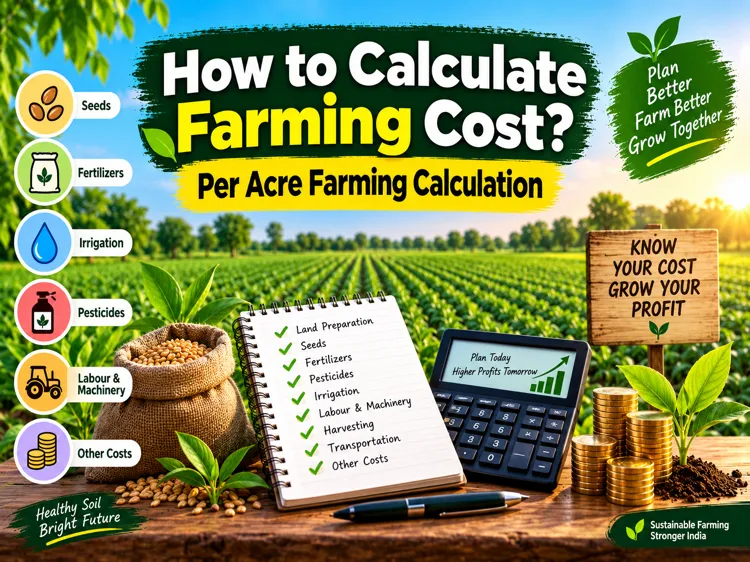
🌾 How to Calculate Farming Costs? Per-Acre Farming Calculation in Simple Language
How to Calculate Farming Costs? This question is very important for every farmer. A farmer works day and night, prepares the field, buys seeds, adds fertilizers, does irrigation, takes care of the crop, and finally sells the produce in the market or to a trader. But many times, the farmer does not clearly know how much money was actually spent to grow one acre of crop and how much profit was earned after selling it.
That is why only getting a good crop yield is not enough in farming. Farming can be considered successful only when the farmer knows the correct calculation of the cost and actual profit.
Suppose a farmer grows wheat on one acre and receives ₹30,000 after selling the crop. It may look like a good income. But if ₹22,000 was spent to grow that crop, then the actual profit is only ₹8,000.
Therefore, for every crop, a farmer must know three things:
What is the total cost?
What is the total sale amount?
What is the actual profit?
In this article, we will understand in very simple language how to calculate farming cost per acre, which expenses should be included, what hidden costs are, and how to calculate the actual profit from farming.
🌾 1. What is Farming Cost?
The money a farmer spends from sowing a crop in the field until selling it can be called the farming cost of that crop.
It does not include only the cost of seeds, fertilizers and medicines. There are many small and big expenses in farming that farmers often do not include in their calculation.
For example:
- Field ploughing
- Seeds
- Manure
- Fertilizers
- Pesticides
- Labour
- Irrigation
- Diesel
- Machinery
- Harvesting
- Threshing
- Transportation
- Market or selling-related expenses
- Field preparation
- Farmer’s own labour
After adding all these expenses, we get a better idea of the actual farming cost.
The biggest mistake is that a farmer considers only the payments made from the pocket as the farming cost.
If a farmer ploughed the field using his own tractor, no money may have directly gone from his pocket. But the tractor’s diesel, maintenance and machine usage are still part of the farming cost.
Similarly, if family members worked in the field, even though they were not paid separate wages, their labour still has an economic value.
🧮 2. Easy Formula to Calculate Farming Cost Per Acre
A simple formula can be used to calculate the farming cost:
Total Farming Cost = Field Preparation + Seeds + Manure/Fertilizers + Pesticides + Labour + Irrigation + Machinery + Harvesting/Threshing + Transportation + Other Expenses
After that:
Total Profit = Total Sales − Total Farming Cost
And if the farmer wants to know how much was spent on producing one kilogram of crop:
Cost Per Kg = Total Farming Cost ÷ Total Production
Example:
Suppose a farmer gets 22 quintals of wheat production from one acre.
If the total cost is ₹22,000, then:
₹22,000 ÷ 2,200 kg = ₹10 per kg
This means the wheat production cost for the farmer was approximately ₹10 per kg.
If the farmer knows the selling price of the crop, he can estimate his actual income based on it.
🚜 3. How to Add Field Preparation Cost?
The crop starts with field preparation. Therefore, it is important to include the field preparation cost in the farming cost.
It can include:
- Ploughing with a tractor
- Rotavator
- Cultivator
- Planking
- Land leveling
- Making field bunds
- Other machinery work
For example, if ₹2,000 was spent on ploughing and preparing one acre of land, add ₹2,000 to the farming cost.
If the farmer has his own tractor, adding only the diesel cost may not be enough. The tractor’s maintenance and machine usage cost can also be considered.
However, for a small farmer, the easiest way to start is to write down the actual market cost of each farming activity.
This will gradually make the farming calculation clearer.
🌱 4. How to Calculate Seed Cost?
Seeds are the first important input in farming.
To calculate the seed cost, check:
Quantity of seed used × Price per kg of seed = Seed Cost
Example:
40 kg of seed was used for one acre.
The price of the seed is ₹50 per kg.
So:
40 × ₹50 = ₹2,000
Therefore, the seed cost was ₹2,000.
If the farmer uses leftover seed from his own home, it can still be given an economic value. This helps the farmer understand the actual cost of the crop.
While recording seed cost, write not only the price but also the quantity of seed used.
This will help the farmer compare in the next season how much quantity was used for each variety and how much production was received in return.
🧪 5. How to Add Manure and Fertilizer Cost?
The cost of manure and fertilizers is also important in farming.
It can include:
- Urea
- DAP
- MOP
- NPK
- Organic manure
- Cow dung manure
- Micronutrients
- Other agricultural fertilizers
Example:
If for one acre:
- Urea = ₹800
- DAP = ₹1,500
- Other fertilizers = ₹700
Then the total fertilizer cost is:
₹800 + ₹1,500 + ₹700 = ₹3,000
If the farmer uses cow dung manure prepared on his own farm, instead of considering it completely free, it is useful to understand its transportation and application cost.
This can help the farmer understand the actual expense on nutrient management in farming.
🐛 6. Cost of Pesticides and Crop Protection
Farmers use different types of medicines to protect the crop from pests and diseases.
It can include:
- Pesticides
- Fungicides
- Herbicides
- Organic products
- Spraying cost
- Sprayer machine cost
- Labour cost for spraying
Suppose ₹1,800 was spent on medicines for one acre and ₹500 was paid as labour cost for spraying.
Then the total crop protection cost is:
₹1,800 + ₹500 = ₹2,300
It is useful to write this expense separately because it helps the farmer know in the next season how much is being spent on crop protection for each crop.
💧 7. How to Calculate Irrigation Cost?
Irrigation cost is often ignored while calculating farming costs.
But for many crops, irrigation is an important expense.
Irrigation cost can include:
- Diesel
- Electricity
- Motor usage
- Cost of purchasing water
- Pipe cost
- Irrigation labour
- Canal or other irrigation charges
If the farmer uses a diesel pump for irrigation:
Quantity of Diesel × Price of Diesel = Diesel Cost
Apart from this, the maintenance and repair cost of the pump can also affect the farming cost in the long term.
Therefore, the farmer should develop the habit of writing down the cost of every irrigation.
👨🌾 8. Make Sure to Add Labour Cost
Many farmers do not include the work done by family members in the farming cost.
This is why the actual farming calculation often looks lower than it really is.
Labour can include:
- Sowing
- Weeding and intercultural operations
- Applying fertilizers
- Spraying medicines
- Irrigation
- Harvesting
- Cleaning the crop
- Threshing
- Filling bags
- Loading and unloading
If ₹5,000 was paid to outside labourers, add ₹5,000 directly to the cost.
If family members worked on the farm, the farmer can also write the estimated cost of family labour separately based on their working hours and the local labour rate.
This helps the farmer understand the economic value of his own hard work.
🚜 9. Cost of Harvesting and Threshing
Expenses do not end even after the crop is ready.
Harvesting and threshing can include expenses for:
- Harvester
- Labour
- Thresher
- Tractor
- Diesel
- Crop cleaning
- Bags
- Loading
- Unloading
Suppose ₹3,000 was spent on harvesting and threshing one acre of crop.
Then this ₹3,000 should also be included in the total cost.
This is an expense that farmers often forget because it comes suddenly after the crop is ready.
🚚 10. Transportation Cost to the Market is Also a Farming Cost
The farmer’s crop is ready in the field, but it has not been sold yet.
There can be expenses to transport the crop to the market, trader, mill or another buyer.
It can include:
- Tractor rental
- Vehicle rental
- Loading
- Unloading
- Bags
- Other market-related expenses
If the farmer spent ₹1,000 to sell the crop, this should also be added to the total crop cost.
Because for a farmer, what matters is not only how many rupees the crop earned from the field, but how much money is left in his hand after all expenses are deducted.
🕵️ 11. What is Hidden Cost in Farming?
There are some expenses in farming that are not immediately visible to the farmer.
We can call these hidden costs.
Examples:
- Farmer’s own labour
- Family labour
- Use of own tractor
- Machine depreciation and wear
- Travel cost to and from the field
- Repair of equipment
- Time spent monitoring the field
- Crop storage cost
- Damaged or wasted produce
- Interest on borrowed money
Suppose the farmer worked using his own tractor and did not hire a tractor from outside.
There may be no rental payment from the pocket, but using the tractor is not free.
Similarly, the farmer’s time also has value.
The real picture of farming becomes clear only when both visible and hidden costs are understood.
📋 12. Per-Acre Farming Calculation: An Easy Example
Now let us understand the complete calculation with a simple example.
Suppose a farmer grows a crop on one acre.
| Expense | Amount |
|---|---|
| Field preparation | ₹2,000 |
| Seeds | ₹2,000 |
| Manure and fertilizers | ₹3,000 |
| Medicines | ₹2,000 |
| Irrigation | ₹2,000 |
| Labour | ₹4,000 |
| Harvesting and threshing | ₹3,000 |
| Transportation | ₹1,000 |
| Other expenses | ₹1,000 |
| Total Cost | ₹20,000 |
Now suppose the total crop production is 20 quintals, or 2,000 kg.
So the cost per kg is:
₹20,000 ÷ 2,000 = ₹10 per kg
If the entire crop is sold for ₹25,000:
Total Sales = ₹25,000
Profit = ₹25,000 − ₹20,000 = ₹5,000
In this way, the farmer knows that the estimated cost for one acre was ₹20,000 and the sales were ₹25,000.
Keep in mind that this is only an example for understanding. Actual cost and profit can change depending on the crop, location, weather, input prices, production, labour costs and selling price.
💰 13. How to Calculate Actual Profit in Farming?
For a farmer, knowing only the total sales is not enough.
To understand the actual profit, all related expenses should be deducted.
Formula:
Actual Profit = Total Sales − Total Cost
Example:
Total Sales = ₹50,000
Total Cost = ₹35,000
Then:
Profit = ₹50,000 − ₹35,000 = ₹15,000
Now the farmer can also calculate:
Profit Per Acre = Total Profit ÷ Total Acres
If the total profit from 2 acres is ₹30,000:
₹30,000 ÷ 2 = ₹15,000 per acre
This number can help the farmer compare the economics of different crops.
📊 14. What Things Should Be Written to Keep Farming Records?
A farmer can keep farming records even in a simple notebook.
Make a separate page for each crop.
Write:
Crop Name:
Total Area:
Sowing Date:
Variety:
Then write the expenses:
- Field preparation
- Seeds
- Manure
- Fertilizers
- Medicines
- Labour
- Irrigation
- Machinery
- Harvesting
- Threshing
- Transportation
- Storage
- Other expenses
After selling the crop:
Total Production:
Total Sales:
Total Cost:
Total Profit:
Cost Per Kg:
Profit Per Acre:
This simple record can give the farmer a much better understanding of the economics of his farming.
📱 15. Why is Digital Farming Record Important for Farmers?
Today, farming is not limited only to working hard in the field. It is also becoming important for farmers to understand their farm like a business.
If a farmer keeps the record of every season digitally, he can answer many important questions in the future:
- How much was spent on each crop last year?
- Which crop gave the highest production?
- Which crop had higher pesticide expenses?
- How much was spent on irrigation?
- What was the actual cost per acre?
- How much money was left after selling the crop?
- How much capital will be needed for the next season?
This data can help the farmer make better plans in the future.
If a farmer has records for several years continuously, he can understand his farming decisions not only based on estimates, but also based on his previous data.
❤️ 16. A Farmer’s Hard Work Also Has Value
When a farmer stands in the field and looks at his crop, he does not see only green plants.
He sees his hard work.
Waking up early in the morning, going to the field, worrying about water, watching the weather, protecting the crop from pests, arranging labour, and hoping for a good price in the market, farming is not only a business, but also a work of hard work and patience.
Therefore, a farmer should keep a record of his hard work.
It is important to know how much income was earned.
But it is even more important to know how much was spent to earn that income.
If a farmer does not know his farming cost, it can be difficult to decide whether his crop is actually giving him profit or not.
🌾 17. Starting to Understand Farming as a Business
Understanding farming as a business does not mean that a farmer has to leave his farming traditions or emotions.
It means that the farmer should give the right economic value to his hard work.
Every farmer should know at least these 5 numbers:
1. Total Area
2. Total Cost
3. Total Production
4. Total Sales
5. Total Profit
After this, the farmer can calculate the cost per acre and production cost per kg.
Gradually, he can create his own records for different crops.
This record can become the base for better farming planning in the future.
⚠️ 18. Common Mistakes While Calculating Farming Costs
Many farmers make some common mistakes while calculating their farming costs.
18.1. Adding Only Seed and Fertilizer Costs
The farming cost is much more than this.
18.2. Considering Own Labour as Free
The farmer’s hard work also has economic value.
18.3. Forgetting Machinery Costs
The cost of using your own tractor and machinery should also be understood.
18.4. Not Adding the Full Irrigation Cost
The cost of diesel, electricity, water and maintenance can be different.
18.5. Forgetting Harvesting and Transportation Costs
Expenses continue even after the crop is ready.
18.6. Calculating Only After Selling the Crop
It is better for the farmer to write down every expense from the day of sowing.
18.7. Depending on Estimates
Instead of saying, “Maybe this much was spent,” it is better to write the actual numbers.
📝 19. Easy Per-Acre Farming Calculation Format
A farmer can make the following format in his notebook:
Crop: __________
Area: 1 Acre
Season: __________
Expenses
Field Preparation: ₹__________
Seeds: ₹__________
Manure: ₹__________
Fertilizers: ₹__________
Medicines: ₹__________
Labour: ₹__________
Irrigation: ₹__________
Machinery: ₹__________
Harvesting: ₹__________
Threshing: ₹__________
Transportation: ₹__________
Other Expenses: ₹__________
Total Cost: ₹__________
Total Production: __________ kg
Cost Per Kg: ₹__________
Total Sales: ₹__________
Total Profit: ₹__________
Profit Per Acre: ₹__________
In this way, even a simple notebook can become a farmer’s farming record book.
🔍 20. Why is it Important to Know Farming Costs?
Knowing the farming cost is important because it helps the farmer understand the actual financial condition of his farm.
When a farmer knows his cost, he can:
- Make an economic plan for the crop.
- Estimate expenses for the next season.
- Understand his capital requirement.
- Compare the costs of different crops.
- Calculate production cost per kg.
- Understand the actual profit after selling the crop.
- Identify unnecessary expenses.
- Learn from his old records.
The most important thing is that the farmer starts understanding his hard work not only on the basis of production, but also on the basis of cost and profit.
🌱 Conclusion: Along With Hard Work, Proper Calculation is Also Important in Farming
There is no comparison to a farmer’s hard work. But with proper record-keeping along with hard work, farming can be understood in a much better way.
Calculating farming cost per acre is not difficult.
Just write down every expense:
Ploughing + Seeds + Manure + Medicines + Labour + Irrigation + Machinery + Harvesting + Threshing + Transportation + Other Expenses = Total Cost
Then:
Total Sales − Total Cost = Profit
And:
Total Cost ÷ Total Production = Cost Per Kg
These three calculations can greatly help the farmer understand the financial picture of his crop.
Remember:
A farmer who knows his cost has the first important number needed to understand the financial condition of his farming.
Take one small step from today.
Start writing down every expense of your next crop.
Because a farmer’s hard work is not only in the field:
keeping the right record of that hard work is also a way of respecting it.