


Licorice Farming: Complete Guide to Cultivation, Harvesting, Yield & Profit
🌿 Licorice Farming: The ‘Sweet Root’ Hidden in the Farmer’s Field, Complete Information from Sowing to Harvesting and Profit
An Indian farmer does not only produce food; he sows hope in the soil. Every time he plants a seed or plant in the field, along with it are connected the needs of his family, his children’s education, household expenses, and the hope for a better future. But with changing times, an important question comes before farmers—Can there be a type of farming along with traditional crops that has a different identity and usefulness in the market?
An interesting answer to this question is—Licorice Farming.
People generally connect licorice with throat care and Ayurvedic use, but from a farmer’s point of view, it is an important medicinal plant. Its most important part is not the plant visible above the ground, but the sweet root that develops under the soil.
Licorice roots are used in various Ayurvedic preparations. This crop needs patience because it is not a normal crop that becomes ready within a few months. It may take around two and a half to three years for the crop to produce good root yield. Therefore, licorice farming can be a more sensible option for farmers who want to adopt long-term medicinal farming in a planned way.
Let us understand in detail—what is licorice, how to do licorice farming, which soil is suitable, when to plant it, how to irrigate it, when the crop becomes ready, and how its roots can create an income opportunity for farmers.
If you also want to understand other options for medicinal crop farming, you can read our Medicinal Farming Information.
🌱 1. What is Licorice and Why is its Farming Special?
Licorice is known as the ‘Sweet Root’. Its roots are sweet in taste and are used in different types of Ayurvedic preparations. According to the source, products made from licorice roots have traditionally been used in medicinal preparations for skin-related problems, jaundice, ulcers, bronchitis, and other conditions.
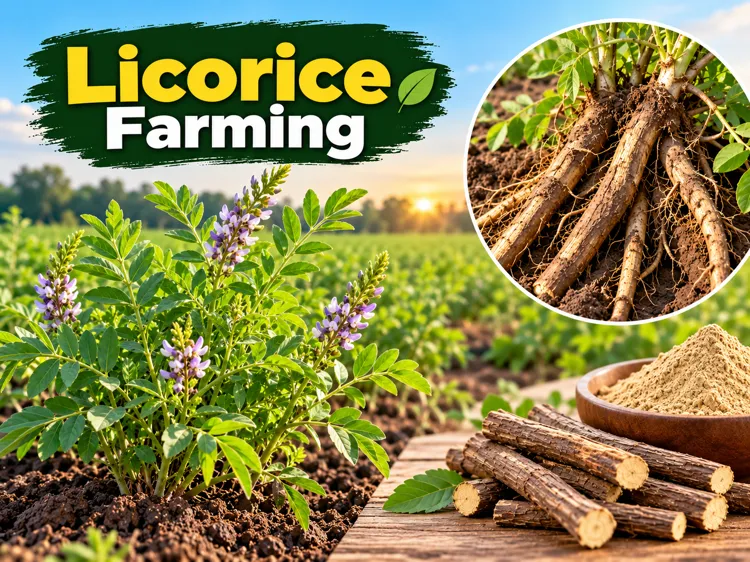
The licorice plant can grow around 1 to 2 metres tall. Its flowers are purple to white-blue in colour. Its root is its most important commercial part.
In India, its cultivation is mentioned in Punjab and the sub-Himalayan regions. An ABP Live report has also mentioned the climate of Rajasthan as suitable for licorice farming.
This is why farmers who are thinking of moving towards medicinal farming can look at licorice not only as a plant but as a long-term crop.
💚 2. Where is the Opportunity for Farmers in Licorice Farming?
The biggest mistake in farming is to look only at the market price of a crop. The real questions should be where the demand for the crop is, how long it will take to become ready, how much production can be achieved, and who will buy the finished produce.
The special thing about licorice is that it is connected with medicinal use. An ABP Live report states that its roots are purchased by Ayurvedic and other pharmaceutical companies. The same report mentioned a purchase price of around ₹50 to ₹100 per kg in the context of 2023. This should not be considered the current market price because prices can change according to time, location, quality, and buyer.
The same report mentions the possibility of producing around 4,000 kg per hectare.
Therefore, farmers should not start cultivation simply after hearing “how much money can be earned.” It is more important to first understand the buyers in your area, current prices, root quality requirements, and purchasing conditions.
Farming can start with emotions, but profit comes from proper calculation and market knowledge.
If you want to understand income from different farming options, our Farming Income Information can be useful.
🌤️ 3. What Climate is Suitable for Licorice Farming?
Climate plays an important role in successful licorice farming. According to the available farming information, a normal temperature of around 15 to 30°C is mentioned as suitable.
A temperature of around 8 to 18°C during sowing and around 15 to 25°C during harvesting has been mentioned. Annual rainfall of around 50 to 100 cm is also given.
Farmers should consider these figures as general guidelines. Local weather and field conditions can be different.
There is one thing that needs special attention in licorice farming—water should not remain standing in the field.
Water stagnation can be harmful to the roots and may cause root rot problems. Therefore, good drainage in the field is important.
🌾 4. Which Soil is Best for Licorice Farming?
Sandy loam and fertile soil are considered suitable for licorice. A soil pH of around 6 to 8.2 is considered suitable.
The most important produce of licorice is its root. Therefore, the soil should be loose and have good drainage.
Before starting licorice farming, it is important to understand the condition of the soil. For this, you can read our Complete Information on Soil and Crop Management.
Soil testing can help farmers understand the pH and nutrient condition of the soil. Your website’s farming guidance also considers soil testing, ploughing, land levelling, and organic manure as part of basic farm preparation.
🚜 5. How to Prepare the Field Before Planting Licorice?
The field should be properly levelled before licorice cultivation. Good ploughing should be done to make the soil loose, and it should be ensured that water does not remain standing in the field.
According to information published by ABP Live, 2 to 3 deep ploughings are mentioned for preparing the field. The same source also mentions the use of well-decomposed cow dung manure along with nitrogen and phosphorus before the final ploughing.
On the other hand, information from Apni Kheti states that licorice generally does not require a large amount of manure; if the soil is light, well-decomposed cow dung manure can be added during field preparation.
For this, our information on Essential Farming Practices can be useful for farmers.
It is important to understand this difference. Every field does not have the same type of soil. Therefore, instead of blindly following a fixed quantity of manure, it is better to decide according to the condition of the field and soil.
📅 6. When to Sow and Plant Licorice?
The right time is very important in licorice farming.
According to the available information, the nursery can be prepared during January to February. Planting or sowing in the main field can be done during February-March or July-August.
Licorice can be planted directly in the field, or seedlings can first be prepared and then transplanted.
But in this crop, simply putting seeds like normal grain crops is not enough. It can also be propagated through root or stem parts.
🌱 7. How to Transplant Licorice?
In licorice farming, root or stem pieces with healthy buds can be selected.
According to Apni Kheti, 15 to 25 cm long root or stem pieces, having 2 to 3 buds, can be used for planting. The planting distance is mentioned as around 90 × 45 cm.
For good plant growth, the use of around 100 to 120 kg of stem pieces per acre is mentioned, and the bed depth is given as around 6 to 8 cm.
ABP Live also mentions planting with pieces around 8-9 inches long and having two to three buds. Planting in rows and light irrigation immediately after planting has been advised.
This means that initial establishment is a very important stage of licorice farming. Healthy planting material from roots or stems becomes the foundation of the future crop.
💧 8. How to Irrigate Licorice?
After planting, the plant needs moisture to become properly established in the soil. Therefore, light irrigation during the initial stage is important.
Light irrigation after planting in the spring season is advised so that the root or stem can become properly established in the soil.
During the dry summer season, irrigation at an interval of around 30 to 45 days is mentioned. During winter, irrigation is generally required less or may not be required. For the complete crop period, 7 to 10 irrigations are also mentioned.
But farmers should always remember one thing here—
Licorice needs water, but it does not need waterlogging.
For modern information related to irrigation and water saving, you can read our Smart Irrigation Technology information.
Excess water and poor drainage can cause root rot problems. Therefore, do not allow water to remain standing in the field.
🌿 9. Why is Weed Control Important?
Licorice is a crop that remains in the field for a long period. In such a situation, ignoring weeds can increase problems later.
During the first year, around 3 to 4 rounds of weeding and hoeing are mentioned. In the following years, hoeing can be done around 2 times.
The purpose of weeding and hoeing is to keep the field free from weeds so that the growth of the main crop is not affected.
Licorice is not a crop that promises quick income to farmers. It requires long-term care of the field. Therefore, regular inspection is an important part of its cultivation.
🐛 10. Major Pests That Attack Licorice
Some pests can attack licorice plants.
Available farming information mentions problems such as aphids, snails, and caterpillars. Aphids can attack during hot and dry weather. Snails damage the plant by eating green leaves, and caterpillars can also damage green leaves.
The source mentions the use of neem oil or Bacillus thuringiensis for controlling caterpillars. ABP Live information also mentions the use of biological pesticides for protection against pests and diseases.
For detailed information related to pest management, you can read our Causes of Pests in Crops and Organic Control information.
Farmers should avoid the habit of inspecting the field only after a problem becomes visible. Regularly checking the leaves, stems, and soil condition can help in better crop management.
🍃 11. Which Disease Can Affect Licorice?
A fungal problem with white spots on the leaves has been mentioned in licorice. The source provides information about the use of potassium bicarbonate for its control.
But in disease management, depending only on medicines or spraying is not the right approach.
Proper plant spacing, good drainage, weed control, and regular monitoring are also important parts of crop management.
As licorice is a medicinal crop, before using any chemical, it is sensible to take advice from a local agriculture expert and also consider the quality requirements of the buyer.
⏳ 12. How Long Does Licorice Crop Take to Become Ready?
This is where licorice farming becomes different from normal seasonal crops.
Licorice roots take time to develop. According to the available information, the plant starts giving yield in around two and a half to three years. An ABP Live report also mentions around three years for the development of the root and thick stem.
The meaning is clear—
Licorice farming requires patience.
It would not be right to expect full income only a few months after planting the crop. Farmers have to look at the field, expenses, labour, and market from a multi-year perspective.
But this long duration is also a special feature of this crop. If a farmer plans the cultivation in advance, it can be considered as a long-term part of the farming business.
⛏️ 13. When and How to Harvest Licorice?
The actual crop of licorice is in its roots.
According to Apni Kheti information, harvesting is mainly done during November to December. Harvesting during this period is mentioned in relation to getting a higher amount of glycyrrhizic acid in the roots.
It is important to remove the roots carefully because they are the main part for selling and further processing.
An interesting point has also been mentioned in the ABP Live report—the licorice roots left in the field after harvesting may give the possibility of getting another production after irrigation. In this way, there may be a possibility of getting further benefits from an established crop.
This feature makes licorice more interesting as a long-term medicinal crop.
☀️ 14. What to Do with Licorice Roots After Harvesting?
Removing the crop from the field is not the end of farming. Proper post-harvest management converts the produce into a marketable product.
After harvesting, licorice roots are dried in sunlight and then sorted. The dried roots can be stored in bags protected from air.
Products such as tea and powder can also be prepared from dried licorice roots.
This is where an important business lesson for farmers is hidden.
A crop produced in the field is not only raw material. Cleaning, drying, sorting, and further processing can change its market value.
💰 15. How Much Licorice Can Be Produced from One Hectare?
An ABP Live report from 2023 mentioned around 4,000 kg of licorice production per hectare. The same report mentioned that Ayurvedic and other pharmaceutical companies were purchasing it at around ₹50 to ₹100 per kg at that time.
But farmers should not directly consider these two figures together as a fixed profit.
Actual production can depend on soil, climate, planting material, crop care, crop age, and management. Similarly, market prices can change with time and location.
Therefore, before starting licorice farming, farmers should definitely find answers to three questions—
First: How are the soil and climate in my area for licorice farming?
Second: Who will buy the crop when it is ready?
Third: What quality, moisture level, size, and form of licorice does the buyer require?
If the answers to these questions are known in advance, farmers can understand and manage their farming risk much better.
📈 16. What Should Be the Right Approach to Earning from Licorice Farming?
On the internet, claims such as “earn lakhs”, “a crop that can make you rich”, or “plant once and earn money” are often seen about medicinal farming.
Instead of being influenced by such headlines, farmers should understand the reality behind the numbers.
Licorice can be a crop with a duration of around three years. This means that the land may remain engaged for a long period. During this time, farmers have to pay attention to aspects such as planting material, field preparation, irrigation, weeding and hoeing, labour, harvesting, drying, and transportation.
Therefore, it would be wrong to consider only the possible selling amount as “profit”.
Profit = The actual amount left after deducting the total cost from total sales.
Before entering licorice farming, farmers should definitely survey the market and talk to potential buyers.
⚠️ 17. Things to Pay Special Attention to Before Starting Licorice Farming
Licorice is a medicinal crop, but this does not mean that planting it will guarantee income.
First, it may be better to understand your field and local conditions on a small scale. Check the soil and drainage condition. Choose healthy planting material. Prepare a financial plan by keeping the long duration of the crop in mind.
The most important thing—find the market first, then cultivate on a larger area.
If there are Ayurvedic product manufacturing units, medicinal plant traders, or other potential buyers nearby, it can be useful for farmers to get information from them in advance about quality and purchasing conditions.
Licorice farming requires patience, so the planning should also be equally strong.
🤝 18. For Farmers, Licorice Is Not Just a Crop but Also an Opportunity to Change Their Thinking
Indian farmers have been growing wheat, rice, mustard, millet, and other traditional crops for generations. These crops will always have their own importance.
But in changing agriculture, farmers also have an opportunity to understand new options.
Medicinal farming can be one part of this change.
Licorice teaches us one simple but important thing—the real value of a field is not only in its area, but in connecting the right crop, the right information, and the right market with it.
The same root that an ordinary person knows as licorice used at home for the throat can be an agricultural product prepared by the farmer through years of hard work.
Therefore, farmers should not think only about being crop growers, but should also gradually think in the direction of becoming agricultural entrepreneurs.
🌾 19. Which Farmers Can Consider Licorice Farming?
Licorice can be considered especially by farmers who want to understand medicinal plant farming, can keep their land engaged for a long-duration crop, and can look for a market arrangement before harvesting.
But every farmer has different land, water, capital, and market conditions. Therefore, directly planting licorice on a large area after seeing another farmer’s success would not be the right strategy.
First, get information.
Then check the local conditions.
Understand the market.
After that, decide the area for cultivation.
This approach can help farmers move beyond only producing crops towards better agricultural business.
❤️ 20. Farmer Brother, The Field Does Not Grow Only Crops, It Also Grows the Future
Three years is not a short period.
When a farmer plants a small licorice root in the soil, he does not get its full value in the next month. He has to take care of the field, remove weeds, manage water, and wait while moving with the weather.
Perhaps this is also one of the biggest truths of farming—
The soil gives the reward for hard work, but in its own time.
Licorice farming is also a combination of patience, knowledge, and market understanding. If a farmer adopts it thinking of it only as a “quick-rich farming” option, the risk can increase. But if it is considered as a medicinal agricultural business by understanding the soil, time, cost, and market, its possibilities can be evaluated better.
Today, Indian agriculture needs not only more production, but also the right production and the right market.
And this can be an important step towards making our farming more self-reliant.
To read useful information about farming, animal husbandry, medicinal crops, and farmers, stay connected with Subsistence Farming.
❓ 21. Common Questions Related to Licorice Farming
Q1. How long does the Licorice crop take to become ready?
According to the available farming information, Licorice can start giving root yield in about two and a half to three years.
Q2. What is the right time to plant Licorice?
The nursery can be prepared in January-February, while transplanting can be done in February-March or July-August.
Q3. What type of soil is required for Licorice?
Sandy loam and fertile soil are considered better. Soil with a pH of about 6 to 8.2 is considered suitable.
Q4. How much distance should be maintained while transplanting Licorice?
According to the available information, a spacing of about 90 × 45 centimetres is suggested.
Q5. Is waterlogging in a Licorice field okay?
No. Waterlogging can cause root rot problems, so proper drainage is important.
Q6. When is Licorice harvested?
The main harvesting is mentioned to be done during November-December.
Q7. What is the use of Licorice root?
Its root is used in medicinal preparations. Products such as tea and powder can also be made from dried roots.
Q8. Can good income be earned from Licorice farming?
It has commercial potential, but actual income will depend on production, quality, cost, and market price. A report from 2023 mentioned production of up to 4,000 kg per hectare and a purchase price of ₹50-₹100 per kg at that time; this should not be considered as the current price or a guarantee of fixed income.
🌱 Conclusion
Licorice farming is a good example of understanding the possibilities of medicinal farming in India. Its sweet root has medicinal uses, but for a farmer, its real success depends on the right soil, proper drainage, healthy planting material, regular care, patience, and most importantly, the right market.
Licorice may require waiting for around three years. Therefore, it is more practical to consider it as a long-term medicinal crop rather than a crop that gives quick money.
Farmer brother, change in the field does not always start with a very big step.
Sometimes, change begins with a small root planted in the soil.
And when the right knowledge, hard work, and understanding of the market come together with that root—then farming does not remain only a work of producing crops, but can become the foundation of a better future for the family.
📚 References
- Ministry of Agriculture & Farmers Welfare, Government of India – Guidance related to crop production, plant protection, and agriculture.
- Indian Council of Agricultural Research (ICAR) – Information related to agricultural research, crop management, and pest and disease management.
- National Horticulture Board (NHB) – Information related to production and plant protection of horticultural crops.
- Vikaspedia – Multilingual knowledge portal of the Government of India.