

Why Crops Get Pests and How to Control Them with Organic Pest Control
🌾 Why Crops Get Pests and How to Control Them Organically
Farming is not only a source of livelihood for a farmer, but it is connected with his hard work, hope, and the future of his family. A farmer works hard in the field for months, sows seeds, irrigates the crop, applies manure, and faces every challenge of the weather. So, when pests suddenly attack the crop, holes start appearing in the leaves, plants become weak, or fruits and ears start getting damaged, it is natural for the farmer to become worried.
Crop pests and diseases are among the major problems in agriculture. If they are identified at the beginning and properly managed, crop damage can be reduced to a great extent.
It is not necessary to immediately use chemical pesticides for every pest. By adopting crop rotation, healthy soil, organic manure, protection of natural enemies, regular field inspection, neem and other plant-based methods, and Integrated Pest Management (IPM), better efforts can be made to protect crops from pests and diseases.
In this article, we will learn why pests attack crops, how to identify them, and how they can be managed through organic and natural methods.
🌱 1. Main Reasons Why Pests Attack Crops
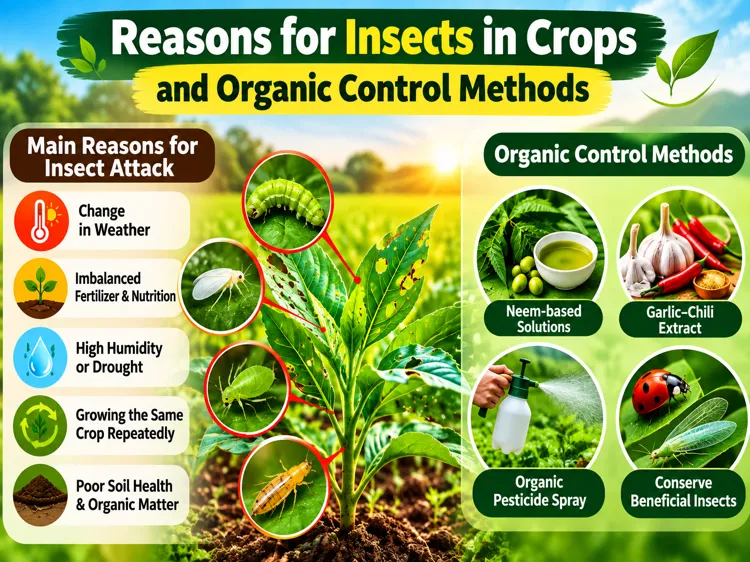
There is not only one reason behind pest attacks in crops. Weather, soil, cropping practices, nutrition, weeds, crop residues, and field monitoring can all affect pest infestation.
Growing the same crop continuously gives some pests repeated food and a favourable environment. Leaving infected crop residues in the field, excessive weeds, and deficiency or excess of balanced nutrition can also increase pest problems under some conditions.
Therefore, pest control does not start only with pesticide spraying, but with improving the complete farming system.
🔄 1.1. Why Can Pests Increase When the Same Crop Is Grown Continuously?
When the same crop is grown continuously in the same field, some pests and diseases related to that crop may continue to get food and shelter.
To reduce this problem, crop rotation can be useful. Growing different crops in a planned sequence in different seasons can help disturb the life cycle of some pests and diseases.
While planning crop rotation, soil, weather, irrigation, market conditions, and local pest and disease problems should be considered.
🌾 1.2. Importance of Healthy Seeds and Good Planting Material
A crop starts with healthy seeds. Weak, infected, or poor-quality seeds can create many problems right from the early stage of the crop.
Farmers should select good-quality seeds suitable for their area. Traditional or indigenous varieties suitable for local conditions can also be used, but special attention should be given to seed quality and freedom from diseases.
Buying seeds from a reliable source and using recommended seed treatment when required can help give the crop a good start.
🌱 1.3. Why Is It Important to Keep the Soil Healthy?
Healthy soil is the foundation of a healthy crop.
Having enough organic matter in the soil can improve its structure, water-holding capacity, and biological activity. Well-decomposed compost and organic manure can contribute to improving soil health.
Soil rich in organic matter can also provide a better environment for earthworms and beneficial microorganisms.
However, adding manure alone is not enough. It is also important to test the soil from time to time to understand its actual condition.
🌿 1.4. Proper Weed Management
Weeds compete with crops for water, nutrients, and sunlight. Some weeds can also provide alternative food or shelter to certain pests.
Therefore, weeds should be managed on time and through suitable methods.
However, it is also not appropriate to remove every plant from the field and field bunds. Some useful plants can provide food or shelter to beneficial insects and other organisms.
🌾 1.5. Proper Management of Crop Residues
After harvesting, infected plant residues left in the field can provide shelter to some pests and disease-causing organisms.
Therefore, properly manage diseased plant parts and infected crop residues.
It is not necessary to burn crop residues in every situation. Wherever possible, they can be managed through composting, biological decomposition, or other safe methods according to local agricultural advice.
🧪 1.6. Make Crops Strong with Balanced Nutrition
Plants need balanced nutrition for healthy growth.
Applying too much nitrogen can, under some conditions, cause very soft green plant growth, which may create a favourable environment for some sap-sucking pests.
Therefore, fertilizers and nutrients should be used according to soil testing and crop requirements.
🌦️ 1.7. Effect of Weather on Pest Infestation
Temperature, humidity, rainfall, and wind conditions can affect the reproduction and activity of many pests.
Because of this, the infestation level of the same pest can be different in different seasons and regions.
Farmers should monitor the crop stage and pest population along with the weather.
👀 2. Regular Field Monitoring and Natural Balance
👀 2.1. Why Is Regular Field Inspection Important?
The cheapest and most important step in pest control is—regular monitoring.
Visit the field several times a week and carefully check the upper and lower surfaces of leaves, stems, flowers, fruits, and new growth.
Identifying pests at an early stage can provide an opportunity to control the problem before it becomes a major infestation.
🐞 2.2. Not Every Insect Is Harmful
Every insect seen in the field is not an enemy of the crop.
Ladybird beetles, lacewings, spiders, parasitoid wasps, and many other organisms can help reduce the population of harmful pests.
Frogs and some birds can also play an important role in the farm ecosystem.
Therefore, do not destroy any organism by assuming it is harmful without proper identification.
🌻 2.3. Create a Suitable Environment for Natural Enemies in the Field
Maintaining biodiversity in the field can provide food and shelter to beneficial organisms.
Marigold, tulsi, neem, Daikan, Nirgundi, Chiraita, and other local plants can be planted on field bunds or suitable locations.
Some farmers also plant such plants on field bunds whose smell or flowers may help attract beneficial organisms.
Plants should be selected according to the main crop and local conditions.
🔍 3. How to Identify Pests in Crops
The first rule of pest control is:
Yellowing, curling, or weakening of leaves does not always happen because of pests. Diseases, viruses, nutrient deficiency, too much water, less water, or weather stress can also cause such symptoms.
Therefore, it is important to correctly identify the problem before using any solution or pesticide.
🐛 3.1. What to Do When Holes Appear in Leaves?
When small or large holes appear in leaves, there may be a possibility of leaf-eating caterpillars, beetles, or other pests.
Check both sides of the leaves and also see whether eggs, small caterpillars, or insect droppings are present around the leaves.
At the early stage of infestation, manually removing affected leaves or pests can also be useful.
🦟 3.2. What to Check When Leaves Curl and Become Sticky?
Sap-sucking pests such as aphids, whiteflies, and jassids take sap from plants.
During their infestation, leaves may curl, new growth may become weak, and a sticky substance may appear on the leaves.
In such a situation, especially check the lower surface of the leaves.
🍅 3.3. What to Do When There Are Holes in Fruits?
When holes appear in fruits, there may be a possibility of fruit borers or other pests.
Instead of leaving affected fruits in the field, it can be useful to separate them and manage them safely.
Pheromone traps and regular monitoring can also be useful for fruit borer problems.
🌾 3.4. Common Crop Pests and Their Damage
| Pest or Group | Common Damage |
|---|---|
| 🦟 Aphids | Suck plant sap |
| 🪰 Whitefly | Suck plant sap and may play a role in spreading some diseases |
| 🦗 Jassid | Suck sap from leaves |
| 🐛 Stem borer | Damages the stem |
| 🐛 Fruit borer | Damages fruits and tender plant parts |
| 🐛 Leaf-eating caterpillar | Eats leaves |
| 🪲 Beetle | Damages leaves and other plant parts |
| 🐜 Termite | Damages roots, stems, and the base of the plant |
🌿 4. Neem-Based Organic Pest Control
🌿 4.1. Organic Pest Control Using Neem Leaves
Neem has been used for a long time in Indian farming traditions for plant protection.
Neem leaf extract can be traditionally prepared by soaking neem leaves in water, grinding them and filtering them. A small amount of country-made soap or a suitable emulsifier can be added to it and sprayed on the leaves.
Traditional methods are available for preparing extract from about 10–12 kg of neem leaves for one acre. In one common traditional method, about 1 kg of leaves is soaked in 10 litres of water overnight. The next day, the leaves are ground and filtered, and a small amount of soap is added before spraying.
Neem leaf extract is traditionally used for the management of some pests and some plant diseases.
Before using it in the whole field, it is necessary to test it on a few plants.
🌰 4.2. Organic Solution from Neem Kernels
Extract prepared from neem kernels is also used in traditional organic pest management.
In one traditional method, about 1 kg of neem kernels is crushed and soaked in 20 litres of water overnight. The next day, it is rubbed well and filtered, and about 20 grams of country-made soap or about 50 grams of soapnut solution is added.
Such extracts are used for the management of some pests.
After preparing the extract, it is better to use it fresh instead of storing it for a long time.
🧴 4.3. Use of Neem Oil
Neem oil can be useful in the management of some pests.
In one traditional method, about 15–30 ml of neem oil is mixed with 1 litre of water, along with a small amount of country-made soap or soapnut solution, and used immediately.
The required quantity for one acre may vary according to the crop, formulation and spray volume. The concentration of neem-based agricultural products available in the market may also vary.
Therefore, when using a commercial product, give priority to the crop-specific quantity mentioned on its label.
🌿 4.4. Use of Neem Cake
Neem cake is used in organic farming for soil management and traditional control of some soil-borne problems.
A traditional method of applying about 40 kg of neem cake per acre and mixing it into the soil during field preparation is commonly followed.
Mixing it properly into the soil also provides organic matter and, under some conditions, may help in managing harmful organisms present in the soil.
🌱 4.5. Neem Cake Extract
Neem cake can be soaked in water to prepare an extract.
In one common traditional method, neem cake is tied in a cloth bag and soaked in water overnight. The next day, it is rubbed and filtered, and the obtained solution is used on the crop.
The correct quantity of the solution should be decided according to the crop and purpose.
🌳 5. Other Plant-Based Organic Pest Control
🌳 5.1. Pest Control Using Daikan or Bakayan
Daikan or Bakayan is traditionally used for plant protection in some regions as an alternative to neem.
Traditional methods are available for preparing leaf extract using about 5–6 kg of leaves per acre.
It can be important to make the solution reach both surfaces of the leaves because many sap-sucking pests hide on the lower surface of the leaves.
Make sure of the correct botanical identification of Daikan and test it on a small area before spraying it in the whole field.
🌳 5.2. Natural Pest Management Using Karanja
Karanja is a leguminous tree whose seeds are used to obtain oil. Its cake can be used as manure and its leaves can be used as green manure.
Karanja oil, seeds, leaves and cake are traditionally used in agriculture for pest and plant protection.
The quantity and use of Karanja-based solutions should be decided according to the crop and target pest.
🧄 5.3. Pest Control Using Garlic
Garlic has been traditionally used in agriculture for managing some pests because of its natural compounds.
For one traditional solution, about 1 kg of garlic and 100 grams of country-made soap are mixed with 5 litres of water and filtered.
This method is traditionally used especially for managing pests seen in chilli, onion and some other vegetable nurseries.
Garlic solution can damage leaves if it is too concentrated, so test it on a small area first.
🌿 5.4. Use of Chulu and Mustard Cake
Chulu and mustard cake are traditionally used in farming for managing some fungal-related problems.
A traditional method of applying about 40 kg of cake per acre before sowing is followed.
It should be mixed properly into the soil.
Its effect is not the same on every fungal disease, so correct identification of the disease is necessary.
🥛 5.5. Use of Sour Buttermilk
Sour buttermilk is used in some traditional farming systems for managing plant diseases.
In one traditional method, about 2 litres of sour buttermilk is mixed with 30 litres of water. A method of using about 6 litres of buttermilk for one acre of crop is also commonly followed.
It should be used carefully according to the crop stage and local conditions.
🍈 5.6. Traditional Control of Caterpillars Using Custard Apple and Papaya
Powder made from the seeds, leaves and fruits of custard apple and papaya is traditionally used in some areas for controlling caterpillar-like pests.
In one traditional method, about 1 kg of seeds or about 3 kg of leaf and fruit powder is mixed with 20 litres of water. After filtering, it is sprayed on the crop.
Test it on a small area first and stop using it if leaf burning or any other damage is seen.
🌿 5.7. Traditional Multi-Plant Organic Solution
In some traditional farming systems, mixed organic solutions are prepared using dried leaves of different local plants.
Such mixtures may use plants such as Daikan, walnut, Chiraita, Temru and Kadvi. These plants are ground and mixed with water and a small amount of natural soap to prepare the solution.
Such mixtures are used during field preparation for managing some pests and diseases present in the soil.
Correct identification of local plants is very important because the same name may be used for different plants in different regions.
🐄 6. Organic Methods Based on Cow Dung, Cow Urine and Panchagavya
🐄 6.1. Traditional Agricultural Use of Cow Urine
Cow urine is used in traditional organic farming in some plant protection solutions and organic inputs.
In one traditional method, it is diluted with about 5–10 times water and used for spraying on some fruit, vegetable and vine crops.
It should not be considered a definite treatment for all pests and diseases. When using it on food crops, hygiene and safety should be taken care of.
🐄 6.2. Use of Panchagavya
Panchagavya is a mixture traditionally used in organic farming.
To prepare it, approximately:
- 100 grams cow ghee
- 1 litre cow urine
- 1 litre milk
- 1 kg cow dung
- 100 grams molasses or honey
are mixed and kept for about 4 days to 1 week, depending on the weather. The mixture is stirred from time to time. After that, it is filtered and used after mixing with water in about a 1:10 ratio.
Panchagavya is considered a supporting input for traditional plant nutrition and plant protection. It should not be considered a definite treatment for any particular disease or pest.
🐄 6.3. Cow Dung Solution
A traditional organic solution is prepared from cow dung.
In one common method, about 1 kg of cow dung is mixed with 10 litres of water and filtered through a cloth.
Some farmers use this type of solution for traditional management of pests seen on leaves.
When using it on food crops, take special care of hygiene and food safety.
🪤 7. Pest Monitoring Using Sticky Traps and Pheromone Traps
🪤 7.1. Use of Yellow and Blue Sticky Traps
Sticky traps can be useful for monitoring small flying pests.
Yellow sticky traps are used in many situations for monitoring pests such as whiteflies and aphids.
Blue sticky traps are used in some situations for monitoring thrips.
Their main purpose is to understand the presence of pests and changes in their numbers.
🧲 7.2. Pest Monitoring Using Pheromone Traps
Pheromone traps are useful for some target pests.
They are used for monitoring some fruit borer and stem borer pests.
It is important to use the correct lure in a pheromone trap and place it at the proper location.
🐜 8. Management of Termites, Rats and Diseased Plants
🐜 8.1. Protecting Crops from Termites
Termites can damage roots and stems in some crops.
Healthy field management, proper cropping practices and balanced use of organic materials are important for termite management.
Neem cake is used in some farming systems for termite management. In crops such as sugarcane, the use of neem cake at the time of planting is also traditionally followed.
Proper use of farmyard manure and neem leaves in the field is also part of some traditional methods.
In case of severe infestation, crop-specific advice should be taken from a local agricultural expert.
🐀 8.2. Management of Rats in the Field
Rats can damage standing crops, seeds and stored grains in the field.
Identification of rat burrows, field cleanliness and safe rodent-management methods are important for controlling rats.
Some traditional methods have used pellets made from walnut shells and flour.
However, keeping any poisonous or potentially toxic substance openly in the field can create a risk for children, animals and beneficial organisms.
Therefore, give priority to safe and approved rodent-control methods.
🌾 8.3. Remove Diseased Plants on Time
If diseased plants or ears are seen in the crop, it is not advisable to leave them in the field for a long time.
Carefully remove the affected plant parts and manage them safely according to local agricultural advice.
In some situations, this can help reduce the spread of diseases related to fungi, viruses and bacteria.
Burning diseased plants in the open field is not necessary or appropriate in every situation.
🌻 9. Importance of Organic Fences and Field Bunds
Field bunds can play an important role in maintaining biodiversity.
Plants such as marigold, tulsi, neem, Daikan, Nirgundi, Chiraita and other local plants can be planted on field bunds.
In some areas, there is also a traditional practice of planting marigold or other useful plants around crops such as rice.
Instead of cutting and burning useful trees present in the field without any need, their usefulness should be considered.
Trees and vegetation on field bunds can provide shelter to birds, beneficial insects and other organisms.
🚜 10. What is Integrated Pest Management (IPM)?
IPM means Integrated Pest Management. Its purpose is not to eliminate every pest present in the field.
Its purpose is to keep the pest population at a level where the economic damage to the crop is reduced and unnecessary control measures can be avoided.
An effective IPM system may include:
Healthy Seeds → Healthy Soil → Crop Rotation → Biodiversity → Regular Monitoring → Correct Identification → Natural Enemies → Traps → Biological Control → Monitoring Results
When needed, other approved control measures can also be adopted according to the crop and pest.
📅 11. 7-Day Pest Monitoring Plan for Farmers
Day 1: Conduct a general inspection of the field.
Day 2: Check the upper and lower surfaces of the leaves.
Day 3: Check new leaves, flowers and fruits.
Day 4: Check sticky traps and pheromone traps.
Day 5: Observe beneficial insects and other natural enemies.
Day 6: Record the number of pests and the condition of the crop.
Day 7: If the problem is increasing, take advice from an agricultural expert and take appropriate action.
⚠️ 12. Things to Keep in Mind While Using Organic Methods
Natural or organic substances do not mean that they are completely safe in every situation.
Therefore:
- Do not spray any solution without identifying the problem.
- Do not mix several different solutions together without proper knowledge.
- Test a new solution on a small area first.
- Avoid spraying sensitive plant extracts in strong sunlight.
- Take care of hygiene and safety when using them on food crops.
- Read the label of commercial biological products carefully.
- Keep all agricultural solutions away from children and animals.
- In case of severe infestation, take advice from an agricultural expert or Krishi Vigyan Kendra.
🚫 13. Be Careful with Tobacco, Salt and Kerosene-Based Methods
Some traditional farming methods mention the use of substances such as tobacco, salt, soap, slaked lime and kerosene.
These substances should not be directly used in the field by considering them as common and safe organic pesticides.
They can:
- Damage the crop.
- Have adverse effects on soil and water.
- Affect beneficial organisms.
- Create safety and residue-related problems in food crops.
- Create risks for animals and humans.
Therefore, such methods should be used only on the clear advice of a local agricultural expert and according to applicable agricultural safety rules.
❤️ 14. A Farmer’s Crop Is Not Just a Crop
For a farmer, the standing crop in the field is not just a row of plants.
It contains months of hard work.
It contains the hope of the family.
It contains the education of the children.
It contains the preparation for the next season.
And the farmer’s future is connected to it.
Therefore, when the first pest is seen in the field, neither ignore it nor panic and use any medicine or home-made solution without identification.
First, observe the field.
Identify the pest.
Identify the friends of nature.
Then choose the right solution.
This is smart farming.
🌿 15. 15 Golden Rules of Organic Pest Control
1️⃣ Use healthy and good-quality seeds.
2️⃣ Improve soil health with compost and organic matter.
3️⃣ Follow crop rotation.
4️⃣ Regularly monitor the field.
5️⃣ Correctly identify the pest.
6️⃣ Protect natural enemies.
7️⃣ Maintain biodiversity in the field.
8️⃣ Use sticky and pheromone traps according to need.
9️⃣ Carefully use neem, Karanja and other plant-based methods.
🔟 Use bio-pesticides according to the label.
1️⃣1️⃣ Remove diseased plant parts on time.
1️⃣2️⃣ Maintain balanced nutrition and irrigation.
1️⃣3️⃣ Develop field bunds and organic fences in a useful way.
1️⃣4️⃣ Do not spray homemade solutions without proper identification.
1️⃣5️⃣ When the problem becomes serious, take advice from an agricultural expert or KVK.
🧑🌾 16. What to Do If You See a Pest in the Field Today
If you see a pest in the field today, instead of panicking, follow this sequence:
First step: Identify the pest and the damage.
Second step: Check whether the problem is limited to a few plants or is spreading throughout the field.
Third step: Observe beneficial insects and natural enemies present in the field.
Fourth step: Identify the location of the damage on the leaf, stem, flower, fruit and root.
Fifth step: Wherever possible, use mechanical and non-chemical methods.
Sixth step: Choose a suitable organic or biological-control method according to the crop and pest.
Seventh step: After taking action, check the result again and keep a record.
❓ 17. Why Do Crops Get Pests?
There can be many reasons why crops get pests, such as weather, growing the same crop continuously, weeds, infected crop residues, unbalanced nutrition and lack of regular field monitoring.
Q1. What Is the Best Organic Method for Pest Control in Crops?
There is no single best method for all crops and all pests. A more effective strategy can be to combine correct identification, regular monitoring, crop rotation, protection of natural enemies, mechanical methods and suitable organic control.
Q2. Can Neem Eliminate All Pests?
No. Neem-based methods can be useful for managing some pests, but they are not a universal solution for every pest.
Q4. Are All Insects in the Field Harmful?
No. Many beneficial insects and other organisms help control harmful pests.
Q5. How Does Crop Rotation Help in Pest Control?
A planned sequence of different crops can help disturb the life cycle of some pests and diseases.
Q6. What Is the Benefit of Sticky Traps?
Sticky traps can help in monitoring some flying pests and, in some situations, can help reduce their numbers. They should be used according to the target pest and crop.
Q7. Are Organic Pesticides Always Safe?
No. Substances obtained from natural sources can also harm plants, humans, animals or beneficial organisms if used in the wrong quantity or on the wrong crop.
Q8. What Is Panchagavya?
Panchagavya is a mixture used in traditional organic farming. It contains cow dung, cow urine, milk, ghee and, in some formulations, substances such as molasses or honey.
Q9. What Is Neem Cake Used For?
Neem cake is used as organic manure, for soil management and for the traditional management of some soil-borne problems.
Q10. How Can Crops Be Protected from Termites?
Healthy soil, proper cropping practices, field cleanliness and crop-specific IPM are important for termite management. Methods such as neem cake are used in some farming systems. In case of severe infestation, advice from a local agricultural expert should be taken.
🌾 Conclusion: Farm by Understanding Nature
Pest infestation in crops is certainly a challenge for farmers, but the damage can be reduced by taking the right steps at the right time.
Organic pest control is not only about spraying neem. It is a complete approach to farming.
Healthy soil, healthy plants, crop rotation, biodiversity, natural enemies, regular monitoring, correct identification and proper control—all these together can help farmers protect their crops in a better way.
Neem leaves, neem kernels, neem oil, neem cake, Karanja, Daikan, garlic, Panchagavya, cow dung, buttermilk and other traditional resources can be useful in some situations. But every method does not give the same result for every crop and every pest.
Therefore, combining traditional farming knowledge with modern scientific pest management is the most sensible approach.
Because good farming does not mean only higher production.
Good farming means protecting the farmer’s hard work, keeping the soil healthy, maintaining the balance of nature and protecting the crop from unnecessary damage.
🌾 Observe the field carefully.
🐞 Identify the pest.
🌿 Protect the friends of nature.
🌱 Use organic and scientific methods wisely.
Farmer awareness is the first protection of the crop. ❤️
📚 References
The following agriculture and plant protection sources were used while preparing this article:
- Ministry of Agriculture and Farmers Welfare, Government of India – Guidance related to crop production, plant protection and agriculture.
- Indian Council of Agricultural Research (ICAR) – Information related to agricultural research, crop management, and pest and disease management.
- National Horticulture Board (NHB) – Information related to horticultural crop production and plant protection.
- Vikaspedia – Multilingual knowledge portal of the Government of India.