


Almond Farming: Complete Guide to Varieties, Climate, Soil & Profit
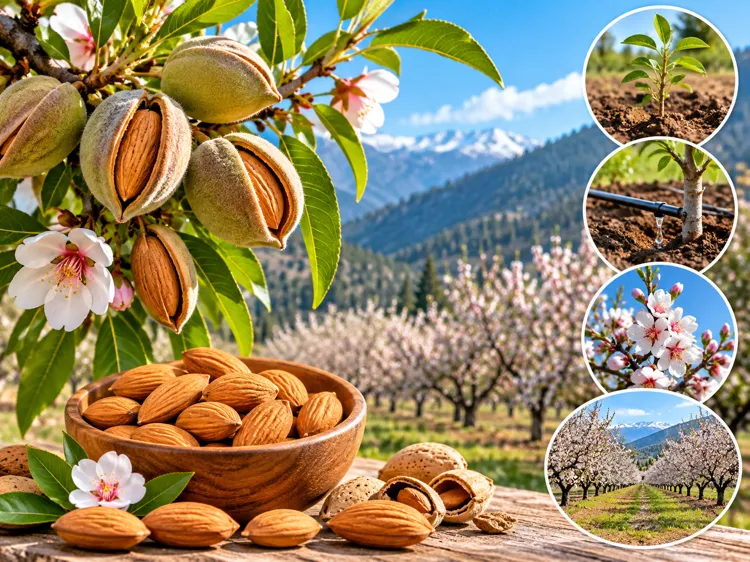
🌰 How to Grow Almonds? Complete Information on Improved Varieties, Climate, Soil, Planting, Irrigation and Profit
Farming in India is not only a way to produce food, but it is connected with the lives, families and future of crores of farmers. When a farmer plants a crop in the field, he does not only grow a crop; he also plants hope for the coming years. Almond farming can be considered one of such long-term and promising crops.
Almond is a major dry fruit, which is used in food, sweets and as a gift on various occasions. Due to its demand, it is considered an important dry fruit in the market. This is why almond farming can be an interesting farming option for farmers living in cold regions.
However, it is not appropriate to start almond farming only by considering it a “high-price crop”. For this crop, it is necessary to take care of suitable climate, proper soil, drainage in the field, proper spacing, plant care, manure, irrigation and harvesting at the right time.
In this article, we will understand how to grow almonds, which are the improved varieties of almonds, what type of climate and soil are required for almonds, how to prepare the field, how to plant the saplings, how to manage irrigation and manure, and what the yield and market price of almonds can be, all these topics in simple English.
🌱 The right farming decision should always be taken by considering the climate, soil, water and local conditions of your farm.
🌰 1. Why Is Almond Farming Important for Farmers?
The use of almonds is not limited to eating at home. They are used in sweets, and almond laddoos are also made during winter. Apart from this, dry fruits are given as gifts on various auspicious occasions, weddings, birthdays and New Year celebrations.
Today, the tradition of giving dry fruits instead of sweets on many occasions is also increasing, in which almonds are an important part. Due to this, almonds are considered an important dry fruit in the market.
For a farmer, the usefulness of any crop is not decided only by its price, but also by its demand, production capacity and suitability for farming. The same thing is important in the case of almonds.
According to the original source, almond market prices have been mentioned at around ₹600 to ₹1,000 per kilogram. However, market prices can change according to demand and supply. Therefore, before starting cultivation, farmers should understand their local area and potential market.
If you want to read information related to different crops, farming income and agricultural management, you can also check the farming-related content available on Subsistence Farming.
🌳 2. What Does an Almond Tree Look Like?
The almond tree is generally of medium size. It has fragrant flowers that appear in pink and white colours. Its stems are thick and its leaves are described as long, broad and soft.
The kernel present inside the almond fruit is what we know as an almond. This kernel is used as an edible dry fruit in the market.
The almond tree is found mainly in hilly areas. Therefore, while cultivating almonds, climate should be considered one of the most important factors.
🇮🇳 3. Where Is Almond Farming Done in India?
In India, almond farming is mainly done in cold regions. According to the given source, Kashmir, Himachal Pradesh and Uttarakhand are mentioned as the major almond-producing areas.
Apart from these, almonds are also cultivated in some areas near the China border, Tibet, Lahaul and Kinnaur.
However, almond farming is now also being tried experimentally in some other states. The source mentions Bihar, Uttar Pradesh and Madhya Pradesh. Some farmers there planted almond saplings as a hobby and also obtained fruits after the plants grew.
This indicates that almond plants can also be planted in warm climate areas with some precautions. But this does not mean that every warm region will be equally suitable for commercial almond farming.
Therefore, the most important thing for a farmer is to understand the climate of their area and make a decision accordingly.
🌰 4. Major Types of Almonds
Almonds are also known by the names of different countries. For example, American almonds, Iranian almonds and Spanish almonds are mentioned.
Mainly, two types are mentioned:
- California or American almonds
- Mamra almonds
While selecting plants, it is important for farmers to get information about the variety and planting material according to their farming conditions.
🌱 5. Which Are the Improved Varieties of Almonds?
Several varieties have been mentioned in the source for almond farming. The major ones include:
- California Paper Shell
- Nonpareil
- Drake
- Thinrhold
- I.X.L.
- Neplus Ultra
For a farmer, knowing only the name of the variety is not enough. Before planting the saplings, it is important to understand whether the selected variety is suitable for the climate and available resources of the area.
In a perennial crop like almonds, the initial selection of plants affects the orchard for the coming years. Therefore, one should avoid rushing while selecting planting material.
🌡️ 6. What Type of Climate Is Required for Almond Farming?
Temperature plays a very important role in almond farming. According to the source, a temperature of around 30 to 35°C during summer is considered necessary for plant growth and kernel filling.
During winter, the plant can tolerate temperatures up to around 2.2°C. However, very low temperatures during the flowering stage can be harmful.
A temperature of around 0.50°C to -11°C can cause damage to flowers. Small flowers can tolerate temperatures of around 2.2 to 3.3°C under some conditions, but if low temperatures continue for a long time, the crop may be damaged.
This is why only having winter is not enough for almond farming. It is necessary to understand the temperature conditions during plant growth, flowering and fruit formation.
🌾 7. What Type of Soil Is Required for Almond Farming?
While selecting land for almonds, special attention should be given to soil quality as well as drainage.
According to the source, the following types of soil are considered suitable for almond farming:
- Level land
- Sandy soil
- Loamy clay soil
- Deep and fertile soil
The most important thing is that there should be proper drainage in the field.
A farmer should not select a field only by looking at its soil fertility. If water remains accumulated in the field for a long time, the normal growth of plants may be affected. Therefore, it is necessary to pay attention to drainage arrangements before establishing the orchard.
🚜 8. How to Prepare the Field for Almond Farming?
Good farming starts with good field preparation. Almond plants are going to remain in the field for a long time, so it is necessary to prepare the land properly in the beginning.
For field preparation, it is mentioned that first the land should be ploughed with a mouldboard plough. After this, the field is ploughed about 3 to 4 times using a cultivator or traditional plough.
After ploughing, the field should be levelled using a plank.
In a levelled field, it becomes easier to prepare pits for the plants and plant them at the proper distance. Along with this, further management of the field can also be done in an organised manner.
🌱 9. Propagation Methods for Preparing Almond Plants
Almond plants are propagated through different methods. The source mentions the following methods:
- Ring budding
- T-budding
- Cutting method
The proper time for budding is mentioned as April to May. For grafting, the period of January to February is mentioned.
This stage is important for preparing planting material. Therefore, farmers should take care of the method and timing of plant preparation.
📏 10. Proper Spacing and Time for Planting Almond Plants
Pits should be prepared before planting almond plants. According to the source, pits of about 3 feet in length, 3 feet in width and 3 feet in depth can be prepared during September to October.
The plants are mentioned to be planted in rows at a distance of about 5 metres.
Planting is mentioned to be done between February and March in the centre of the pits.
In a perennial orchard, plant spacing is very important. Giving plants proper space helps in keeping orchard management organised in the future.
🧪 11. Manure and Fertilizer Management in Almond Farming
Proper use of manure and fertilizers is considered necessary for plant growth and good yield.
According to the source, the following quantity is mentioned per tree per year:
- Well-decomposed cow dung manure — 35 to 40 kg
- Calcium ammonium nitrate — 2 kg
- Single super phosphate — 1.5 kg
- Muriate of potash — 1 kg
It is mentioned that the full quantity of phosphorus and half the quantity of potash should be given in April. Half the quantity of nitrogen should be given in February and the remaining half in April.
Here, one important thing is that fertilizers should be used by considering the condition of the plant and the conditions of the field. Farmers should make necessary adjustments in manure and fertilizer management according to local agricultural advice.
💧 12. How to Irrigate Almond Plants?
Irrigation is important for almond plants, especially during summer.
According to the source, in a young almond orchard, irrigation can be done at an interval of about 10 days during summer. During winter, the irrigation interval is mentioned as about 20 to 25 days.
The use of drip irrigation is mentioned for uneven land.
Adequate irrigation during summer is considered important for fruit-bearing plants. It is said to help reduce the problem of fruit drop and support good fruiting in the following year.
The irrigation requirement may change according to the age of the plants and the weather. The source also mentions an interval of about two weeks for young plants and about 20 to 25 days for mature trees.
Therefore, the purpose of irrigation should not only be to provide water, but to provide water according to the needs of the plant.
🌿 13. Weed Control in Almond Farming
Weeds can compete for the resources available to the crop and plants. Therefore, regular weeding and hoeing are necessary in the almond orchard.
According to the source, the first weeding can be done about 10 to 15 days after planting, the second weeding after 25 to 35 days, and the third weeding after about 45 days.
If there are more weeds in the field, it is mentioned that manual weeding can be done 2 to 3 times.
The removed weeds should be taken away from the field. Keeping the orchard clean helps in managing the plants in an organised manner.
🌳 14. How to Take Care of Almond Trees?
Almond farming is a long-term work. Regular care is required after planting the plants.
Irrigation should be continued according to the needs of the plants. Drip irrigation can be adopted for this.
The use of fertilizers during the spring season is mentioned. It is considered necessary to water the plant after applying fertilizer. Applying fertilizer without water may cause the plant to burn.
Loosening the soil around the tree is also considered beneficial. It is mentioned that this work should be done for the first time at the end of March, up to a depth of about 10 to 12 centimetres.
Apart from this, weeds growing around the plant should be removed regularly.
The source also states that the remaining space in the almond orchard can be used to grow other types of vegetables.
✂️ 15. When to Harvest Almonds?
Farmers need to be patient with the almond crop. According to the source, an almond plant can start producing fruits from around the third year.
Almonds can be harvested about 7 to 8 months after flowering.
After harvesting, the almonds are mentioned to be dried in the shade. After this, the kernel is separated from the outer part of the fruit.
Although the plant can start producing fruits in 3 to 4 years, it may take about 6 years to become fully fruit-bearing.
According to the source, fruits can be obtained from an almond tree for about 50 years.
This is what makes almond farming different from normal seasonal crops. Farmers need to think of it as a long-term orchard instead of expecting immediate results.
📦 16. How Much Yield Can Be Obtained from One Almond Tree?
Almond yield depends on the region and variety. According to the source, about 2 to 2.5 kilograms of dry almonds per tree per year can be obtained.
This figure should not be considered a guarantee of fixed production because the actual yield may vary according to the region, variety and farming conditions.
Therefore, farmers should plan production based on the planting material available in their area, climate and orchard conditions.
💰 17. What Is the Market Price of Almonds?
According to the given source, the market price of almonds is mentioned at around ₹600 to ₹1,000 per kilogram.
However, prices in the agricultural market do not remain fixed. Prices may change according to demand and supply.
Therefore, it is not advisable for farmers to invest only by looking at the expected market price. Before establishing an orchard, it is also important to understand the time required for production to begin and the cost of cultivation.
Almond is a perennial crop. Therefore, farmers should consider it as a long-term farming plan rather than a source of immediate income.
📊 18. Can Almond Farming Give Good Profit?
Almond farming is considered to have profit potential because of market demand and good prices, but the actual profit will depend on several conditions.
Farmers should pay attention to the following points:
- Whether the climate of the field is suitable for almonds or not.
- Whether the soil is deep and fertile or not.
- Whether proper drainage is available in the field or not.
- Whether the right variety has been selected or not.
- Whether sufficient spacing has been maintained between the plants or not.
- Whether irrigation facilities are available or not.
- Whether the plants are regularly receiving manure and fertilizers or not.
- Whether weed control is being done on time or not.
- Whether the farmer has enough patience and resources until production begins or not.
- What the actual market price is.
Therefore, a statement like “almond farming will make farmers rich” should not be understood as a guaranteed result, but rather as a potential farming opportunity.
❤️ 19. The Most Important Thing for Farmers – No Hurry, Proper Planning
The biggest investment in farming is not only money. A farmer’s time, hard work, land and hope are also part of the investment.
Planting an almond plant may seem easy, but preparing a successful orchard requires care for several years. During the initial years, the plant develops and later starts producing fruits.
This is why farmers should evaluate their land and climate before starting almond farming.
If your area has a cold climate, the soil is suitable, drainage is good and you want to establish an orchard for the long term, almonds can be a crop worth considering.
On the other hand, if the climate of the area is not suitable, planting a large number of plants only by looking at the market price can be risky.
Being wise in agriculture does not always mean choosing the most expensive crop. Being wise means—choosing the right crop for your farm.
🌱 20. Basis of a Farmer’s Success in Almond Farming
Imagine a successful almond orchard.
Today, the farmer prepares the land. Digs the pits. Plants the sapling. Gives water during summer. Removes weeds. Gives manure to the tree. Watches the weather. Then, slowly, the plant grows bigger.
After a few years, the same plant starts producing fruits.
This is not just farming, but a story of patience.
In almond farming, this long-term thinking prepares the farmer to play an important role. Providing proper spacing, water, manure and care to the plants from the beginning helps in keeping the orchard well-managed.
For a farmer, every plant is a small hope for the future. And when fruits appear on that plant after several years, they are not just almonds; they also show the farmer’s hard work, patience and faith.
🧮 21. Understand This Calculation Before Starting Almond Farming
A farmer should make a complete farming plan before establishing an orchard.
First, check the area of the land. After this, decide the number of plants and spacing. Then understand the requirements for pit preparation, purchasing plants, field preparation, irrigation, manure, weeding and hoeing, and plant care.
Since an almond tree can produce for many years, a decision should not be made only by looking at the cost of the first year and the first production.
If you want to understand farming costs and possible income in an organised way, you can check farming cost and agricultural information on Subsistence Farming. The website provides content related to farming, crop information, agricultural equipment, irrigation, farming income and other agricultural topics.
🌾 22. Can Almonds Be Grown in Warm Areas?
This question may come to the minds of many farmers.
The given source mentions that some farmers have planted almond plants and obtained fruits even in relatively warm areas such as Bihar, Uttar Pradesh and Madhya Pradesh.
But this information does not mean that every warm area will provide the same production commercially.
Temperature plays a very important role in almond farming, especially during flowering. Extremely low temperatures can damage flowers, while summer temperatures also have a role in plant growth and kernel filling.
Therefore, farmers in warm areas can first consider planting a small number of plants to understand local conditions instead of establishing an orchard over a large area without testing.
🌿 23. Almond Farming and the Farmer’s Future
The biggest question before a farmer today is not only “What should I grow?”
The right question is:
“Considering my land, water, weather, hard work and market, what will be suitable for me to grow?”
Almond farming can be one possible answer to this question, but the answer will not be the same for every farmer.
Where the climate and soil are suitable, an almond orchard can become a long-term farming option. Its crop may start producing fruits around the third year, and it is mentioned that it can reach full fruit-bearing condition around the sixth year.
Information that production can be obtained from a tree for a long period also makes it important as a long-term horticultural crop.
📌 24. Key Points of Almond Farming at a Glance
Crop: Almond
Major Farming Areas: Cold regions of Kashmir, Himachal Pradesh and Uttarakhand; apart from these, it is also cultivated in areas such as Tibet, Lahaul and Kinnaur.
Major Varieties: California Paper Shell, Nonpareil, Drake, Thinrhold, I.X.L. and Neplus Ultra.
Summer Temperature: Around 30–35°C is considered suitable for plant growth and kernel filling.
Suitable Soil: Level, sandy, loamy clay and deep fertile soil with good drainage.
Pit Size: About 3 × 3 × 3 feet.
Plant Spacing: About 5 metres in rows.
Time for Pit Preparation: September–October.
Planting Time: February–March.
Budding Time: April–May.
Grafting Time: January–February.
Start of Fruiting: From around the third year; the source also mentions that fruiting can start in 3–4 years.
Full Fruiting: The tree is mentioned to become fully fruit-bearing around the sixth year.
From Flowering to Harvesting: About 7–8 months later.
Dry Yield per Tree: About 2–2.5 kilograms per year; actual yield may vary according to the region and variety.
Market Price: The source mentions a price of ₹600–₹1,000 per kilogram. This is a figure from a source published in 2022; the current market price may differ according to demand and supply.
Production Period: According to the source, fruits can be obtained from an almond tree for about 50 years.
🔎 25. Frequently Asked Questions
Q1: Where is almond farming mainly done in India?
According to the given source, Kashmir, Himachal Pradesh and Uttarakhand are the major areas. Apart from these, cultivation in some other areas is also mentioned.
Q2: How many years does an almond plant take to produce fruits?
According to the source, the plant can start producing fruits from around the third year and can become fully fruit-bearing around the sixth year.
Q3: At what distance should almond plants be planted?
The source mentions keeping a distance of about 5 metres between the plants.
Q4: How much yield is obtained from an almond tree?
According to the source, about 2 to 2.5 kilograms of dry almonds per tree per year can be obtained. Actual yield depends on the region and variety.
Q5: What is the market price of almonds?
The given source mentions a market price of around ₹600 to ₹1,000 per kilogram. The actual market price may change according to demand and supply.
Q6: Is almond farming possible in warm areas?
The source mentions that some farmers have planted almond plants and obtained fruits in areas such as Bihar, Uttar Pradesh and Madhya Pradesh. However, for commercial farming, it is necessary to evaluate the local climate and conditions.
Q7: How important is irrigation in almond farming?
Irrigation is considered important during summer. In a young orchard, irrigation is mentioned at an interval of about 10 days during summer and about 20–25 days during winter.
Q8: How can weeds be controlled in an almond orchard?
Regular weeding and hoeing should be done. The source mentions the first weeding 10–15 days after planting, the second after 25–35 days and the third after about 45 days.
❤️ Conclusion: Plant an Almond Tree Today, Think About the Future
Almond farming can be a subject of special interest for farmers who are considering perennial horticulture and long-term farming planning.
The most important things in this crop are not only good prices, but the right climate, suitable soil, proper drainage, quality planting material, proper spacing, balanced manure, regular irrigation and continuous care.
Farmers should understand that it takes time to get results from almond farming. After planting the sapling, it needs to be cared for over several years. But under suitable conditions, the same plant can become a fruit-bearing tree for the coming years.
A farmer’s biggest weapon in farming is experience. Understand the land, understand the weather, understand the water and understand the market. Then choose the crop.
Because when a farmer plants a plant in the field, he does not think only about today.
He plants the future for his family, his land and the coming generation.
If you want to read about other crops, modern agriculture, irrigation, farming costs, farming income and farmer-focused information, Subsistence Farming can be a useful place for agricultural knowledge.
📚 References
- Ministry of Agriculture & Farmers Welfare, Government of India – Guidance related to crop production, plant protection, and agriculture.
- Indian Council of Agricultural Research (ICAR) – Information related to agricultural research, crop management, and pest and disease management.
- National Horticulture Board (NHB) – Information related to production and plant protection of horticultural crops.
- Vikaspedia – Multilingual knowledge portal of the Government of India.