


Cabbage Farming in India: Complete Guide for High Yield
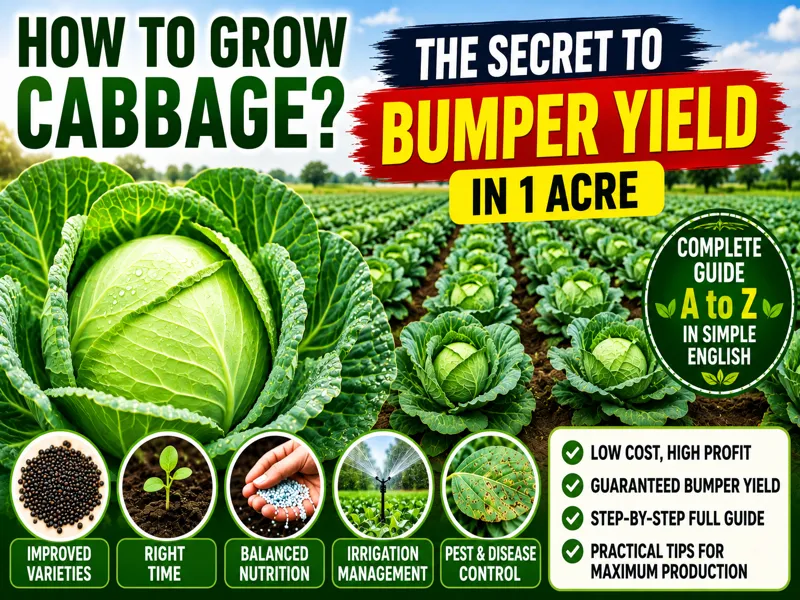
How to Do Cabbage Farming? Complete Method to Get High Yield from 1 Acre
If you want to earn a good profit from Cabbage Farming with low investment and high production, then selecting the right variety, balanced fertilizer management, timely irrigation, and proper pest and disease control are very important. By following scientific farming practices, farmers can harvest 75 to 80 quintals or even more per acre.
Cabbage is one of the most widely grown green vegetables in India. It has a strong market demand throughout the year, while Rabi season cultivation is considered the most profitable. With the right farming techniques, farmers can earn a good income in a short period.
In this article, you will learn:
✅ Best time for cabbage farming
✅ Best cabbage varieties
✅ Seed rate and seed treatment
✅ Land preparation
✅ Fertilizer and nutrient management
✅ Irrigation and weed management
✅ Major pests and disease control
✅ Harvesting, yield, and profit
If you are growing cabbage for the first time or want to increase production, this complete guide will be very useful for you.
🌿 1. Introduction to Cabbage Farming
Cabbage is an important leafy vegetable grown in almost every state of India. It belongs to the Brassica family and is highly popular among farmers because of its high nutritional value, better yield potential, and strong market demand.
It is rich in Vitamin A, Vitamin C, Vitamin K, Calcium, Potassium, Phosphorus, Iron, and Fiber. This is why cabbage is in continuous demand not only in household markets but also in hotels, restaurants, supermarkets, and the food processing industry.
If cultivated using scientific methods, farmers can earn good profits from this crop, which is ready for harvesting in 90 to 110 days.
Why Choose Cabbage Farming?
- Good market demand throughout the year.
- Short-duration crop.
- Lower risk compared to many other vegetables.
- Good production per acre.
- High demand in local markets as well as big cities.
- Also used in the food processing industry.
Main Information About Cabbage Farming
| Details | Information |
|---|---|
| Crop | Cabbage |
| Season | Rabi |
| Sowing Time | September–October |
| Harvesting | 90–110 Days |
| Temperature | 12–30°C |
| Soil pH | 5.5–6.5 |
| Seed Rate | 200–250 g/acre |
| Average Yield | 75–80 Quintals/acre |
Expert Tip 💡
If you want to get a better market price, choose a variety that matures when the market supply of cabbage is low.
🌦️ 2. Suitable Climate for Cabbage Farming
Cabbage is a cool-season crop and grows best at temperatures between 12°C and 30°C. During nursery raising and early plant growth, slightly higher temperatures are also suitable. However, cool weather is essential during head formation.
Excessive heat or continuous frost can affect both the yield and quality of the crop.
Ideal Temperature
| Activity | Temperature |
| Seed Germination | 25–30°C |
| Plant Growth | 12–30°C |
| Head Formation | 10–15°C |
| Harvesting Time | 10–15°C |
Benefits of Suitable Climate
- Produces large and firm cabbage heads.
- Increases head weight.
- Improves crop quality.
- Provides better market prices.
- Reduces pest and disease attacks.
Keep These Points in Mind
- Ensure proper drainage in areas receiving continuous rainfall.
- Avoid transplanting during extremely hot weather.
- Light irrigation during winter helps protect the crop.
Expert Tip 💡
If the temperature in your area remains above 35°C, delay transplanting for a few days so that head formation takes place during cooler weather.
🌱 3. Suitable Soil for Cabbage Farming
Cabbage can be grown in almost all soil types, but well-drained loamy and sandy loam soils are considered the best.
Waterlogging can quickly lead to root rot, fungal infections, and other diseases. Therefore, proper drainage is very important.
Ideal Soil
- Loamy soil
- Sandy loam soil
- Soil rich in organic matter
- Well-drained land
- Soil pH between 5.5 and 6.5
Avoid These Soil Types
❌ Highly acidic soil
❌ Waterlogged fields
❌ Heavy clay soil
Why is Soil Testing Important?
A soil test helps determine:
- Nitrogen level
- Phosphorus
- Potash
- Zinc
- Boron
- Calcium
- Magnesium
Based on these results, the correct amount of fertilizers can be applied.
Expert Tip 💡
Mix well-decomposed farmyard manure into the field before transplanting. It improves soil fertility and promotes faster root development.
🥬 4. Improved and High-Yielding Cabbage Varieties
Choosing the right variety is the most important step for obtaining high production. Select the variety according to your region, climate, and market demand.
Popular Improved Varieties
| Variety | Feature |
| Golden Acre | Early maturing |
| Pusa Mukta | High yielding |
| Pusa Drumhead | Large-sized heads |
| K-1 | Good quality |
| Pride of India | Attractive and heavy heads |
| Copenhagen Market | Popular in the market |
| Ganga | High yielding |
| Pusa Synthetic | Disease tolerant |
| Shree Ganesh Gol | Uniform head size |
| Hariana | Suitable for North India |
| Kaveri | Better quality |
| Bajrang | High yielding |
Other Popular Varieties
- Mid Season Market
- September Early
- Early Drum Head
- Late Large Drum Head
- K-1
Points to Consider While Selecting a Variety
- Regional climate
- Market demand
- Disease resistance
- Yield potential
- Harvesting period
Average Yield
With proper crop management, farmers can harvest 75–80 quintals per acre or even more.
Expert Tip 💡
If you plan to sell your produce in distant markets, choose varieties with firm heads that remain fresh for a longer period.
🚜 5. How to Prepare the Field
Proper field preparation is essential for obtaining a good cabbage yield. In loose and level soil, plant roots spread quickly, resulting in stronger plants and better head development.
Correct Method of Field Preparation
First Ploughing
- Deep plough the field using a mouldboard plough.
Second and Third Ploughing
- Plough the field 2–3 times using a country plough or rotavator.
Final Ploughing
- Level the field properly.
- Remove all weeds.
- Mix well-decomposed farmyard manure into the soil.
Farmyard Manure Per Acre
Apply about 40 tons of well-decomposed farmyard manure per acre.
This helps to:
- Make the soil loose and fertile.
- Improve water-holding capacity.
- Supply essential micronutrients.
- Promote faster root growth.
Points to Remember During Field Preparation
✅ There should be no waterlogging in the field.
✅ Ensure proper irrigation facilities.
✅ Keep the field well leveled.
✅ Maintain adequate soil moisture before transplanting.
Expert Tip 💡
If crop residues from the previous crop are present in the field, mix them thoroughly into the soil. This increases organic matter and improves soil quality.
🌾 6. How to Prepare a Cabbage Nursery?
Successful Cabbage Farming starts with a healthy and strong nursery. If the seedlings are healthy from the beginning, they grow faster in the field, face fewer disease problems, and ultimately give higher yields. Generally, 25–30 days old seedlings are considered best for transplanting.
📅 Right Time to Prepare the Nursery
For the Rabi season crop, nursery sowing should be done between September and October. During this period, the temperature is suitable for seed germination, and the seedlings grow quickly.
🌱 How to Prepare the Nursery Bed?
For a healthy nursery, prepare raised beds so that water does not accumulate after rainfall or irrigation.
Recommended Bed Size
| Details | Measurement |
|---|---|
| Width | 1 Meter |
| Length | As Required |
| Height | 15–20 cm |
Mix well-decomposed farmyard manure into the bed soil and make it loose and fine.
🌾 How to Sow the Seeds?
- Sow the seeds at a depth of 1–2 cm.
- Keep a row-to-row spacing of 5–7 cm.
- After sowing, cover the seeds with a light layer of soil or compost.
- Give light irrigation immediately.
💦 Nursery Care
- Maintain light soil moisture.
- Do not allow waterlogging.
- Remove weeds regularly.
- Use a light shade net if required.
- Remove diseased seedlings immediately.
🌿 When Are the Seedlings Ready for Transplanting?
The seedlings are ready for transplanting if they have the following characteristics:
- About 25–30 days old
- 4–6 healthy leaves
- Strong stem
- White and well-developed roots
- Free from pests and diseases
💡 Expert Tip
Give light irrigation one day before transplanting. This helps remove the seedlings easily and reduces root damage.
🌱 7. Seed Rate, Seed Treatment, and Transplanting
For higher production, selecting a good variety alone is not enough. Using the correct seed rate, proper seed treatment, and scientific transplanting methods is also essential.
🌾 Seed Rate Per Acre
| Details | Quantity |
| Seed | 200–250 grams per acre |
Always use certified seeds of good quality.
🧪 Why is Seed Treatment Important?
Seed treatment improves germination and protects the crop from early fungal and bacterial diseases.
✅ Hot Water Treatment
- Use water at 50°C temperature.
- Soak the seeds for 30 minutes.
✅ Streptocycline Treatment
- 0.01 gram per litre of water
- Soak the seeds for about 2 hours.
- Dry the seeds in shade before sowing.
✅ Carbendazim Treatment
To prevent stem rot in sandy soil:
- Carbendazim 50% WP
- 3 grams per kilogram of seed
Treat the seeds before sowing.
🌿 Right Time for Transplanting
Transplant the seedlings into the field 25–30 days after nursery preparation.
📏 Plant Spacing
Early Sown Crop
45 × 45 cm
Late Sown Crop
60 × 45 cm
Proper spacing provides enough sunlight, air circulation, and nutrients to the plants.
🌱 Correct Method of Transplanting
- Give light irrigation to the field before transplanting.
- Evening is the best time for transplanting.
- Do not damage the roots of the seedlings.
- Irrigate immediately after transplanting.
💡 Expert Tip
Always select healthy and strong seedlings for transplanting. Weak seedlings reduce the final yield.
💧 8. Fertilizer and Nutrient Management in Cabbage
If fertilizers are applied in balanced quantities, cabbage heads become larger, firmer, and heavier. It also improves both yield and crop quality.
🌿 Recommended Fertilizer Dose Per Acre
| Fertilizer | Quantity |
| Urea | 110 kg |
| SSP (Single Super Phosphate) | 155 kg |
| Muriate of Potash (MOP) | 40 kg |
| Well-Decomposed Farmyard Manure | 40 Tons |
🧪 Nutrient Requirement
| Nutrient | Quantity |
| Nitrogen (N) | 50 kg |
| Phosphorus (P) | 25 kg |
| Potash (K) | 25 kg |
🌱 Right Time to Apply Fertilizers
🌾 Before Transplanting
Mix the following thoroughly into the soil:
- Full quantity of farmyard manure
- Full SSP
- Full MOP
- Half quantity of urea
🌿 Four Weeks After Transplanting
Apply the remaining half quantity of urea as top dressing.
🌼 Foliar Spray for Higher Yield
Early Growth Stage
19:19:19
- 5–7 grams per litre of water
About 40 Days After Transplanting
12:61:00
- 4–5 grams per litre of water
Along with this, spray:
- Micronutrients: 2.5–3 grams per litre
- Boron: 1 gram per litre
During Head Formation
13:00:45
- 8–10 grams per litre of water
Spraying at this stage improves head size and quality.
⚠️ Micronutrient Deficiency
Magnesium Deficiency
Spray:
- Magnesium Sulphate
- 5 grams per litre of water
- 30–35 days after transplanting
Calcium Deficiency
Spray:
- Calcium Nitrate
- 5 grams per litre of water
- 30–35 days after transplanting
Boron Deficiency
If you notice:
- Hollow stem
- Brown cabbage heads
- Curling leaves
Apply 250–400 grams of Borax per acre.
💡 Expert Tip
Always apply fertilizers according to the soil test report. This reduces production costs and provides balanced nutrition to the crop.
🚿 9. Irrigation Management in Cabbage
Balanced irrigation is very important in cabbage farming. Too little water slows plant growth, while excess water can cause head cracking and increase problems like root rot.
💦 First Irrigation
Give the first irrigation immediately after transplanting so that the seedlings establish well.
📅 Further Irrigation
During winter, irrigation is generally required at an interval of 10–15 days. However, this interval may vary depending on soil type and weather conditions.
🌿 Points to Remember During Irrigation
- Do not allow water to stagnate in the field.
- Give light but regular irrigation.
- Maintain proper moisture during head formation.
- Avoid excessive irrigation.
⚠️ Problems Caused by Excess Water
- Cracking of cabbage heads
- Root rot
- Yellowing of plants
- Increase in fungal diseases
💡 Expert Tip
If possible, adopt a drip irrigation system. It saves 30–40% water and also improves fertilizer efficiency.
🌾 10. Weed Management in Cabbage
Weeds compete with the crop for nutrients, water, and sunlight. If not controlled on time, they can significantly reduce crop yield.
🌱 Chemical Weed Control
Four days before transplanting, spray:
- Pendimethalin – 1 litre per acre
🚜 Mechanical Weed Control
- First weeding and hoeing 20–25 days after transplanting.
- Carry out a second weeding if required.
- Destroy weeds before they produce flowers.
🌿 Benefits of Weed Control
- Faster plant growth
- Better nutrient utilization
- Reduced pest and disease incidence
- Higher production
- Larger and better-quality cabbage heads
💡 Expert Tip
Light hoeing after rainfall keeps the soil loose, improves air movement to the roots, and makes weed removal easier.
🐛 11. Major Pests in Cabbage Farming and Their Control
Many types of pests attack the cabbage crop, affecting both yield and quality. If pests are identified early and controlled properly, up to 80–90% of crop losses can be prevented. Therefore, farmers should inspect their fields regularly.
🐛 1. Cutworm
This pest cuts young plants at the ground level, causing newly transplanted seedlings to dry up and fall. Its attack is more common during the early stage after transplanting.
Symptoms of Damage
- Young plants are cut at the soil surface.
- Plants suddenly wilt and fall.
- Plant population in the field starts decreasing.
Control
- Before transplanting, mix Methyl Parathion or Malathion at 10 kg per acre into the soil.
- Keep the field free from weeds.
- Inspect the field during the evening.
🐛 2. Leaf Eating Caterpillar
This caterpillar feeds on the leaves, creating large holes. Heavy infestation weakens the plants and stops proper head development.
Symptoms of Damage
- Irregular holes appear on the leaves.
- Green leaves are rapidly damaged.
- Plant growth becomes slow.
Control
- Spray Dichlorvos 200 ml mixed in 150 litres of water.
- Or spray Flubendiamide 48% SC at 0.5 ml per 3 litres of water.
🦋 3. Diamondback Moth
This is considered the most dangerous pest of cabbage. The female moth lays eggs on the lower surface of the leaves, and the green caterpillars feed on the leaves, causing severe crop damage.
If not controlled in time, it can reduce production by 80–90%.
Symptoms of Damage
- Small holes appear on the leaves.
- Only the leaf veins remain.
- Head development stops.
- Plants become weak.
Control
- At the initial stage, spray Neem Seed Kernel Extract at 40 grams per litre of water.
- Repeat the spray after 10–15 days.
- For biological control, spray BT (Bacillus thuringiensis) 500 grams per acre at 35 and 50 days after transplanting.
- In case of severe infestation, spray Spinosad 2.5% SC 80 ml mixed in 150 litres of water.
🐜 4. Sap-Sucking Insects (Aphids)
These insects suck plant sap, making the plants weak. Affected leaves turn yellow, and plant growth stops.
Symptoms of Damage
- Leaves start turning yellow.
- Leaves become curled.
- Plant growth stops.
- Cabbage heads remain small.
Control
- Spray Imidacloprid 17.8% SL 60 ml mixed in 150 litres of water per acre.
- During dry weather, spray Thiamethoxam 80 grams mixed in 150 litres of water.
🌿 Integrated Pest Management (IPM)
- Use certified and healthy seedlings.
- Follow crop rotation.
- Keep the field free from weeds.
- Install yellow sticky traps.
- Use chemical pesticides only when the pest population increases.
- Give preference to biological pesticides.
💡 Expert Tip
Inspect the crop every 5–7 days. Identifying pests at the early stage allows effective control at a lower cost.
🍂 12. Major Diseases in Cabbage and Their Prevention
If diseases are not controlled on time, both crop yield and quality can decline significantly. Healthy seeds, balanced nutrition, and regular monitoring can prevent most diseases.
🍃 1. Leaf Spot and Blight Disease
This fungal disease spreads rapidly under high moisture conditions.
Symptoms
- Brown or black spots appear on the leaves.
- Leaves begin to dry.
- Head development is affected.
Control
- Spray Metalaxyl 8% + Mancozeb 64% WP 250 grams mixed in 150 litres of water.
- Or spray Mancozeb 400 grams or Carbendazim 400 grams mixed in 150 litres of water.
🍂 2. Downy Mildew
This disease spreads rapidly during cool and humid weather.
Symptoms
- Brown or purple spots appear on the lower surface of the leaves.
- Leaves start turning yellow.
- Plants become weak.
Control
- Keep the field clean.
- Follow crop rotation.
- Spray Metalaxyl + Mancozeb 2 grams per litre of water.
- Give 3 sprays at an interval of 10 days.
🌱 3. Damping-off / Rot Disease
This disease is mainly seen in the nursery and during the early growth stage.
Symptoms
- Stem starts rotting.
- Seedlings fall over.
- Roots turn black.
Control
- Always treat the seeds before sowing.
- Avoid waterlogging.
- If the disease appears, spray Copper Oxychloride 300 grams + Streptomycin 6 grams mixed in 150 litres of water.
🛡️ General Disease Prevention Measures
- Use certified seeds.
- Always treat the seeds before sowing.
- Apply balanced fertilizers.
- Prevent waterlogging in the field.
- Remove infected plants immediately.
- Monitor the crop regularly.
💡 Expert Tip
Do not wait for diseases to appear. When weather conditions are favourable for disease development, preventive fungicide sprays are more effective.
🌿 13. Crop Care and Advanced Methods for Higher Yield
Higher production is not achieved only by irrigation and fertilizer application. If the crop is regularly managed using scientific methods, both yield and quality can be improved significantly.
✅ Important Practices for Higher Yield
- Transplant only healthy and certified seedlings.
- Irrigate on time and avoid waterlogging.
- Apply fertilizers in balanced quantities.
- Remove weeds on time.
- Regularly monitor pests and diseases.
- Correct micronutrient deficiencies immediately.
- Maintain proper moisture during head formation.
- Follow crop rotation.
- Keep the field clean.
- Conduct soil testing from time to time.
🌱 Special Tips for Higher Yield
- Adopt drip irrigation.
- Use more organic manure.
- Perform farming operations according to the weather.
- Maintain the recommended plant spacing.
- Select high-quality seeds.
💡 Expert Tip
If all farming operations are carried out on time, farmers can easily obtain 75–80 quintals per acre or even more under normal conditions.
✂️ 14. Harvesting, Yield, and Storage of Cabbage
Harvesting the cabbage crop at the right time is very important. If harvested too early, the heads do not develop properly. If harvesting is delayed, the heads may crack, reducing both quality and market value.
🗓️ When to Harvest Cabbage?
Generally, the crop is ready for harvesting 90–110 days after transplanting. However, this period also depends on the variety, weather, and cultivation practices.
Harvest only when:
- The head is fully developed.
- The head is firm and compact.
- The colour is bright green.
- There are no cracks in the head.
- The market price is good.
🔪 Correct Harvesting Method
- Use a sharp and clean knife.
- Leave 2–3 outer leaves with the head for protection during transportation.
- Harvest in the morning or evening.
- Do not keep harvested heads under direct sunlight.
📦 What to Do After Harvesting?
To maintain quality after harvesting:
- Grade the heads according to size.
- Separate diseased and damaged heads.
- Pack them in clean plastic crates or baskets.
- Keep them in a shaded place.
- Transport them to the market or buyer as soon as possible.
📊 Average Yield Per Acre
| Farming Level | Average Yield |
|---|---|
| Normal Farming | 60–70 Quintals |
| Scientific Farming | 75–80 Quintals |
| Advanced Management | 80–100+ Quintals* |
Note: Yield depends on the variety, weather, soil, irrigation, nutrition, and pest and disease management.
🏪 Storage
If immediate sale is not possible:
- Store at 0–2°C temperature.
- Maintain 90–95% humidity.
- Remove damaged or rotten heads immediately.
- Avoid excessive pressure during transportation.
💡 Expert Tip
If market prices are low, cabbage can be stored for 2–3 days under proper conditions and sold later when prices improve.
💰 15. Cost, Income, and Profit in Cabbage Farming
Cabbage is a vegetable crop that can provide good profits in a short period when grown using scientific farming methods. However, the actual cost and profit depend on the region, labour charges, variety, irrigation system, and market price.
💵 Estimated Cost Per Acre
| Item | Estimated Cost (₹) |
| Seed | 1,500–3,000 |
| Field Preparation | 5,000–8,000 |
| Farmyard Manure | 8,000–15,000 |
| Fertilizers | 5,000–8,000 |
| Insecticides & Fungicides | 3,000–6,000 |
| Irrigation | 3,000–5,000 |
| Labour | 12,000–18,000 |
| Other Expenses | 3,000–5,000 |
| Total Estimated Cost | ₹40,000–₹70,000 |
📈 Expected Income
If the average yield is 75 quintals per acre:
| Market Price (₹/Quintal) | Estimated Income |
| ₹800 | ₹60,000 |
| ₹1,200 | ₹90,000 |
| ₹1,500 | ₹1,12,500 |
| ₹2,000 | ₹1,50,000 |
💹 Estimated Net Profit
With a good market price, farmers can earn a net profit of ₹30,000 to ₹80,000 or even more per acre.
Note: Actual income may be lower or higher depending on crop yield, quality, and local market prices.
🌟 Tips to Earn Higher Profit
- Select high-quality varieties.
- Transplant at the right time.
- Follow balanced fertilizer management.
- Use drip irrigation.
- Protect the crop from pests and diseases.
- Sell directly to wholesalers, hotels, supermarkets, or FPOs instead of only selling in the mandi.
- Sell the produce when market demand is high.
💡 Expert Tip
If farmers produce an early-season or off-season crop, they can often get 30–50% higher prices compared to normal market days.
🚜 16. Useful Farming Articles
- Pumpkin Farming in India: Complete Guide to High Yield & Profit
- Broccoli Farming 2026: Cost, Profit & Complete Guide
- Pointed Gourd Farming: Time, Medicine & Hybrid Guide
- Mushroom Farming Full Process at Home & Compost Making Guide
- Advanced Beans Farming: Earn Lakhs with Low Investment
- Top Summer Horticulture Crops & Better Crop Management
- Summer Vegetable Care and Management Guide
- Round Gourd Cultivation Guide for High Yield
- Arbi Farming & Recipes: Complete Guide
- Lotus Cucumber
- BeetRoot Farming
- Snake Cucumber Farming
- Cucumber Farming
- Sponge Gourd Farming
- Ladyfinger Farming
- Capsicum Farming
- Spinach Farming
- Bitter Gourd Farming
- How to Do Organic Farming
- Benefits of Natural Farming
- Vermicompost Preparation Method
- Benefits of Drip Irrigation
- Pest and Disease Management
- Soil Health Card Scheme
❓17. Frequently Asked Questions (FAQs)
Q1. What is the right time for Cabbage Farming?
For the Rabi season, September to October is considered the best time for cabbage cultivation.
Q2. How much seed is required per acre?
About 200–250 grams of certified seed is sufficient per acre.
Q3. What is the ideal temperature for cabbage cultivation?
A temperature of 12°C to 30°C is ideal for plant growth, while 10°C to 15°C is best during head formation.
Q4. Which soil is best for Cabbage Farming?
Well-drained loamy or sandy loam soil with a pH of 5.5–6.5 is considered the best.
Q5. Which are the major improved cabbage varieties?
Golden Acre, Pusa Mukta, Pusa Drumhead, K-1, Pride of India, Ganga, Kaveri, and Bajrang are some of the major improved varieties.
Q6. After how many days should cabbage seedlings be transplanted?
The seedlings should be transplanted 25–30 days after nursery preparation.
Q7. What is the average yield per acre?
By following scientific farming practices, farmers can obtain 75–80 quintals per acre or even more.
Q8. When should the first irrigation be given in cabbage?
The first irrigation should be given immediately after transplanting.
Q9. Which is the most dangerous pest in cabbage?
The Diamondback Moth is considered the most harmful pest in cabbage cultivation.
Q10. When should cabbage be harvested?
Harvest the crop when the heads are fully developed, firm, and compact.
📌 18. Cabbage Farming at a Glance
| Topic | Information |
|---|---|
| Season | Rabi |
| Sowing Time | September–October |
| Seed Rate | 200–250 g/acre |
| Temperature | 12–30°C |
| Soil pH | 5.5–6.5 |
| Transplanting | After 25–30 Days |
| Irrigation | Every 10–15 Days |
| Average Yield | 75–80 Quintals/acre |
| Expected Profit | ₹30,000–₹80,000+ per acre* |
📝 Conclusion
Cabbage Farming is one of the major vegetable crops that can provide a good income within a short period. If farmers select improved varieties, prepare a healthy nursery, follow balanced nutrient management, provide timely irrigation, control weeds, and scientifically manage pests and diseases, they can achieve excellent yield and better profits per acre.
Keeping market demand in mind, harvesting the crop at the right time and proper grading can also significantly increase income. If you are starting Cabbage Farming for the first time, following all the steps explained in this article will help you achieve successful and profitable cultivation.