

One Acre Farming Income Ideas: 15 Ways to Earn More
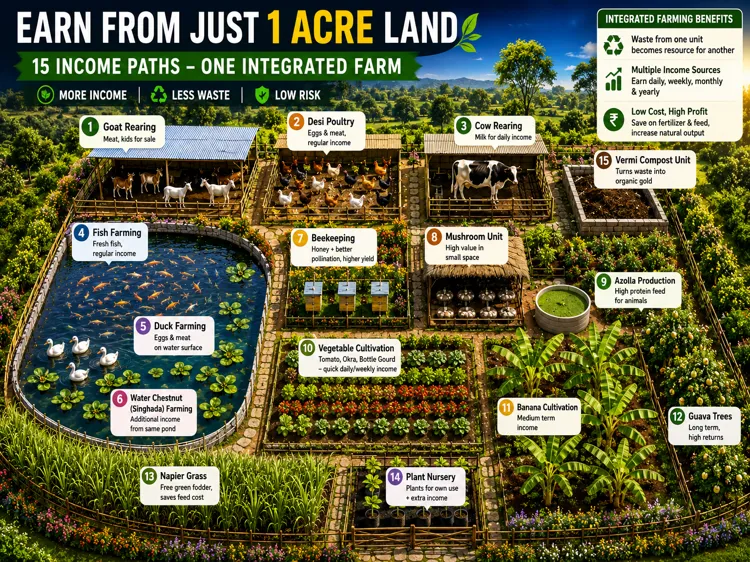
🌱 15 Ways to Earn from Just 1 Acre of Land: The Complete Master Plan
Can 15 different income sources be created from just one acre of land?
Yes. With proper planning, one acre of land can be developed into a farm where farming, livestock, fish farming, poultry farming, beekeeping, mushroom, nursery, and organic manure units work together.
This is called Integrated Farming.
The special thing about this model is that waste coming from one unit can become a resource for another unit. In other words, something that looks like waste at first can later become useful for the farm.
But one important thing must be understood. Starting 15 units on one acre does not mean starting all 15 businesses on the first day. The right approach is to start small and gradually expand the farm with experience.
🌾 1. What Are the 15 Income Sources on One Acre?
In this model, different units are connected on the same land so that the land and available resources can be used in a better way.
The 15 income sources can be understood as follows:
- 🐐 Goat Farming
- 🐔 Desi Poultry Farming
- 🐄 Cow Farming
- 🐟 Fish Farming
- 🦆 Duck Farming
- 🌰 Water Chestnut Farming
- 🐝 Beekeeping
- 🍄 Mushroom Unit
- 🌿 Azolla Production
- 🍅 Vegetable Farming
- 🍌 Banana Farming
- 🍈 Guava Trees
- 🌱 Napier Grass
- 🌿 Plant Nursery
- ♻️ Vermicompost Unit
All these units should not be seen as separate businesses. They should be understood as one complete farm system.
🔄 2. What Is Integrated Farming?
Integrated farming does not simply mean growing many things in one place.
Its real meaning is that different units of the farm are connected with each other.
For example, cow, goat, and poultry manure and organic farm waste can be sent to the vermicompost unit. Earthworms convert this material into organic manure. The same manure can then be used again for vegetables and fruits grown on the farm.
In the same way, Azolla and Napier grass can be used as feed for animals.
This means the waste from one unit becomes useful for another unit.
This is the most important part of this model—Circular Economy.
🌱 3. 15 Ways to Earn from One Acre of Land
🐐 3.1. Income from Goat Farming
A shed for goat farming can be built in one part of the one-acre farm.
Goats provide meat, and their kids can become a direct source of income as they grow.
But the benefit of goat farming is not limited to meat and kids. Goat manure and other waste are also useful for the farm.
It can be used in the vermicompost unit, and the organic manure produced from it can be used again in farming.
In this way, goat farming becomes connected with other units of the farm.
🐔 3.2. Desi Poultry Farming
A Desi Poultry Farming Unit can be created around the goat shed or according to the farm plan.
This can create a regular income source through eggs and meat.
Waste produced by chickens can also be used in the farm’s vermicompost unit.
In this way, poultry farming does not remain a separate unit. Instead, it becomes a part of the recycling system of the complete farm.
🐄 3.3. Cow Farming for Milk and Farm Resources
Cow farming can also be a part of this model for daily milk.
The cow provides milk, and its manure becomes an important resource for the farm.
The manure can be sent to the vermicompost unit to prepare organic manure. This manure can then be used again for vegetable and fruit farming.
In this way, milk from cow farming becomes one source of income, while its manure becomes useful for farming.
🐟 3.4. Fish Farming in a Pond
One of the most important parts of this complete model is the pond.
The size of the pond can be kept according to local needs.
Fish can be raised in the pond. But this pond is not limited only to fish farming.
Ducks can swim on the surface of the water, providing eggs and meat.
If the local weather is suitable, water chestnut farming can also be done in the same water.
In this way, different income sources such as fish farming, duck farming, and water chestnut farming can be created from the same pond.
🦆 3.5. Duck Farming
Duck farming on the pond is another part of this model.
Ducks can provide eggs and meat.
The special thing is that duck farming can be connected with the pond. This means there is no need for a large separate area. Instead, the available water area can be used.
🌰 3.6. Water Chestnut Farming
If the local weather is suitable for it, water chestnut farming can also be done in the pond.
This means that instead of using the pond only for fish farming, its capacity can be used in multiple ways.
This is the thinking behind integrated farming—multiple uses from one resource.
🐝 3.7. Beekeeping
Beekeeping can also be added because vegetables and flowers are available on the farm.
It provides honey.
At the same time, bees can help improve pollination of crops.
In this way, beekeeping provides honey on one side and also plays a useful role for the crops on the farm.
🍄 3.8. Small Mushroom Unit
A small mushroom unit can be started by using a suitable covered area of the farm.
The special feature of this unit is that it does not need a lot of space.
Therefore, even the small available space on a one-acre farm can be used.
🌿 3.9. Azolla Production
Azolla can be grown in a small tank as feed for animals.
Azolla can be used as animal feed.
The purpose is to use the available farm space to create an additional source of feed for animals.
🍅 3.10. Vegetable Farming: A Way to Earn Quickly
A large part of the one-acre farm can be used for three-tier crops, meaning three-level farming.
At the ground level, vegetables such as tomato, okra, and bottle gourd can be grown.
The main benefit of vegetables is that they can create a way to bring cash every day or every week.
This means that while banana and guava are for the longer term, vegetables become a comparatively quick-income part of the farm.
🍌 3.11. Banana Farming
Banana plants can be planted to use the vertical space available above the farm.
This also helps use the vertical space of the land.
Banana is a part of the medium-term income in this farm model.
In this way, vegetables create short-term income, banana creates medium-term income, and guava creates long-term income sources.
🍈 3.12. Guava Trees
Guava trees can be planted along the boundary of the farm.
This makes use of the farm boundary and creates a long-term source of income.
In this way, crops that provide income at different times are included on the same land.
🌱 3.13. Napier Grass
Napier grass can be planted along the boundaries and sides of the farm.
It can be used as green fodder for animals.
This can help reduce the cost of buying fodder from the market.
So, even if Napier grass does not directly generate income, it can still become an important unit for reducing the cost of the farm.
🌿 3.14. Plant Nursery
A small plant nursery can be prepared in a small area.
This can provide plants for the farm’s own farming needs.
In addition, extra plants can be sold to create another source of profit.
In this way, the nursery meets the farming needs and also provides an opportunity for additional income.
♻️ 3.15. Vermicompost: The Recycling Engine of the Complete Farm
One of the most important support units in this complete model is the vermicompost unit.
Cow, goat, and poultry manure, along with organic farm waste, can be sent to this unit.
Earthworms convert this material into organic manure.
The same manure can then be used again for vegetable and fruit farming.
In this way, a circular system is created on the farm:
Animals & Birds → Manure/Waste → Vermicompost → Organic Manure → Vegetables/Fruits → Farm
On the other side:
Azolla + Napier Grass → Feed for Animals
In this model, something that was waste earlier becomes a useful resource for the farm.
🗺️ 4. How to Make a One-Acre Master Plan?
The location of each unit is very important when creating the layout of a one-acre farm.
🐄 4.1. Animal Shed + ♻️ Vermicompost
The animal sheds and vermicompost unit can be placed close to each other on one side of the land.
The purpose is to reduce the need to carry manure over long distances for converting it into organic manure.
🐟 4.2. Pond in the Middle or Lower Part
The pond can be placed in the middle of the farm or in the lowest part of the land.
This can help make irrigation of the complete farm easier.
🍅 4.3. Vegetables Around the Pond and Shed
Vegetables can be grown around the pond and animal shed.
This allows the available land to be used for farming.
🍌 4.4. Use of the Boundary
Banana, guava, and Napier grass can be planted along the farm boundary.
This makes the farm boundary useful and also saves the space inside the farm for other activities.
💰 5. Will There Be a Guaranteed Income of Lakhs of Rupees from One Acre?
Here it is very important to understand one thing.
There is no guarantee of any fixed income.
Your actual income from this model will depend on many things:
- 📍 Your local market
- 📈 Local demand
- 🥬 Quality of production
- 🌦️ Weather
- 🌱 Cost of fodder
- 💼 Your management
Therefore, you should not blindly trust any fixed or guaranteed income shown on the internet.
First, it is important to find out in your area what the price of each product is and how much demand there is for it.
🛡️ 6. Biggest Benefit of 15 Units: Risk Diversification
The biggest strength of this model is risk diversification, which means dividing risk among different income sources.
Suppose the price of vegetables suddenly becomes low in a particular year.
Then you may have milk as another option.
If there is a problem in the milk business, goats and chickens can provide other income sources.
If the crop is weak, fish in the pond can help reduce the loss.
This means the farmer’s complete income does not depend only on one crop or one business.
🚜 7. Should You Start All 15 Businesses on the First Day?
Absolutely not.
This can be the biggest mistake when starting this model.
Starting all 15 units at the same time can increase the workload, management requirements, and risk.
Therefore, starting with only two or three units is a more practical approach.
For example:
🥬 Grow some vegetables
+
🐐 Start a small livestock unit
First, gain experience by working on the land.
Understand your local market.
When you start understanding both the work and the market, gradually add other units.
📈 8. Build Your Integrated Farm Gradually
One acre of land is certainly small, but with proper planning, many types of activities can be connected to it.
Vegetables can provide a quick source of income.
Banana can become a medium-term part.
Guava can become a long-term source.
Goats, chickens, and cows provide animal-based income.
Fish, ducks, and water chestnut can be added to the pond when the weather is suitable.
Beekeeping, mushroom, Azolla, nursery, and vermicompost can make small spaces useful.
The most important thing is that all these units should not be seen separately, but as one complete system.
🚜 9. Important Information for Farmers
- Murrah Buffalo: Complete Information on Milk, Diet & Rearing
- Sheep Farming in India: Breeds, Feed, Housing, Costs & Profit
- Desi Cow Farming 2026: Best Breeds & Complete Guide
- Goat Farming Loan 2026: Get Government Subsidy & Easy Finance
- Dairy & Animal Farming
- Kisan Credit Card
- PM Kisan Yojana
- Department of Animal Husbandry & Dairying (DAHD)
- National Government Services Portal
- Pests and Diseases in Crops: Definition, Significance & Impact
- Pest and Disease Control
- How to Do Organic Farming
- Benefits of Natural Farming
- How to Make Organic Vermicompost from Cow Dung in 30 Days
- Vermicompost Preparation Method
- Benefits of Drip Irrigation
- Pest and Disease Management
- Soil Health Card Scheme
❓ 10. 15 Ways to Earn from One Acre: Important FAQs
Q1. Can 15 Different Businesses Be Started on One Acre of Land?
Yes, with proper planning, 15 units such as goat farming, Desi poultry farming, cow farming, fish farming, duck farming, water chestnut farming, beekeeping, mushroom, Azolla, vegetables, banana, guava, Napier grass, plant nursery, and vermicompost can be connected in an integrated farming model. However, instead of starting all 15 units together, starting gradually is more practical.
Q2. What Is Integrated Farming?
Integrated farming is a farm model where different units work together and are connected with each other. For example, manure from cows, goats, and chickens and farm waste can be used in the vermicompost unit. The prepared organic manure can then be used again for growing vegetables and fruits. In this way, the waste from one unit becomes a resource for another unit.
Q3. Why Is a Pond Important in a One-Acre Farm?
The pond is an important unit of this model. Fish farming can be done in it. Ducks can be raised on the water surface, and if the local weather is suitable, water chestnut farming can also be done. Keeping the pond in the middle or lowest part of the land can help make farm irrigation easier.
Q4. Which Vegetables Can Be Grown on One Acre?
In the given model, vegetables such as tomato, okra, and bottle gourd can be grown at the ground level. Vegetables are part of the short-term income of this farm and can create a way to bring cash every day or every week.
Q5. How Can Goat, Cow, and Poultry Farming Be Connected with Farming?
The manure and waste produced by these animal and poultry units can be used in the vermicompost unit. Organic manure is prepared from it, which can then be used again for vegetables and fruits in the farm. In this way, livestock farming and crop farming become connected with each other.
Q6. Can Fish, Ducks, and Water Chestnut Be Raised in the Same Pond?
According to the given model, fish can be raised in the pond, ducks can be kept on the water surface, and if the local weather is suitable, water chestnut can also be grown in the same water. Therefore, instead of using the pond for only one purpose, it can be connected with multiple activities.
Q7. What Is the Benefit of a Vermicompost Unit on a One-Acre Farm?
The vermicompost unit works like the recycling engine of the complete farm. Manure from cows, goats, and chickens and organic farm waste can be put into it. Earthworms convert it into organic manure, and this manure can then be used again for growing vegetables and fruits.
Q8. Can a One-Acre Farm Guarantee an Income of Lakhs of Rupees?
No, no fixed income can be guaranteed. Actual income will depend on your local market, local demand, quality of production, weather, fodder prices, and your management. Therefore, before starting, it is important to understand prices, demand, and costs in your area through practical experience.
Q9. Should All 15 Units Be Started in the Beginning?
No. This can be a big mistake. A better approach is to start with only two or three units. For example, you can start vegetable farming and a small livestock unit. First, gain practical experience, understand the local market, and then gradually add the remaining units to the farm.
Q10. What Is the Biggest Benefit of the 15-Unit One-Acre Model?
The biggest benefit of this model is risk diversification, which means dividing risk among different income sources. If vegetable prices fall, other options such as milk, goats, poultry, or fish may be available. Similarly, if one crop performs poorly, another unit can help reduce the loss. This means the complete farm does not depend only on one crop or one business.
✅ Conclusion: Turn One Acre of Land into a Business System
One acre of land is not just a small piece of land.
With proper planning, it can become an integrated farm system where multiple income sources and support units are connected with each other.
The real strength of this model is not in putting 15 things together at the same time.
Its real strength is:
♻️ Reusing Waste
🌱 Better Use of Available Space
🐄 Connecting Livestock Farming with Crop Farming
🐟 Using Water in Multiple Ways
💰 Different Income Sources
🛡️ Dividing Risk
But always keep the beginning small.
Start with two or three units first. Gain experience. Understand the local market. Then gradually add the remaining units.
One acre of land may be small, but with proper planning, its possibilities can be very large.
If you want the complete one-acre layout, cost, and potential income detailed plan, write in the comments:
💬 “Complete One-Acre Plan”
📚 References
- Source 1 – Information related to the topic
- Source 2 – Information related to the topic