


Orange Farming: Higher Yield & Better Profit Tips
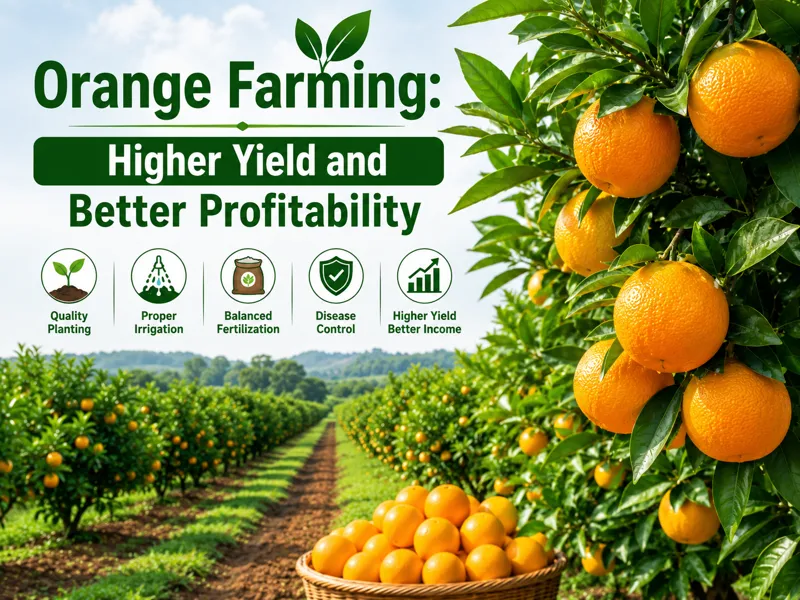
🌱 How to Do Orange Farming? Complete Information for Higher Production
Orange is an important citrus fruit crop in India. Its farming is considered one of the good income-generating crops for farmers. In India, oranges contribute around 50 percent share among citrus fruits. Its demand remains throughout the year, so farmers can earn good profit even from small land areas.
Nowadays, orange farming is increasing rapidly in many states including Rajasthan, Punjab, Himachal Pradesh, and Uttar Pradesh. By using the right variety, proper irrigation, balanced fertilizer management, and disease control, farmers can get higher production per acre.
In this article, we will understand complete information related to orange farming in simple language, so that rural farmer brothers can earn better profit by doing farming with modern methods.
1. 🍊 Introduction of Orange Crop
Orange is a juicy and nutritious fruit which people use as fresh fruit, juice, and many food products. It is considered a good source of Vitamin C. Orange has a sweet and slightly sour taste, because of which its demand always remains in the market.
In India, orange and Malta farming are done on a large scale. Orange is a long-term productive horticulture plant, so it can become a good source of permanent income for farmers.
Major Features of Orange Farming
🔸 More income in less area
🔸 Good market demand
🔸 Used in juice industry
🔸 Long-term production
🔸 Export possibility
2. 💪 Benefits and Uses of Eating Orange
2.1. Health Benefits
Orange is considered a very beneficial fruit for health.
Main Benefits
✅ Increases body immunity power
✅ Fulfills Vitamin C requirement
✅ Helps keep skin healthy
✅ Useful for improving digestion
✅ Removes water deficiency in the body
✅ Gives freshness during summer season
2.2. Uses of Orange
Domestic Uses
🔸 As fresh fruit
🔸 For making juice
🔸 In salad
🔸 In sweets
Industrial Uses
🔸 Juice factory
🔸 Flavor industry
🔸 Food processing
🔸 Cosmetic products
3. 📘 Scientific Classification of Orange
| Classification | Information |
|---|---|
| Common Name | Orange |
| Scientific Name | Citrus reticulata |
| Family | Rutaceae |
| Crop Type | Fruit Tree |
| Plant Nature | Evergreen |
👉 Click here for detailed information
4. 🌦️ Climate and Temperature for Orange Farming
Moderate climate is considered best for orange farming.
4.1. Temperature
| Work | Temperature |
|---|---|
| Normal Growth | 10°C to 30°C |
| Sowing Temperature | 10°C to 25°C |
| Harvest Time Temperature | 30°C to 34°C |
4.2. Rainfall
Around 500 to 600 mm rainfall is considered suitable for orange farming.
4.3. Suitable Season
Right Time for Plantation
✅ February to March
✅ August to October
5. 🌱 Soil Information for Orange Farming
Orange farming can be done in many types of soils, but light loamy soil is considered best.
5.1. Soil Features
🔸 Well-drained soil
🔸 Soil rich in organic matter
🔸 Light loamy land
🔸 Water should not collect in the field
5.2. Soil pH
For orange farming, pH 6.0 to 8.0 is considered suitable.
5.3. Important Points While Selecting Field
✅ Do not select waterlogged land
✅ Avoid alkaline soil
✅ Irrigation facility should be available in the field
6. 🍊 Improved Varieties and Plant Information of Orange
Selection of the right variety is very important for higher production and better quality.
6.1. Khasi Variety
This variety is mainly grown in Assam and Meghalaya. Its fruits are orange-yellow in color. It contains 9 to 25 seeds.
6.2. Kinnow Variety
This is one of the most popular commercial varieties. Its fruits are juicy and attractive. Fruits ripen from January to February.
Features
✅ More juicy
✅ Higher market demand
✅ Better production
6.3. Coorg Variety
The fruits of this variety are bright orange in color and can be peeled easily.
6.4. Nagpur Variety
This is a very famous variety. Its fruits are medium-sized and more juicy.
6.5. Other Major Varieties
🔸 Mudkhed
🔸 Shrinagar
🔸 Butwal
🔸 Dancy
🔸 Kara Abohar
🔸 Darjeeling
🔸 Sumithra
🔸 Seedless 182
7. 🌿 Seed Rate and Plant Population
In orange farming, around 110 plants per acre density should be maintained.
7.1. Why is Plant Population Important?
✅ Plants get sufficient nutrition
✅ Air flow among plants remains good
✅ Diseases are reduced
✅ Production increases
8. 🛒 Where to Buy Orange Plants?
Farmers should always buy certified and healthy plants only.
Sources for Buying Plants
🔸 Government nursery
🔸 Agricultural university
🔸 Horticulture department
🔸 Certified private nursery
Important Points While Buying Plants
✅ Take disease-free plants
✅ Take plants of equal size
✅ Root development should be good
9. 🚜 Field Preparation
For good orange farming, field preparation is very important.
9.1. Process of Field Preparation
First Ploughing
Do deep ploughing with soil turning plough.
Second Ploughing
Do cross ploughing and make the soil soft and loose.
Preparing Pits
Dig pits of 1×1×1 meter size.
Filling in the Pits
Add the following in each pit:
✅ 15 to 20 kg farmyard manure
✅ 500 gram single super phosphate
10. 🌱 Orange Sowing and Plantation Method
10.1. Plantation Time
In Punjab and many other regions, plantation is done during the following time:
✅ February to March
✅ August to October
10.2. Distance Between Plants
For sweet orange, maintain 5×5 meter distance.
10.3. Depth
Dig pits of 1×1×1 meter size.
11. 🌿 Propagation of Orange
11.1. Propagation by Seed
Seeds are taken from healthy plants and sown. Germination takes around 3 to 4 weeks.
Main Points
✅ Select healthy fruits
✅ Dry the seeds in shade
✅ Sow at 3 to 4 cm depth
11.2. Budding Method
T-budding is a very popular method in orange farming.
Budding Time
✅ February to March
✅ August to September
12. ✂️ Pruning and Trimming Management
Pruning of new plants is very important. It helps in giving proper shape to the plants.
12.1. Benefits of Pruning
✅ Good quality fruits
✅ Disease control
✅ Balanced plant growth
✅ Higher production
12.2. While Doing Pruning
🔸 Remove dry branches
🔸 Cut diseased branches
🔸 Remove lower branches
13. 🧪 Manure and Fertilizer Management
Balanced fertilizer is very important in orange crop.
13.1. For 1 to 3 Year Old Plants
| Fertilizer | Quantity Per Plant |
|---|---|
| Farmyard Manure | 10 to 30 kg |
| Urea | 240 to 720 gram |
13.2. For 4 to 7 Year Old Plants
| Fertilizer | Quantity |
|---|---|
| Farmyard Manure | 40 to 80 kg |
| Urea | 960 to 1680 gram |
| SSP | 1375 to 2400 gram |
13.3. For Plants More Than 8 Years Old
| Fertilizer | Quantity |
|---|---|
| Farmyard Manure | 100 kg |
| Urea | 1920 gram |
| SSP | 2750 gram |
13.4. Right Time for Applying Fertilizers
✅ Farmyard manure in December
✅ Urea in February and April-May
✅ SSP with first dose of urea
14. 💧 Irrigation Management
Orange is an evergreen plant, so it needs regular irrigation.
14.1. Important Irrigation Time
✅ During flowering stage
✅ During fruit setting stage
✅ During fruit development stage
14.2. Important Points to Remember
🔸 Do not allow waterlogging
🔸 Use salt-free water
15. 🌾 Weed Control
- Weeds take away nutrients from the plants.
Control Methods
Hand Weeding
- Do hoeing from time to time.
Chemical Control
- Spray Glyphosate 1.6 liter mixed in 150 liter water.
Precaution
⚠️ Do not spray on the main crop.
16. 🐛 Pest and Disease Management
16.1. Citrus Psylla
This is a sap-sucking insect.
Control
✅ Cut affected branches
✅ Spray Monocrotophos 0.025%
16.2. Leaf Miner Insect
This insect curls the leaves.
Control
✅ Pheromone trap
✅ Spray Phosphamidon
16.3. Scale Insect
This insect sucks the sap of the plant.
Control
✅ Neem oil spray
✅ Dimethoate spray
16.4. Stem Borer
The larvae damage the branches.
Control
✅ Destroy affected branches
✅ Spray Monocrotophos
16.5. Aphid and Mealy Bug
These insects suck the sap of leaves.
Control
✅ Insecticidal oil
✅ Pyrethroids
17. 🦠 Disease Management
17.1. Citrus Canker
Brown spots appear on leaves and fruits.
Control
✅ Remove infected branches
✅ Spray Bordeaux 1%
17.2. Gummosis Disease
In this disease, gum comes out from the bark.
Control
✅ Maintain proper drainage
✅ Use Trichoderma
17.3. Leaf Spot Disease
Leaves become yellow and curl.
Control
✅ Remove affected parts
✅ Spray Carbendazim
17.4. Black Spot Disease
This is a fungal disease.
Control
✅ Spray on time
17.5. Root Rot
This is a fungal disease.
Control
✅ Copper spray
✅ Maintain proper drainage
18. ⚠️ Nutrient Deficiency
18.1. Zinc Deficiency
Yellowing appears in leaves.
Solution
✅ Spray Zinc Sulphate
18.2. Iron Deficiency
New leaves become yellow-green.
Solution
✅ Apply Iron Chelate
19. ⏳ Crop Duration
According to the variety of orange, fruits ripen from January to March.
20. 🍊 Harvesting Method
Harvest the fruits when proper color and sweetness develop.
Important Points During Harvesting
✅ Harvest on time
✅ Do not delay too much
✅ Do not damage the fruits
21. 📦 Post Harvest Management and Storage
After harvesting, wash the fruits with clean water.
21.1. Storage Process
Process
✅ Dip in chlorinated water
✅ Dry in shade
✅ Apply wax coating
✅ Pack in boxes
21.2. Benefits of Storage
🔸 Fruits remain safe for a longer time
🔸 Better market price is received
22. 📈 Production Per Acre
By taking good care of orange crop, farmers can get good production. Production depends on variety, plant population, irrigation, and fertilizer management.
Ways to Increase Production
✅ Select improved varieties
✅ Apply fertilizers on time
✅ Control diseases
✅ Do proper irrigation
23. 💰 Cost and Profit Per Acre
Orange farming is a long-term income-generating crop.
Factors Affecting Income
🔸 Market price
🔸 Fruit quality
🔸 Variety
🔸 Production capacity
Ways for Better Profit
✅ Direct mandi sale
✅ Grading and packing
✅ Sale to juice industry
24. 🏷️ Information About MSP (Minimum Support Price)
Orange is a horticulture crop. Generally, MSP is not fixed for this crop. Farmers get market-based prices.
What Should Farmers Do?
✅ Check local mandi prices
✅ Do direct selling
✅ Join Farmer Producer Organization
25. 🏛️ Government Schemes
Orange producing farmers can take benefits of various government schemes.
Major Benefits
✅ Plant distribution
✅ Drip irrigation subsidy
✅ Horticulture support
✅ Training programs
Where to Contact?
🔸 Agriculture Department
🔸 Horticulture Department
🔸 Krishi Vigyan Kendra
26. 📜 Is Government Permission Required for Orange Farming?
Generally, no special government permission is required for orange farming.
But Keep These Things in Mind
✅ Use certified plants
✅ If exporting, quality standards may be required
✅ Take advice from the local agriculture department
27. ❓ Important FAQ Related to Orange Farming
Q1. What is the right time for orange plantation?
February to March and August to October are considered the best time.
Q2. How many plants are planted per acre?
Around 110 plants are planted per acre.
Q3. Which soil is good for orange farming?
Light loamy soil with pH 6 to 8.
Q4. Which variety is the most popular?
Kinnow and Nagpur varieties are very popular.
Q5. When should irrigation be done in orange farming?
Irrigation is necessary during flowering, fruit setting, and fruit development stage.
Q6. How to remove zinc deficiency?
Spray Zinc Sulphate.
Q7. How to prevent fruit dropping?
2,4 D or GA3 spray can be useful.
Q8. Which major disease affects orange crop?
Citrus canker is one of the major diseases.
Q9. When should harvesting be done?
From January to February when proper color and sweetness develop.
Q10. What should be done after harvesting?
Wash the fruits, dry them, and pack in boxes.
🌟 Conclusion
Orange farming can become a profitable horticulture business for farmers. By selecting the right variety, doing timely irrigation, balanced fertilizer management, and disease control, farmers can get higher production. Due to continuous market demand for oranges, long-term stable income can be earned from its farming.
If farmers adopt modern techniques and scientific methods, better quality fruits and higher income per acre are possible. Therefore, orange farming has become a strong and profitable option in today’s time. 🍊🌱
👉 For more fruits farming guides, keep exploring our website