


Murrah Buffalo: Complete Information on Milk, Diet & Rearing
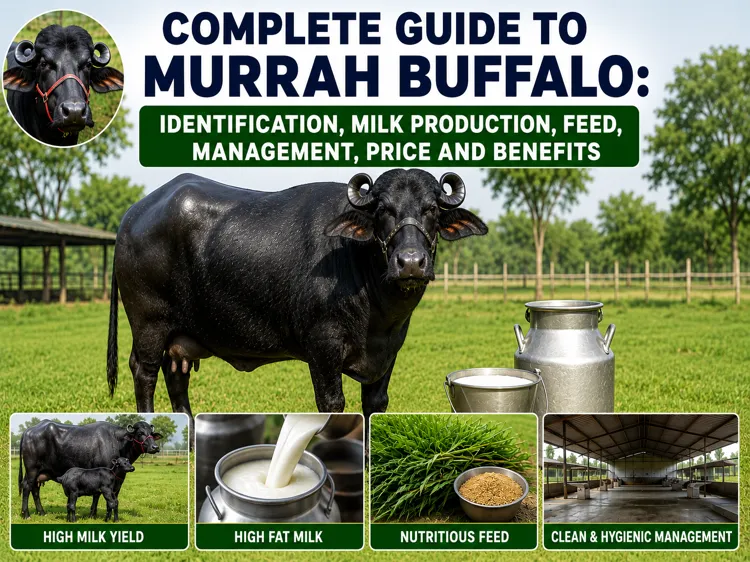
🐃 Murrah Buffalo: Identification, Milk Production, Diet, Rearing, Price and Benefits
Murrah buffalo is one of the most famous and important dairy buffalo breeds in India. It is mainly known for its good milk production capacity, relatively high fat content in milk, and strong body. The native area of the Murrah buffalo is mainly considered to be around Haryana and Delhi, but today it is reared in many states across the country.
For farmers starting a dairy business, the Murrah buffalo can be an attractive option. However, simply buying a Murrah breed animal does not guarantee higher milk production or higher profit. The animal’s genetic potential, diet, health, reproduction, housing, water, and farmer’s care directly affect milk production.
This article provides detailed information about the identification, native area, milk production, milk fat, first calving, diet, summer care, vaccination, reproduction, price, precautions while buying, and usefulness of Murrah buffalo in dairy farming.
Important Fact: There is no single fixed milk production figure that applies to all Murrah buffaloes. According to the Indian Council of Agricultural Research–Central Institute for Research on Buffaloes, around 2,000 kg of milk production in 305 days is reported, while data from the National Dairy Development Board reports an average of around 1,752 kg. Production can vary significantly among individual animals.
🐃 1. What is a Murrah Buffalo?
Murrah is one of the major dairy buffalo breeds of India. It is especially famous for milk production and good fat content in milk.
According to the Indian Council of Agricultural Research–Central Institute for Research on Buffaloes, Hisar, the main area of the Murrah breed is central Haryana and the area around Delhi. According to the National Dairy Development Board, its native area includes Hisar, Rohtak, Gurugram, and Jind districts of Haryana and the Delhi region.
The most important identification features of a Murrah buffalo are its deep black colour and short, tightly curled horns. Its body is strong and well developed.
The importance of the Murrah buffalo in India is not limited to milk production. The Murrah breed has also been widely used for breeding better animals and for genetic improvement.
🔎 2. How to Identify a Murrah Buffalo?
Correct identification is very important when buying a good Murrah buffalo. A buffalo should not be considered a pure Murrah only by looking at its black colour.
The main physical characteristics of a Murrah buffalo are as follows:
- The body colour is generally deep or jet black.
- The body is long and strong.
- The body structure is heavy and well developed.
- The horns are short and tightly curled.
- The tail is long.
- White hair may be visible at the end of the tail.
- The head and neck are well developed.
- In a dairy animal, the udder should be well developed.
- The animal should have a normal and healthy walk.
According to the Indian Council of Agricultural Research–Central Institute for Research on Buffaloes, the Murrah has a jet-black colour, a long and heavy body, and short, tightly curled horns.
Why Should You Not Buy a Murrah Only by Its Colour?
Many local or crossbred buffaloes can also have a black colour. Therefore, it is not correct to consider an animal a pure Murrah only by looking at its colour and horns.
If the animal is expensive, always check its milk production record, mother’s milk production, breeding history, health records, and available breed-related information.
🥛 3. How Much Milk Does a Murrah Buffalo Produce?
The most commonly asked question about a Murrah buffalo is how much milk it gives per day.
There is no single fixed answer to this.
Milk production is affected by the animal’s genetic potential, number of calvings, time after calving, diet, health, and weather.
According to the Murrah breed information from the Indian Council of Agricultural Research–Central Institute for Research on Buffaloes, around 300 days of lactation period and about 2,000 kg of milk production in 305 days are reported.
On the other hand, according to the National Dairy Development Board, the average milk production of a Murrah buffalo is around 1,752 kg, with a reported range of about 1,003 to 2,057 kg.
This difference may be due to different animal groups, management practices, and study conditions.
Therefore, it is not correct to say that every Murrah buffalo gives 10, 12, or 15 litres of milk per day.
What Factors Affect Milk Production?
The major factors that affect milk production in a Murrah buffalo are:
- Genetic potential of the animal
- Milk production of the parents
- Age of the animal
- Number of calvings
- Balanced diet
- Green fodder
- Dry fodder
- Concentrate feed
- Mineral mixture
- Adequate water
- Protection from heat
- Protection from diseases
- Proper breeding management
- Cleanliness
Therefore, while buying an animal, a farmer should not make a decision simply by hearing, “This is a Murrah.” The actual production record is more important.
🧈 4. How Much Fat is Present in Murrah Buffalo Milk?
Murrah buffalo milk is famous for its higher fat content.
According to available livestock improvement data from the Indian Council of Agricultural Research, the average fat content in Murrah buffalo milk is around 7.88 percent.
However, this is not a fixed fat percentage for every individual buffalo. Fat content can change depending on the animal, diet, stage of lactation, and other conditions.
If a farmer’s milk is purchased based on fat content, higher-fat milk can be economically beneficial.
For this reason, Murrah buffalo milk has special importance in the dairy business.
🐄 5. When Does a Murrah Buffalo Give Birth for the First Time?
According to Murrah breed data from the Indian Council of Agricultural Research–Central Institute for Research on Buffaloes, the average age at first calving is around 44 months.
However, due to good growth, balanced nutrition, and scientific rearing practices, some animals may have their first calving earlier than this.
According to the National Dairy Development Board, good care and balanced nutrition can improve the growth and age at first calving of buffaloes.
Therefore, for a heifer, not only age but also its body condition, weight, growth, and reproductive health are important.
⏱️ 6. Murrah Buffalo Calving Interval
Calving interval means the time between one calving and the next calving.
According to the Murrah breed data from the Central Institute for Research on Buffaloes, an average calving interval of about 453 days has been reported.
Regular reproduction is very important for a dairy farmer because if the animal does not become pregnant for a long time, milk production and economic benefits can be affected.
For this, the farmer should:
- Identify heat on time.
- Get artificial insemination done at the proper time.
- Maintain good nutrition of the animal.
- Protect the animal from reproductive diseases.
- If the animal repeatedly fails to become pregnant, get it examined by a veterinarian.
🌱 7. How to Manage the Diet of a Murrah Buffalo?
To get a good quantity of milk from a Murrah buffalo, only giving more concentrate feed is not enough. Its diet should have a proper balance of green fodder, dry fodder, grain or concentrate feed, mineral mixture, salt, and sufficient clean water. The actual requirement of the animal changes according to its body weight, milk production, milk fat, age, pregnancy, and health. According to the National Dairy Development Board, an unbalanced diet can reduce milk production, increase the cost of milk production, and also affect the health and reproduction of the animal.
What Should Be Included in the Diet of a Murrah Buffalo?
The daily diet of a Murrah buffalo can mainly be understood in these parts:
- Green fodder
- Dry fodder
- Grain or concentrate feed
- Mineral mixture and salt
- Clean and sufficient water
All these should be balanced according to the requirement of the animal.
7.1. Green Fodder
Green fodder is an important part of the diet of a Murrah buffalo. According to the Central Institute for Research on Buffaloes, in the native area of the Murrah breed, green fodders such as berseem, oats, and mustard are fed during the Rabi season, while bajra, sorghum, and guar are used during the Kharif season. Depending on the availability of fodder, farmers can use suitable fodder available locally.
According to the general recommendation of the National Dairy Development Board, a normal adult dairy animal can be given about 15–20 kg of green fodder and about 6 kg of dry fodder per day. However, this is not a fixed quantity for every Murrah buffalo; animals producing more milk may have different total feed requirements.
The National Dairy Development Board generally recommends maintaining about a 1:3 ratio of legume and non-legume fodders in green fodder.
Keep in mind: The quantity of green fodder also changes according to its dry matter content. For example, fresh berseem and dry fodder may have the same weight, but their water content can be very different. Therefore, nutrition should not be compared only by looking at kilograms. The Central Institute for Research on Buffaloes also considers the dry matter content of fodder in its feeding guidelines.
7.2. Dry Fodder
Dry fodder is an important source of fibre in the animal’s diet. Farmers can use wheat straw, paddy straw, and other suitable dry fodders available locally.
According to the Central Institute for Research on Buffaloes, during periods of fodder shortage, Murrah buffaloes are given wheat and pulse straw along with oil cakes and other concentrate feeds.
It is useful to cut dry fodder before feeding it. According to the National Dairy Development Board, chopping fodder before feeding can help reduce fodder wastage and improve digestibility.
7.3. Grain or Concentrate Feed
For a milking Murrah buffalo, concentrate feed can be an important source of energy and protein. Depending on the animal’s requirement, it may include grains, bran, oil cakes, and other nutritious ingredients.
But the quantity of concentrate feed should not be decided only because the animal is a “Murrah buffalo.”
For example, the nutritional requirement of a buffalo giving 5 litres of milk and a buffalo giving 10 litres of milk will not be the same.
The National Dairy Development Board provides different feed combinations as examples for buffaloes producing 5 litres and 10 litres of milk per day. For a buffalo producing 10 litres of milk, the examples include different combinations such as about 7 kg dry fodder, 5–15 kg green fodder, and 6–7 kg cattle feed. These are example rations and not fixed daily quantities for every Murrah buffalo.
Therefore, practically, the farmer should prepare a balanced ration according to the animal’s milk production and the available fodder.
7.4. Mineral Mixture and Salt
Mineral mixture should not be ignored. Calcium, phosphorus, and other essential minerals are important for the animal’s body, milk production, and reproduction.
According to the National Dairy Development Board, a region-specific mineral mixture should be included in the animal’s ration.
The Central Institute for Research on Buffaloes also recommends giving good-quality mineral mixture to all animals and provides information that its quantity should be decided based on total dry matter intake.
Therefore, it is not correct to give every Murrah buffalo the same fixed quantity of mineral mixture. It is better to decide the quantity according to the local mineral mixture and the actual nutritional requirement of the animal.
7.5. Clean Water
Water is the most important but often ignored part of a Murrah buffalo’s diet.
According to the Central Institute for Research on Buffaloes, water requirements change according to diet, milk production, weather, and other conditions, and buffaloes should get an opportunity to drink water at least three times a day.
According to the National Dairy Development Board, a normal adult animal may require about 70–80 litres of water per day, and water requirements also increase as milk production increases. The requirement may be even higher during the summer season.
Therefore, the better arrangement is to keep clean and drinkable water available to the buffalo at all times.
🌱 8. Why is a Balanced Diet Important?
Many farmers increase concentrate feed when milk production decreases. But this is not always the right solution.
The objective of the National Dairy Development Board’s balanced diet programme is to maintain a proper balance of nutrients, including energy, protein, and minerals, according to the animal’s requirements.
A balanced diet can:
- Improve milk production.
- Improve milk quality.
- Reduce unnecessary feed costs.
- Help maintain better body condition of the animal.
- Improve reproductive performance.
- Help maintain better animal health.
Therefore, a dairy farmer should learn not to “feed more” but to provide the right quantity and a balanced diet.
☀️ 9. Summer Care of Murrah Buffalo
The summer season can be challenging for buffaloes. Buffaloes have a limited ability to remove heat from their body, and heat stress can increase under conditions of high temperature and humidity.
Because Murrah buffaloes have a dark skin and hair colour, additional management for protection from heat can be useful.
Follow These Measures During Summer
- Keep the animal in a shady place.
- Protect it from strong afternoon sunlight.
- Keep sufficient clean water available.
- Ensure proper air movement in the animal shed.
- Arrange water cooling when required.
- Do not keep the animal tied directly under sunlight for a long time.
- Monitor the animal’s feed intake and water intake during summer.
According to the Central Institute for Research on Buffaloes, very high temperature, high humidity, and poor air movement can increase heat stress in buffaloes.
🏠 10. What Should a Shed Be Like for a Murrah Buffalo?
A good animal shed should have the following facilities:
- Sufficient shade
- Good air circulation
- Clean and dry floor
- Sufficient space
- Clean water arrangement
- Regular cleaning of dung and urine
- Protection from rain
- Cooling arrangements during summer
If the animal shed is too closed, heat and humidity can increase.
On the other hand, in a very open and unprotected place, there can be problems due to rain, cold, and other weather conditions.
Therefore, the animal shed should be constructed according to the local weather conditions.
💉 11. Vaccination of Murrah Buffalo
Vaccination is very important for preventing diseases in dairy animals.
According to the available vaccination schedule of the National Dairy Development Board, vaccination is done in cows and buffaloes for various diseases.
Major diseases include:
- Foot and Mouth Disease
- Haemorrhagic Septicaemia
- Black Quarter
- Brucellosis
- Other infectious diseases in specific areas
According to the programme of the National Dairy Development Board, vaccination for Foot and Mouth Disease is done at the prescribed intervals. Brucellosis vaccination is also important in female calves.
The final vaccination schedule should be according to the advice of the Animal Husbandry Department applicable in your state and area.
What Should the Farmer Do?
Make a health record for the animal and write down:
- Vaccination date
- Name of the vaccine
- Date of the next dose
- Date of deworming medicine
- Date of insemination
- Calving date
- Milk production
This will help maintain a complete record of the animal.
🐄 12. What Should You Check While Buying a Murrah Buffalo?
If you are buying a Murrah buffalo for a dairy business, do not make a decision in a hurry.
12.1. Check the Milk Yourself Before Buying
If possible, get the animal milked yourself and check the milk production.
Do not depend only on the milk production told by the seller.
12.2. Check the Previous Milk Production Record
Find out how much milk the animal produced during its previous lactation.
12.3. Check the Mother’s Record
If available, information about the mother’s milk production is also important.
12.4. Check the Udder
The udder should be healthy and normal.
Milk flow from all four teats should be proper.
12.5. Check the Animal’s Walking
Watch the animal while it is walking. Lameness or leg problems may cause problems in the future.
12.6. Check the Age
Do not depend only on what the seller says about the age. The age can also be estimated from available records and the condition of the teeth.
12.7. Ask About the Breeding History
Ask:
- How many times has it calved?
- When did it calve last?
- When was the last insemination done?
- Is it pregnant or not?
- Was there any problem during previous pregnancies?
12.8. Check the Health Record
Ask about the vaccination and disease history.
12.9. Check the Fat Content of Milk
When buying an expensive animal, if possible, get the fat content of the milk tested.
12.10. Get the Animal Examined by a Veterinarian
Before buying an expensive animal, getting it examined by a veterinarian for health and reproductive-related conditions is the safest option.
🐃 13. Is It Correct to Consider Only a Black Buffalo as a Murrah?
No.
This is a very important point.
Being a black buffalo is not proof that it is a Murrah.
For identifying a Murrah, things such as:
- Body size
- Horns
- Body colour
- Tail
- Breed characteristics
- Production record
- Breeding record
- Available pedigree
should be considered.
If someone is selling an animal by saying only, “It is black, so it is a pure Murrah,” the farmer should be careful.
💰 14. What is the Price of a Murrah Buffalo?
There is no single fixed price for a Murrah buffalo that applies throughout India.
The price of an animal depends on many factors:
- Age
- Milk production
- Number of calvings
- Current lactation stage
- Pregnancy
- Fat content in milk
- Health
- Breeding history
- Genetic quality
- Pedigree
- Local market
- Region
- Seller
A buffalo with high production and good records can cost much more than a normal Murrah buffalo.
Therefore, it is not correct to consider any single price mentioned on the internet as the fixed price of a Murrah buffalo throughout India.
Do Not Look Only at the Price While Buying an Animal
A cheaper animal is not always profitable.
If a buffalo is available at a low price but has low milk production, reproductive problems, or poor health, its future expenses may be higher.
Similarly, an expensive animal can be a suitable investment only when its production and health-related claims are verified through records.
❤️ 15. Benefits of Murrah Buffalo Rearing
15.1. Good Milk Production Capacity
Murrah is one of the important dairy buffalo breeds of India.
15.2. Higher Fat Content in Milk
Murrah milk has good fat content, which makes it important for the dairy business.
15.3. Useful for Dairy Business
With proper diet and management, Murrah buffalo can be useful for commercial dairy farming.
15.4. Importance in Genetic Improvement
In India, work has been carried out for a long time for the genetic improvement and better breeding of Murrah buffaloes.
15.5. Availability in Many Areas
The Murrah breed has spread outside its native area, and animals of this breed are found in many states across the country.
⚠️ 16. Challenges of Murrah Buffalo Rearing
Murrah buffalo is a good breed, but this does not mean that every farmer will automatically get higher profit from it.
The main challenges are:
- Purchase cost of a good-quality animal
- Fodder cost
- Care during summer
- Veterinary expenses
- Reproductive problems
- Changes in the market price of milk
- Dry period
- Rearing of calves and heifers
- Cost of the animal shed
- Labour cost
Therefore, before buying a Murrah buffalo, the farmer should prepare a complete financial calculation.
💰 17. How Much Profit Can Be Earned from a Murrah Buffalo in Dairy Business?
No fixed amount of profit can be stated.
Understand it like this:
Daily income from milk = Total milk × Selling price
After this:
Daily net profit = Income from milk − Fodder cost − Labour − Veterinary expenses − Water/Electricity − Other expenses
In addition, the purchase price of the animal, value of the heifer, time between calvings, and dry period should also be included in the calculation for the full year.
The biggest mistake is that the farmer calculates profit only by looking at the maximum milk production.
The correct calculation should be based on production and expenses for the entire year.
🐃 18. Why is Murrah Heifer Rearing Important?
A good Murrah heifer can be an important asset for a dairy farm in the future.
According to the calf-rearing programme of the National Dairy Development Board, scientific nutrition and proper care can improve the growth, health, and age at first calving of heifers.
Pay attention to the following points while rearing a heifer:
- Proper care immediately after birth
- Sufficient and appropriate quantity of colostrum
- Clean water
- Proper nutrition
- Timely vaccination
- Deworming programme
- Adequate growth
- Clean housing
Proper rearing of a good heifer can help increase the productivity of the entire dairy herd in the future.
🐄 19. Reproductive Management in Murrah Buffalo
Reproduction is very important in the dairy business.
If the animal does not become pregnant on time, its productive life can be affected.
The farmer should:
- Identify the signs of heat.
- Get artificial insemination done at the right time.
- Maintain good body condition of the animal.
- Provide sufficient nutrition.
- Contact a veterinarian immediately if there is any reproductive disease.
- Maintain records of all reproductive events.
The purpose of good reproductive management is not only to achieve pregnancy, but also to get a healthy calf and regular calving.
🥛 20. Is Murrah Buffalo Milk Better Than Cow Milk?
The answer depends on the individual’s requirement.
According to the National Dairy Development Board, buffalo milk generally contains higher amounts of fat, total solids, protein, casein, lactose, and ash compared to cow milk.
Therefore, buffalo milk has different characteristics because of its nutritional composition.
However, which milk is suitable for a person depends on their individual dietary requirements.
Therefore, it is not appropriate to say that any milk is the “best” for everyone based only on the breed.
🚜 21. Important Information for Farmers
- Sheep Farming in India: Breeds, Feed, Housing, Costs & Profit
- Desi Cow Farming 2026: Best Breeds & Complete Guide
- Goat Farming Loan 2026: Get Government Subsidy & Easy Finance
- Dairy & Animal Farming
- Kisan Credit Card
- PM Kisan Yojana
- Department of Animal Husbandry & Dairying (DAHD)
- National Government Services Portal
❓ 22. Important Questions Related to Murrah Buffalo
Q1. Which State is the Murrah Buffalo Breed From?
The main native area of the Murrah is considered to be around Haryana and Delhi.
Q2. What is the Colour of a Murrah Buffalo?
Usually, its colour is deep or jet black.
Q3. What is the Main Identification of a Murrah Buffalo?
Its deep black colour, strong body, and short, tightly curled horns are its main identification features.
Q4. How Much Milk Does a Murrah Buffalo Give?
Its production varies according to the animal and management. According to the data from the Central Institute for Research on Buffaloes, about 2,000 kg of milk production in 305 days has been reported.
Q5. Does Every Murrah Buffalo Give 10 Litres of Milk?
No. Milk production is different for every animal.
Q6. How Much Fat is Present in Murrah Buffalo Milk?
According to the available data from the Indian Council of Agricultural Research, average fat content of about 7.88 percent has been recorded.
Q7. When Does a Murrah Buffalo Give Birth for the First Time?
According to the data from the Central Institute for Research on Buffaloes, the average age at first calving is about 44 months.
Q8. How Should a Murrah Buffalo Be Kept During Summer?
Provide shade, clean water, good air circulation, and cooling arrangements when required.
Q9. Is Every Black Buffalo a Murrah?
No. The breed cannot be identified only on the basis of colour.
Q10. What is the Price of a Murrah Buffalo?
The price changes according to the animal’s age, milk production, health, pregnancy, pedigree, and local market.
Q11. Is a Murrah Buffalo Good for Dairy Farming?
A Murrah buffalo with good genetic potential and proper management is useful for dairy farming.
Q12. What Should Be Fed to a Murrah Buffalo?
A balanced combination of green fodder, dry fodder, concentrate feed as required, mineral mixture, and sufficient clean water should be provided.
Q13. Is Vaccination Necessary for a Murrah Buffalo?
Yes. The prescribed vaccination schedule should be followed for disease prevention.
Q14. What is the Most Important Thing to Check While Buying a Murrah Buffalo?
Check the actual milk production record, health, udder, legs, age, breeding history, and available pedigree.
Q15. Is an Expensive Murrah Buffalo Always Better?
No. The animal’s actual production capacity, health, and breeding record are more important than its price.
✅ Conclusion
Murrah buffalo is one of the major dairy buffalo breeds of India and is an important animal for dairy farmers. Its main native area is considered to be around Haryana and Delhi. Its deep black colour, strong body, and short, tightly curled horns are its main identification features.
Murrah buffalo is known for good milk production capacity and higher fat content in milk. However, the milk production of every Murrah buffalo is not the same. The available data from the Indian Council of Agricultural Research–Central Institute for Research on Buffaloes and the National Dairy Development Board also show differences in average production.
Therefore, while buying a Murrah buffalo, farmers should not look only at the breed name, colour, or external appearance.
While selecting a good dairy animal, give the most attention to:
Good genetic potential + Actual milk record + Healthy udder + Good health + Proper breeding history + Balanced diet + Sufficient water + Protection from heat + Vaccination + Regular veterinary care.
If the farmer pays attention to all these aspects, a Murrah buffalo can become a useful and productive animal for the dairy business.
Major Sources
The important data and scientific facts in this article have been presented after referring to the following reliable sources:
- Indian Council of Agricultural Research–Central Institute for Research on Buffaloes, Hisar – Characteristics of the Murrah breed, milk production, and reproductive-related data.
- National Dairy Development Board – Information related to the Murrah breed, animal nutrition, balanced diet, and vaccination.
- Research Publications of the Indian Council of Agricultural Research – Scientific data related to milk production, fat, and reproduction of Murrah buffaloes.
- Department of Animal Husbandry and Dairying, Government of India – Guidelines related to animal disease control and vaccination.
- Central Institute for Research on Buffaloes Buffalo Knowledge Portal – Information related to heat stress and animal shed management.