


How to Grow Buckwheat: A Low-Cost Crop for Good Income
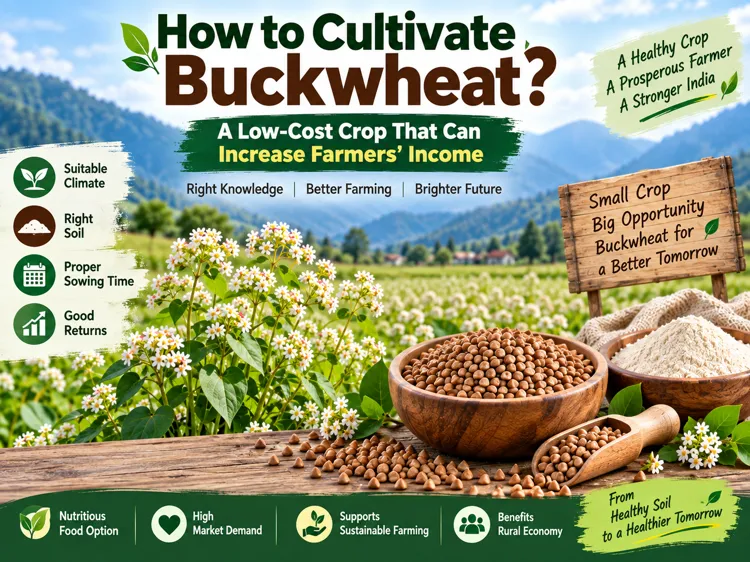
How to Grow Buckwheat? A Low-Cost Crop That Can Be a Good Source of Income
Buckwheat farming can be a good income option for farmers if the right season, suitable soil and proper farming methods are followed. Know the right time for buckwheat farming, soil, seeds, varieties, irrigation, harvesting and complete information about yield.
For a farmer, his land is not just a piece of soil. The hopes of his family are connected with that land. The education of children, household expenses and dreams for the future are supported by the same farm. That is why every farmer wants to grow such crops in which he gets the right value for his hard work and the farming cost also remains under control.
But farming is not as easy today as it used to be. Sometimes the weather does not support the farmer, sometimes the rain does not come on time, sometimes market prices become low, and sometimes the cost of farming increases so much that very little saving is left with the farmer. In such a situation, it becomes important for farmers to think about some crops that have different demand in the market along with traditional crops.
Buckwheat farming is also one such crop.
Buckwheat is generally known as flour used during fasting. But very few people know that buckwheat is not only a flour used during fasting. Many types of food products are made from its seeds and there is demand for it in different areas.
So, let us understand in simple language how buckwheat is grown and how farmers can add a new option to their farming through this crop.
🌾 1. What is Buckwheat?
Buckwheat is a flowering plant. It is known by different names in different regions. It is also known as Tau, Ogla, Fafad and Buckwheat.
In India, buckwheat is mainly grown in hilly and some plain areas. Examples of its cultivation can be found in states such as Uttarakhand, Himachal Pradesh, Assam, Sikkim, Jammu and Kashmir, Chhattisgarh and Uttar Pradesh.
The most famous use of buckwheat is its flour. In India, during Navratri and other fasting periods, roti, puri, pakodi and other dishes are made from buckwheat flour.
This is why the demand for buckwheat is not limited only to the farming season. Its demand can increase especially during festivals and fasting periods.
This market connection of a crop is important for farmers.
Because a good crop is not only the one that gives higher production, but a good crop is also the one that a farmer can sell in the right market at a good price.
💰 2. Why Can Buckwheat Farming Be Important for Farmers?
When a farmer thinks about a new crop, three questions come to his mind first:
- How much will the farming cost?
- How much time will the crop take to become ready?
- What will be its demand and price in the market?
In the case of buckwheat farming also, it is important to study all these three questions based on local conditions.
Buckwheat is used not only for making flour but also in many food products. Its seeds are also used in noodles, soup, tea and some other products. There is also demand for buckwheat-based food products in foreign countries.
This means that if a farmer, instead of only selling the grain in the market, later gets involved in activities such as cleaning, packaging and value addition, additional ways of earning can be created.
The future of farming is not limited only to “grow and sell”.
In the future of farming, farmers will also have to think about:
What to grow, for whom to grow, in which market to sell and in what form to sell the product.
🌦️ 3. What Type of Climate Is Needed for Buckwheat Farming?
A cool and humid climate is considered suitable for buckwheat farming. Very hot weather is generally not considered suitable for it.
For this reason, it is grown in many hilly areas.
A farmer should decide about buckwheat farming only after looking at the weather conditions of his area. The crop should not be sown only because other farmers are getting good production.
Every farm has different soil and every area has different weather.
Therefore, before sowing, it is wise to take advice from the local agriculture department, Krishi Vigyan Kendra or an agriculture expert.
🌱 4. What Type of Soil Is Needed for Buckwheat Farming?
Buckwheat can be grown in different types of soil. But very saline and alkaline land is not considered suitable for it.
Soil with around 6.5 to 7.5 pH is considered suitable for buckwheat.
Farmers should get their soil tested before starting cultivation.
Even today, many farmers keep applying manure and fertilizers without testing the soil. This can increase the cost and may also affect the balance of the soil.
Soil testing is not a farming expense, but an investment in farming.
If a farmer already knows which nutrients are low in his soil and which are sufficient, he can make a better farming plan.
📅 5. What Is the Right Time for Buckwheat Sowing?
The sowing time is very important in buckwheat farming.
For sowing buckwheat, September to October is considered suitable, and for the Rabi season, information is available that sowing can be done approximately between 15 September and 15 October.
However, farmers should decide the sowing time according to the climate of their area.
Because in farming, more important than the calendar is:
Local weather.
If the temperature in your area is different from normal, or the rain is coming late or early, it is better to make the sowing decision based on local agricultural advice.
🌾 6. Which Are the Improved Varieties of Buckwheat?
Different varieties are used for buckwheat farming in different areas.
The major varieties mentioned are:
- Himpriya
- Himgiri
- Sangla-1
These varieties are especially grown in areas such as Himachal Pradesh, Jammu and Kashmir and Uttarakhand. Information says that a maximum production of about 13 quintals per hectare can be obtained from these varieties.
But there is one important thing for the farmer here.
Before buying the seed of any variety, make sure to check its suitability for your area.
A variety that performs well in one state may not necessarily give the same results in another area.
Selecting certified and good-quality seeds is the most important step at the beginning of farming.
🌰 7. How Much Seed Is Needed for Buckwheat Farming?
The seed quantity is also important in buckwheat farming.
About 75 to 80 kg of seed per hectare is said to be required.
However, the actual seed rate can vary depending on the field condition, sowing method, seed quality and local farming practices.
Farmers should not expect higher production just by using more seeds.
If there are too many plants, competition between plants for nutrients, water and sunlight can increase.
Therefore, it is important to follow the correct seed rate.
🚜 8. How to Sow Buckwheat?
Buckwheat can be sown by the broadcasting method. Information says that the distance from row to row should be about 30 centimetres and the distance from plant to plant should be about 10 centimetres.
The field should be properly prepared before sowing.
There should not be large lumps of soil in the field. If the soil is loose and fine, the seeds can get a suitable environment.
At the time of sowing, farmers should keep these things in mind:
- Use good and clean seeds.
- Prepare the field properly.
- Avoid very deep sowing.
- Do not allow waterlogging in the field.
- Treat the seeds according to the advice of the local agriculture expert.
- Regularly monitor the field after sowing.
A small mistake in farming can cause a big loss later.
Therefore, do not consider sowing as only a one-day task.
A good crop starts even before the first seed is put into the field.
💧 9. How Much Irrigation Is Needed for Buckwheat Crop?
In buckwheat farming, light irrigation can be given as needed.
Information says that light irrigation can be done after sowing and then light irrigation can be given as required.
But farmers should always remember one thing:
Irrigate according to need, not according to habit.
The water requirement is not the same in every field.
The decision about irrigation should be taken by looking at the soil, weather, temperature and rainfall.
Giving too much water can cause waterlogging in the field, which can damage the crop.
Therefore, irrigation according to the moisture level of the field is a better method.
👨🌾 10. Why Is Field Monitoring Important?
The farmer’s work does not end after sowing the seeds.
The real hard work starts after that.
The farmer should regularly visit the field and observe the plants.
Pay attention to:
- How is the growth of the plants?
- Are weeds growing in the field?
- Is water collecting anywhere?
- Are there any signs of disease or pests on the plants?
- Is the colour of the plant leaves normal or not?
If the farmer identifies a problem at an early stage, its solution can be relatively easier.
But if the problem is ignored, the loss can increase.
In farming, the farmer’s eyes are also a kind of tool.
✂️ 11. When Is the Buckwheat Crop Ready?
The buckwheat crop needs the most care during harvesting.
The crop should be harvested when about 70 to 80 percent of it is ripe.
One reason for this is that there can be a problem of buckwheat seeds falling from the plants.
If the farmer delays harvesting too much, the mature seeds may fall in the field and this can cause a loss in production.
Therefore, it is important to decide the right harvesting time by looking at the crop.
🌾 12. How to Harvest Buckwheat?
When the crop reaches the proper stage, it is cut and properly dried.
After this, threshing is done and the seeds are separated.
Even after harvesting, the farmer should not be in a hurry.
It is important to dry the seeds properly so that there is no moisture problem during storage.
After this, the crop can be cleaned and graded and prepared for the market.
This is where the farmer can take a step towards converting the crop from a normal grain into a better product.
📊 13. What Can Be the Average Yield of Buckwheat?
The average yield of buckwheat is said to be about 11 to 13 quintals per hectare.
But it is very important for the farmer to understand that actual production depends on many things:
- Soil
- Weather
- Seed quality
- Sowing time
- Irrigation
- Field preparation
- Nutrients
- Crop management
- Local conditions
Therefore, the maximum yield mentioned in any article should not be considered as the fixed yield of your field.
In farming, numbers show the direction, but they do not give a guarantee.
💼 14. Why Should the Income Path in Buckwheat Farming Not Be Limited Only to the Market?
Today, the biggest challenge before farmers is not only production.
The challenge is:
Taking the production to the right market.
Suppose a farmer produces good-quality buckwheat. If he sells it immediately without cleaning, without grading and without market information, he may not get the full value of his crop.
On the other hand, if the farmer or farmer group:
- Cleans the buckwheat,
- Dries it properly,
- Grades it,
- Packs it,
- Understands local demand,
- Contacts buyers directly,
then the farmer’s role in the value chain can increase.
In the coming time, value addition is going to be very important in farming.
🍽️ 15. What Products Can Be Made from Buckwheat?
The most popular product of buckwheat is its flour.
In India, the following products are made from it:
- Buckwheat roti
- Puri
- Pakodi
- Paratha
- Halwa
- Other fasting dishes
Buckwheat seeds are also used in noodles, soup, tea and some other food products.
This means that buckwheat should not be seen only as a grain.
It is an agricultural product around which a small food processing business can also be developed.
🛒 16. When Can the Demand for Buckwheat Increase?
In India, buckwheat has a very close connection with fasting and religious occasions.
On occasions like Navratri, the demand for buckwheat flour can increase in many markets.
But farmers should not depend only on demand during festivals.
Today, awareness about health is increasing and people are also including different types of grains and traditional food products in their diet.
This can create new markets for products like buckwheat in the future.
However, the actual market demand and price keep changing according to the area and time.
Therefore, before sowing and before selling, farmers should definitely check the market price in their local market.
⚠️ 17. What Can Be the Biggest Mistake in Buckwheat Farming?
The biggest mistake can be that a farmer grows the crop only by looking at another farmer.
Suppose a neighbouring farmer grew buckwheat and got a good price.
This does not mean that you will get the same result in your field.
The farmer should first check:
Is the climate of my area suitable for buckwheat?
Is my soil suitable?
Can I get certified seeds?
Is there a market for it around me?
Are harvesting and storage facilities available?
Where will I sell the crop?
Only after getting answers to these questions should a decision be taken to cultivate buckwheat on a large area.
🧑🌾 18. What Should Farmers Doing Buckwheat Farming for the First Time Do?
If you are going to grow buckwheat for the first time, it may be better to start with a small area instead of experimenting on the entire land at once.
For example, a farmer can grow buckwheat on a small part of his total land and observe its performance.
During this, the farmer can learn:
- How does the crop perform on his land?
- How much does it cost?
- How much irrigation is required?
- How much production is obtained?
- Who are the buyers in the local market?
- What price is received at the time of sale?
The experience of one season can make farming better in the next season.
A small experiment in farming can sometimes save you from a big loss.
📱 19. Why Is Market Information Important for Farmers?
Farmers often search for a market after the crop is ready.
But the better way is the opposite.
First understand the market, then plan the crop.
If there are traders who buy buckwheat around you, a local flour mill, a processing unit or a way to reach consumers directly, then keeping this information in advance can be useful.
Information about Farmer Producer Organisations (FPOs), local traders, mandis, processors and digital markets can also be collected.
The farmer of the future will not be only a producer.
He can gradually become a producer + trader + brand creator as well.
🤔 20. Is Buckwheat Farming Profitable for Every Farmer?
The answer is not simply “yes” or “no”.
The profitability of any crop depends on the area, cost, production, market price and method of selling.
Buckwheat farming can be a good option for some farmers, but every farmer should make a decision according to the conditions of their area.
Before growing the crop, definitely do a small calculation.
Total Cost
Seed + field preparation + labour + irrigation + manure/nutrients + harvesting + threshing + transportation + packaging
Potential Income
Total production × estimated selling price
Potential Profit
Total sales – total cost
If the farmer does this calculation in advance, he will know the level of risk with which he is entering farming.
❤️ 21. Buckwheat Can Be More Than Just a Crop for a Farmer; It Can Be an Opportunity
The biggest strength of a farmer is his hard work.
But in today’s time, information is also necessary along with hard work.
There was a time when a farmer used to grow crops and sell them by going to the mandi.
Now the time is changing.
Today, a farmer can check the weather on a mobile phone. He can check market prices. He can take advice from an agriculture expert. He can contact buyers directly. He can pack his products and reach customers through digital platforms.
A crop like buckwheat can become a part of this changing farming.
If a farmer only grows and sells buckwheat, he will get one level of income.
But if the farmer goes ahead and understands the complete chain:
Buckwheat → Cleaning → Grading → Flour → Packaging → Brand → Customer
then many new opportunities can open up for him.
📋 22. Keep These 10 Things in Mind Before Buckwheat Farming
Before starting buckwheat farming, farmers should definitely remember this small list:
1. Get the soil tested.
2. Understand the climate of your area.
3. Use certified and good-quality seeds.
4. Confirm the sowing time with a local agriculture expert.
5. Maintain the proper seed rate.
6. Irrigate according to the requirement.
7. Regularly monitor the field.
8. Do not delay harvesting too much when the crop is mature.
9. Dry the seeds properly after harvesting.
10. Find the market for selling the crop before sowing.
Keeping these ten points in mind can be very useful for the farmer.
🙏 Conclusion: Farmers Should Get the Right Value for Their Hard Work
A farmer leaves for the field before the sun rises.
His hands are covered with soil.
Sometimes the sun does not leave his side, sometimes the rain tests him, and sometimes the market changes his hopes.
Still, in the next season, the farmer again goes to the field with seeds.
This is the farmer’s biggest strength—hope.
Buckwheat farming can also become a new path of this hope.
But just sowing a new crop is not enough.
The farmer will also have to adopt a new way of thinking.
From soil testing to selecting a good variety, sowing at the right time, taking care of the crop, harvesting on time and having market information—every step is important.
In buckwheat farming, a cool and humid climate, suitable soil, proper sowing time and correct crop management are considered important. According to the available source, its average yield is said to be about 11 to 13 quintals per hectare, but actual production will depend on the conditions of the field and weather.
Therefore, instead of immediately starting large-scale farming after seeing any crop, the farmer should first test it on a small scale.
Because farming done with proper understanding does not only increase today’s income, but also makes the farmer stronger for the coming years.
And finally, always remember one thing:
“When a farmer understands the soil, reads the weather and understands the market, only then does his hard work get its real value.”
Before deciding whether buckwheat farming is suitable for your area or not, definitely take advice from a local agriculture expert, Krishi Vigyan Kendra or Agriculture Department.
Information is the biggest capital of a farmer in farming.