


How to Grow Guggul? Earn Lakhs from Barren Land with Medicinal Farming
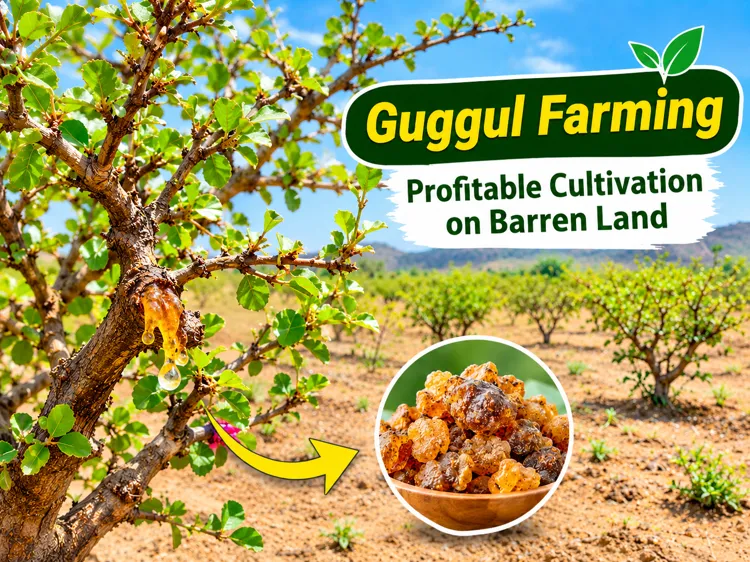
🌿 How to Grow Guggul? Grow a Medicinal Plant on Barren Land and Learn the Complete Farming and Earning Process
Guggul Farming: The importance of medicinal plant cultivation is continuously increasing in India. Farmers are now looking for crops along with traditional grains and vegetables that require less water and can provide opportunities for long-term income. Guggul is one such important medicinal crop, also known as Guggal or Gugal.
Guggul is a medicinal shrub that produces natural gum. This gum is used in Ayurvedic medicines, incense and agarbatti manufacturing. Its biggest speciality is that it can survive even in low-water and dry conditions. This is why Guggul cultivation can become a potential option for farmers who have less fertile and rocky land in states like Rajasthan, Gujarat and Madhya Pradesh.
Farmers often have a question: Can useful farming be done on land where growing normal crops is difficult? Guggul can be an interesting answer to this question.
However, it would not be right to consider Guggul cultivation a way to earn money quickly. It may take around eight years to get the first yield from this plant. Therefore, before starting its cultivation, it is important to make a complete plan for land, plants, care, market and investment.
In this article, we will learn how to grow Guggul, what type of soil and climate it requires, how to plant it, how to manage irrigation and fertilisers, when and how to collect its gum, and what the earning opportunities are from selling it.
🌱 1. What Is Guggul and What Does Its Plant Look Like?
Guggul is an important medicinal plant that grows in the form of a shrub. Its height can generally range from one to three metres. Its branches have thorns, and the outer bark of its stem looks brown or ash-coloured.
The flowers of this plant are brownish-red in colour. Its fruits are fleshy and long in shape, and they turn red when ripe.
The most valuable produce of Guggul is its natural gum. This gum comes out from the stem and branches of the plant. It is used in manufacturing medicinal products and other commercial items.
One important feature of Guggul cultivation is that its plant does not require heavy irrigation and regular care like normal crops.
Main Characteristics of Guggul:
- It is a medicinal plant that grows in the form of a shrub.
- Its height is approximately one to three metres.
- Its branches have thorns.
- It can grow in low-water conditions.
- Useful natural gum is obtained from its stem and branches.
- It does not require heavy irrigation for cultivation.
- It may take around eight years to get the first yield.
🌍 2. Where Is Guggul Cultivated in India?
Guggul is naturally found in several regions of India. According to Kisaan Helpline, this plant has been naturally found in areas such as Rajasthan, Gujarat, Madhya Pradesh, Assam, Sylhet, Bengal and Mysore.
Its cultivation potential can especially be explored in dry and low-water regions.
Farmers in India who have rocky land, less fertile fields or land where normal crops do not produce good yields can explore Guggul cultivation as an alternative.
However, the fact that Guggul grows naturally in a particular state does not guarantee that its commercial cultivation will be successful on every type of land there. The decision should be made according to the local climate and soil conditions.
☀️ 3. What Type of Climate Is Required for Guggul Farming?
Guggul is a plant that grows in dry climatic conditions. It is known for its ability to tolerate strong sunlight and low-water conditions.
According to Kisaan Helpline, a temperature of 25 to 30 degrees Celsius is mentioned as suitable for its cultivation.
The following conditions can be considered suitable for growing this plant:
- Hot and dry climate.
- Sufficient natural sunlight.
- Low-irrigation conditions.
- Land where water does not remain collected for a long time.
- Local weather conditions suitable for plant growth.
Guggul can be considered a crop that may be useful in areas where water availability is limited.
However, maintaining proper moisture during the initial establishment period of the plant is very important.
🪴 4. What Type of Soil Is Required for Guggul Farming?
One of the biggest advantages of Guggul cultivation is that it can grow even in less fertile and dry conditions compared to normal crops.
Proper soil drainage is important for its cultivation. On land where rainwater remains collected for a long time, attention should be given to proper drainage arrangements before planting.
According to the information available on Kisaan Helpline, the soil pH value for Guggul is mentioned as 6 to 7.
Important Points Related to Soil:
- The soil pH value should be around 6 to 7.
- There should be no problem of waterlogging in the land.
- Soil testing should be done before planting.
- Well-decomposed cow dung manure should be used in the field.
- Before starting cultivation on rocky land, the possibility of successful plant establishment should be tested.
Farmers are advised to conduct a trial on a small area before planting Guggul on a large scale. This will help them understand plant growth according to local soil and weather conditions.
🚜 5. How to Prepare the Field for Guggul Farming?
Field preparation is an important step for successful Guggul cultivation.
First, remove unnecessary weeds and bushes from the field that may create problems for the growth of new plants.
After that, check the soil condition and drainage system of the field.
While preparing the field, well-decomposed cow dung manure should be mixed into the soil.
According to the details provided by Kisaan Helpline, two different quantities of manure are mentioned. At one place, 10 tonnes of cow dung manure or compost per acre is mentioned, while the detailed information mentions 5 tonnes of manure per acre. Therefore, it would not be appropriate to consider one fixed quantity suitable for all fields.
Farmers should decide the quantity of manure according to their soil test results and the advice of local agricultural experts.
Field Preparation Process:
- Clean the field.
- Remove weeds and unnecessary bushes.
- Get the soil tested.
- Mix well-decomposed cow dung manure into the soil.
- Make proper arrangements for water drainage.
- Prepare pits at suitable distances for planting.
🌿 6. How to Prepare Guggul Plants?
Guggul can mainly be propagated through both seeds and cuttings.
According to Kisaan Helpline, preparing plants through cuttings is considered a more suitable method.
While purchasing cuttings or planting material, pay special attention to their quality and correct identification.
If farmers want to start cultivation on a commercial scale, it is better to purchase plants from a certified and reliable nursery.
The quality of plants is directly related to their establishment in the field and their further growth.
Main Methods of Getting Guggul Plants:
1. Through Seeds
New Guggul plants can also be prepared from seeds. In this method, it is important to pay attention to seed quality and germination.
2. Through Cuttings
Preparing plants through cuttings is mentioned as a more suitable method by Kisaan Helpline. In this method, healthy cuttings obtained from the right mother plant are used.
3. Through Ready-to-Plant Saplings
If farmers want to start cultivation on a large area, purchasing ready-to-plant saplings from a reliable nursery can be a practical option.
📅 7. Best Time to Plant Guggul
The period between July and September is considered suitable for planting Guggul saplings.
During this time, monsoon rainfall keeps moisture available in the soil, which can help new plants establish themselves.
An article published by ABP Live also mentions planting saplings or cuttings during the months of June or July.
Therefore, the actual planting time should be decided according to the arrival of the monsoon in your area and the moisture available in the soil.
Important Points to Remember While Planting:
- Keep the pits ready before planting.
- Select healthy plants of the correct species.
- Plant at a suitable time according to the monsoon.
- Irrigate immediately after planting.
- Monitor the condition of plants during the initial days.
📏 8. What Should Be the Distance Between Guggul Plants?
Maintaining proper distance between plants is important in Guggul cultivation so that each plant gets enough space to grow.
According to Kisaan Helpline, a spacing of 2 metres × 2 metres between plants is mentioned.
Based on this spacing, approximately 1,000 plants can be accommodated per acre. However, the same information from Kisaan Helpline also mentions planting around 2,000 plants in one acre.
There is a difference between these two figures. Therefore, farmers should not plan for 2,000 plants by considering it a fixed number at a spacing of 2 metres × 2 metres.
Before planting, farmers must calculate the number of plants according to the actual field area and plant spacing.
Pit Size:
It is suggested to prepare pits of approximately 45 × 45 × 45 centimetres for planting Guggul saplings.
While preparing the pits, a suitable quantity of well-decomposed cow dung manure can be mixed with the soil.
💧 9. How to Irrigate Guggul Plants?
One important advantage of Guggul cultivation is its low water requirement.
According to Kisaan Helpline, plants should be irrigated immediately after planting.
During the first year, watering at an interval of approximately one and a half months is mentioned. After that, regular irrigation is generally not required under normal conditions.
However, the irrigation interval may change depending on local weather, rainfall, soil moisture and plant conditions.
Irrigation Management:
- Water the plants immediately after planting.
- Pay special attention to soil moisture during the first year.
- An interval of approximately one and a half months is generally mentioned.
- Avoid giving too much water.
- Do not allow waterlogging in the field during the rainy season.
- Irrigate according to the condition of the plants.
Remember, low water requirements do not mean that plants will not need water at all.
🌾 10. Use of Manure and Fertilisers in Guggul Farming
Maintaining soil quality in the field is important for the healthy growth of Guggul plants.
Well-decomposed cow dung manure or compost can be used during field preparation.
Kisaan Helpline mentions two different quantities of manure: 5 tonnes and 10 tonnes per acre. Therefore, the actual quantity should be decided based on soil testing.
Chemical fertilisers should also be used only when required and according to soil test results.
Applying too much fertiliser without any need can increase the cost of cultivation.
🌿 11. Weed Control in Guggul Plants
During the initial growth of Guggul plants, weeds can compete with the plants for available moisture and nutrients.
Therefore, regular weeding and hoeing in the field are necessary from time to time.
Remove unnecessary weeds growing around the plants.
While doing weeding and hoeing, make sure that the roots of Guggul plants are not damaged.
Regular monitoring of plants during the initial years is especially useful.
🐛 12. Diseases in Guggul Farming and Their Management
Guggul plants can also be affected by diseases during cultivation.
Kisaan Helpline mentions leaf spot disease. In this disease, spots may appear on the leaves of the plants.
Infected plant residues and rainwater splashes can play a role in spreading the disease.
How to Prevent Leaf Spot Disease:
- Do not allow waterlogging in the field.
- Remove infected plant residues.
- Monitor the plants regularly.
- Maintain cleanliness in the field.
- Consult an agricultural expert if symptoms of the disease appear.
Kisaan Helpline also mentions neem cake and some chemical treatments. However, before using any medicine or chemical, confirm the correct identification of the disease and its currently approved use with a local agricultural expert.
⏳ 13. When Do You Get the First Yield from a Guggul Plant?
Farmers need to have the most patience when it comes to Guggul cultivation.
According to Kisaan Helpline, the first yield from Guggul plants is obtained after approximately eight years.
This means farmers will have to focus on plant establishment and care during the initial years. Starting cultivation with the expectation of earning money immediately would not be the right decision.
It is an option for long-term medicinal plant cultivation.
Therefore, before starting Guggul cultivation, farmers should prepare a plan by keeping their financial condition, land and future requirements in mind.
🌳 14. How to Extract Gum from Guggul Plants?
The most important commercial produce of Guggul is its natural gum.
To obtain this gum, controlled cuts are made on the stem and branches of the plant.
According to Kisaan Helpline, white, milky-like gum is obtained by making cuts on the branches while leaving the main stem untouched.
The most important thing in this process is to ensure that the plant does not suffer unnecessary damage.
General Process of Gum Extraction:
- Select a healthy and sufficiently developed plant.
- Avoid damaging the main stem.
- Select a suitable place on the branches.
- Make cuts in a controlled manner.
- Carefully collect the gum that comes out.
- Maintain the quality and cleanliness of the gum.
The process of extracting gum from Guggul plants should be carried out only under the guidance of a trained person or a relevant expert.
Making excessive cuts can damage the plant. Also, while extracting gum from naturally growing Guggul plants, it is important to follow conservation practices and applicable rules.
⚖️ 15. How Much Gum Can Be Obtained from One Guggul Plant?
Guggul production depends on the age, size and condition of the plant.
According to Kisaan Helpline, approximately 600 grams to 1 kilogram of pure Guggul can be obtained from the initial pruning of one plant through a solvent process.
According to the same information, the quantity obtained may increase as the plant grows older and with subsequent harvests.
However, this figure should not be considered the fixed yield of every plant.
Actual production may be affected by the condition of the plants, the gum extraction method and the processing process.
Before starting commercial cultivation, farmers should verify actual production information and confirm the details with local buyers.
💰 16. What Is the Price of Guggul Gum?
One of the major reasons for the increasing interest of farmers in Guggul cultivation is its medicinal gum.
According to an article published by ABP Live on 30 May 2026, the price of pure Guggul gum is mentioned as approximately ₹1,000 per kilogram.
This price is information published in a news article. It should not be considered a fixed market price applicable throughout India.
The actual selling price may depend on the following factors:
- Purity of the gum.
- Quality of the gum.
- Processing method.
- Buyer’s demand.
- Local market conditions.
- Quantity sold and supply conditions.
Before starting cultivation, farmers should contact companies manufacturing Ayurvedic products, traders purchasing medicinal raw materials and local buyers.
📊 17. How Much Can You Earn from Guggul Farming?
To understand the earning potential of Guggul cultivation, it is important to first consider its yield and market price separately.
Suppose a farmer gets one kilogram of pure Guggul gum in the future and receives a selling price of ₹1,000 per kilogram.
In this situation, selling one kilogram will generate a gross income of ₹1,000.
But this is not net profit.
It does not include the cost of purchasing plants, field preparation, planting, manure, irrigation, labour, gum extraction and processing.
Apart from this, the cost of taking care of the plants for eight years must also be considered.
Therefore, farmers should not blindly trust claims of earning lakhs of rupees from Guggul cultivation.
To calculate the actual earnings, farmers should maintain records of the following:
- Total number of plants.
- Planting cost per plant.
- Field preparation expenses.
- Annual maintenance expenses.
- Actual gum production.
- Actual selling price.
- Processing and transportation costs.
The actual profit from cultivation can be understood based on these figures.
🏭 18. Which Industries Have Demand for Guggul Gum?
Guggul gum is used in manufacturing different products.
According to ABP Live, its major users include companies manufacturing Ayurvedic medicines, agarbatti manufacturers and companies making dhoop.
This can create several potential buyer options for farmers.
Main Uses of Guggul:
- Manufacturing Ayurvedic products.
- Use as medicinal raw material.
- Use in making dhoop.
- Use in making fragrant agarbatti.
The best approach for farmers would be to collect information about potential buyers before starting production.
Just because there is demand in the market does not guarantee that farmers will get a good price. Proper quality and the right selling channel are equally important.
🌱 19. Benefits of Guggul Farming for Farmers
There are several aspects of Guggul cultivation because of which farmers can consider including it in their long-term farming plans.
The main benefits are as follows:
1. Low Water Requirement
Guggul cultivation generally requires less irrigation under normal conditions. This creates opportunities for its cultivation in areas where water availability is limited.
2. Use of Rocky Land
In areas where growing normal crops is difficult, the possibility of cultivating plants like Guggul can be tested.
3. Medicinal Importance
Its gum is used in Ayurvedic products.
4. Low-Irrigation Farming Option
After the plants are established, the need for regular irrigation may be low under normal conditions.
5. Use in Different Industries
Its gum is used in manufacturing medicinal products, dhoop and agarbatti.
6. Long-Term Farming Opportunity
Guggul cultivation can be considered a long-term farming plan.
⚠️ 20. Avoid These Mistakes Before Starting Guggul Farming
Despite the good potential of Guggul cultivation, some mistakes can cause financial losses to farmers.
Therefore, it is important to pay attention to the following points before planting.
First Mistake: Expecting Immediate Profit
The first yield of Guggul is mentioned to be available after approximately eight years. Therefore, do not consider it a crop that provides quick money.
Second Mistake: Purchasing Plants Without Proper Information
Always purchase planting material with correct identification from a reliable source.
Third Mistake: Maintaining Incorrect Plant Spacing
Calculate the correct distance between plants and the number of plants per acre.
Fourth Mistake: Providing Excessive Irrigation
As it is a low-water crop, irrigation should be provided according to the needs of the plants and soil moisture.
Fifth Mistake: Starting Cultivation Without Market Information
Collect information about companies and traders who purchase Guggul gum in advance.
Sixth Mistake: Extracting Too Much Gum from Plants
Making excessive cuts can damage the plants. Follow the correct technique.
Seventh Mistake: Depending Only on the Price Mentioned in News Reports
A price of ₹1,000 per kg is not guaranteed everywhere or for every quality of Guggul gum.
🧑🌾 21. How Can Small and Large Farmers Start Guggul Farming?
Farmers who want to start Guggul cultivation should initially prepare a plan according to their land and financial capacity.
Small farmers can first plant Guggul in a limited area and observe its growth according to the local climate and soil conditions.
Before starting commercial-scale cultivation, large farmers should prepare a detailed plan for the availability of planting material, planting distance, labour and future market opportunities.
Suggestions for Small Farmers:
- First, conduct a trial on a limited area.
- Maintain records of plant growth.
- Assess water availability.
- Take advice from local agricultural experts.
- Collect information about potential buyers.
Suggestions for Large Farmers:
- Get the soil tested.
- Prepare a layout of the entire field.
- Calculate the number of plants and planting distance.
- Purchase plants from a reliable nursery.
- Calculate long-term costs and expected income.
- Contact potential companies for selling the produce.
❓ 22. Important Questions and Answers Related to Guggul Farming
Q1. What is the best time for Guggul cultivation?
According to Kisaan Helpline, planting Guggul saplings between July and September is suitable. Decide the planting time according to the local monsoon.
Q2. How many metres tall does a Guggul plant grow?
A Guggul plant can generally grow up to one to three metres in height.
Q3. How much water is required for Guggul cultivation?
It requires less irrigation. Water should be given immediately after planting, and irrigation at an interval of approximately one and a half months during the first year is mentioned.
Q4. What should be the distance between Guggul plants?
Kisaan Helpline mentions a spacing of 2 metres × 2 metres. Calculate the number of plants per acre according to this spacing.
Q5. When do farmers get their first income from Guggul plants?
According to Kisaan Helpline, the first yield is obtained after approximately eight years.
Q6. How much gum can be obtained from one Guggul plant?
Kisaan Helpline mentions that approximately 600 grams to one kilogram of pure gum can be obtained through the solvent process during the initial pruning. The actual quantity may vary.
Q7. What is the price of Guggul gum?
An article published by ABP Live on 30 May 2026 mentions a price of approximately ₹1,000 per kilogram. The actual price varies according to quality and market conditions.
Q8. Can Guggul be cultivated on barren land?
There may be possibilities of growing Guggul on less fertile and rocky land. However, it is important to check the soil condition and drainage system.
Q9. Can Guggul plants be grown from seeds or cuttings?
Plants can be prepared through both methods. Kisaan Helpline mentions cuttings as a more suitable method.
Q10. Who buys Guggul gum?
Companies manufacturing Ayurvedic medicines, dhoop and agarbatti are potential buyers of Guggul gum.
🌾 23. Conclusion: Make Barren Land Useful Through Guggul Farming
Today, farming is facing several challenges, such as water shortages, declining soil fertility and increasing cultivation costs. At such a time, farmers need to stay informed about crops that are suitable for local conditions.
Guggul is a medicinal plant that can be cultivated in low-water and dry conditions. Its gum is used in manufacturing Ayurvedic products, dhoop and agarbatti.
However, the biggest challenge in its cultivation is the long waiting period. It may take approximately eight years to get the first yield. Therefore, farmers should not invest in large-scale cultivation in a hurry.
If you have land where normal crops produce low yields, testing the possibilities of Guggul cultivation can be a good step.
Our aim is to provide farmers with useful information so that they can make informed decisions, adopt new farming options and make better use of their land.
Dear farmers, remember that successful farming is not just about growing a good crop. It also requires the right information, patience, hard work and an understanding of the market.
If you also want to get information about medicinal plant farming, modern agricultural techniques and useful farming practices for farmers, stay connected with our website Subsistence Farming.
Make farming not just a tradition, but a way to gain knowledge, work hard and build a better future.
📚 References
- Ministry of Agriculture & Farmers Welfare, Government of India – Guidance related to crop production, plant protection, and agriculture.
- Indian Council of Agricultural Research (ICAR) – Information related to agricultural research, crop management, and pest and disease management.
- National Horticulture Board (NHB) – Information related to production and plant protection of horticultural crops.
- Vikaspedia – Multilingual knowledge portal of the Government of India.
- Kisaan Helpline – Guggul Farming – Production, Climate, Soil and Cultivation Information.
- ABP Live – Guggul Farming: Grow This Medicinal Plant Even on Barren Land.