


Areca Nut Farming: Complete Guide to Cultivation, Planting, and Profit
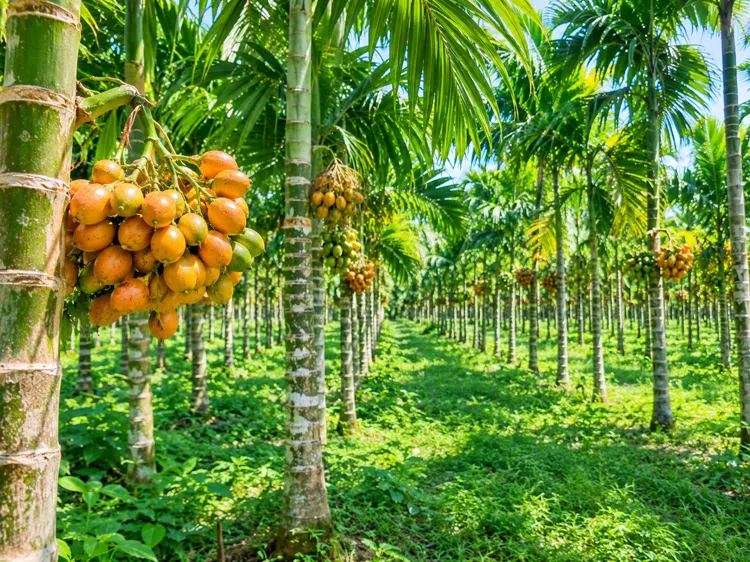
🌴 How to Do Areca Nut Farming? Learn Advanced Cultivation, Planting, Irrigation, Fertilizer Management, and the Complete Success Story of Farmers
An Indian farmer does not grow only food grains; he also sows the dreams of his family, the future of his children, and the hopes of coming generations in his fields. Sometimes, he sees happiness in the golden ears of paddy, while at other times, he sees the reward of his hard work in a golden wheat crop. However, in the world of agriculture, there are some crops that have the potential to provide farmers with income for a long time. Areca Nut Farming is one such important horticultural crop.
Areca nut, also known as Betel Nut in English, is an important part of India’s traditional agriculture and cultural life. It is used in religious and social traditions, as well as in various food and industrial sectors.
In many parts of South India, tall areca nut trees are a symbol of farmers’ hard work and agricultural traditions. It is cultivated in states such as Karnataka, Kerala, Assam, Tamil Nadu, Meghalaya, and West Bengal.
Today, when farmers are facing challenges such as rising farming costs, uncertain weather conditions, and market difficulties, getting the right information about perennial horticultural crops like areca nut becomes important.
But remember, the success of any crop does not depend only on planting seeds or saplings. The right climate, suitable soil, healthy planting material, balanced nutrition, regular irrigation, and timely disease management form the foundation of successful farming.
In this article, we will understand everything about areca nut farming in simple English, from starting the cultivation process to nursery preparation, field transplantation, fertilizer management, irrigation, harvesting, and the financial opportunities for farmers.
🌱 1. What Is Areca Nut Farming and What Is Its Importance in India?
The areca nut plant is a tropical palm species. The hard kernel found inside its fruit is dried and used as areca nut.
The importance of areca nut in India is not limited to business and trade. It has been used in Indian traditions for a long time during worship, religious ceremonies, and social occasions.
Areca nut farming is particularly important in areas where a warm and humid climate, sufficient rainfall, and well-drained soil are available.
🌍 Where Is Areca Nut Cultivated in India?
The major areca nut-producing states in India include:
- Karnataka
- Kerala
- Assam
- Tamil Nadu
- Meghalaya
- West Bengal
Due to favourable climatic and soil conditions, areca nut plantations have developed in these states.
In many areas of Karnataka and Kerala, areca nut farming is an important part of farmers’ livelihoods. In Northeast India, small areca nut plantations also help farmers earn additional income.
💚 Why Should Farmers Choose Areca Nut Farming?
Areca nut farming offers some important opportunities for farmers:
- It is a perennial horticultural crop.
- With proper care, plants can produce for a long time.
- Suitable intercrops can be grown under the plantation.
- Areca nut has religious, cultural, and commercial importance in the market.
- Once a plantation is established, production can be obtained for many years.
However, its cultivation requires patience and investment during the initial years. Therefore, farmers should not start cultivation just by looking at the possible earnings. First, it is important to assess the climate, water availability, soil conditions, and market situation of their area.
🌦️ 2. Suitable Climate for Areca Nut Farming
Climate is one of the most important factors for successful areca nut cultivation.
This plant grows well in warm and humid conditions. Areas with sufficient moisture, regular rainfall, and favourable temperatures can support better growth of areca nut plants.
Suitable Temperature Conditions:
- Suitable temperature: Approximately 14°C to 36°C.
- Temperatures below 10°C can damage the crop.
- Temperatures above 40°C can also be unfavourable for the plants.
Excessive heat and dry winds can affect plant growth. Similarly, very low temperatures can negatively affect the leaves and overall plant development.
☀️ What Type of Climate Do Areca Nut Plants Need?
Areca nut plants prefer a climate where sufficient moisture is maintained.
Farmers should keep the following points in mind:
- Do not allow plants to suffer from a lack of water for a long time.
- Maintain soil moisture during summer.
- Protect young plants from extremely hot winds.
- Do not allow water to accumulate in the field during the monsoon.
- Avoid waterlogging around the roots of the plants.
Special Advice for Farmers: If your area experiences extreme summer temperatures and has limited water availability, test the suitability of areca nut cultivation on a small area before establishing a large plantation.
🪴 3. Suitable Soil for Areca Nut Farming
The future of any crop is connected to its soil. The same applies to areca nut cultivation.
Red soil and laterite soil are considered suitable for areca nut farming. Apart from these, it can also be cultivated in loamy soil with good drainage facilities.
For more useful information related to farming, you can also read agricultural articles on our website, Subsistence Farming.
🌾 Major Soil Characteristics
| Soil Type | Suitability for Cultivation |
|---|---|
| Red Soil | Suitable |
| Laterite Soil | Suitable |
| Loamy Soil | Suitable if proper drainage is available |
| Black Soil | Generally unsuitable |
| Sandy Soil | Generally unsuitable |
| Saline Soil | Unsuitable |
| Calcareous Soil | Generally unsuitable |
The soil should have a sufficient amount of organic matter and a good drainage system.
🔬 Why Is Soil Testing Important?
Farmers often start planting without getting their soil tested. Later, they discover that the field has a shortage of nutrients or that water is getting accumulated in the soil.
To avoid this problem:
- Get your field soil tested.
- Check the soil pH value.
- Understand the organic matter content.
- Get information about the major nutrients available in the soil.
- Arrange proper drainage facilities in advance.
In this way, farmers can understand the limitations of their fields before starting plantation.
🌿 4. Improved Varieties of Areca Nut and Their Selection
Selecting a good variety affects future production in areca nut farming.
Farmers should choose varieties according to the climate, soil, and local agricultural conditions of their region.
Some major varieties include:
| Variety Name | Main Identification |
|---|---|
| Thirthahalli Local | Local variety |
| Maidan Local | Local variety |
| South Canara Local | Local variety |
| Mohit Nagar | Popular variety |
| Srivardhan | Popular variety |
| Mangala | Improved variety |
| Sumangala | Improved variety |
| Shrimangala | Improved variety |
| Swarnamangala (VTL-12) | Improved variety |
| SAS-1 | Selected variety |
| Vittal Areca Hybrid-1 | Hybrid variety |
| Vittal Areca Hybrid-2 | Hybrid variety |
🌳 Mangala and Sumangala Varieties
Mangala and Sumangala are well-known improved varieties of areca nut. Apart from these, Shrimangala and Swarnamangala also hold an important position among farmers.
🌱 Vittal Areca Hybrid-1
This variety is known as Vittal Areca Hybrid-1.
🌱 Vittal Areca Hybrid-2
This is also included among the hybrid varieties of areca nut.
Important Advice: Do not purchase plants just by looking at the variety name or the success of another farmer. Always check the quality of the planting material, its suitability for your local conditions, and its availability from a reliable nursery.
🌰 5. How to Prepare Areca Nut Seedlings?
Areca nut farming is mainly carried out through seeds.
For successful cultivation, it is important to select healthy and high-quality seeds right from the beginning.
If weak seeds are selected at the initial stage, they can affect the number of plants, their growth, and the overall quality of the plantation in the future.
🪴 Four Important Steps for Preparing Seedlings
First Step – Selection of Mother Plants
First, select healthy mother plants with good growth.
Give preference to plants that do not show any visible signs of disease and have good growth.
Second Step – Selection of Areca Nut Seeds
Select healthy seeds obtained from the mother plants.
The seeds should not show any signs of rotting, damage, or disease.
Third Step – Germination and Seedling Preparation
The selected seeds are planted in the nursery. Maintaining moisture is important for good germination.
Fourth Step – Selection of Healthy Seedlings
After germination, do not consider all seedlings to be the same. Select healthy, strong, and well-grown seedlings for planting in the main field.
🌱 Method of Preparing an Areca Nut Nursery
In the nursery, seeds are sown in the form of whole fruits.
Follow these steps to prepare the nursery:
- First, select a suitable location.
- Prepare nursery beds approximately 150 cm wide and 15 cm high.
- Maintain proper moisture in the nursery beds.
- Plant the seeds in a vertical position at a distance of approximately 15 cm from each other.
- Water the nursery regularly.
- Monitor the growth of the seedlings after germination.
- Select healthy seedlings for further transplantation.
Seedlings can also be raised in polythene bags in the secondary nursery.
The main purpose of a nursery is not just to increase the number of plants but to prepare healthy and strong seedlings.
🚜 6. Field Preparation and Planting of Areca Nut Seedlings
Proper field preparation is very important before establishing an areca nut plantation. Even a small mistake during field preparation can cause major losses in the future.
First, remove unnecessary weeds and bushes from the field. After that, plough the land two to three times according to the soil condition so that the soil becomes loose and fine.
Make sure to arrange a proper drainage system in the field.
📐 What Should Be the Distance Between Areca Nut Plants?
The spacing between areca nut plants should be selected according to the variety, soil type, and local farming practices.
The following spacing is mentioned in available agricultural information:
- 6 metres × 6 metres
- 7 metres × 7 metres
- 2.7 metres × 2.7 metres
These spacings are recommended under different cultivation practices. They should not be considered the same or interchangeable. Choose the appropriate spacing for your region with the advice of a local agricultural expert.
🕳️ How to Prepare Pits for Planting?
For planting areca nut seedlings, pits of approximately 90 × 90 × 90 centimetres are prepared.
Pit Preparation Process:
- Mark the field according to the recommended distance between plants.
- Dig pits approximately 90 centimetres in length, width, and depth.
- Keep the soil removed from the pits separately.
- Mix well-decomposed farmyard manure (FYM) with the soil.
- Fill the pits up to approximately 50 to 60 centimetres with the prepared mixture.
- Carefully plant a healthy seedling.
- Gently arrange the soil around the plant.
- Provide sufficient water immediately after planting.
Bamboo sticks or other suitable supports can be provided to protect young plants from strong winds.
📅 Best Time for Areca Nut Planting
It is important to consider the weather and local conditions when selecting the right time for areca nut planting.
Available agricultural guidelines mention the periods from May to June and September to October. In some regions, planting is also done during the last phase of summer and the beginning of the monsoon.
Farmers should choose a time when plants can get sufficient moisture and there is no risk of excessive waterlogging.
One important thing: Do not damage the roots of the plants during transplantation. Also, avoid planting seedlings too deep in the soil.
💧 7. Irrigation Management in Areca Nut Farming
Sufficient water availability is very important for the healthy growth of areca nut plants.
This crop prefers moisture, but it does not mean that the roots should remain continuously submerged in water.
Excessive water and waterlogging can affect root health.
🚿 How Many Days Apart Should Areca Nut Plants Be Watered?
The irrigation interval changes according to soil type, weather, and geographical region.
According to available agricultural information:
| Region | General Irrigation Interval |
|---|---|
| Plains of Karnataka | 4 to 7 days |
| Dry months in Kerala | 7 to 8 days |
These are examples mentioned for specific regions and are not fixed rules for every field.
If the soil in your field dries quickly, more frequent irrigation may be required. In heavy soil, water may remain for a longer period.
🌊 Which Irrigation Method Is Better for Areca Nut?
Drip Irrigation is a useful irrigation method for areca nut plantations.
Its benefits include:
- Water reaches the roots of the plants.
- It helps reduce water wastage.
- Maintaining soil moisture becomes easier.
- Irrigation can be controlled according to requirements.
- Better water management becomes possible.
If drip irrigation facilities are not available, sprinklers or other irrigation methods can be used according to local conditions.
🌧️ Why Is Drainage Important During the Monsoon?
Dear farmers, areca nut plants need moisture, but continuous water accumulation around their roots is not good.
During the monsoon:
- Keep the field drainage channels clean.
- Identify areas where water gets accumulated.
- Prepare drainage channels wherever required.
- Prevent waterlogging in pits and around plant roots.
Remember, along with proper irrigation, good drainage is also an important part of successful areca nut production.
🌿 8. Manure and Fertilizer Management in Areca Nut Farming
Plants need nutrients for healthy growth and better production.
Farmers should understand that applying more fertilizer does not guarantee higher production. Providing the right quantity of nutrients at the right time is more important.
🧪 Nutrients Required for Areca Nut Plants
According to available agricultural guidelines, the following quantities of nutrients are recommended per plant:
| Nutrient | Quantity |
|---|---|
| Nitrogen | 100 grams |
| Phosphorus (P₂O₅) | 40 grams |
| Potash (K₂O) | 140 grams |
| Green Manure | 12 kilograms |
Along with these nutrients, the following fertilizer quantities are also mentioned:
| Fertilizer | Recommended Quantity |
|---|---|
| Urea | 220 grams |
| Rock Phosphate | 200 grams |
| Muriate of Potash (MOP) | 235 grams |
These quantities are provided as general agricultural references. The actual fertilizer quantity should be decided according to soil testing, plant age, and local agricultural recommendations.
📆 Best Time to Apply Fertilizers
According to the available guidelines, fertilizers are recommended to be applied in two parts:
- First application: May to June.
- Second application: September to October.
This helps provide nutrients to the plants at different stages of the year.
Another agricultural guideline mentions applying 10 to 20 kilograms of well-decomposed farmyard manure (FYM) to plants older than five years. It also refers to applying half the recommended NPK quantity to plants younger than five years.
Do not combine and apply these two fertilizer management recommendations without proper assessment. Prepare a fertilizer plan according to the age of your plantation and the actual requirements of your soil.
🍃 Importance of Organic Manure
Well-decomposed farmyard manure and green manure help increase organic matter in the soil.
Soil rich in organic matter can help maintain moisture and improve soil structure.
Farmers should use well-decomposed manure instead of raw farmyard manure.
🌱 9. What Is Fertigation and How Is It Used in Areca Nut Farming?
Fertigation is an agricultural method in which nutrients are supplied to plants through irrigation water.
In this method, fertilizers are mixed with water and delivered to the plants.
Fertigation can be useful in areca nut plantations, especially where drip irrigation facilities are available.
💧 Benefits of Fertigation
- Irrigation and nutrient management can be carried out together.
- Nutrients can be supplied in divided quantities.
- It helps provide nutrition according to plant requirements.
- Fertilizer usage can be managed systematically.
Available information mentions dividing fertilizers into ten parts and applying them every 20 days from November to May.
However, fertilizer selection, solubility, and quantity are very important for fertigation. Do not add any fertilizer to the irrigation system without consulting an expert.
🌾 10. Additional Income by Growing Intercrops in Areca Nut Plantations
One of the biggest challenges for farmers is how to use the available land until the plantation becomes fully productive.
After planting areca nut seedlings, the vacant space between the plants during the initial years can be used for growing suitable intercrops.
This gives farmers an opportunity to earn additional income along with the main crop.
According to available agricultural information, the following intercrops can be grown along with areca nut:
- Black Pepper
- Coffee
- Vanilla
- Cardamom
- Clove
- Citrus Fruit Crops
In Northeast India, growing King Chilli, also known as Bhut Jolokia, under areca nut trees is also mentioned.
🌿 Precautions While Practising Intercropping
Growing every crop along with areca nut may not be profitable.
Therefore, keep the following points in mind:
- Understand the water requirements of both crops.
- Avoid unnecessary competition for nutrients.
- Allow sufficient sunlight to reach the plants.
- Regularly monitor diseases and pests.
- Check the market demand for the intercrop in your local area.
Choosing the right intercrop can help increase farmers’ income.
🐛 11. Major Diseases Affecting Areca Nut Crops and Their Management
Keeping the crop healthy is as important for farmers as preparing good-quality seedlings.
In areca nut farming, some diseases can affect the leaves, stems, and fruit production of plants.
The major problems include:
- Leaf rot.
- Stem rot.
- Leaf spots.
🍂 Leaf Rot
Leaf rot is one of the problems commonly seen in areca nut plants.
Due to this problem, leaves may get affected, and the normal growth of plants can also be affected.
Farmers should inspect the leaves regularly from time to time.
🌳 Stem Rot
Keeping the stem healthy is essential for the overall health of the plant.
If symptoms of stem rot appear, farmers should not ignore them by considering them a normal problem.
🍃 Leaf Spots
The appearance of spots on leaves can also be a sign of a disease-related problem.
If the colour of leaves is changing or unusual marks are appearing on them, get the plants inspected.
🛡️ What Should Farmers Do for Disease Management?
- Use healthy and disease-free planting material.
- Maintain cleanliness in the plantation.
- Solve waterlogging problems.
- Get affected plants inspected when disease symptoms appear.
- Follow suitable treatment methods with the advice of a local agricultural expert.
- Give preference to disease-resistant varieties recommended for your region.
Do not spray chemical pesticides or medicines without identifying the disease. Proper treatment should be given only after correctly identifying the disease.
🌳 12. Care of Areca Nut Plants and Weed Management
Regular care is necessary after establishing an areca nut plantation.
Many farmers leave the plants to grow naturally after planting them. However, plants require special attention during the initial years.
🌱 Weed Management
Weeds compete with plants for water, nutrients, and space.
Therefore, carry out regular weeding and hoeing in the plantation.
According to available agricultural information, hoeing with a hand hoe two to three times a year is recommended.
🌳 Prevent Soil Erosion
If your field is located in a sloping area, rainwater can cause soil erosion.
In such conditions, preparing terrace fields and arranging a proper drainage system can be useful.
🌬️ Protection of Young Plants
Young areca nut plants can get damaged due to strong winds.
In such situations, provide bamboo sticks or other suitable support whenever required.
Regularly monitor the plants and remove dry or damaged leaves properly.
🧺 13. When and How to Harvest Areca Nut?
The most beautiful moment for a farmer is when the crop is ready and visible in the field after hard work.
Harvesting areca nut at the right time is also very important. If the fruits are harvested too early, their quality and processing may be affected.
🟠 How to Identify Ripe Areca Nut Fruits?
When areca nut fruits ripen, their colour starts changing.
According to available agricultural information, fruits that are approximately nine months old may turn from yellow to orange-red.
Harvesting should be done according to the maturity of the fruits.
Another agricultural guideline recommends harvesting the fruits when they are approximately three-fourths mature.
✂️ Method of Harvesting Areca Nut
A sickle or knife is used for harvesting areca nut.
During harvesting, the fruit bunches are cut carefully.
Farmers should follow these precautions:
- Check the maturity of the fruits before harvesting.
- Keep the tools clean and safe.
- Do not damage the plants or stems.
- Collect the fruits in a clean place.
- Start the drying process after harvesting.
☀️ Drying Process of Areca Nut
After harvesting, areca nuts are dried in sunlight.
Available information mentions sun-drying for approximately 10 days to 35–40 days. This period depends on the condition of the fruits and the drying method.
After this, the kernels are removed, and the final drying process is completed.
Proper drying of areca nuts is important to maintain the quality of the final product.
💰 14. How Much Income Can Farmers Earn from Areca Nut Farming?
Dear farmers, before adopting any commercial crop, the biggest question is how much income it can generate.
Areca nut farming offers the possibility of getting production for a long period. However, actual earnings depend on several factors.
These include:
- Total farm area.
- Number of plants planted.
- Variety and quality of plants.
- Soil and climate.
- Irrigation and fertilizer expenses.
- Harvesting and labour costs.
- Quality of areca nuts.
- Local market price.
📊 How Many Areca Nut Plants Can Be Planted in One Acre?
According to available agricultural information, approximately 120 to 180 plants can be planted in one acre when a spacing of 6 × 6 metres or 7 × 7 metres is maintained between plants.
However, another agricultural practice also mentions a spacing of 2.7 × 2.7 metres.
Therefore, while deciding the number of plants per acre, it is important to understand the selected planting method and the actual conditions of the field.
💵 How to Calculate Income from Areca Nut Farming?
It would not be right to claim a fixed profit from areca nut farming because production and market prices can vary.
Farmers can estimate their potential income using this formula:
Total Sales = Quantity of Areca Nut Sold × Selling Price Per Kilogram
After that:
Net Profit = Total Sales − Total Cultivation and Selling Expenses
For example, if a farmer gets 1,000 kilograms of areca nut and receives a selling price of ₹300 per kilogram, then:
– Total Sales = ₹3,00,000.
This is only a hypothetical example to explain the calculation. It is not a claim about actual market prices or production.
While calculating actual profit, also include the expenses of plant establishment, fertilizers, irrigation, labour, harvesting, drying, and transportation.
❤️ The Real Meaning of a Farmer’s Success
A farmer’s success is not measured only by the money deposited in a bank account.
Success means that a farmer can provide a better life for his family, complete his children’s education, adopt new farming technologies, and make his land more fertile for future generations.
This long-term approach is the most important thing in perennial crops like areca nut.
👨🌾 15. What Can We Learn from Areca Nut Farmers of South India?
Areca nut farming has been a part of the agricultural system in South India for a long time.
In many agricultural regions of Karnataka and Kerala, areca nut plantations are closely connected with farmers’ livelihoods.
We can learn some important farming lessons from these regions:
First Lesson – Respect the Climate.
Farmers should not grow any crop just by looking at its market demand. The chances of success can be better in regions where the climate is suitable for that particular crop.
Second Lesson – Start with Good-Quality Seedlings.
A plantation remains productive for many years. Therefore, selecting good-quality seedlings at the beginning is important for future farming.
Third Lesson – Make Full Use of the Land.
Understand the possibilities of growing suitable intercrops in areca nut plantations.
Fourth Lesson – Manage Water Properly.
It is important to pay attention to both irrigation and drainage.
Fifth Lesson – Stay Informed About the Market.
Instead of searching for buyers after the crop is ready, understand the local market and selling arrangements before starting cultivation.
The experience of South Indian farmers gives us the message that success in horticulture requires continuous care, patience, and scientific knowledge.
📅 16. How Long Does It Take for Areca Nut Plants to Produce Fruits?
This is a very important question for new farmers who want to start areca nut farming.
Different agricultural sources provide different information about the time required for fruit production.
- According to one source, plants may start producing fruits approximately 3 to 4 years after planting.
- Another agricultural guideline mentions fruit production after approximately 5 years.
- Under some conditions, it may take even longer for production to begin.
This difference depends on the plant variety, climate, soil, and maintenance.
🌳 Do Areca Nut Plants Produce Fruits for a Long Time?
With proper care and favourable conditions, areca nut plants can produce fruits for a long time.
One available agricultural source mentions the possibility of getting production for approximately 50 years.
Therefore, farmers should consider it not just as a one-season crop but as a long-term horticultural investment.
⚠️ 17. Avoid These Mistakes Before Starting Areca Nut Farming
Dear farmers, sometimes losses in farming do not happen because of a major natural disaster but because of small mistakes.
The following mistakes should be avoided in areca nut farming:
- Selecting land without testing: Always get the soil and drainage conditions of your field tested.
- Purchasing weak seedlings: Do not compromise on plant quality just to purchase cheaper seedlings.
- Planting at the wrong spacing: Decide the distance between plants according to the variety and region.
- Allowing waterlogging: Keep the field drainage channels clean during the monsoon.
- Applying unbalanced fertilizers: Follow nutrient management according to soil test results.
- Ignoring diseases: Regularly monitor the leaves and stems of plants.
- Not having market information: Find out about local buyers and selling arrangements before starting cultivation.
- Expecting quick profits: Be prepared for the initial investment and waiting period required for a perennial crop.
❤️ 18. Our Special Advice for Farmers
Farming is not just the work of putting seeds into the soil. It is a relationship with nature.
When a farmer plants a small sapling in his field, he does not think only about today. He has hopes for the coming years in his mind.
Areca nut farming also requires patience, hard work, and proper understanding in the same way.
If your region has a suitable climate, sufficient water availability, and soil suitable for areca nut cultivation, you can consider growing this crop.
However, it is better to test its suitability on a small scale before establishing a large plantation.
Here are some special suggestions from our side for farmers:
- Check the quality of seedlings before purchasing them.
- Confirm the variety with an agricultural expert.
- Arrange proper drainage facilities in the field.
- Understand the possibilities of drip irrigation.
- Use organic manure and balanced nutrients.
- Explore opportunities for additional income through intercropping.
- Get market information before the crop is ready.
Remember, the foundation of good farming is not just a good crop but also making the right decision at the right time.
❓ 19. Frequently Asked Questions About Areca Nut Farming
Q1. Which Soil Is Best for Areca Nut Farming?
Red soil and laterite soil are considered suitable for areca nut farming. It can also be cultivated in loamy soil with good drainage and sufficient organic matter.
Q2. What Temperature Is Required for Areca Nut Farming?
A temperature of approximately 14°C to 36°C is considered suitable for the healthy growth of areca nut plants.
Q3. How Many Years Does an Areca Nut Plant Take to Produce Fruits?
According to general agricultural information, fruit production may start in approximately 3 to 5 years. The actual time depends on the variety and cultivation conditions.
Q4. How Many Areca Nut Plants Can Be Planted in One Acre?
Approximately 120 to 180 plants can be planted with a spacing of 6 × 6 metres or 7 × 7 metres. The number of plants may differ under other high-density planting methods.
Q5. Which Manure and Fertilizers Should Be Applied to Areca Nut Plants?
Well-decomposed farmyard manure, green manure, and nitrogen, phosphorus, and potash fertilizers are used. Decide their quantities according to soil test results and the age of the plants.
Q6. After How Many Days Should Areca Nut Plants Be Irrigated?
Irrigation depends on the soil and weather conditions. Available examples mention an interval of 4 to 7 days in the plains of Karnataka and 7 to 8 days during the dry months in Kerala.
Q7. Which Irrigation Method Is Best for Areca Nut?
Drip irrigation is a useful method. It delivers water directly to the roots of plants and helps reduce water wastage.
Q8. Which Are the Major Varieties of Areca Nut?
Mangala, Sumangala, Shrimangala, Swarnamangala, Mohit Nagar, Thirthahalli Local, Maidan Local, and Vittal Areca Hybrids are among the major varieties.
Q9. When Should Areca Nut Be Harvested?
Harvesting is done when the fruits turn from yellow to orange-red and reach the appropriate maturity stage.
Q10. Which Intercrops Can Be Grown Along with Areca Nut?
Black pepper, coffee, vanilla, cardamom, clove, and citrus fruit crops can be grown as intercrops under suitable conditions.
Q11. Which Diseases Affect Areca Nut Plants?
Leaf rot, stem rot, and leaf spots are among the major problems. These should be managed through proper identification, cleanliness, and expert advice.
Q12. Can Areca Nut Farming Provide Income for a Long Time?
Yes, an areca nut plantation can provide production for a long time with proper care and favourable conditions. However, there is no fixed guarantee of production or income.
🌾 20. Conclusion: A Plant Planted Today Can Become a Farmer’s Hope Tomorrow
Areca nut farming is one of the important horticultural crops in India. Its religious, cultural, and commercial importance makes it a potential long-term agricultural option for farmers.
The cultivation experience of states such as Karnataka, Kerala, Assam, Tamil Nadu, Meghalaya, and West Bengal shows that areca nut plantations can be developed with a suitable climate and proper agricultural management.
Healthy seedlings, suitable soil, correct planting distance, balanced nutrition, sufficient irrigation, proper drainage, and timely disease management are essential for successful cultivation.
Dear farmers, no farming decision should be taken just by looking at the earnings of others. You should move forward only after understanding your own land, water availability, weather conditions, and market.
Because a farmer’s real strength lies not only in hard work but also in making wise decisions.
Let us make farming not just a tradition but also a medium of knowledge, technology, and a better future.
If you found this information about areca nut farming useful, please share it with your farmer friends and family members.
Keep visiting our website, Subsistence Farming, for useful information about agriculture, horticulture, and other farming topics.
One right decision from you can change the direction of your farming journey.
📚 References
- Ministry of Agriculture & Farmers Welfare, Government of India – Guidance related to crop production, plant protection, and agriculture.
- Indian Council of Agricultural Research (ICAR) – Information related to agricultural research, crop management, and pest and disease management.
- National Horticulture Board (NHB) – Information related to production and plant protection of horticultural crops.
- Vikaspedia – Multilingual knowledge portal of the Government of India.
- ApniKheti – Farmers’ Own Farming, Farmers’ Own Information.