


How to Grow Pistachios: Climate, Planting, Care & Profit Potential
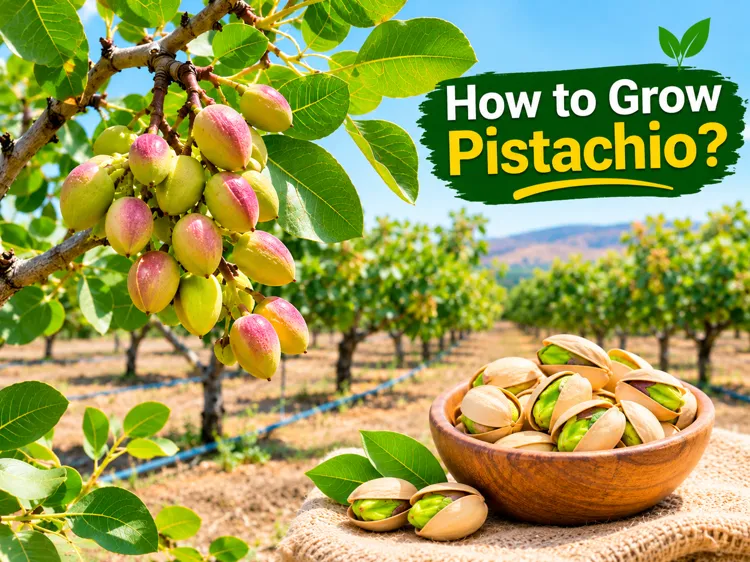
🌾 Introduction: Grow a New Dream of Profit in Your Fields
Indian farmers have the ability to turn soil into gold through their hard work. Sometimes they grow wheat and rice, sometimes mustard and cotton, and sometimes they look for new opportunities in their fields. With changing times, farming is no longer limited to traditional crops. Now, farmers are also looking towards crops that can provide good income for a long time.
One such opportunity is pistachio farming.
Pistachio is a popular and expensive dry fruit. It is used in sweets, snacks, ice creams, and many types of food products. Its demand remains in the market, and its price can also be higher compared to normal agricultural products.
But can Indian farmers grow pistachios in their fields? Is pistachio farming possible in Rajasthan, Haryana, Uttar Pradesh, or other states? How many years does a pistachio plant take to produce fruits? How many male and female plants should be planted for pistachio farming?
You will get detailed answers to all these questions in this article.
Our aim is not just to show you the dream of growing an expensive crop, but also to explain its actual requirements, precautions, and farming techniques. Because a farmer’s hard work and investment are both valuable. Having the right information before investing in any new crop is very important.
Remember, good farming does not start with good seeds alone. It starts with the right information and the right decision.
🌳 1. What Is Pistachio and Why Is Its Farming Important?
Pistachio is a nut-bearing fruit crop. Its scientific name is Pistacia vera. The fruit that grows on its tree contains an edible seed, which we know as pistachio.
Pistachios are mainly used in the following products:
- Sweets and Indian food items.
- Ice creams and bakery products.
- Dry fruit mixtures.
- Snacks and roasted nuts.
- Nutritious food products.
Pistachio farming is different from normal seasonal crops. Once an orchard is established, there is a possibility of getting production for many years. However, the plants take time to become mature. Therefore, it is an option worth considering for farmers who want to invest in long-term horticulture.
🌟 1.1. Major Benefits of Pistachio Farming
- High Market Price: Pistachio is an expensive dry fruit, and there is a possibility of earning good income from its sale.
- Long-Term Production: Mature trees can produce fruits for many years.
- Possibility in Dry Climate: Its cultivation has better possibilities in areas with hot and dry weather.
- A New Crop Option: Along with traditional farming, farmers can consider new horticulture options.
- Business Opportunities: Pistachios can be supplied to the market as dry fruits.
However, a high price does not mean that every farmer will definitely earn high profits. Success depends on climate, variety, pollination, plant quality, maintenance, and market conditions.
🌍 2. Which Areas Are Suitable for Pistachio Farming in India?
The most important requirement for pistachio farming is a suitable climate. It is not a plant that can be grown successfully in every part of India in the same way.
Pistachio trees need hot and dry weather during summers and sufficient cold during winters. High humidity and continuous rainfall can create challenges for its cultivation.
The possibilities of pistachio cultivation are being considered in areas such as Jammu and Kashmir, Himachal Pradesh, and Uttarakhand. Some dry areas of Rajasthan are also mentioned in farming-related articles.
But farmers should not plant trees in their fields just by looking at the name of a state. Climate, soil, and water availability can be different in different districts of the same state.
🏜️ 2.1. Pistachio Farming in Rajasthan
Due to the hot and dry climate in some parts of Rajasthan, farmers show interest in pistachio cultivation.
Districts such as Sri Ganganagar, Bikaner, Churu, Tonk, and Jaipur have been mentioned in available articles related to pistachio farming.
However, commercial farming success in these districts should not be considered automatically proven. Farmers should get their field soil, winter temperatures, summer conditions, and irrigation water tested.
❄️ 2.2. Jammu and Kashmir and Himalayan Regions
The winter cold in areas such as Jammu and Kashmir and Himachal Pradesh can be useful for pistachio trees. However, plant growth may be affected in areas with very high altitudes, unsuitable temperatures, and excessive humidity.
Our Advice: Before starting a large orchard, confirm the suitability of your area with a local agriculture expert and plant a limited number of trial plants.
☀️ 3. What Type of Climate Is Required for Pistachio Farming?
Climate plays the most important role in successful pistachio farming.
Pistachio trees need sufficient heat during summers and cold during winters. Plants can grow well in hot and dry weather, while excessive humidity and continuous rainfall can create problems.
According to the information published on Kisan Helpline, daytime temperatures above 36°C are considered useful for pistachio cultivation. Similarly, a winter temperature of around 7°C is considered sufficient for the dormant stage.
This means that heat alone is not enough for pistachio farming. The plant also needs proper seasonal changes.
🌡️ 3.1. Effect of Climate on the Crop
- Hot and dry weather can be suitable for plant growth.
- The required winter cold is important for the plant’s seasonal growth cycle.
- High humidity can increase the risk of diseases.
- Continuous rainfall and waterlogging can damage the roots.
- Unsuitable temperatures can affect the process of flowering and fruit formation.
Therefore, farmers should properly evaluate the climate of their area before purchasing plants.
🪴 4. Which Soil Is Best for Pistachio Farming?
Pistachio plants can grow better in deep soil with good drainage.
Sandy loam and deep clay loam soils are considered suitable for this crop. Such soil provides enough space for roots to spread and allows excess water to drain easily.
According to Kisan Helpline, pistachio trees can grow well in soil with a pH level of around 7.0 to 7.8.
🧑🌾 4.1. Main Soil Requirements
- The soil should be deep.
- There should be a proper drainage system.
- Water should not remain standing in the field for a long time.
- The soil should have enough space for root growth.
- Soil salinity and alkalinity should be tested.
⚠️ 4.2. Why Is It Important to Avoid Waterlogging?
The roots of pistachio plants grow deep into the soil. If water remains accumulated in the field for a long time, the risk of root rot and fungal diseases can increase.
Therefore, while selecting a field, checking only soil fertility is not enough. Proper drainage is equally important.
Important Advice: Get your soil tested before establishing an orchard. Do not use manure, fertilizers, or soil conditioners without proper testing.
🚜 5. How to Prepare the Field for Pistachio Farming?
A pistachio orchard remains in the field for many years. Therefore, carelessness during the initial preparation can cause losses in the future.
First, plough the field properly. After that, inspect the soil, drainage system, and depth of the land.
If there is a hard layer below the ground, it should be considered a possible obstacle to the growth of plant roots.
The article published on Kisan Helpline mentions the need to break hard obstacles present at a depth of approximately 6 to 7 feet.
Main Steps for Field Preparation
- First, get the field soil tested.
- Remove unnecessary bushes and weeds from the land.
- Plough the field properly.
- Prepare drainage channels for removing excess water.
- Decide the locations for planting the trees.
- Prepare pits of the required size in advance.
- Make a field layout according to the number of plants.
The purpose of field preparation is not just to create space for planting trees, but also to provide them with a suitable environment for healthy growth over the coming years.
🌱 6. Where to Buy Pistachio Plants and How to Plant Them?
Choosing the right plants is very important for pistachio farming. Farmers should buy healthy and certified plants from a reliable nursery.
In pistachio farming, plants prepared on suitable rootstocks are used. According to available agricultural information, plants can be prepared in a nursery and then planted in the field.
While purchasing plants, make sure to check their variety, age, health, and whether they are male or female.
🪴 6.1. Method of Planting Pistachio Plants
- Dig the pits in the field in advance.
- Keep enough space in the pits for the roots of the plants to spread.
- Carefully remove the plants from the nursery.
- Place the plants in the pits without damaging their roots.
- According to available sources, plants should be planted approximately one inch deeper than the depth at which they were growing in the nursery.
- Gently press the soil around the plants.
- Provide light irrigation as required.
After planting, monitor the plants regularly. Maintain moisture in the soil, but do not allow water to accumulate.
📅 6.2. Best Time to Plant Pistachio Trees
In the information you provided, October to November has been mentioned as a good time for planting.
However, the actual planting time depends on the climate of the region, availability of plants, and local conditions.
Therefore, farmers should decide the planting time according to their local conditions.
📏 7. How Much Distance Should Be Maintained Between Pistachio Plants?
Pistachio trees grow large, and their branches spread widely. Therefore, maintaining proper distance between plants is important.
If the distance is too short, trees may not get enough sunlight and air. On the other hand, maintaining proper spacing makes orchard management easier.
According to available agricultural information:
| Farming Condition | Distance Between Plants |
|---|---|
| Irrigated Orchard | 6 × 6 metres |
| Rainfed Area | 8 × 10 metres |
This distance should be decided according to field conditions and the planting method being followed.
🌳 7.1. How Many Plants Can Be Planted in One Acre?
One acre contains approximately 4,047 square metres of land.
If a spacing of 6 × 6 metres is maintained, mathematically, there is space for approximately 112 plants.
If a spacing of 8 × 10 metres is maintained, there is space for approximately 50 plants.
These are only mathematical estimates. The actual number may change depending on the shape of the field, pathways, boundaries, drainage system, and the ratio of male and female plants.
🌸 8. Why Is the Ratio of Male and Female Plants Important in Pistachio Farming?
This is the most important technical aspect of pistachio farming.
Pistachio trees have separate male and female plants. Planting only female trees cannot ensure good fruit production because male trees are required for pollination.
Male trees release pollen grains, which reach the female flowers through the wind. This process helps in fruit formation.
🌼 8.1. Correct Ratio of Male and Female Plants
According to available agricultural sources, generally:
- 1 male plant for every 8 female plants.
- 1 male plant for every 10 female plants.
This means that the ratio of male and female plants can be maintained at approximately 1:8 to 1:10.
⚠️ 8.2. Choose the Right Location for Male Plants
Male plants should be planted in such a way that their pollen grains can reach the female plants through the wind.
Apart from this, it is also important that male and female plants have matching flowering periods.
If the flowering time of male plants and female plants is different, pollination may be affected.
Special Advice for Farmers: While purchasing plants, do not check only the male-to-female ratio. Also collect information about their varieties and flowering times.
💧 9. How to Irrigate Pistachio Plants?
Pistachio trees have the ability to tolerate dry conditions. But this does not mean that plants do not need water.
Proper care and sufficient moisture are very important, especially during the initial years.
Irrigation should be done according to water availability and soil conditions.
🚿 9.1. Why Is Drip Irrigation Better?
The drip irrigation system can be a useful option for pistachio farming.
Through this system, water is supplied directly around the roots of the plants.
Its main benefits are:
- Helps in saving water.
- Provides moisture to plants as required.
- Reduces the chances of unnecessary water accumulation in the field.
- Helps in better irrigation management.
- Makes orchard maintenance easier.
🌿 9.2. Ways to Maintain Soil Moisture
Spreading a layer of dry grass around the plants can help maintain moisture in the soil.
This is called mulching.
However, mulch should not be placed directly against the plant stem, and waterlogging should not be allowed in the field.
Remember, it is important to protect pistachio plants from drought, but providing too much water can also be harmful.
🧪 10. Use of Manure and Fertilizers for Pistachio Plants
Pistachio trees need nutrients for proper growth. Nitrogen is one of the important nutrients required by these plants.
The article published on Kisan Helpline provides information about not applying fertilizers in the first year and supplying nitrogen as required in the following years.
It mentions applying approximately 450 grams of ammonium sulphate in two parts during the second year. It also mentions using 45 to 65 kg of actual nitrogen per acre in the following years.
However, these quantities should not be considered fixed recommendations for every field.
🌱 10.1. Things to Keep in Mind Before Applying Fertilizers
- Get the soil tested.
- Decide the nutrient requirements according to the age of the plant.
- Assess the nitrogen requirement.
- Apply fertilizers at the right time.
- Avoid using unnecessary quantities of fertilizers.
- Maintain a balance between irrigation and fertilizer management.
Applying more fertilizers alone does not guarantee higher production. Choosing the right quantity at the right time helps achieve better results.
✂️ 11. How to Prune Pistachio Trees?
Regular pruning of pistachio trees is an important part of orchard management.
The purpose of pruning is to give the tree a proper shape, remove unnecessary branches, and allow sunlight to reach the inner parts of the tree.
Developing pistachio trees with an open structure is considered useful because it allows sunlight to reach the branches and leaves.
🌳 11.1. Main Methods of Pruning
- Remove dry and diseased branches.
- Prune weak and unnecessary branches.
- Keep the middle part of the tree sufficiently open.
- Allow branches to grow in the proper direction.
- Use clean and suitable tools for pruning.
Available agricultural information mentions removing secondary and less important branches and developing the tree structure around the fourth or fifth winter season.
While pruning, remember that cutting more branches than necessary can damage the tree.
🐛 12. Protection from Weeds and Diseases in Pistachio Orchards
Keeping the area around plants clean is very important in pistachio farming.
Weeds compete with the main plants for water and nutrients available in the soil. Therefore, weeds should be controlled regularly in the orchard.
Apart from this, water accumulation can increase the risk of root rot and fungal problems.
🛡️ 12.1. Important Measures for Protection
- Maintain proper drainage in the field.
- Remove unnecessary weeds around the plants.
- Do not provide excessive irrigation.
- Remove dry and diseased branches.
- Regularly inspect the leaves and stems of plants.
- If any problem appears, consult a local agriculture expert.
Remember that none of the three available sources provides a detailed and verified list of specific diseases and their recommended medicines. Therefore, do not use any pesticide or fungicide without identifying the disease.
⏳ 13. How Many Years Does a Pistachio Tree Take to Produce Fruits?
In pistachio farming, patience is the biggest investment.
It is not a seasonal crop that provides quick income. A pistachio tree can take several years to develop and start giving commercial production.
According to Kisan Helpline, grafted plants may become ready to produce fruits in around five years. Information also suggests that sufficient production can be obtained approximately 12 years after planting.
This means that farmers should be prepared to take care of their orchard and invest money for several years during the initial period.
📊 Expected Production Timeline in Pistachio Farming
| Plant Stage | Expected Condition |
|---|---|
| Initial Years | Growth of roots and plants |
| Around Fifth Year | Fruit production may start under certain conditions |
| 10–12 Years | Possibility of increased production |
| Mature Stage | Possibility of sufficient production |
This is not a fixed production calendar. The time may vary depending on the plant variety, rootstock, climate, pollination, and maintenance.
🧺 14. When and How to Harvest Pistachio Crops?
It is important to harvest pistachios at the right time.
If fruits are harvested before they are fully developed, their quality may be affected.
According to Kisan Helpline, when the outer covering of the fruit becomes loose and starts separating, it can be a sign of ripeness.
🌰 Main Signs of Ripe Pistachios
- The outer covering of the fruit starts becoming loose.
- The fruit completes its development.
- The edible seed inside becomes fully developed.
- The outer layer of the fruit starts separating easily.
Take care during harvesting so that undeveloped kernels and poor-quality fruits can be separated.
After harvesting, proper arrangements for cleaning, drying, and safely storing pistachios are also important.
💰 15. How Much Can You Earn from Pistachio Farming?
Now comes the most important question: How much money can a farmer earn from pistachio farming?
Pistachio is an expensive dry fruit sold in the market. For this reason, farmers consider it a potentially profitable horticulture crop.
The sources you provided contain different information about pistachio prices.
The title of the Kisan Helpline article mentions a price of Rs. 1,000 per kilogram, while the article from your provided farming website mentions a wholesale market price of Rs. 3,300 to Rs. 3,800 per kilogram.
However, it is important to understand that these prices are not fixed for every time, location, or quality.
The actual price of pistachios depends on the following factors:
- Quality of pistachios.
- Size of the kernels.
- Moisture content of the product.
- Market demand.
- Place of sale.
- Wholesale or retail selling.
- Availability of traders and buyers.
🧮 How to Calculate Profit from Pistachio Farming?
Farmers should not estimate their earnings only by looking at the market price.
For this, it is important to calculate both the production and total expenses.
Net Profit Formula:
Net Profit = Total Sales Amount − Total Production Cost
Total expenses may include the following:
- Purchase of plants.
- Field preparation.
- Cost of digging pits.
- Irrigation system.
- Manure and fertilizers.
- Labour charges.
- Pruning and orchard management.
- Harvesting and selling.
- Storage and transportation.
📈 Understand with an Example
Suppose a farmer gets 100 kg of pistachios from the orchard in the future and receives a selling price of Rs. 1,000 per kilogram.
Then the total sales amount will be:
100 × 1,000 = Rs. 1,00,000.
If the same farmer receives a selling price of Rs. 3,000 per kilogram, then the total sales amount for 100 kg will be Rs. 3,00,000.
But this is only a mathematical example, not a guarantee of actual production or market prices.
The net profit can be calculated only after deducting the farming expenses from this amount.
Dear farmers, an expensive crop does not always mean higher profits. Actual earnings depend on proper production, quality, and access to the market.
🌿 16. Is Pistachio Farming Commercially Profitable in India?
Pistachio farming can be considered a potential long-term option in India. However, its success will not be the same in all states and all fields.
Farmers must first understand whether the climate and soil conditions of their area are suitable for pistachio cultivation.
If the field has suitable temperatures, sufficient winter cold, good drainage, and irrigation facilities, pistachio farming can be tested.
On the other hand, if the area has excessive humidity, unsuitable winters, or continuous rainfall, its cultivation can be risky.
🧑🌾 Why Should You Start on a Small Scale Instead of Establishing a Large Orchard?
Pistachio farming may require investment for a long period. Therefore, planting trees across the entire land without proper testing will not be a wise decision.
We recommend farmers start in the following way:
- Get the field soil tested.
- Evaluate the temperature and weather conditions of your area.
- Collect information about plants from a reliable nursery.
- Ensure the availability of both male and female plants.
- Plant trees in a limited area as a trial.
- Observe the growth and adaptation of the plants.
- Expand cultivation only after getting good results.
In this way, farmers can understand the possibilities of this new crop while keeping their investment safer.
📚 17. Important Information About Pistachio Farming at a Glance
| Farming-Related Topic | Information |
|---|---|
| Crop Name | Pistachio |
| Crop Type | Nut Crop |
| Suitable Climate | Hot and Dry |
| Suitable Soil | Deep Sandy Loam |
| Suitable Soil pH | Approximately 7.0–7.8 |
| Suggested Planting Time | October–November |
| Spacing in Irrigated Areas | 6 × 6 metres |
| Spacing in Rainfed Areas | 8 × 10 metres |
| Male-Female Ratio | 1:8 to 1:10 |
| Irrigation Option | Drip Irrigation |
| Initial Fruit-Bearing Time | Around Five Years Mentioned |
| Sufficient Production | Around 12 Years Later Mentioned |
Note: These figures are general information based on the sources you provided. Actual results may vary according to the region, plant variety, and farming management.
❓ 18. Frequently Asked Questions About Pistachio Farming
Q1. 🌱 Which Soil Is Best for Pistachio Farming?
Deep, well-drained sandy loam and clay loam soils are considered suitable for pistachio farming. Agricultural sources mention soil with a pH of approximately 7.0 to 7.8.
Q2. ☀️ What Type of Climate Is Required for Pistachio Farming?
Pistachio plants prefer a hot and dry climate. Along with this, sufficient winter cold is also necessary. Excessive humidity and waterlogging can damage the plants.
Q3. 🌳 How Many Years Does a Pistachio Tree Take to Produce Fruits?
According to available agricultural information, fruit production may start in around five years. It may take approximately 12 years to get sufficient production.
Q4. 💧 How Much Water Is Required for Pistachio Farming?
Water requirements depend on the soil, climate, and age of the plant. Drip irrigation is a useful option. Provide sufficient moisture to the plants, but avoid waterlogging.
Q5. 🌸 How Many Male and Female Pistachio Plants Should Be Planted?
Generally, a ratio of one male plant for every eight to ten female plants is recommended. Selecting the right male and female plants is important for proper pollination.
Q6. 💰 Can Farmers Earn Lakhs of Rupees from Pistachio Farming?
There may be a possibility of earning good income from pistachio farming, but earning lakhs of rupees is not guaranteed. Suitable climate, good varieties, sufficient production, and access to the right market are necessary.
Q7. 🏜️ Can Pistachio Be Grown in Rajasthan?
The possibilities of pistachio cultivation can be considered in some dry areas of Rajasthan. However, farmers should not start large-scale cultivation without checking the local climate, winter temperatures, and soil conditions.
Q8. 🌿 Will Pistachio Trees Produce Fruits If Only One Type of Plant Is Planted?
No, pistachio trees have separate male and female plants. To get fruits, it is necessary to plant male and female plants in the proper ratio.
❤️ Conclusion: Give Farmers’ Hard Work the Support of New Opportunities
Dear farmers, farming is not just about growing crops on land. It is connected with our family’s hopes, our children’s future, and years of hard work.
Today, with increasing farming costs and market uncertainties, farmers are looking for options that can create possibilities of better income in the coming years.
Pistachio farming can also be one such option, but there is no place for hurry in this cultivation.
The most important requirements for this crop are the right climate, suitable soil, good-quality plants, a proper balance of male and female trees, drip irrigation, and regular care for a long period.
If you want to establish a pistachio orchard in your field, first check whether your area is suitable. Start on a small scale and decide on a bigger investment only after understanding the growth of the plants.
We believe that providing information about new crops to farmers is not enough. It is also important to help them make the right and responsible decisions.
Because a farmer’s success is not only hidden in the crop he grows, but also in his secure future and the happiness of his family.
Let us adopt new knowledge in farming, understand the potential of our soil, and create better opportunities for the future with hard work.
📚 References
- Ministry of Agriculture & Farmers Welfare, Government of India – Guidance related to crop production, plant protection, and agriculture.
- Indian Council of Agricultural Research (ICAR) – Information related to agricultural research, crop management, and pest and disease management.
- National Horticulture Board (NHB) – Information related to production and plant protection of horticultural crops.
- Vikaspedia – Multilingual knowledge portal of the Government of India.