


Digital Agriculture Mission India 2026 Guide
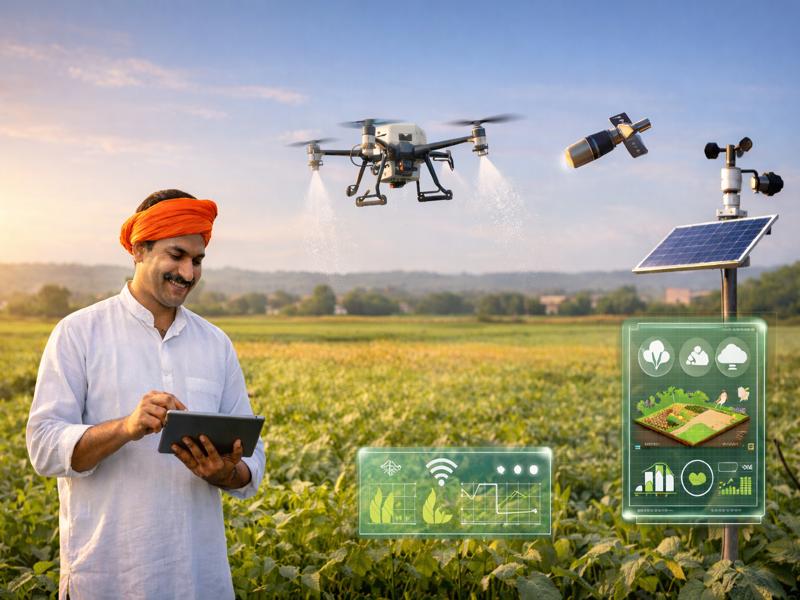
🌾 Digital Agriculture Mission India: Complete Guide for Smart Farming for Farmers (2026)
Agriculture has a very big contribution in India’s economy. Around half of the country’s population depends directly or indirectly on farming. But traditional farming has many challenges- like uncertain weather, low productivity, lack of market information, and not getting proper advice at the right time.
To solve these problems, the Government of India has started the Digital Agriculture Mission India.
This mission is a big step towards making farming digital, smart, and data-based, so that farmers’ income increases and farming becomes more profitable.
🎯 Objective of Digital Agriculture Mission
The main goal of this mission is to connect farming with modern technology and empower farmers.
Key Objectives:
- Make farming digital
- Provide real-time information to farmers
- Deliver benefits of government schemes directly
- Increase agricultural productivity
- Reduce cost and increase profit
The government’s vision is that in coming years, farmers will take decisions based on data and technology.
🧠 AgriStack: Foundation of Digital Farming
The most important part of Digital Agriculture Mission is AgriStack
AgriStack kya hai?
It is a digital platform where all information related to farmers will be available at one place.
Ismein kya shamil hoga:
- Farmer’s name and identity
- Land records
- Crop information
- Data of government schemes
Farmer ID:
Every farmer will be given a unique Farmer ID, through which all services provided to them can be tracked.
👉 With this, the government will be able to provide targeted services to farmers.
📱 Digital Platforms and Mobile Apps
Under the digital mission, many mobile apps and portals are being developed for farmers.
These platforms are mainly operated by Ministry of Agriculture & Farmers Welfare.
What farmers will get?
🌦️ Weather information
📊 Mandi Bhav (Market Price)
🌱 Crop related advice
🧪 Soil information
👉 Farmers can get all the information directly from their mobile.
🤖 Use of AI, Drone and Satellite
In the Digital Agriculture Mission India, the use of new technologies is increasing fast.
Main Technologies:
- Artificial Intelligence (AI)
- Machine Learning
- Drone Technology
- Satellite Imaging
How it is used?
- Crop disease identification
- Production estimation
- Right time for irrigation and fertilizer
👉 With this, farming becomes accurate (Precision Farming).
🌦️ Smart Advisory System
This system gives advice to farmers according to their needs.
On what basis advice is given?
- Weather condition
- Soil quality
- Crop stage
Example:
If rain is coming, then the farmer will get information in advance.
👉 This reduces loss and increases production.
💰 DBT: Direct Benefits to Farmers
A very important part of Digital Agriculture Mission is Direct Benefit Transfer (DBT). This means that subsidy, financial help, and scheme money given by the government is directly transferred to farmers’ bank accounts—without any middleman.
This system is linked with many schemes, like PM-KISAN Samman Nidhi, through which farmers get financial support on time.
Main Benefits of DBT:
💳 Money directly in bank account
⏱️ No delay in payment
🔍 Full transparency
🚫 Reduction in corruption and middlemen
How DBT works?
- Farmer’s bank account is linked with Aadhaar
- After completing eKYC, payment is approved
- Money is directly transferred to the account
👉 This creates a direct connection between government and farmers and makes the system more reliable.
📊 Data-Based Decisions (Data-Driven Governance)
Under the Digital Agriculture Mission India, the government is now taking agriculture-related decisions based on data. Earlier, decisions were based on estimation and experience, but now real-time data and analytics are being used.
In which areas data is being used:
🌾 Crop production estimation
🌧️ Drought and flood management
📉 Market demand and supply analysis
📑 Formation of new agriculture policies
What is the benefit?
- Better planning is done
- Proper use of resources
- Risk is reduced
👉 It helps both government and farmers to take the right decision at the right time.
🤝 Public-Private Partnership (PPP Model)
To make the Digital Agriculture Mission successful, the government has adopted the Public-Private Partnership (PPP) model. In this, the government and private companies work together.
In this process, Ministry of Agriculture & Farmers Welfare collaborates with various agri-tech companies and startups.
Benefits of PPP Model:
🚀 Fast development of new technology
💡 Promotion of innovation
📲 Better digital services to farmers
Examples:
- AI-based farming solutions
- Crop survey using drones
- Smart farming tools
👉 With this, the whole farming system is becoming modern and fast.
🌐 Development of Digital Infrastructure
For the success of the digital mission, it is necessary to have strong digital infrastructure in villages. The government is continuously working in this direction.
Main efforts:
📡 Increasing internet connectivity in rural areas
📱 Promoting smartphone usage
🧑🏫 Providing digital training to farmers
Why is it important?
If a farmer does not have internet and mobile, then he will not be able to take benefit of digital services.
👉 That is why special focus is being given on “Last Mile Connectivity”.
⚠️ Challenges
With every new initiative, some challenges also come. Digital Agriculture Mission is also not untouched by this.
Main Challenges:
📚 Lack of digital literacy
🌐 Problem of internet connection
🔐 Data security and privacy concerns
🤔 Hesitation in adopting new technology
What can be the solution?
- Provide training to farmers
- Provide better network in villages
- Strengthen data security laws
👉 By solving these challenges, the mission can be made more effective.
🚀 Benefits for Farmers
The biggest benefit of Digital Agriculture Mission India will be for farmers.
Main Benefits:
📈 Increase in production
💸 Reduction in cost
🛒 Better market price
⏳ Saving of time
📊 Help in taking right decisions
👉 This will increase farmers’ income and improve their standard of living.
🔮 Future Farming (Future Scope)
Digital Agriculture Mission is not only important for today, but also for the future.
In coming time:
🤖 Fully automated farming
🎯 Precision Farming (accurate farming)
🌍 Direct connection with global market
📡 IoT-based smart farms
👉 India’s farming will become globally competitive and advanced.
📌 How Farmers Can Take Benefit of This Mission?
If you are a farmer and want to take full benefit of this mission, then follow the steps given below:
Important Steps:
📱 Start using smartphone and internet
📝 Register on government portal
🆔 Get Farmer ID made (under AgriStack)
✔️ Complete eKYC
📊 Regularly check apps and portals
👉 The more digital you become, the more benefit you will get.
🧑🌾 Conclusion
Digital Agriculture Mission India has brought a new hope for farmers. This mission is taking farming out of traditional methods and making it modern, smart, and technology-based.
If today’s farmer adopts this change, then he can not only increase his income but also face future challenges easily.
👉 Now is the time to become a “Digital Farmer”.
👉 For more detailed information on technical farming, click here