


How to Grow Walnuts: Best Varieties, Planting, Fertilizers, and Yield
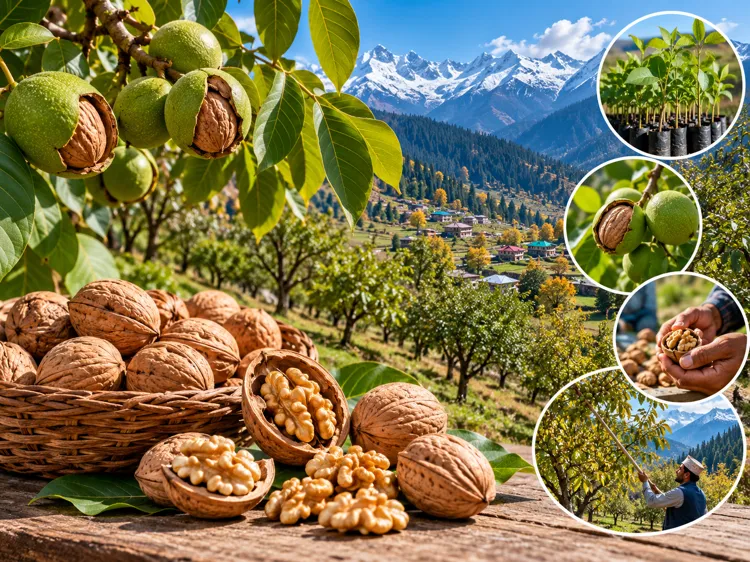
🌰 How to Grow Walnuts? Learn About Climate, Improved Varieties, Planting Methods, and Income
Walnut is an important nut crop, and its demand remains throughout the year in the market. It is used in sweets, bakery products, dry fruits, and healthy diets. Walnuts contain protein, healthy fats, fibre, vitamins, and several essential minerals. This is why they are in demand in both the domestic market and the food processing industry.
In India, walnut cultivation is mainly done in Jammu and Kashmir, Himachal Pradesh, Uttarakhand, and other cold hilly regions. The climate and soil of these regions are suitable for the growth of walnut trees. By selecting the right variety, planting trees at the proper distance, providing balanced fertilisers and water, and taking timely care, farmers can obtain production from a walnut orchard for a long time.
The walnut tree is a perennial crop. Once an orchard is well established, it produces fruits for many years. However, before starting commercial cultivation, it is important to assess the local climate, market, availability of plants, and initial investment.
🌱 1. Where Is Walnut Cultivation Done in India?
Commercial walnut cultivation in India is mainly done in cold and hilly regions. Jammu and Kashmir is among the major walnut-producing regions. Apart from this, walnut orchards are also planted in suitable hilly areas of Himachal Pradesh and Uttarakhand.
Walnut cultivation requires sufficient winter chill and favourable temperatures during summer. In areas where the climate and soil conditions are suitable, walnut trees can grow well.
The major walnut-growing regions are as follows:
- Jammu and Kashmir: The Kashmir Valley and other suitable hilly regions.
- Himachal Pradesh: Mid-altitude and high-altitude areas with cold weather.
- Uttarakhand: Hilly land with suitable temperatures and good drainage.
- Other hilly regions: Areas where winter chill, summer temperatures, and soil conditions are suitable for the requirements of walnut trees.
Before establishing an orchard, farmers should obtain information about locally successful varieties and suitable plants from their district’s agriculture or horticulture department.
🌦️ 2. What Should the Climate Be Like for Walnut Cultivation?
A cold climate is important for good walnut production. Walnut trees require sufficient winter chill, while excessive heat and frost occurring at the wrong time can damage the crop.
Choose a location for a walnut orchard where:
- Sufficient winter chill is available according to the variety.
- Summer temperatures remain favourable for tree growth.
- There is a low risk of severe frost during flowering and fruit formation.
- Strong winds do not cause excessive damage to the trees.
- Rainwater does not remain accumulated in the field for a long time.
Weather plays a very important role during flowering and fruit formation in walnut trees. Therefore, selecting a cold region alone is not enough; the local weather conditions must also match the selected variety.
🪴 3. Which Soil Is Suitable for Walnut Cultivation?
Deep, fertile, well-drained loamy soil is considered best for walnut cultivation. The soil should contain sufficient organic matter so that roots can develop properly and plants continue to receive essential nutrients.
Keep the following points in mind while selecting a field:
- The soil should be deep, providing enough space for the roots to spread.
- The field should have good drainage.
- The soil should contain sufficient organic matter.
- Avoid land that experiences excessive waterlogging.
- Get the soil tested and use manure and fertilisers according to the test results.
Walnut roots are sensitive to waterlogging. Water accumulation in the field can cause root rot and weaken the trees. Therefore, it is important to improve the field’s drainage system before planting.
Soil pH affects the availability of nutrients to plants. Generally, soil with a pH of around 6.0 to 7.5 can be considered suitable for walnut cultivation. However, tolerance may vary according to different varieties and local conditions.
In highly acidic or alkaline soil, some nutrients may not be available to plants in sufficient quantities. This can affect plant growth and production.
Therefore, get the soil tested before establishing a walnut orchard. If the soil pH is outside the suitable range, consult an agricultural expert for corrective measures. Lime or other soil amendments should not be used without testing the soil.
🌰 4. Which Are the Improved Varieties of Walnuts?
In walnut cultivation, the selection of a variety affects production, fruit quality, and the market price. The performance of different varieties may vary according to temperature, altitude, and winter chill in different regions.
Some major walnut varieties are as follows:
- Chandra: Included among the varieties selected for commercial horticulture in suitable regions.
- Gobind: A walnut variety grown in hilly regions.
- SSP: Included among the varieties selected according to local conditions.
- Franquette: A foreign-origin variety that can be grown in a suitable climate.
- Hartley: A variety known for good fruit quality.
- Payne: Another well-known walnut variety.
Farmers should not purchase plants based only on the variety name. It is important to obtain information about local adaptability, flowering time, pollination requirements, fruit quality, and resistance to diseases.
Pollination is also important in walnut cultivation. In many varieties, male and female flowers mature at different times. Therefore, while planning an orchard, farmers should also consider the need for a suitable polliniser variety.
🌿 5. How Are Walnut Plants Prepared?
Walnut plants can also be raised from seeds, but for commercial orchards, grafted plants obtained from a certified nursery are generally more useful. With such plants, it is easier to maintain fruit quality and preserve the identity of the variety.
Keep the following points in mind while purchasing plants:
- The plant should be healthy and disease-free.
- Its roots should be well developed.
- The plant should be purchased from a certified nursery.
- The variety name and plant identity should be clearly mentioned.
- The plant should be suitable for the climate of your region.
Trees grown from seeds may take longer to bear fruit, and their fruit quality may not necessarily be the same as that of the parent tree. Therefore, for commercial cultivation, it is better to purchase plants of the correct variety from a reliable source.
🚜 6. The Right Time and Method for Planting Walnut Trees
The time for planting walnut trees depends on the local climate and winter conditions. In many cold regions, planting is done at the end of winter or the beginning of spring, when the soil is workable and the risk of severe frost is low. In some regions, other planting times may also be suitable according to local conditions.
Prepare the field properly before planting. Remove weeds and ensure proper water drainage.
The general process of planting walnut trees is as follows:
- Mark the planting spots in the field at the proper distance.
- Prepare sufficiently large pits according to the soil conditions and the size of the plant’s roots.
- Mix well-decomposed cow dung manure with the fertile topsoil.
- Carefully place the plant in the pit without damaging its roots.
- Fill the pit with soil and gently press the soil around the plant.
- Irrigate the plant after planting as required.
- Make arrangements to protect the plant from animals and strong winds.
Initial care after planting is very important. Regular inspection helps identify problems such as plants drying out, pests, and diseases in time.
📏 7. What Distance Should Be Maintained Between Walnut Trees?
Walnut trees grow large, and their branches can spread considerably over time. Therefore, it is important to maintain sufficient distance between plants so that the trees get enough sunlight, air, and space for root development.
The distance between plants is decided according to the variety, soil fertility, tree growth, and orchard management system. Traditional orchards may require a spacing of approximately 8 × 8 metres to 10 × 10 metres or even more. This is only general guidance; the final spacing should be decided with the advice of a local horticulture expert.
Benefits of maintaining the proper distance:
- Trees receive sufficient sunlight.
- Branches develop better.
- Proper air circulation is maintained in the orchard.
- Pruning and tree care become easier.
- Competition between large trees is reduced.
💧 8. How to Irrigate Walnut Trees?
Walnut trees require sufficient moisture for good growth and fruit development. It is especially important to maintain soil moisture for young plants and during the fruit development stage.
Keep the following points in mind while irrigating:
- Water young plants regularly according to the weather and soil conditions.
- Monitor soil moisture during summer and dry periods.
- Do not allow water shortage during fruit formation and growth.
- Avoid waterlogging in the field.
- If drip irrigation is available, it can help use water more efficiently.
The amount and interval of irrigation depend on the soil, rainfall, temperature, age of the trees, and local conditions. Therefore, a fixed irrigation interval cannot be considered suitable for every field.
🌱 9. Manure and Fertiliser Management in Walnut Cultivation
Balanced nutrition is essential for the good growth and production of walnut trees. The quantity of manure and fertilisers should be decided according to the age of the tree, soil fertility, and production level.
Include the following practices in manure and fertiliser management:
- Use well-decomposed cow dung manure while preparing the field.
- Apply nitrogen, phosphorus, and potash based on soil test results.
- Correct micronutrient deficiencies as required.
- Do not apply manure or fertilisers directly against the trunk; apply them properly in the active root zone.
- Avoid applying excessive fertilisers, as this can adversely affect tree growth and fruit production.
It is not necessary to apply the same quantity of manure every year. Managing plant nutrition according to soil test results and plant condition helps control expenses and maintain healthy trees.
🌾 10. Weed Control in Walnut Orchards
Weeds take water and nutrients from the soil, which can affect plant growth, especially in young trees. Therefore, it is important to keep walnut orchards free from weeds.
For weed control:
- Carry out weeding and hoeing around the trees from time to time.
- Apply mulch while maintaining a proper distance from the plant trunk.
- When using dry grass or organic mulch, do not cover the trunk.
- If required, adopt other weed control methods with the advice of a local agricultural expert.
Weed control around young plants is particularly important because, during the initial years, plants are more sensitive to competition for water and nutrients.
🌿 11. Which Intercrops Can Be Grown in a Walnut Orchard?
During the initial years, there is sufficient vacant space between walnut plants. During this period, some short-duration crops can be grown according to the area’s climate, water availability, and market demand.
Under suitable conditions for intercropping, farmers can choose legume crops, some vegetables, and seasonal crops that do not grow too tall.
Keep the following points in mind while selecting intercrops:
- The main trees should not face a shortage of water and nutrients.
- The crop roots should not compete excessively with walnut tree roots.
- Sufficient sunlight should be available in the field.
- Irrigation and fertiliser management should be done according to the different requirements of each crop.
- Change the intercropping system as the trees grow older and their shade increases.
Intercropping can provide some additional income during the initial years, but farmers should select crops that do not interfere with the growth of walnut trees.
⏳ 12. When Do Walnut Trees Start Bearing Fruits?
The time when walnut trees start bearing fruits depends on the plant variety, its quality, and cultivation practices. Grafted plants can generally start bearing fruits earlier than trees grown from seeds.
There is a difference between the appearance of the first fruits and the stage when commercial production begins. Fruit production may be low in the beginning, while it can increase as the tree matures.
Farmers should keep the following points in mind:
- Focus on root and branch development during the initial years.
- Provide regular irrigation and balanced nutrition.
- Avoid unnecessary pruning.
- Pay attention to weather conditions and pollination during fruiting.
- Keep expectations of higher production according to the tree’s age and local conditions.
Walnut is a long-term horticultural crop. Therefore, before establishing an orchard, calculate the initial expenses and the period required for income to start.
🧺 13. When and How to Harvest Walnuts?
The walnut harvesting time may vary according to the region, variety, and weather. In many growing regions, walnuts are harvested from late summer through autumn. As the fruits mature, the outer green husk changes, and walnuts begin to fall naturally from the trees.
Keep the following points in mind during harvesting:
- Collect mature walnuts on time.
- Do not leave fallen fruits on the ground for too long.
- Keep the fruits separate from soil and dirt.
- Remove the outer green husk properly.
- Dry the walnuts thoroughly to prevent moisture damage during storage.
Delays in harvesting can affect fruit quality. Therefore, inspect the orchard regularly and harvest according to the maturity stage of the fruits.
📦 14. How to Store Walnuts?
Proper drying and storage after harvesting are essential to maintain walnut quality. Excess moisture increases the risk of fungal growth and deterioration in taste.
For storage:
- Dry the walnuts properly in a clean and well-ventilated place.
- Separate poor-quality and damaged fruits before storage.
- Protect dried walnuts from moisture.
- Use clean, dry, and suitable containers or packaging.
- For long-term storage, choose a cool place with controlled moisture levels.
Properly drying and storing walnuts helps maintain their quality, taste, and market acceptance.
📊 15. How Much Yield Can Be Obtained from Walnut Cultivation?
Walnut production depends on the age of the tree, variety, climate, soil, pollination, irrigation, and orchard management. Therefore, it would not be correct to specify a fixed yield for all regions and orchards.
A well-established and mature orchard may produce more than an orchard in its initial years. However, changes in weather, frost, water shortages, and pests and diseases can also affect the yield.
Keep the following points in mind while estimating production:
- The number of plants and their age.
- The production capacity of the variety.
- Pollination arrangements in the orchard.
- Soil conditions and water availability.
- Fruit quality at the time of harvesting.
- The quantity of marketable walnuts available for sale in the local market.
Before establishing an orchard, it is useful to obtain information about the average local yield and the performance of different varieties from your area’s horticulture department.
💰 16. How to Increase Income from Walnut Cultivation?
To earn better income from walnut cultivation, high production alone is not enough. Fruit quality, timely harvesting, proper drying, and access to a good market are also important.
Farmers can focus on the following points to increase their income:
- Choose a good-quality variety that is suitable for the region.
- Purchase healthy plants from a certified nursery.
- Take regular care of the orchard.
- Clean and dry the fruits properly after harvesting.
- Grade and pack walnuts according to their quality.
- Get market information from local mandis, wholesalers, and processing units.
- If possible, earn additional income through suitable intercrops during the initial years.
Walnut market prices keep changing according to quality, size, variety, moisture, packaging, and demand. Therefore, estimate local market prices and production costs before starting cultivation. It is not appropriate to claim a fixed profit without calculating the actual costs and selling price.
✅ 17. Major Benefits of Walnut Cultivation
Walnut cultivation can be useful for farmers for several reasons, especially in regions where the climate is suitable.
Its major benefits are:
- Long-term Horticulture: Once an orchard is established, the trees can produce fruits for many years.
- Demand in the Nut Market: Walnuts are used for domestic consumption and food processing.
- Value Addition Opportunities: Proper drying, grading, and packaging can create better market opportunities.
- Intercropping: Additional income can be earned by growing suitable crops during the initial years.
- Diversification: Farmers in hilly regions can adopt horticulture along with their traditional crops as an additional income option.
Despite these benefits, it is important to consider the initial investment, the time required for fruiting, weather risks, and market uncertainties in walnut cultivation.
❓ 18. Frequently Asked Questions About Walnut Cultivation
Q1. Where Can Walnuts Be Grown in India?
Walnuts are cultivated in suitable cold hilly regions of Jammu and Kashmir, Himachal Pradesh, and Uttarakhand. The success of cultivation in other regions will depend on local climate conditions and the suitability of the variety.
Q2. What Is the Best Time to Plant Walnut Trees?
The planting time depends on the climate of the region. The end of winter or the beginning of spring may be suitable in cold regions, but it is better to seek advice from the local horticulture department.
Q3. What Distance Should Be Maintained Between Walnut Trees?
In traditional orchards, a distance of approximately 8 × 8 metres to 10 × 10 metres or more can be maintained. The correct spacing depends on the variety, soil, tree growth, and orchard plan.
Q4. How Long Does a Walnut Tree Take to Bear Fruits?
The time required for fruiting depends on the plant variety and its characteristics. Grafted plants can generally start bearing fruits earlier than plants grown from seeds. Trees may take longer to mature and reach commercial production.
Q5. Can Walnut Cultivation Provide Good Income?
Yes, walnut cultivation can become a good income option when the climate is suitable, the variety is good, proper care is provided, and market access is available. To understand the actual profit, it is important to calculate the costs of plants, irrigation, manure and fertilisers, labour, harvesting, and transportation.
Q6. Which Soil Is Best for Walnuts?
Deep, fertile, and well-drained loamy soil is suitable. Waterlogged land can damage the roots.
🌳 Conclusion: Create a Long-Term Income Opportunity Through Walnut Cultivation
Walnut cultivation can be a useful option for farmers whose regions have a cold climate, suitable soil, and sufficient water. Selecting the right variety, establishing an orchard with healthy plants, maintaining proper spacing, providing balanced manure and water, and taking timely care can improve tree growth and fruit quality.
Farmers should also understand that walnut is a long-term crop. After the initial investment, it may take time to obtain fruits and commercial production. Therefore, before establishing an orchard, consult local agricultural experts, understand market demand, and calculate the total cost.
If the farming plan is prepared properly, a walnut orchard can provide opportunities for nut production and additional income for a long time.
📚 References
- Ministry of Agriculture & Farmers Welfare, Government of India – Guidance related to crop production, plant protection, and agriculture.
- Indian Council of Agricultural Research (ICAR) – Information related to agricultural research, crop management, and pest and disease management.
- National Horticulture Board (NHB) – Information related to production and plant protection of horticultural crops.
- Vikaspedia – Multilingual knowledge portal of the Government of India.