

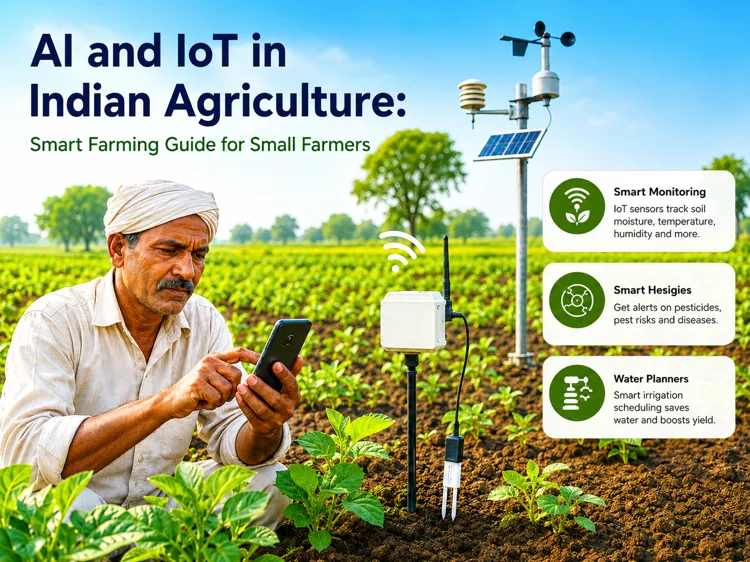
AI and IoT in Indian Agriculture: Smart Farming Guide for Small Farmers
🤖 AI and IoT in Indian Agriculture: Smart Farming Guide
Indian small farmers make daily decisions about irrigation, fertilizer, pest control, labour, harvesting, and crop sales while dealing with changing rainfall, water shortages, rising input costs, pest and disease risks, and uncertain prices. For a farmer cultivating one or two acres, technology is useful only when it addresses a specific farm problem at a reasonable cost.
Artificial intelligence (AI), Internet of Things (IoT) sensors, weather information, satellite imagery, drones, soil testing, and digital advisories can help farmers collect and interpret information. However, these technologies are decision-support tools, not substitutes for local agricultural knowledge or professional advice.
🌾 1. Why Small-Farm Technology Matters in India
Agriculture Census 2015-16 data show that marginal holdings below 1 hectare accounted for 68.45% of operational holdings, while small holdings of 1–2 hectares accounted for 17.62%. Together, marginal and small holdings represented 86.07% of operational holdings. The average size of all operational holdings was 1.08 hectares.
This landholding structure matters when choosing farm technology. A large automated system may be practical for a commercial farm but uneconomical for a farmer cultivating one or two acres. Small farmers therefore need affordable sensors, mobile-based advisories, rental services, shared equipment, and technologies that can demonstrate value on a limited area.
🌱 2. What Is Smart Farming?
Smart farming means using field data and digital tools to improve agricultural decisions. It does not necessarily mean installing expensive equipment.
For example, a soil-moisture sensor can provide information about conditions around the crop root zone. A weather alert can help a farmer reconsider spraying before rainfall. A smartphone-based image tool can screen a leaf for possible disease symptoms. Satellite imagery can help identify areas of a field showing unusual crop development.
The important question is not whether a technology is advanced. It is whether the information helps the farmer make a better decision.
Market Intelo research on precision agriculture and smart farming estimates the global sector at $18.2 billion in 2025, with a projected value of $51.7 billion by 2034. This figure describes the broader technology ecosystem and should not be interpreted as a prediction of income, savings, or returns for an individual Indian farmer.
🧠 3. What Can AI Do on a Small Farm?
AI can process images, weather information, historical records, sensor readings, and other datasets to identify patterns that may support farm decisions.
Potential applications include:
- Crop disease and pest image screening
- Weed identification
- Crop monitoring
- Irrigation scheduling
- Weather-based advisories
- Yield estimation
- Field mapping
- Fertilizer planning
- Farm record management
NITI Aayog has identified computer vision, machine learning, remote sensing, IoT, and drone imagery as technologies with applications in agricultural monitoring and precision management.
However, AI-generated recommendations should be treated carefully. A photograph may not contain enough information to distinguish between a disease, nutrient deficiency, pest damage, or environmental stress. Important crop-health decisions should therefore be verified with agricultural officers, Krishi Vigyan Kendras, or qualified agronomists.
Example: AI for Vegetable Farming
Suppose a tomato farmer notice yellowing leaves. A mobile application may help identify possible causes from an image. Instead of immediately applying a pesticide or fertilizer, the farmer can use the result as an initial screening step and verify the diagnosis through local agricultural expertise.
This approach reduces the risk of treating the wrong problem.
📡 4. How IoT Helps Indian Farmers
IoT connects physical devices such as sensors with software that records measurements and can generate alerts.
Depending on the system, farm sensors can measure:
- Soil moisture
- Soil or air temperature
- Relative humidity
- Water levels
- Weather conditions
- Other crop or irrigation parameters
Repeated measurements can help farmers understand how field conditions change instead of relying only on occasional manual observations.
For example, a farmer growing vegetables under drip irrigation can monitor soil moisture and compare it with irrigation events, rainfall, crop stage, and yield. The purpose is not to irrigate automatically simply because a sensor is installed. The purpose is to improve the timing of irrigation.
Sensor installation also matters. Devices should be placed in representative locations and at appropriate root-zone depths. Farmers should ask about calibration, battery replacement, connectivity, maintenance, software charges, and warranty before purchasing.
Where mobile connectivity is weak, systems with local displays, offline storage, or low-bandwidth communication may be more practical.
⚙️ 5. Which Technology Should a Small Farmer Choose?
| Farming problem | Suitable technology | Practical purpose |
| Excessive or poorly timed irrigation | Soil-moisture sensor | Support irrigation decisions |
| Possible pest or disease problem | AI image screening + expert verification | Early identification |
| Weather uncertainty | Weather alerts | Plan spraying and field work |
| Uneven crop growth | Satellite or drone imagery | Identify areas requiring inspection |
| Fertilizer uncertainty | Soil testing + farm records | Match inputs with crop requirements |
| Repetitive field monitoring | IoT sensors | Collect regular observations |
| High equipment cost | Rental/shared services | Avoid full ownership |
| Poor farm record keeping | Digital farm records | Track inputs and outcomes |
The best first technology is usually the one connected to the farm’s most significant recurring problem.
💧 6. Smart Irrigation and Water Management
Water management is a practical area for testing digital agriculture because irrigation involves measurable activities such as pumping, electricity or diesel consumption, labour, and irrigation frequency.
A farmer using drip irrigation can record:
- Irrigation date
- Pumping duration
- Water volume, where measurable
- Rainfall
- Soil-moisture readings
- Electricity or diesel consumption
- Crop growth
- Final yield
If rainfall has already provided sufficient moisture, sensor information may indicate that irrigation can be postponed. The actual benefit will depend on soil type, crop, weather, irrigation system, pump efficiency, sensor placement, and farm management.
Farmers should compare technology-assisted irrigation with previous practice rather than assuming that sensors automatically reduce water use.
🚁 7. Drones and Satellite Technology for Small Farms
Drones can collect high-resolution imagery for crop scouting, field mapping, stress identification, and selected agricultural operations. Satellite data can provide broader information for crop monitoring, mapping, and assessment.
For a farmer cultivating one or two acres, purchasing a drone may not be economical. Ownership involves more than the aircraft itself. Costs can include batteries, software, maintenance, training, operation, and applicable regulatory requirements.
For many small farmers, drone rental and service models may be more practical than ownership.
Farmers can investigate services offered through Custom Hiring Centres, Farmer Producer Organisations (FPOs), cooperatives, agricultural institutions, and private service providers.
Government programmes have also supported drone access and agricultural mechanisation through different schemes and assistance mechanisms. Eligibility and assistance conditions can vary, so farmers should verify the current rules before making financial decisions.
Important: There is no single nationwide drone rental price that applies to every farm. Charges can vary according to crop, location, acreage, operation, operator, and whether the service involves imaging or spraying.
🌾 8. Crop-Specific Examples of Smart Farming
8.1. Cotton
A cotton farmer can combine weather information, field scouting, pest observations, and digital records to improve monitoring for pest pressure. AI-based image tools may assist with preliminary identification, but pesticide decisions should be based on reliable diagnosis and recommended agricultural practices.
8.2. Tomato and Other Vegetables
Vegetable crops can benefit from closer monitoring because irrigation and crop-health decisions may need to be made frequently. Soil-moisture information can support irrigation scheduling, while image-based tools can help flag possible disease symptoms for further verification.
8.3. Rice
Rice farmers can use weather information, field records, and remote-sensing information where available to support crop monitoring. Digital tools should complement, rather than replace, local water-management practices and agronomic recommendations.
8.4. Sugarcane
For longer-duration crops such as sugarcane, digital records can help track irrigation, fertilizer applications, pest observations, and crop development over time. Farmers can compare these records with yield and input costs at the end of the season.
8.5. Horticulture and Fruit Crops
Orchard farmers can use weather alerts, field photography, irrigation monitoring, and satellite or drone services to identify areas requiring closer inspection. Shared drone services may be more practical than purchasing equipment for a small orchard.
💰 9. What Does Smart Farming Cost?
Technology should be evaluated as a complete system rather than by looking only at the purchase price.
A sensor project may involve:
- Sensor hardware
- Installation
- Connectivity
- Gateway equipment
- Mobile or web software
- Batteries
- Calibration
- Maintenance
- Replacement parts
Similarly, digital advisory services may be free, subscription-based, or bundled with another agricultural service.
Farmers should ask vendors whether quotations include installation, training, taxes, connectivity, software access, maintenance, warranty, and after-sales support.
A lower upfront price is not necessarily a lower total cost if important services are excluded.
Measuring ROI and Payback
Farmers should measure results before expanding a technology project.
Simple ROI = [(Annual measurable benefit − annualized investment cost) ÷ annualized investment cost] × 100
Simple payback period = Initial investment ÷ annual measurable benefit
Consider a hypothetical two-acre vegetable farmer who spends ₹10,000 on a technology pilot. If the measurable annual benefit is ₹5,000, the simple payback period would be two years.
This is only an example, not an expected return.
Measurable benefits may include:
- Lower pumping costs
- Reduced input waste
- Fewer scouting hours
- Reduced crop damage
- Lower labour requirements
- Additional saleable yield
Farmers should avoid including uncertain or assumed benefits in the calculation.
👨🌾 10. A Practical Two-Acre Farmer Case Study
Consider a hypothetical farmer growing vegetables on two acres who frequently irrigates the crop and has experienced losses from late pest detection.
Instead of purchasing a drone, the farmer begins with soil-moisture monitoring and a digital crop advisory service.
The farmer records irrigation frequency, pumping time, input purchases, labour hours, pest incidents, crop damage, yield, and technology expenses.
At the end of the season, the farmer compares the results with the previous season.
If the technology produces measurable improvement without compromising yield or crop quality, the farmer can consider expanding the system. If the results are weak, the farmer can identify whether the problem was technology selection, installation, connectivity, interpretation, or agronomic practice before making another investment.
🚜 11. How Small Farmers Can Start With Smart Farming
- Identify one recurring problem, such as excessive irrigation, pest losses, or labour-intensive monitoring.
- Select the simplest technology that addresses that problem.
- Compare at least two quotations or service providers.
- Ask about installation, connectivity, maintenance, training, warranty, and support.
- Start with one crop, plot, or defined area.
- Record costs, water use, inputs, labour, crop damage, and yield.
- Compare results with the previous season or a suitable comparison area.
- Calculate the actual ROI and payback period.
- Expand only when the evidence supports the next investment.
⚠️ 12. Challenges of Smart Farming for Smallholders
Technology adoption can be difficult when farmers face high equipment costs, limited digital literacy, weak connectivity, maintenance requirements, or uncertainty about data use.
Shared services can reduce ownership costs. FPOs, Custom Hiring Centres, cooperatives, and local service providers can improve access to equipment without requiring every farmer to purchase it.
Training is equally important. A farmer may own a technically capable sensor but receive little benefit if the device is incorrectly installed or its readings are misunderstood.
Local-language training, demonstrations, simple interfaces, and accessible technical support can make digital agriculture more practical.
Farmers should also ask technology providers:
- Who owns the farm data?
- What information is collected?
- How long is it retained?
- Who can access it?
- Is it shared with third parties?
- Can the farmer request deletion where applicable?
- What happens if the service is discontinued?
India’s Digital Agriculture Mission is developing digital public infrastructure for agriculture, while government information on AgriStack describes a federated structure in which relevant state governments and Union Territories maintain the foundational registries.
🏛️ 13. Government Support for Digital Agriculture in India
The Union Cabinet approved the Digital Agriculture Mission on 2 September 2024 with an outlay of ₹2,817 crore, including a central share of ₹1,940 crore. The mission is intended to support digital public infrastructure and other technology initiatives in agriculture.
Key components include AgriStack, the Krishi Decision Support System, soil fertility and profile mapping, and digital crop-estimation initiatives. AgriStack includes the Farmers Registry, Geo-Referenced Village Maps, and Crop Sown Registry.
The Krishi Decision Support System is intended to bring together information such as geospatial data, weather, satellite information, water resources, and other agricultural datasets.
Farmers should not assume that government support means a particular device will automatically receive a subsidy. Eligibility, approved equipment, assistance levels, application procedures, and implementation can differ by scheme and state.
Before purchasing equipment, farmers should check the latest information from the relevant Central Government department, state agriculture department, or authorised implementing agency.
🔮 14. Future of AI and IoT in Indian Agriculture
The future of smart farming is likely to involve greater integration between AI advisories, IoT sensors, weather information, satellite data, drones, soil information, and digital farm records.
The value will come from connecting these technologies to specific farm decisions rather than collecting data simply because the technology is available.
For small farmers, useful outcomes can include better irrigation timing, improved crop monitoring, reduced unnecessary field visits, better input planning, and earlier identification of potential crop problems.
These outcomes should be measured rather than promised.
❓ 15. Frequently Asked Questions for AI and IoT in Indian Agriculture
Q1. What is smart farming?
Smart farming uses data, sensors, AI, IoT, satellites, drones, weather services, and digital tools to support agricultural decisions.
Q2. Is smart farming suitable for one or two acres?
Yes. Small farmers can use mobile advisories, soil testing, sensors, rented drone services, and shared equipment when these options address a specific farm problem.
Q3. Which technology should a small farmer use first?
Start with the technology that addresses the farm’s largest recurring cost or loss. If irrigation is the main concern, soil-moisture monitoring may be a practical starting point.
Q4. Can AI diagnose crop diseases?
AI image tools can screen for possible symptoms, but farmers should verify important diagnoses with qualified agricultural experts before taking treatment decisions.
Q5. How much do IoT farming sensors cost?
There is no single standard price. Costs depend on sensor type, accuracy, connectivity, installation, software, maintenance, and other specifications. Farmers should obtain current local quotations.
Q6. Do IoT sensors require maintenance?
Yes. Correct installation, sensor protection, calibration checks, battery management, connectivity checks, and periodic inspection may be required.
Q7. Should small farmers buy drones?
Not necessarily. Farmers should compare the total ownership cost with local rental or service charges and expected usage before purchasing.
Q8. How can farmers reduce smart-farming costs?
Shared services, Custom Hiring Centres, FPOs, cooperatives, rental providers, and agricultural institutions may provide access without full equipment ownership.
Q9. Are government subsidies guaranteed?
No. Eligibility, subsidy rates, approved equipment, application procedures, and scheme implementation can vary. Farmers should verify current official information.
Q10. Can AI and IoT guarantee higher farm income?
No. Technology can support better decisions, but farm income continues to depend on weather, prices, crop health, input costs, management, and other factors.
🎯 Conclusion
AI and IoT can support more data-driven farming in India without requiring every small farmer to purchase expensive equipment.
With marginal and small holdings accounting for 86.07% of operational holdings in the Agriculture Census 2015-16, practical adoption depends on affordability, shared access, local training, reliable information, and measurable results.
The most practical approach is to start with one problem, choose the simplest suitable technology, conduct a defined pilot, record costs and outcomes, and expand only when the evidence supports the investment.
Smart farming is not about buying the most advanced device. It is about using timely and relevant information to make better decisions about water, inputs, labour, crop health, and farm risk.
Source: MarketIntelo – Precision Agriculture and Smart Farming Market