


Top 15 Farming Business Ideas in India to Make Money (2026)
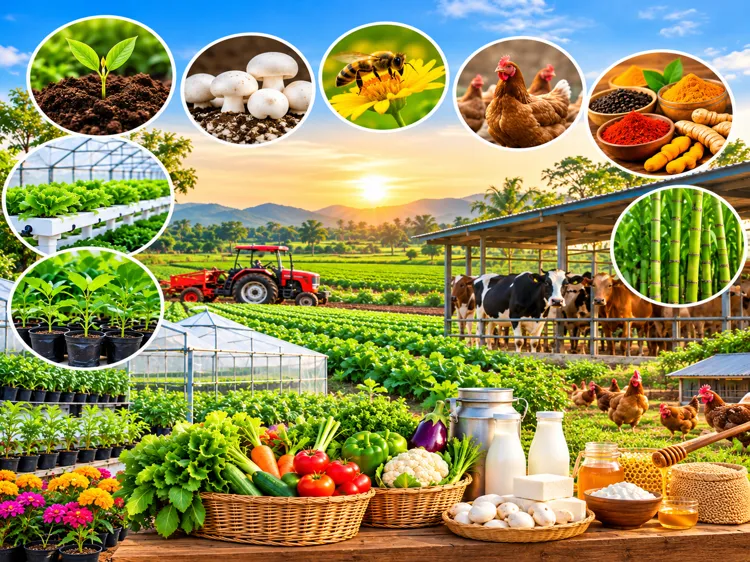
🌾 Top 15 Farming Business Ideas in India to Make Money (2026): Start a Profitable Business with Low Investment
Farming in India is not limited to growing food grains. Today, farmers can increase their income through businesses such as animal husbandry, mushroom production, beekeeping, organic manure production, plant nurseries, and agricultural product processing, along with traditional farming. With the right planning, market demand, and the use of modern technologies, farming can be turned into a successful business.
If you are a farmer, live in a village, or want to start a new business in the agriculture sector, this article will be useful for you. Here, we will learn in detail about the top 15 farming business ideas in India to make money, their potential, required resources, markets, and ways to get started.
📌 What Will You Learn in This Article?
- What is an agriculture business, and how can you earn money from it?
- Farming businesses that can be started with low investment.
- Business ideas for people who own land and those who do not have much land.
- Important steps required to start an agriculture business.
- How to properly calculate costs, profits, and market potential.
- Important points related to government support, training, and risk management.
🌱 1. What Is an Agriculture Business and How Can You Earn Money from It?
An agriculture business means carrying out farming and related activities for commercial purposes. It includes crop production, animal husbandry, buying and selling agricultural products, manure production, food processing, plant production, and services related to agricultural technology.
For example, instead of growing wheat and selling it only in the market, a farmer can also sell it after cleaning, packaging, and processing it into flour. Similarly, a farmer who grows vegetables can supply their produce to local shops, hotels, restaurants, and customers directly.
Income from an agriculture business can mainly be earned through the following methods:
- Selling crops, fruits, vegetables, and flowers.
- Selling milk, eggs, honey, and other animal products.
- Processing and packaging agricultural products.
- Producing plants, seeds, and organic manure.
- Earning income through agricultural equipment and technical services.
- Building a direct sales network between farmers and customers.
Note: Profit is not guaranteed in any agricultural business. It depends on your location, investment, production costs, weather, market prices, and sales arrangements.
💰 2. Top 15 Best Farming Business Ideas in India to Make Money
2.1. 🥬 Organic Farming Business
Organic farming can be a good option for farmers who want to reduce their dependence on chemical inputs and sell naturally grown products in the local market.
In this business, you can grow vegetables, fruits, grains, pulses, and spices. Organic farming focuses on improving soil health, using organic manure, and adopting suitable natural methods for pest management.
How to Start?
- Choose suitable crops according to your area.
- Get your farm soil and water tested.
- Use cow dung manure, compost, and other approved inputs properly.
- Contact local shopkeepers, customers, and sellers of organic products.
- If you want to sell products as certified organic, learn about the applicable certification and labelling rules.
Earning Potential: Selling good-quality products directly to customers may help you get better prices. However, higher profits from organic farming are not guaranteed, and increasing production may take time.
2.2. 🐄 Dairy Farming Business
Dairy farming is a popular agriculture-related business in India. In this business, milk is sold by rearing cows or buffaloes. In addition, if there is demand and the necessary resources are available, income can also be increased by selling products such as curd, paneer, and ghee.
Before starting a dairy business, arranging fodder, water, veterinary care, and a proper system for selling milk is more important than simply buying animals.
How to Get Started?
- Choose healthy animals suitable for the local climate.
- Build a clean and well-ventilated shed for the animals.
- Arrange green fodder, dry fodder, and balanced animal feed.
- Maintain milk quality.
- Arrange milk sales through a dairy cooperative society, milk collection centre, or local customers.
How to Increase Earnings?
Regular milk supply, proper animal health management, and control over fodder costs can help improve profits. However, losses may also occur due to diseases, reduced milk production, and rising fodder prices.
2.3. 🍄 Mushroom Farming
Mushroom farming can be a useful option for people who have limited land but can provide a clean and controlled growing environment.
You can start oyster mushroom farming on a small scale. Button and milky mushrooms may require different arrangements according to their specific growing requirements.
Ways to Start a Mushroom Business:
- First, find out the demand for mushrooms in your area.
- Get training from a Krishi Vigyan Kendra (KVK) or a reliable training institute.
- Arrange a clean room, suitable substrate, and good-quality mushroom spawn.
- Take care of temperature, humidity, ventilation, and cleanliness.
- Contact buyers before the mushrooms are ready for harvesting.
Main Markets: Vegetable sellers, hotels, restaurants, local markets, and direct customers.
Mushrooms can spoil quickly, so it is important to arrange timely harvesting, packaging, transportation, and sales. Starting with small batches of production is a better option.
2.4. 🐝 Beekeeping and Honey Production
Beekeeping can provide an opportunity to earn additional income along with farming. Apart from honey, products such as beeswax can also be obtained from this business.
Bees help pollinate many crops, which may improve crop production and quality under certain conditions.
How to Start?
- Get practical training in beekeeping.
- Check the availability of flowers and pollen sources in your area.
- Arrange beehive boxes and bee colonies at a suitable location.
- Take care of bee health and protect them from pests.
- Make proper arrangements for honey extraction, filtering, packaging, and sales.
If you want to sell honey under your own brand name, learn about the applicable food safety, quality, and labelling rules.
2.5. 🐔 Poultry Farming Business
In poultry farming, birds are reared for egg production or meat production. This business can be started on a small scale, but regular care and disease prevention are very important.
Main Types of Poultry Farming:
- Layer farming: Egg production.
- Broiler farming: Meat production.
- Desi poultry farming: Selling eggs and meat according to local demand.
Important Things to Know Before Starting:
- Check the local demand for eggs and chicken.
- Arrange a shed, proper ventilation, and clean drinking water.
- Ensure balanced feed and veterinary support.
- Follow expert advice on vaccination and biosecurity.
- Contact buyers and sales centres in advance.
This business involves risks such as feed costs, disease outbreaks, mortality rates, and changes in market prices. Therefore, avoid investing a large amount at the beginning.
2.6. 🌿 Vermicompost and Organic Manure Production
In vermicompost production, organic waste is converted into manure with the help of suitable earthworms. This business can be useful for farmers who have access to cow dung, crop residues, and organic waste.
How to Get Started?
- Choose a shaded place with proper drainage.
- Arrange suitable raw materials and earthworms.
- Maintain suitable moisture and temperature levels.
- Sieve the finished manure and pack it safely.
- Contact nurseries, gardeners, and farmers to sell your product.
The availability of raw materials and local demand can benefit this business. However, producing good-quality manure and building a regular customer base takes time.
2.7. 🌼 Flower Farming Business
Flower farming is also known as floriculture. You can grow marigold, rose, tuberose, gladiolus, and other flowers suitable for your local area.
Flowers may be in demand for weddings, festivals, religious events, decoration, and flower shops.
Ways to Start the Business:
- Choose flower varieties according to the climate in your area.
- Assess the soil, irrigation, and plant requirements.
- Match the planting time with local market demand.
- Contact flower sellers, event decorators, and wholesale traders.
- Arrange ways to keep flowers fresh after harvesting and deliver them quickly.
Flowers can spoil quickly, and their prices may change significantly during festivals or special events. Therefore, it is important to produce flowers according to market demand.
2.8. 🪴 Plant Nursery Business
If you have a small piece of land, water, and time to take care of plants, a nursery business can be a good option.
You can grow vegetable seedlings, fruit plants, ornamental plants, flower plants, and other plants used in gardening.
Ways to Earn Money from a Nursery:
- Sell vegetable seedlings to farmers.
- Sell fruit plants and ornamental plants.
- Provide pots, growing media, and gardening materials.
- Take orders from local customers and through online platforms.
The success of a nursery depends on plant quality, the reliability of plant varieties, and the availability of plants at the right time of the year. When selling fruit plants, pay special attention to the authenticity of their varieties and sources.
2.9. 🎋 Bamboo and Other Commercial Tree Farming
Growing bamboo and certain other commercial trees can be a long-term investment option. Bamboo is used in construction, handicrafts, furniture, and other products.
However, tree-based businesses may take time to generate income. Therefore, they should not be considered an option for earning immediate, regular income.
Things to Consider Before Starting:
- Choose a species suitable for your area’s climate and soil.
- Buy plants from a reliable source.
- Gather information about local buyers and processing units.
- Estimate irrigation, maintenance, and harvesting costs.
- Check local rules related to harvesting and transportation.
It is important to research the potential market before planting trees so that you do not face difficulties selling the finished products.
2.10. 💧 Hydroponic Farming
In hydroponic farming, plants are grown with the help of nutrients dissolved in water instead of soil. This technique is used to produce leafy vegetables and certain herbs.
It can be useful in areas where farming can be carried out in a controlled environment in limited space and buyers for premium-quality products are available nearby.
Main Requirements:
- A suitable hydroponic system.
- Clean water and a balanced nutrient solution.
- Regular monitoring of pH and nutrients.
- Adequate light and suitable temperature.
- Arrangements for electricity, equipment, and technical maintenance.
The initial cost of this business may be higher than that of traditional farming. Therefore, before investing, conduct a practical assessment of the market, electricity costs, technical support, and potential production.
2.11. 🌾 Agricultural Product Processing and Packaging
Processing agricultural products gives farmers an opportunity to sell finished or value-added products instead of raw produce.
For example, wheat can be processed into flour, turmeric into powder, tomatoes into sauce, and fruits into jam or other processed products.
Options That Can Be Started on a Small Scale:
- Flour and spice processing.
- Cleaning and packaging pulses.
- Dried fruits and vegetables.
- Pickles, murabba, and other food products.
- Grading and packaging grains and pulses.
In this business, you should consider raw material quality, machine capacity, electricity, packaging, storage, and sales costs.
To manufacture and sell food products, you may need to comply with applicable FSSAI registration or licensing requirements and other relevant rules.
2.12. 🌾 Seed Production Business
There is a demand for good-quality seeds during every farming season. Seed production is different from regular crop production because special attention must be given to varietal purity, quality, and germination capacity.
How to Start a Seed Business?
- Choose a crop suitable for your climate and land.
- Learn about certified seed production programmes and authorised organisations.
- Select a suitable seed source.
- Follow the rules related to required spacing, isolation, and crop inspection.
- Make proper arrangements for seed cleaning, testing, packaging, and storage.
Before selling seeds commercially, make sure you understand the relevant seed laws and applicable quality standards.
2.13. 🥭 Direct Selling of Fruits and Vegetables
Farmers can explore alternatives to traditional selling systems by supplying their produce directly to consumers, shopkeepers, restaurants, and local institutions.
In this model, building direct contact with customers and providing products according to quality requirements are important.
Ways to Sell Directly:
- Prepare weekly vegetable baskets for local customers.
- Supply products regularly to shops and restaurants.
- Take orders through platforms such as WhatsApp.
- Set up stalls at local farmers’ markets.
- Sell suitable products after grading and packaging them.
Direct selling may help farmers get better prices, but the costs of delivery, packaging, customer service, and unsold produce should also be included.
2.14. 🚜 Agricultural Equipment Rental Business
How to Start This Business?
- Make a list of the equipment most commonly used in your area.
- Ask farmers which equipment they need.
- Estimate equipment purchase, maintenance, and fuel costs.
- Decide the rental rates and booking arrangements.
- Set rules for the safe use and timely return of equipment.
You can start by working with one or two pieces of equipment that have high demand. Since equipment usage is seasonal, estimate your annual income carefully.
2.15. 🌶️ Spice and Medicinal Plant Farming
However, every crop is not suitable for every area. It is important to choose crops according to the soil, climate, water availability, and local market.
Things to Consider Before Starting the Business:
- Choose a suitable species according to your area.
- Check the quality of seeds or planting material.
- Understand the crop’s growing period and production costs.
- Contact potential buyers and processing units.
- Arrange facilities for drying, cleaning, and storage after harvesting.
In the case of medicinal plants, it is especially important to understand buyer requirements and quality standards in advance. Do not choose a crop based only on claims of high profits.
📊 3. How Much Investment Is Required for Different Farming Businesses?
It is important to estimate the investment required before starting an agriculture business. The figures given below are broad estimates for initial planning only. They do not guarantee the actual cost or profit of any business.
| Agriculture Business | Estimated Initial Investment | Main Requirements |
|---|---|---|
| Vermicompost Production | ₹10,000–₹75,000 | Organic waste, space, and water |
| Beekeeping | ₹30,000–₹1.5 lakh | Boxes, bee colonies, and training |
| Mushroom Production | ₹25,000–₹2 lakh | Clean room and growing materials |
| Plant Nursery | ₹30,000–₹3 lakh | Space, plants, and irrigation |
| Flower Farming | ₹40,000–₹3 lakh | Land, plants, and market |
| Poultry Farming | ₹1 lakh–₹5 lakh | Shed, birds, and feed |
| Dairy Farming | ₹2 lakh–₹10 lakh or more | Animals, fodder, and shed |
| Hydroponic Farming | ₹1 lakh–₹10 lakh or more | System, water, and technology |
| Food Processing | ₹1 lakh–₹15 lakh or more | Machines, packaging, and compliance |
The actual cost can vary significantly depending on land, buildings, machinery, the number of animals, production capacity, and local prices. These estimates do not include land purchases, working capital, or all other expenses in every situation.
🧑🌾 4. How to Choose the Right Agriculture Business for Yourself?
Every business is not suitable for every farmer. Therefore, assess your situation before investing.
4.1. Assess Your Land and Resources
If you have enough agricultural land, you can consider options such as crop production, flower farming, or a plant nursery.
If you have limited land, options such as mushroom production, a nursery, or small-scale packaging of agricultural products may be useful.
4.2. Check Local Market Demand
Before starting a business, it is important to find out who will buy your products.
For example, before starting mushroom production, talk to shopkeepers and restaurants. Before starting a dairy business, check the availability of milk collection centres or customers.
4.3. Calculate Your Capital and Operating Expenses
The cost of purchasing only machinery, animals, or initial materials is not enough. You should also include expenses for fodder, electricity, labour, transportation, packaging, maintenance, and sales.
4.4. Give Priority to Experience and Training
Avoid making a large investment in a business that uses new technology without proper training. You can get training and expert advice from Krishi Vigyan Kendras (KVKs), agricultural universities, and relevant departments.
4.5. Start on a Small Scale
Wherever possible, first test production or sales on a small scale. Expand the business only after understanding the actual costs and market response.
📝 5. Step-by-Step Process to Start an Agriculture Business
Step 1: Choose a Business Idea
Choose a business according to your land, budget, skills, and local demand.
Step 2: Conduct Market Research
Talk to at least a few potential buyers. Understand the product demand, quality requirements, quantity, packaging, and payment terms.
Step 3: Prepare a Business Plan
Include the following points in your business plan:
- Initial investment.
- Monthly or seasonal expenses.
- Production capacity.
- Expected selling price.
- Information about buyers and sales channels.
- Available financial arrangements in case of losses.
Step 4: Arrange the Necessary Resources
Assess your requirements for land, water, machinery, raw materials, training, and employees.
Step 5: Check Registration and Licensing Requirements
Depending on the type of business, check the applicable FSSAI, GST, local authority, seed, fertiliser, or other relevant rules. The same permissions are not required for every business.
Step 6: Make Sales Arrangements
Before starting production, establish contact with potential buyers, wholesalers, cooperative societies, or direct sales channels.
Step 7: Maintain Records of Costs and Profits
Record the expenses and sales for every batch or production cycle. This will help you understand whether the business is actually generating a profit.
🏦 6. Government Support and Financing for Agriculture Businesses
You can explore various government schemes, bank loans, and institutional support to start or expand an agriculture business.
Possible options include:
- Kisan Credit Card (KCC): Credit facilities for eligible farmers’ agricultural and related needs, according to the applicable provisions.
- Pradhan Mantri Mudra Yojana: Financial assistance for eligible micro-businesses, subject to the applicable conditions.
- Agriculture Infrastructure Fund (AIF): Financial support for eligible agricultural infrastructure projects according to the prescribed rules.
- Rashtriya Krishi Vikas Yojana (RKVY): Support through various approved projects and programmes in the agriculture sector.
- State Government Schemes: State-specific schemes related to animal husbandry, horticulture, irrigation, agricultural mechanisation, and processing.
Scheme eligibility, financial benefits, and availability may vary depending on the time and state. Before applying, confirm the current rules with the relevant government department, bank, or official portal. Subsidies or loan approvals are not guaranteed under any scheme.
⚠️ 7. Important Ways to Avoid Losses in an Agriculture Business
An agriculture business can face losses due to weather, production issues, diseases, and market uncertainties. Follow these important measures to reduce risks.
7.1. Do not increase production without a market. First, gather information about potential buyers and selling prices.
7.2. Plan according to the weather. Use irrigation, drainage, and weather-based agricultural advice.
7.3. Maintain quality. Poor-quality products can affect both customer trust and sales.
7.4. Record all expenses. Include labour, transportation, electricity, packaging, and spoiled produce in your production costs.
7.5. Keep emergency funds. During the initial stage of the business, arrange funds for a few months of essential operating expenses.
7.6. Reduce dependence on a single source of income. Wherever practical, start a suitable supplementary activity alongside your main farming business.
7.7. Check your repayment capacity before taking a loan. Assess your ability to repay instalments based on realistic and cautious income estimates rather than expected sales alone.
🚀 8. Modern Technologies to Increase Farming Income
Today, the proper use of technology in agriculture can help reduce costs and organise work more efficiently.
- Drip Irrigation: For better water management in suitable crops.
- Soil Testing: To understand nutrient requirements and improve fertiliser management.
- Digital Marketing: To share product information with customers.
- Weather-Based Advice: To plan irrigation, spraying, and harvesting.
- Grading and Packaging: To maintain product quality and organise sales.
- Digital Records: To maintain records of production, expenses, sales, and payments.
Choose technology according to your needs and budget. Before buying expensive equipment, check whether the potential benefits justify its cost.
❤️ Conclusion: Make Farming a Strong Source of Income with the Right Planning
There are many business opportunities available to increase farming income in India. Businesses such as organic farming, dairy farming, mushroom production, beekeeping, vermicompost production, plant nurseries, flower farming, and agricultural product processing can be useful in different situations.
However, you should not choose a business only by looking at its potential earnings. It is more important to make a decision after considering your land, water availability, investment, experience, market, and production costs.
If you are starting an agriculture business for the first time, choose an option that allows you to gain practical experience with limited investment. Start on a small scale, build trust with buyers, and keep records of your actual profits. Only then should you expand the business.
Remember: Success in farming depends not only on good production but also on proper planning, quality, cost control, and timely sales.
❓ Frequently Asked Questions (FAQs) About Agriculture Businesses
Q1. Which Is the Best Agriculture Business in India?
The best business depends on your land, budget, skills, and local market. Options such as mushroom production or a plant nursery may be useful in limited spaces, while animal husbandry or agricultural processing requires different resources.
Q2. Which Agriculture Business Can Be Started with Low Investment?
Vermicompost production, small-scale mushroom production, beekeeping, and plant nurseries can be started with low investment in certain situations. The actual cost varies according to space, training, materials, and market conditions.
Q3. Can You Run an Additional Business Alongside Farming?
Yes. Farmers can add activities such as beekeeping, vermicompost production, plant production, or other suitable businesses alongside their main crops. However, you should assess the time, labour, and available resources before choosing an additional business.
Q4. How Much Profit Can You Earn from an Agriculture Business?
Profit depends on production, selling prices, costs, weather, and market demand. Even farmers running the same type of business may achieve different results. Therefore, you should prepare estimates based on local data before investing.
Q5. How Can You Get a Loan for an Agriculture Business?
Depending on your business, you can explore banks, financial institutions, or relevant government schemes. Eligibility, interest rates, documents, and repayment terms vary according to the lender and scheme.
Q6. How Can You Earn Money from Farming Without Much Land?
You can consider options such as mushroom production, plant nurseries, certain types of hydroponic farming, or packaging agricultural products in limited spaces. Check the market demand and costs of each option before starting.
Q7. What Should You Do Before Starting an Agriculture Business?
First, conduct market research, estimate initial and operating costs, get training, contact potential buyers, and learn about the licences or registrations required for your business.
Q8. Is Government Subsidy Available for Agriculture Businesses?
Financial assistance or subsidies may be available for certain agricultural and related businesses, depending on eligibility and scheme rules. These benefits are not equally available to every business or applicant. Contact the relevant department for the latest information.
📚 References
- Ministry of Agriculture & Farmers Welfare, Government of India – Guidance related to crop production, plant protection, and agriculture.
- Indian Council of Agricultural Research (ICAR) – Information related to agricultural research, crop management, and pest and disease management.
- National Horticulture Board (NHB) – Information related to production and plant protection of horticultural crops.
- Vikaspedia – Multilingual knowledge portal of the Government of India.