

Tomato Blight Medicine: Complete Treatment for Early & Late Blight
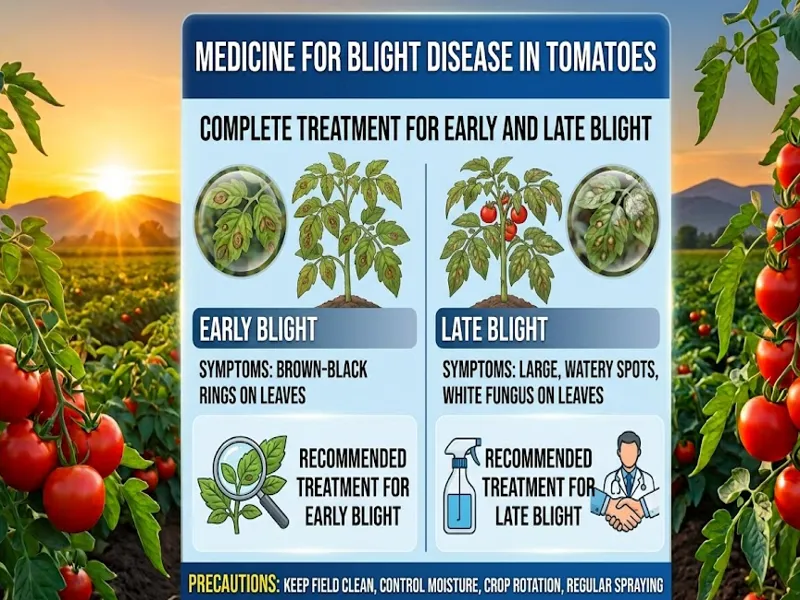
Most Effective Tomato Blight Medicine 2026 | Complete Guide to Early & Late Blight Identification, Prevention and Control
Tomato is one of the most important vegetable crops in India, but several diseases can reduce farmers’ hard work and profits. Among them, Blight Disease is considered one of the most dangerous. If it is not identified and controlled on time, it can affect the entire crop within a few days and reduce production by 30% to 80%.
Most farmers start looking for medicine only after the disease has spread completely. However, the most effective way to manage tomato blight is early identification and timely prevention. In this article, we will explain the symptoms, causes, prevention methods, organic and chemical control, spray schedule, and important precautions for Early Blight and Late Blight in detail.
🔍1. What is Tomato Blight Disease?
Tomato blight is a fungal disease that spreads rapidly due to high humidity, continuous rainfall, cool weather, and waterlogging in the field.
This disease mainly affects the leaves, stems, and sometimes even the fruits of the tomato plant. If not controlled on time, the plant becomes weak, photosynthesis decreases, and both the size and quality of the fruits are affected.
Tomato blight is mainly of two types:
- Early Blight
- Late Blight
Both diseases have different symptoms, infection periods, and control methods. Therefore, proper identification is very important.
🌱2. How to Identify Early Blight?
Early Blight usually starts appearing 25 to 40 days after transplanting. It first attacks the older leaves at the bottom of the plant.
Main Symptoms
- Older leaves start turning yellow.
- Round or ring-shaped brown spots appear on the leaves.
- The spots look like a target board pattern.
- Gradually, the leaves dry up and fall off.
- The infection spreads from the bottom to the top of the plant.
- Plant growth becomes slow.
If the disease is not controlled at this stage, the entire plant may become infected.
🍅3. How to Identify Late Blight?
Late Blight usually appears when the tomato plants start bearing fruits. It spreads very quickly during continuous rainfall and high humidity.
Main Symptoms
- Dark brown or black spots appear on the upper young leaves.
- The edges of the leaves start drying.
- Infected leaves begin to wilt rapidly.
- Infection may also appear on the stems and fruits.
- The entire field can become infected within a few days.
Late Blight is considered more destructive than Early Blight.
⚠️4. Main Causes of Tomato Blight Disease
Tomato blight does not occur suddenly. It develops rapidly under favourable conditions.
Main Causes
- Continuous rainfall.
- Waterlogging in the field.
- Insufficient spacing between plants.
- High humidity and cool weather.
- Use of infected seedlings or seeds.
- Leaving crop residues in the field.
- Lack of balanced nutrition.
- Growing tomatoes continuously in the same field.
If these causes are managed in advance, the risk of blight disease can be reduced significantly.
🛡️5. Most Effective Ways to Prevent Tomato Blight
Preventing a disease is always better than treating it after it appears. The same principle applies to tomato blight.
Field Preparation
- Select a field with good drainage.
- Do not allow water to accumulate in the field.
- Maintain proper spacing between plants.
- Use healthy and certified seedlings.
Organic Protection
Beneficial fungi such as Trichoderma can be mixed with well-decomposed farmyard manure or vermicompost before transplanting. This helps reduce the effect of many harmful fungi present in the soil.
Regular Monitoring
Inspect the field every 2–3 days. If you notice early symptoms on any plant, take immediate action.
💊6. Most Effective Tomato Blight Medicine
If the disease has started appearing in the field, organic methods alone may not be enough. In such cases, a suitable fungicide can be used as per the advice of an agricultural expert.
Farmers commonly use the following types of fungicides:
- Copper-based fungicides (COC)
- Mancozeb-based fungicides
- Metalaxyl + Mancozeb combination
- Azoxystrobin + Difenoconazole combination
Important: Always choose the fungicide according to the advice of your local agricultural expert or as mentioned on the product label. Do not mix different fungicides without proper guidance.
📅7. Spray Schedule for Tomato Blight
If the weather remains continuously humid or the field has a history of blight disease, timely spraying becomes very important.
General Spray Schedule
- Apply the first spray as soon as the initial symptoms appear.
- Apply the second spray after 4–7 days.
- Apply the third spray, if required, based on the weather conditions.
- Do not use fungicides from the same chemical group continuously.
This helps reduce the chances of fungicide resistance in the disease-causing fungus.
🌿8. Organic Control of Tomato Blight
For farmers practicing natural farming or organic farming, the following methods can be useful:
- Regular use of Trichoderma.
- Use neem-based products.
- Remove and destroy infected leaves.
- Maintain good air circulation in the field.
- Avoid excess moisture.
Keep in mind that if the infection has already become severe, organic methods alone may not be sufficient.
🚜9. Crop Management to Prevent Tomato Blight
Good crop management plays an important role in controlling tomato blight.
- Use balanced fertilizers.
- Avoid excessive use of nitrogen.
- Carry out timely weeding and intercultural operations.
- Keep the field free from weeds.
- Maintain proper spacing between plants.
- Try to adopt drip irrigation.
- Irrigate in the morning so that the leaves dry by evening.
⚡10. Important Precautions While Spraying
A fungicide is effective only when it is used correctly.
- Always use clean water for spraying.
- Spray in the morning or evening.
- Do not spray during strong sunlight.
- Avoid spraying if rain is expected.
- Do not use more than the recommended dosage.
- Wear protective equipment while spraying.
- Avoid mixing different fungicides without proper knowledge.
❌11. Common Mistakes Farmers Make
The biggest problem in controlling tomato blight is poor crop management.
Many farmers:
- Buy fungicides only after the disease has already spread.
- Use the same fungicide repeatedly.
- Apply fungicides in excessive amounts.
- Leave infected plants in the field.
- Spray just before rainfall.
- Do not monitor the field regularly.
By avoiding these mistakes, the impact of tomato blight can be reduced significantly.
📌12. Expert Tips for Higher Tomato Yield by Preventing Blight
If you want to harvest a healthy tomato crop every year, always remember these points:
- Use certified seedlings.
- Prepare the field properly before transplanting.
- Use biological products such as Trichoderma.
- Inspect the field regularly.
- Never ignore the early symptoms of the disease.
- Apply fungicides on time according to the weather conditions.
- Rotate fungicides with different chemical groups.
- Maintain balanced nutrition and proper irrigation.
🚜13. Useful Farming Articles
- Tomato Blight Medicine: Complete Treatment for Early & Late Blight
- Pests and Diseases in Crops: Definition, Significance & Impact
- Pest and Disease Control
- How to Do Organic Farming
- Benefits of Natural Farming
- How to Make Organic Vermicompost from Cow Dung in 30 Days
- Vermicompost Preparation Method
- Benefits of Drip Irrigation
- Pest and Disease Management
- Soil Health Card Scheme
❓14. Frequently Asked Questions (FAQs)
Q1. What is Tomato Blight Disease?
Tomato blight is a dangerous fungal disease that mainly appears as Early Blight and Late Blight. It affects the leaves, stems, and fruits, reducing plant growth and causing a significant loss in yield. If tomato blight medicine is not used on time, the entire crop can be affected. Therefore, identifying the early symptoms and taking immediate action is very important.
Q2. What is the Best Medicine for Tomato Blight?
If you want to know what is the best tomato blight medicine, the answer depends on the stage of the disease. During the early stage of infection, copper-based fungicides, Mancozeb, Metalaxyl + Mancozeb, or other recommended fungicides may be used as advised by an agricultural expert. Biological products such as Trichoderma also help in disease prevention. Always select the fungicide according to the product label and the recommendations of the agriculture department.
Q3. Please Suggest a Medicine for Tomato Blight.
If your crop is showing symptoms of blight and you are asking for a medicine for tomato blight, first identify whether it is Early Blight or Late Blight. Then choose a suitable fungicide as recommended by an agricultural expert. Treating the disease at the initial stage gives better results. It is also important to prevent waterlogging, remove infected leaves, and provide balanced nutrition.
Q4. What Causes Tomato Blight?
Tomato blight mainly spreads due to high humidity, continuous rainfall, waterlogging, infected seedlings, poor air circulation, and infected crop residues. When moisture remains in the field for a long time, the fungus develops rapidly. In such situations, timely use of tomato blight medicine and regular field monitoring can greatly reduce crop damage.
Q5. What Are the Early Symptoms of Tomato Blight?
In the early stage of blight, small brown or black spots appear on the leaves. In Early Blight, the lower leaves are affected first, while in Late Blight, the upper young leaves become infected. Gradually, the leaves turn yellow and dry. As soon as these symptoms appear, use tomato blight medicine properly to prevent the disease from spreading further.
Q6. What Is the Difference Between Early Blight and Late Blight in Tomato?
Early Blight usually appears 25–40 days after transplanting and starts from the lower leaves. Late Blight generally appears during the fruiting stage and spreads rapidly on the upper leaves. Timely selection of tomato blight medicine is very important because both diseases spread differently and require proper management.
Q7. Which Is the Most Effective Medicine for Tomato Blight?
The most effective medicine for tomato blight is the one that is used at the right time according to the disease stage and weather conditions. Copper-based fungicides, Mancozeb, Metalaxyl combinations, and other recommended fungicides may be used under the guidance of an agricultural expert. Better results come not only from changing fungicides but also from proper spray timing and good crop management.
Q8. Is Trichoderma Useful for Tomato Blight?
Yes, Trichoderma is a beneficial biological fungus mainly used for the prevention of tomato blight. It is applied by mixing it with well-decomposed farmyard manure or vermicompost before transplanting. However, if the disease has already spread severely, Trichoderma alone is not enough. In such cases, use tomato blight medicine as advised by an agricultural expert.
Q9. What Should Be Done First After Tomato Blight Appears?
As soon as blight symptoms appear, remove the infected leaves, control excess moisture in the field, and immediately consult an agricultural expert. Spraying fungicides without proper disease identification may also cause problems. After confirming the disease, use tomato blight medicine and continue regular field monitoring.
Q10. How Quickly Does Tomato Blight Spread?
Under favourable weather conditions, tomato blight can spread rapidly within 3 to 7 days. Continuous rainfall and high humidity speed up the infection. Therefore, instead of searching for information after the disease spreads, take immediate control measures as soon as the early symptoms appear.
Q11. How Much Damage Can Tomato Blight Cause?
If tomato blight is not controlled on time, it can reduce crop yield by 30% to 80%. In severe infections, most of the leaves dry up, the fruits remain small, and their quality also declines. The disease spreads rapidly during continuous rainfall and high humidity. Therefore, as soon as the early symptoms appear, use tomato blight medicine according to the advice of an agricultural expert to reduce economic losses.
Q12. Does Tomato Blight Increase After Rain?
Yes, continuous rainfall and high humidity create the most favourable conditions for tomato blight to spread. After rain, moisture remains on the leaves for a long time, allowing the fungus to grow rapidly. During such weather, inspect the field regularly and use tomato blight medicine properly as soon as the early symptoms appear. Also, prevent waterlogging and maintain proper spacing between plants for good air circulation.
Q13. Which Fungus Causes Tomato Blight?
Tomato blight mainly occurs in two forms. Early Blight is mainly caused by the fungus Alternaria solani, while Late Blight is caused by Phytophthora infestans. The symptoms and spread of both diseases are different. Therefore, always identify the disease correctly before selecting tomato blight medicine. Using the wrong fungicide or delaying treatment may allow the disease to spread rapidly.
Q14. When Should Tomato Blight Medicine Be Sprayed?
If the weather remains humid, cloudy, or rainy, monitor the field regularly. As soon as the first spots appear on the leaves, start spraying tomato blight medicine. Many farmers wait until the disease has spread widely before spraying, making control more difficult. Spraying in the morning or evening is considered more effective, and the product label instructions should always be followed.
Q15. How Many Sprays Are Required for Tomato Blight?
The number of sprays depends on the disease severity, weather conditions, and crop stage. Under normal conditions, the first spray should be applied when the initial symptoms appear. If required, the second or third spray can be applied at an interval of 5 to 7 days. Instead of repeatedly using fungicides from the same chemical group, it is better to rotate recommended fungicides from different chemical groups.
Q16. Does Tomato Blight Also Affect the Fruits?
Yes, if tomato blight is not controlled on time, it does not remain limited to the leaves. It can also affect the stems and fruits. Infected fruits develop black or brown spots, which reduce both their quality and market value. Therefore, focusing only on the leaves is not enough. Using tomato blight medicine at the early stage can also help protect the fruits.
Q17. Is It Possible to Control Tomato Blight in Organic Farming?
Yes, the risk of tomato blight can also be reduced in organic farming. For this, farmers can use Trichoderma, well-decomposed farmyard manure, crop rotation, field sanitation, and balanced irrigation. However, if the infection has spread severely, organic methods alone may not be enough. In such situations, use only products that are permitted under organic farming certification guidelines. Always choose tomato blight medicine according to your farming method.
Q18. How Should the Field Be Prepared to Prevent Tomato Blight?
Prevention of tomato blight starts with proper field preparation. Select a field with good drainage, use healthy seedlings, and maintain proper spacing between plants. Before transplanting, biological fungicides such as Trichoderma may help improve soil health. Do not leave old infected crop residues in the field. These practices can significantly reduce the risk of tomato blight and may also reduce the need for tomato blight medicine later.
Q19. Does Drip Irrigation Reduce the Risk of Tomato Blight?
Yes, drip irrigation can reduce the risk of tomato blight because it delivers water directly to the roots, keeping the leaves dry for a longer time. In contrast, overhead irrigation keeps the leaves wet, allowing the fungus to spread more quickly. If drip irrigation is combined with regular field monitoring, the outbreak of tomato blight can be controlled to a great extent.
Q20. What Is the Role of Weather in the Spread of Tomato Blight?
Weather plays the most important role in the spread of tomato blight. A temperature between 18°C and 25°C, high humidity, continuous cloud cover, and rainy weather provide favourable conditions for fungal growth. During such weather, farmers should inspect the field regularly and use tomato blight medicine on time if required. Proper weather-based crop management can greatly reduce the spread of the disease.
Q21. Should the Same Fungicide Be Used Repeatedly for Tomato Blight?
No, fungicides from the same chemical group should not be used repeatedly as tomato blight medicine. Continuous use of the same fungicide may lead to fungicide resistance, making the product less effective. Agricultural experts recommend rotating fungicides from different chemical groups. Always follow the instructions given on the product label and consult your local agricultural expert if needed.
Q22. Which Fertilizer Should Be Applied When Tomato Blight Appears?
Balanced nutrition is very important when tomato blight affects the crop. Excessive nitrogen encourages the growth of tender new leaves, which may become more vulnerable to infection. Instead, apply balanced amounts of phosphorus, potash, and micronutrients. Good-quality organic manure also helps improve soil health. Along with tomato blight medicine, balanced nutrition improves the plant’s ability to tolerate disease.
Q23. Can a Tomato Plant Affected by Blight Be Saved?
Yes, if the infection is in the early stage, affected plants can often be saved. Remove infected leaves, prevent waterlogging, and spray tomato blight medicine on time as advised by an agricultural expert. If the entire plant is severely infected, it may be better to remove it from the field to prevent the disease from spreading to healthy plants. Regular monitoring helps avoid major crop losses.
Q24. How Can Tomato Blight Be Prevented?
Preventing tomato blight is more effective than treating it. Use healthy seedlings, ensure proper drainage, maintain sufficient spacing between plants, and inspect the crop regularly. Applying biological products such as Trichoderma before transplanting can also be beneficial. If the weather remains continuously humid, suitable preventive fungicides may be used as advised by an agricultural expert. This can reduce the need for tomato blight medicine later.
Q25. Does Seed Treatment Help Reduce Tomato Blight?
Seed treatment helps reduce the risk of many soil-borne and seed-borne diseases and plays an important role in producing healthy seedlings. Although tomato blight mainly spreads due to environmental conditions and fungal infection, using certified seeds and proper seed treatment can reduce the risk of early infection. Along with this, maintaining field hygiene and using tomato blight medicine on time are also important.
Q26. What Mistakes Do Farmers Make When Tomato Blight Appears?
Many farmers ignore the early symptoms and start looking for tomato blight medicine only after the disease has spread widely. Some farmers apply more than the recommended dosage or mix different fungicides without proper guidance. Other common mistakes include allowing waterlogging, not removing infected leaves, and repeatedly using the same fungicide. Avoiding these mistakes can make disease control much more effective.
Q27. Can Home Remedies Cure Tomato Blight?
Home remedies such as neem-based solutions or some organic mixtures may help support plant care during the early stage, but they should not be expected to provide complete control in severe infections. If the disease is spreading rapidly, using tomato blight medicine as advised by an agricultural expert is more effective. Home remedies should be considered only as supportive measures, not the main treatment.
Q28. What Should Be Considered When Buying Tomato Blight Medicine?
Always purchase tomato blight medicine from a trusted seller. Read the product label carefully, check the manufacturing and expiry dates, and make sure the product is recommended for tomato crops. Avoid using unlabeled or suspicious products. If you have any doubts about a product, consult your local agricultural officer or agricultural scientist before purchasing.
Q29. How Can You Differentiate Between Tomato Blight and Bacterial Diseases?
Tomato blight is mainly caused by fungi, while bacterial diseases are caused by bacteria. In tomato blight, brown or black spots appear on the leaves, and the leaves gradually dry up. In bacterial diseases, symptoms may include water-soaked spots, wilting, or oozing from the stems. Correct identification is very important because tomato blight medicine and treatments for bacterial diseases are different.
Q30. How Can You Get Higher Yield by Preventing Tomato Blight?
If you want higher tomato production, do not depend only on tomato blight medicine. Use healthy seedlings, apply balanced fertilizers, provide proper irrigation, maintain field cleanliness, identify diseases at the right time, and manage the crop according to weather conditions. Regular field inspection helps detect early infection and allows timely control. By following scientific farming practices, the impact of tomato blight can be reduced, resulting in higher yield and better-quality produce.
✅ Conclusion
Tomato blight is a serious fungal disease, but its damage can be greatly reduced through timely identification, regular monitoring, and scientific crop management. The most important point is that farmers should not wait for the disease to spread. Instead, they should focus on prevention from the beginning. By maintaining field cleanliness, providing balanced nutrition, adopting biological methods, and using suitable fungicides at the right time when required, farmers can achieve healthy crops and higher yields.
If your tomato crop is facing any problem related to tomato blight, share your symptoms in the comments below. Our team will try to provide the most suitable solution based on your problem.
Need any assistance? 👉 Feel free to contact us.