

Asafoetida Farming in India: Complete Cultivation Guide
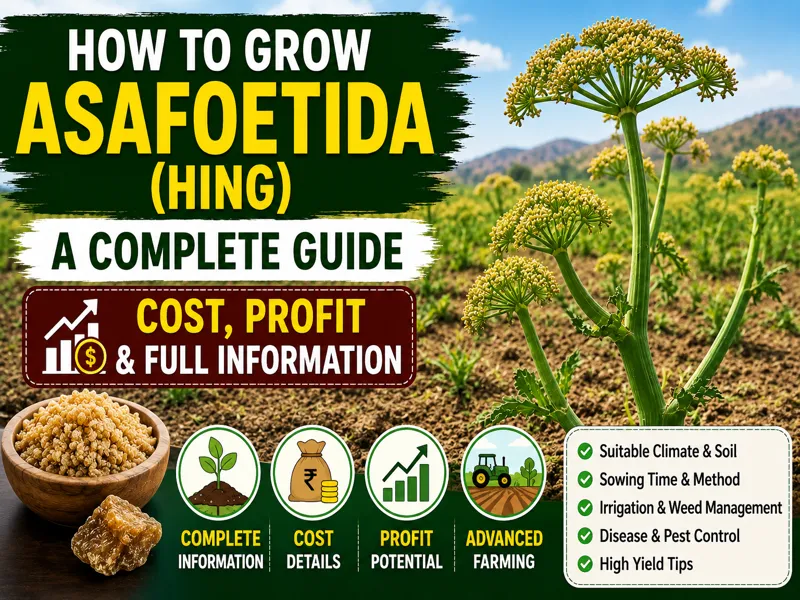
How to Grow Asafoetida (Hing)? Complete Guide on Cultivation, Cost, Income, and Advanced Farming
Asafoetida (Ferula asafoetida), commonly known as Hing, is one of the most widely used spices in India. It is used to enhance the taste and aroma of dals, vegetables, and many traditional dishes. Apart from cooking, Hing also has great importance in Ayurveda because of its medicinal properties.
Although the demand for Hing is very high in India, its production is still not done on a large scale. Due to this, the country depends on imports every year. According to available information, India consumes more than 1,200 tonnes of pure Hing annually and spends around ₹600 crore on its import. India mainly imports Hing from Afghanistan, Iran, and Uzbekistan.
If farmers adopt the right farming techniques and grow Hing under suitable climatic conditions, it can become a profitable source of income. Let us understand everything about Hing farming.
🌱 Introduction
The scientific name of Hing is Ferula asafoetida. It is a perennial plant belonging to the Apiaceae family and is naturally found in the mountainous regions of Iran and Afghanistan.
Hing is prepared by drying the milky resin (latex) that comes out from the roots of the plant. This dried resin is sold in different forms in the market.
To promote Hing cultivation in India, research is being carried out at the Centre of High Altitude Biology (CHAB) in Lahaul-Spiti, Himachal Pradesh. Apart from this, cold and dry regions like Uttarakhand, Ladakh, and Jammu & Kashmir are also considered suitable for its cultivation.
Important Information: Hing is a perennial crop, and it takes around 4 to 5 years to start producing yield.
🌦️ Suitable Climate for Hing Farming
The right climate is very important for getting a good yield of Hing. This crop grows best in cold and dry weather conditions.
Suitable Weather for Hing Cultivation
- Cold and dry climate is considered the most suitable.
- The plant can tolerate a minimum temperature of around 5 to 10°C.
- It can withstand a maximum temperature of around 35 to 40°C.
- In some regions, a temperature range of 20 to 30°C is also considered suitable.
- The plants require plenty of sunlight.
- Excess moisture and waterlogging are harmful to the crop.
Which States Are Suitable for Hing Farming?
According to available information, the following regions are suitable for Hing cultivation:
- Himachal Pradesh
- Uttarakhand
- Ladakh
- Jammu & Kashmir
The cold and dry climate of these regions is considered favourable for successful Hing cultivation.
🌾 Suitable Soil for Hing Farming
Choosing the right soil helps the plants grow better and increases the chances of getting a good yield.
Best Soil for Hing Cultivation
- Sandy loam soil
- Well-drained land
- Sloping fields
- Sunny locations
Things to Keep in Mind
- Water should never remain standing in the field.
- Excess moisture can damage the plants.
- Waterlogging may spoil the crop.
Farmer’s Tip: Before selecting the field, always check whether proper drainage is available.
🌰 Hing Seeds
Hing seeds are light brown in colour and flat in shape. These seeds have natural dormancy, due to which they do not germinate quickly under normal conditions.
Seed Preparation Process
- Seeds are given a chilling treatment to improve germination.
- Sowing is generally done during October-November so that natural winter cold helps break seed dormancy.
- In many places, seedlings are first raised in a greenhouse or nursery.
- Later, the healthy seedlings are transplanted into the main field.
Seed Rate
About 1 kilogram of seed is considered sufficient for direct sowing in one hectare of land.
If seedlings are first prepared in a nursery, the seed requirement may be lower.
🌿 Major Varieties of Hing
According to available information, Hing is mainly of two types.
1. Milky White Hing (Kabuli Safaid)
- It is white in colour.
- It dissolves easily in water.
- It has good demand in the market.
2. Red Hing
- It is red or dark in colour.
- It is considered more soluble in oil.
Forms Available in the Market
Hing is mainly available in the following three forms:
- Tears
- Mass
- Paste
For commercial purposes, raw Hing is also mixed with starch or gum before being sold in the market.
🚜 Sowing of Hing
For a good yield of Hing, it is important to plant at the right time and maintain proper spacing between the plants.
Sowing Time
According to available information, different sowing periods are recommended depending on the region:
- October – November
- July – August
- August – September
The suitable sowing time should be selected according to the local climate.
Field Preparation
Before sowing, plough the field properly and ensure a good drainage system.
If possible, first prepare the seedlings in a nursery and later transplant them into the main field.
Plant Spacing
The following spacing is recommended for better plant growth:
| Spacing | Recommended Distance |
|---|---|
| Row to Row | 1 to 1.5 metres |
| Plant to Plant | 0.75 to 1 metre |
In some places, maintaining a spacing of around 5 feet is also recommended so that the plants get enough space to grow.
🧑🌾 Fertilizer Management in Hing Farming
Hing is a perennial crop, so proper nutrition is essential to keep the plants healthy for a long time. According to available information, fertilizers should be applied from time to time after the plants are established to ensure healthy growth.
Main Points of Fertilizer Management
- Apply fertilizers as required after the plants are established.
- Remove weeds regularly.
- Keep the field clean.
- Continue providing nutrients according to the growth stage of the plants.
🌟 Farmer’s Tip: Keeping the field free from weeds helps the plants absorb nutrients more effectively and promotes better growth.
💧 Irrigation in Hing Farming
Hing has long and deep roots, so it does not require frequent irrigation. Excess watering or waterlogging can damage the plants.
When and How to Irrigate?
- After transplanting, provide light irrigation every 2 to 3 days during the first month.
- Once the plants are established, irrigate only when required.
- Water the crop after checking the soil moisture.
- Do not allow water to accumulate in the field.
- Mulching can be used to maintain moisture around the plants.
- Carry out regular weeding and intercultural operations.
Points to Remember During Irrigation
✅ Do not overwater the crop.
✅ Avoid waterlogging.
✅ Keep the plant roots healthy at all times.
💡 Important Tip: In Hing farming, providing less water is considered better than giving excess water.
🦠 Diseases in Hing Farming
According to the available information, no major diseases have been specifically mentioned for Hing cultivation. However, it is clearly stated that excess moisture and waterlogging can damage the plants.
Disease Management Tips
- Select well-drained land.
- Do not allow water to collect in the field.
- Avoid unnecessary irrigation.
- Inspect the field regularly.
- Remove weeds from time to time.
⚠️ Note: If you notice any unusual changes in the plants, consult an agricultural expert.
🐛 Pest Management in Hing Farming
The information provided does not mention any specific pest that damages the Hing crop.
However, it is mentioned that the flowers of Hing are pollinated by insects, which play an important role in the plant’s reproduction.
Pest Management Tips
- Inspect the field regularly.
- Monitor plant growth closely.
- Consult an agricultural expert immediately if any unusual problem is noticed.
- Avoid unnecessary use of chemical pesticides.
🌿 Farmer’s Tip: Healthy plants are naturally better able to withstand pests and other problems.
🧴 Spray Management in Hing Farming
According to the available information, no specific insecticide or fungicide spray has been recommended for Hing cultivation.
Therefore, avoid using any chemicals unless they are actually required.
Important Points About Spraying
- Do not spray without necessity.
- Monitor the plants regularly.
- If any problem occurs, spray only as advised by an agricultural expert.
- Always use the recommended quantity of any product.
📌 Important: Unnecessary chemical spraying may harm the crop instead of benefiting it.
✂️ Harvesting of Hing
Hing is a perennial crop, so it is not harvested within a few months like regular crops. Farmers have to wait around 4 to 5 years before they can obtain production.
When the plant is fully developed and reaches the stage just before flowering, the process of collecting Hing from its roots begins.
Process of Extracting Hing
- Allow the plant to grow undisturbed for about 4 to 5 years.
- Before flowering, make a cut on the upper part of the root.
- A milky resin (latex) comes out from the cut.
- Leave the resin exposed to the air for some time.
- After drying, the resin turns into Hing.
- The resin extraction process is repeated several times until it stops flowing.
- Finally, the dried Hing is carefully collected.
🌟 Important Information: Do not extract Hing resin from plants that are kept for seed production.
📦 Storage of Hing
After harvesting, it is important to process and store Hing properly to maintain its quality.
According to the available information, the raw Hing resin obtained from the plants is very strong in smell and bitter in taste. It is processed before being made suitable for sale in the market.
Process Before Storage
- The collected resin is dried properly.
- Rice flour or gum is mixed with it as required.
- It is then prepared in the form of cakes or powder.
- Finally, it is packed and stored in a safe place.
Forms Available in the Market
Hing is mainly available in the following three forms:
- Tears
- Mass
- Paste
📌 Note: High-quality Hing gets a higher market price compared to ordinary Hing.
💰 Cost of Hing Farming
The initial investment in Hing farming is comparatively high because the crop takes around 5 years to start producing.
According to the available information:
| Details | Estimated Information |
|---|---|
| Cost per hectare | Around ₹3 lakh |
| Production starts | After about 4–5 years |
During the initial years, the expenses mainly include plant care, irrigation, weeding, intercultural operations, and maintenance.
💡 Farmer’s Tip: Start Hing farming only if you are ready to treat it as a long-term investment.
📈 Income from Hing Farming
Hing is considered one of the most valuable spice crops in India. Its demand remains high throughout the country, and at present, most of the Hing is imported.
If farmers cultivate it scientifically in suitable climatic regions, they can earn a good income.
Expected Production
- About 20 to 25 grams of Hing can be obtained from one plant.
- Production generally starts after 4 to 5 years.
Market Price
According to the available information, the price of Hing varies depending on its quality.
- Around ₹5,000 to ₹25,000 per kilogram.
- Some reports also mention prices ranging from ₹35,000 to ₹45,000 per kilogram.
Expected Income
- An income of around ₹9 lakh per hectare is possible.
- According to other available information, farmers may also earn a profit of up to ₹10 lakh per hectare.
🌟 Important: Hing farming can become a profitable long-term business for farmers.
🔗 Useful Articles for Farmers
Link the following topics from this article:
- Asafoetida Farming
- How to Grow Bay Leaf Farming for High Profit at Low Cost
- Easy Ways to Earn Big from Fenugreek Farming
- Nigella Seeds Farming Guide: High Yield Tips
- Black Pepper Farming in India: Complete Guide
- Green Chilies Farming Guide: Benefits, Cultivation & Tips
- Clove Farming
- Cinnamon Farming
- Celery Farming
- Saffron Farming: Complete Cultivation Guide for High Yield
- Fennel Farming
- Coriander Farming
- Cumin Farming
- Cardamom Farming
- Ginger Farming
- Turmeric Farming in India
- Garlic Farming in India: Complete Cultivation Guide
- How to Do Organic Farming
- Benefits of Natural Farming
- Vermicompost Preparation Method
- Benefits of Drip Irrigation
- Pest and Disease Management
- Soil Health Card Scheme
❓ Frequently Asked Questions (FAQ)
Q1. Which climate is most suitable for Hing farming?
A cold and dry climate is considered the most suitable for Hing cultivation.
Q2. In which states can Hing be cultivated?
Himachal Pradesh, Uttarakhand, Ladakh, and Jammu & Kashmir are considered suitable regions.
Q3. Which soil is best for Hing farming?
Well-drained sandy loam soil is considered the most suitable.
Q4. When does the Hing plant start producing?
The plant generally starts producing after 4 to 5 years.
Q5. How much Hing can be obtained from one plant?
According to the available information, about 20 to 25 grams of Hing can be obtained from one plant.
Q6. Does Hing farming require heavy irrigation?
No. Irrigation should be done only when required because excess water and waterlogging are harmful to the plants.
Q7. What is the cost of Hing farming per hectare?
According to the available information, the cost is around ₹3 lakh per hectare.
Q8. How much income can be earned from Hing farming?
After about 5 years, an income or profit of around ₹9 to ₹10 lakh per hectare is possible.
Q9. From which countries does India import most of its Hing?
India mainly imports Hing from Afghanistan, Iran, and Uzbekistan.
Q10. In which forms is Hing available in the market?
Hing is available in the market in the form of Tears, Mass, and Paste.
📝 Conclusion
The demand for Hing is continuously increasing in India, while its domestic production is still limited. Because of this, it is considered a spice crop with great potential for farmers.
If farmers cultivate Hing in cold and dry regions with suitable soil, proper drainage, and good crop management, they can earn a good income in the long run. Although production starts only after 4 to 5 years, its high market value makes it one of the profitable farming options.
If research and government support continue in the future, India can take significant steps towards becoming self-reliant in Hing production.