


Flood Irrigation: Types, Advantages, Disadvantages & Complete Guide
What is Flood Irrigation?
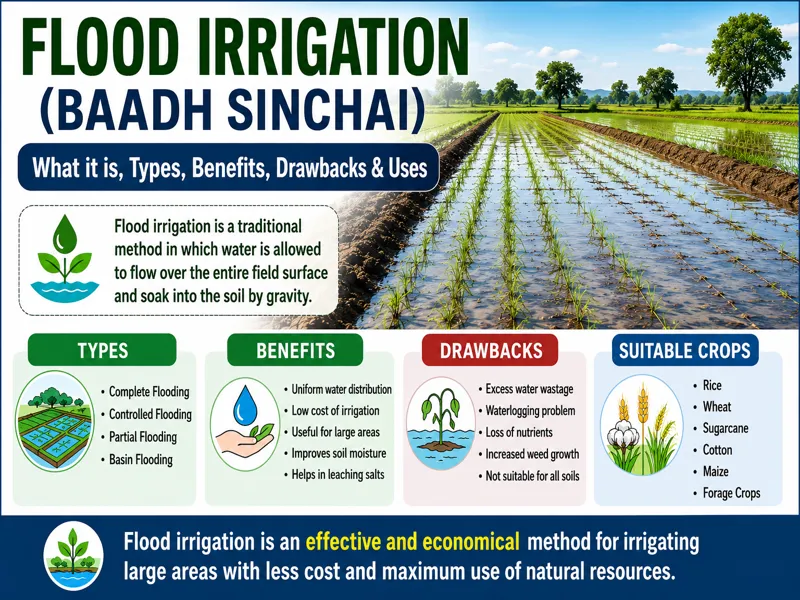
Flood Irrigation is one of the oldest and simplest irrigation methods used in agriculture. In this method, water is released onto the surface of the field so that it spreads across the entire field under the effect of gravity and gradually soaks into the soil. It does not require sprinklers, drip pipes, or any advanced irrigation equipment.
It is very important to keep the field properly leveled so that water can spread evenly throughout the field. If the land is uneven, water may collect in some areas while other areas receive less water, which can affect crop growth.
In India, Flood Irrigation is mainly used for wheat, paddy (rice), sugarcane, fodder crops, and some pulses and oilseed crops. It is still widely practiced in areas where canals, ponds, rivers, or sufficient groundwater are available.
Although modern irrigation systems like drip irrigation and sprinkler irrigation are becoming more popular due to the increasing need for water conservation, Flood Irrigation still remains a practical option for farmers in regions where water is available in sufficient quantity.
⚙️ 1. How Does Flood Irrigation Work?
Flood Irrigation works entirely on the principle of gravity.
In this method, the farmer releases water into the field from a water source such as:
- Canal
- Tube well
- Well
- Pond
- River
The water spreads over the field surface and gradually enters the soil. The crop roots absorb this soil moisture for their growth.
If the field is properly leveled, irrigation is distributed evenly. However, if the land is uneven, water distribution becomes irregular, causing waterlogging in some areas and moisture deficiency in others.
📚 2. History of Flood Irrigation
Flood Irrigation has been used for thousands of years. Ancient civilizations such as Egypt, Mesopotamia, the Indus Valley Civilization, and China used floodwater from rivers for agricultural irrigation.
In India, this method has been used for a long time in regions located along rivers such as the Ganga, Yamuna, Narmada, Godavari, Krishna, and Kaveri.
During the Green Revolution, the expansion of canals and tube wells further increased the use of Flood Irrigation.
Even today, it remains one of the major irrigation methods in many states across India.
⚙️ 3. Principle of Flood Irrigation
The main principle of this irrigation method is:
“To spread water over the field surface and allow it to naturally soak into the soil.”
When water enters the soil:
- Soil moisture increases.
- Plant roots receive sufficient water.
- Plants absorb nutrients more efficiently.
- Crop growth improves.
🧩 4. Major Types of Flood Irrigation
The same Flood Irrigation method is not used in every field. Different methods are adopted depending on the field layout, soil type, land slope, and crop.
4.1. Free Flooding
This is the most common method.
In this method, water is released into the field without dividing it into separate sections.
Features
- Simplest method
- Low cost
- Requires minimal technical knowledge
- Popular among small farmers
Limitations
- High water wastage
- Uneven water distribution
- Possibility of waterlogging
4.2. Controlled Flooding
In this method, the field is divided into small sections.
A controlled amount of water is supplied to each section.
Benefits
- Saves water
- Provides uniform irrigation
- Improves crop production
4.3. Basin Flood Irrigation
In this method, bunds are made around each plant or group of plants, and water is filled inside the basin.
Suitable Crops
- Mango
- Guava
- Lemon
- Orange
- Coconut
- Papaya
4.4. Border Flooding
In this method, the field is divided into long strips called borders.
Water is released from one side and gradually spreads across the entire strip.
Suitable Crops
- Wheat
- Fodder crops
- Barley
4.5. Check Basin Irrigation
In this method, the field is divided into small square or rectangular sections.
Each section is irrigated separately.
This method is especially useful for:
- Paddy (Rice)
- Wheat
- Fodder crops
🌍 5. Suitable Soil for Flood Irrigation
Not every type of soil is equally suitable for Flood Irrigation.
5.1. Loam Soil
This is the most suitable soil.
Reasons
- Good water-holding capacity
- Balanced drainage
- Healthy root development
5.2. Clay Soil
This soil is also considered suitable because it retains water for a longer period.
However, excessive irrigation may lead to waterlogging.
5.3. Sandy Loam Soil
Flood Irrigation can also be practiced in this soil.
However, water drains quickly into the lower layers.
Therefore, more frequent irrigation may be required.
5.4. Sandy Soil
This soil is generally not considered suitable for Flood Irrigation.
Reasons
- Water quickly moves down through the soil.
- Water use efficiency remains low.
- More water is required for irrigation.
🌱 6. Suitable Crops for Flood Irrigation
This method is mainly suitable for crops that require a large amount of water.
Cereals
- Paddy (Rice)
- Wheat
- Barley
- Maize
Cash Crops
- Sugarcane
- Cotton (in some regions)
- Jute
Fodder Crops
- Berseem
- Sorghum
- Pearl Millet (in irrigated areas)
- Napier Grass
Pulses
- Chickpea (to a limited extent)
- Lentil
- Pigeon Pea (under certain conditions)
Horticultural Crops
- Mango
- Guava
- Lemon
- Orange
- Coconut
- Pomegranate (with proper care)
📋 7. Essential Conditions for Flood Irrigation
Certain important conditions are required for the successful implementation of this irrigation method.
7.1. The Field Should Be Properly Leveled
A level field allows water to spread evenly.
Using a laser land leveler can improve irrigation efficiency.
7.2. Adequate Water Availability
This method is successful only when there is a sufficient water source.
7.3. Good Water-Holding Capacity of Soil
Loam soil and clay soil are considered the most suitable.
7.4. Proper Drainage System
Excess water should not remain in the field for a long time.
Otherwise, it may lead to:
- Root rot
- Fungal diseases
- Lack of oxygen
7.5. Proper Slope
A gentle slope in the field helps distribute water evenly.
✅ 8. Major Advantages of Flood Irrigation
8.1. Low Cost
This method does not require expensive irrigation equipment.
8.2. Simple Technique
Farmers can easily adopt this method without any special training.
8.3. Low Electricity Requirement
If water flows through gravity, no additional energy is required.
8.4. Suitable for Large Fields
It is especially economical in canal command areas.
8.5. Good Distribution of Soil Moisture
If the field is properly leveled, adequate moisture is maintained throughout the field.
8.6. Distribution of Fertilizers
Water-soluble fertilizers can also be distributed to some extent along with irrigation water.
8.7. Low Maintenance
Compared to drip irrigation and sprinkler irrigation, this method requires less maintenance.
8.8. Traditional and Reliable
This is a traditional irrigation method that farmers have been using for generations and are familiar with.
⚠️ 9. Limitations of Flood Irrigation (Brief Introduction)
Although this method is simple and low-cost, it also has some important limitations.
The major limitations include:
- High water consumption
- Waterlogging
- Soil erosion
- Nutrient loss
- Weed growth
- Low water use efficiency
❌ 10. Disadvantages of Flood Irrigation
Although Flood Irrigation is still widely used because of its low cost and simple technique, it also has several serious drawbacks. If irrigation is not managed properly, it can result in the loss of water, fertilizers, and soil.
10.1. High Water Consumption
The biggest disadvantage of Flood Irrigation is that it consumes more water than other irrigation methods.
- A large amount of water is lost through evaporation.
- Some water flows out of the field as runoff.
- In many cases, excess water moves deep into the soil beyond the root zone (Deep Percolation).
10.2. Low Water Use Efficiency
Compared to drip irrigation, Flood Irrigation has much lower water use efficiency. If the field is not properly leveled, some areas receive excess water while others receive less.
10.3. Waterlogging
Excess irrigation can cause water to accumulate in the field.
As a result:
- Plant roots do not receive enough oxygen.
- Root rot may develop.
- Plant growth may be affected.
- Crop yield may decrease.
10.4. Soil Erosion
Fast-flowing water can wash away fertile topsoil, gradually reducing soil fertility.
10.5. Nutrient Loss
Excess water carries nitrogen and other soluble nutrients into the deeper soil layers, reducing their availability to plants.
10.6. Weed Growth
Since moisture remains throughout the field, weeds grow rapidly, increasing the cost of weeding and intercultural operations.
10.7. Risk of Diseases and Pests
When water remains in the field for a long time, the incidence of fungal diseases and certain insect pests may increase.
🛠️ 11. Correct Method of Flood Irrigation
If Flood Irrigation is carried out scientifically, both water savings and good crop yield can be achieved.
Step 1: Field Preparation
- Perform deep ploughing of the field.
- Make the soil loose and fine.
- Remove weeds.
- Level the soil with a leveller, if required.
Step 2: Land Leveling
This is the most important step.
If the field is properly leveled:
- Water will spread evenly.
- Waterlogging will be reduced.
- Water will be saved.
- Crops will grow uniformly.
If possible, use a laser land leveler.
Step 3: Make Bunds
Construct strong bunds around the field boundaries so that water does not flow out.
If the Check Basin Irrigation system is being used, divide the field into small sections.
Step 4: Prepare the Water Source
The water source may be:
- Canal
- Tube well
- Well
- Pond
- River
Step 5: Release Water at a Controlled Flow
Do not release water at a very high flow rate.
Allow the water to spread slowly across the entire field.
Step 6: Stop Irrigation
Stop the water supply once the soil has received sufficient moisture. Avoid excessive irrigation.
💧 12. Water Management in Flood Irrigation
Good water management is the key to the success of this irrigation method.
Keep the following points in mind:
- Irrigate during the morning or evening.
- Avoid irrigation during intense sunlight.
- Irrigate after checking the weather forecast.
- Postpone irrigation if rainfall is expected.
- Apply water according to the crop growth stage.
⚠️ 13. Common Mistakes During Flood Irrigation
Many farmers unknowingly make mistakes that can reduce crop production.
Common Mistakes
- Irrigating without proper land leveling.
- Applying more water than required.
- Irrigating too frequently.
- Not providing proper drainage.
- Releasing excessive water into the entire field at once.
- Not understanding the water requirement of the crop.
⚖️ 14. Flood Irrigation vs Other Irrigation Systems
| Feature | Flood Irrigation | Drip Irrigation | Sprinkler Irrigation | Furrow Irrigation |
|---|---|---|---|---|
| Initial Cost | Low | High | Moderate | Low |
| Water Saving | Low | Very High | High | Moderate |
| Labour Requirement | Moderate | Low | Low | Moderate |
| Water Use Efficiency | Low | Highest | High | Moderate |
| Suitable for Large Fields | Suitable | Suitable | Suitable | Suitable |
| Suitable for Uneven Land | Less Suitable | Suitable | Suitable | Moderate |
| Maintenance | Low | High | Moderate | Low |
🎯 15. Under Which Conditions is Flood Irrigation Best?
This method is considered most suitable under the following conditions:
- Sufficient water is available.
- The field is properly leveled.
- The soil is loam or clay.
- Farming is carried out over a large area.
- Farmers prefer a low-cost irrigation system.
- Canal irrigation is available.
16. When Should Flood Irrigation Be Avoided?
Under the following conditions, other irrigation systems may be more beneficial:
- When water is scarce.
- When the soil is sandy.
- When the land has a steep slope.
- When growing high-value horticultural crops.
- When water conservation is a priority.
💰 17. Estimated Cost of Flood Irrigation
The cost of Flood Irrigation depends on several factors, including:
- Field size
- Water source
- Diesel or electricity cost
- Labour cost
- Field preparation
If the field already has canal irrigation facilities, the cost is comparatively lower. However, when irrigation is done using a tube well, additional electricity or diesel expenses are involved.
🇮🇳 18. Use of Flood Irrigation in India
Flood Irrigation is still widely practiced in many Indian states, especially where canal irrigation or sufficient groundwater is available.
Major States
- Uttar Pradesh
- Punjab
- Haryana
- Rajasthan (Canal Irrigated Areas)
- Madhya Pradesh
- Bihar
- Chhattisgarh
- Andhra Pradesh
- Telangana
- Tamil Nadu
🚨 19. Precautions While Adopting Flood Irrigation
- Properly level the field.
- Ensure an effective drainage system.
- Do not over-irrigate.
- Regularly check the soil moisture.
- Avoid irrigation immediately after rainfall.
- Apply water according to the crop growth stage.
- Inspect the field after irrigation.
👨🌾 20. Expert Suggestions
- Adopt laser land leveling to achieve water savings and uniform irrigation.
- Apply fertilizers based on soil testing results.
- Where water is limited, consider micro-irrigation systems such as drip irrigation or sprinkler irrigation.
- Irrigate during the morning or evening to reduce water loss through evaporation.
- If waterlogging occurs, arrange for immediate drainage.
💧 21. Important Information About Irrigation Systems
- Rainwater Harvesting for Farmers: Best Water Conservation Method
- Plant a Tree with Just One Liter of Water – No Irrigation for Life
- Micro Irrigation System
- Low Cost Irrigation Method
- Various Dimensions of Rainwater Harvesting and Water Conservation
- Soil Health Card Scheme
❓ 22. Flood Irrigation: Frequently Asked Questions (FAQs)
Q1. What is Flood Irrigation?
Flood Irrigation is a traditional surface irrigation method in which water is released onto the field surface so that it spreads across the entire field under the effect of gravity and gradually soaks into the soil. Due to its low cost, this method is widely used in India.
Q2. What is the Meaning of Flood Irrigation?
Flood Irrigation means irrigating crops by spreading water over the entire surface of the field. In this method, water is released directly into the field rather than through pipes or sprinklers.
Q3. What is the Flood Irrigation Method?
In the Flood Irrigation method, water is released into the field from a water source, where it spreads naturally across the field due to land slope and gravity. This method is considered suitable for level land and areas with sufficient water availability.
Q4. What is a Flood Irrigation System?
A Flood Irrigation System is an irrigation arrangement in which water from a canal, tube well, well, or other water source is released into the field in a controlled or free-flowing manner to provide moisture throughout the land.
Q5. How Does a Flood Irrigation System Work?
In this system, water is released into the field, where it spreads across the land under the effect of gravity. The water then gradually infiltrates the soil and provides moisture to the plant roots.
Q6. What is Flood Irrigation in Agriculture?
Flood Irrigation in agriculture is a traditional irrigation technique used for irrigating paddy, wheat, sugarcane, fodder crops, and other water-demanding crops. It is more effective in large fields and areas with sufficient water availability.
Q7. What is Traditional Flood Irrigation?
Traditional Flood Irrigation is a method in which water is supplied to the field from a canal, well, or tube well without using modern irrigation equipment. It is one of the oldest and most widely adopted irrigation systems in India.
Q8. What Are the Major Types of Flood Irrigation?
The main types of Flood Irrigation are:
- Free Flooding
- Controlled Flooding
- Basin Irrigation
- Check Basin Irrigation
- Border Flood Irrigation
Q9. Which Crops Are Most Suitable for Flood Irrigation?
This method is mainly suitable for the following crops:
- Paddy (Rice)
- Wheat
- Sugarcane
- Barley
- Fodder crops
- Some pulses and oilseed crops
- Fruit orchards (using the basin method)
Q10. Which Soil is Best for Flood Irrigation?
Loam soil and clay soil are considered the most suitable because they have good water-holding capacity. Sandy soil allows water to drain quickly, making this method less effective.
Q11. What is the Biggest Advantage of Flood Irrigation?
The biggest advantage is its low cost, simple operation, and the ability to irrigate large fields without expensive equipment.
Q12. What is the Biggest Disadvantage of Flood Irrigation?
The biggest drawback is high water consumption. If not managed properly, it may also cause waterlogging, soil erosion, and nutrient loss.
Q13. Can Flood Irrigation Cause Waterlogging?
Yes. Applying excessive water or having poor drainage can lead to waterlogging, which may damage plant roots.
Q14. Does Flood Irrigation Cause Soil Erosion?
If water flows at a high speed or the field has a steep slope, fertile soil may be washed away. Therefore, controlled irrigation and proper land leveling are essential.
Q15. Does Flood Irrigation Increase Weed Growth?
Yes. Since moisture remains throughout the field, weeds can grow rapidly. Therefore, regular weeding and intercultural operations are necessary.
Q16. Can Fertilizers Be Applied Through Flood Irrigation?
Yes. Some water-soluble fertilizers can be applied along with irrigation water. However, the quantity and timing should follow the recommendations of agricultural experts.
Q17. Is Flood Irrigation Suitable for Small Farmers?
Yes. Due to its low initial cost, small and marginal farmers can easily adopt this method, provided they have sufficient water availability.
Q18. Can Flood Irrigation Be Used on Sloping Land?
It can be used on gently sloping fields. However, on steep slopes, water cannot be distributed evenly, and the risk of soil erosion increases.
Q19. Is Laser Land Leveling Necessary?
It is not mandatory, but laser land leveling makes the field completely level, resulting in water savings and more uniform irrigation.
Q20. What is the Difference Between Flood Irrigation and Drip Irrigation?
In Flood Irrigation, water is spread across the entire field, whereas in Drip Irrigation, water is delivered drop by drop directly to the plant roots. Drip Irrigation saves more water, while Flood Irrigation has a lower initial cost.
Q21. Is Flood Irrigation Suitable for Water-Scarce Areas?
No. In areas where water is limited, micro-irrigation systems such as drip irrigation or sprinkler irrigation are more suitable and help conserve water.
Q22. What is a Flood Irrigation Diagram?
A Flood Irrigation Diagram shows the flow of water in the field, bunds, water source, and the direction of irrigation. It is used to help farmers and students understand the irrigation system.
Q23. How to Draw a Flood Irrigation Diagram?
To draw a simple Flood Irrigation Diagram, include the following parts:
- Water source (Canal/Tube Well)
- Main water channel
- Level field
- Bunds
- Direction of water flow (Arrow)
- Crop rows
This type of diagram is commonly used in agricultural education, projects, and training.
Q24. What is a Flood Irrigation Field?
A Flood Irrigation field is a properly leveled field where water is spread over the entire surface so that all plants receive uniform soil moisture.
Q25. What Should Be Considered Before Adopting Flood Irrigation?
Before starting Flood Irrigation, keep the following points in mind:
- The field should be properly leveled.
- A sufficient water source should be available.
- Proper drainage arrangements should be in place.
- Assess the water requirement of the crop.
- Avoid excessive irrigation.
- Regularly check soil moisture.
📝 Conclusion
Flood Irrigation is one of the oldest and most widely adopted irrigation systems in India. Its biggest advantages are low cost, simple operation, and easy use in large fields. However, it also has higher water consumption, and if land leveling, drainage, and irrigation timing are not managed properly, problems such as waterlogging, soil erosion, and nutrient loss may occur.
If farmers properly level their fields, apply controlled amounts of water according to crop requirements, and follow good water management practices, Flood Irrigation can provide good crop yields. In areas where water availability is limited, micro-irrigation systems such as Drip Irrigation and Sprinkler Irrigation are more sustainable and better for water conservation. With suitable field conditions and scientific management, Flood Irrigation continues to be an effective and practical irrigation method for many farmers.
Need any assistance? 👉 Feel free to contact us