


Sarpagandha Farming: Complete Cultivation Guide for High Yield
🌱 1. Introduction to Sarpagandha Farming
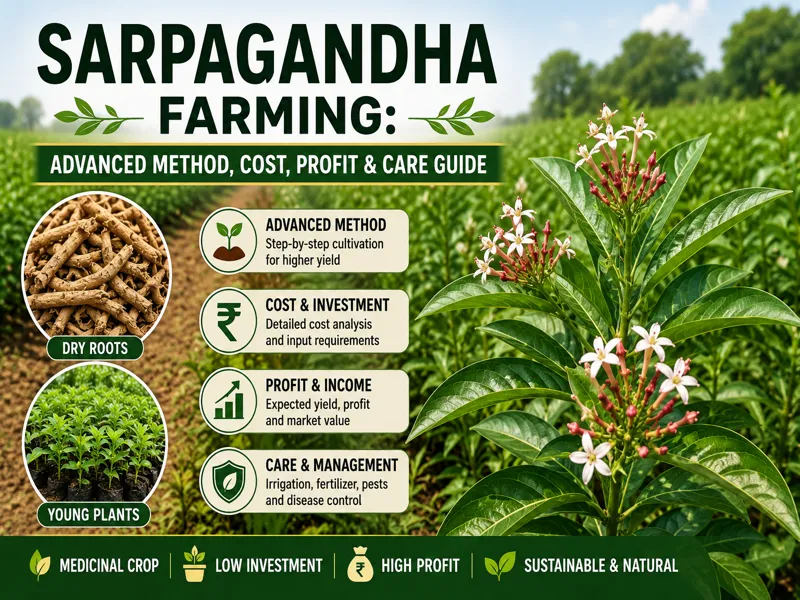
Sarpagandha (Rauvolfia) is one of the major medicinal crops grown in India. It is considered a profitable crop for farmers in the long term. Its roots are widely used in the manufacturing of modern medicines as well as Ayurvedic medicines. This is why the demand for Sarpagandha remains high among farmers engaged in medicinal plant cultivation.
Sarpagandha is a shrub-type plant with an average height of about 0.3 to 1.6 meters. Its leaves are long and measure about 8 to 15 cm in length. The flowers are generally white or pink, while the fruits turn purple-black when fully ripe. The roots are aromatic but have a bitter taste, and they are the most valuable and economically important part of the crop.
Sarpagandha is mainly cultivated for the production of its roots. Under normal conditions, the crop is ready for harvesting in 18 to 30 months, after which the plants are uprooted and the roots are dug out. With proper crop management, farmers can obtain around 8 to 12 quintals of dry roots per acre.
Apart from India, Sarpagandha is also cultivated in Myanmar, Bangladesh, Malaysia, Sri Lanka, Indonesia, and the Andaman Islands. In India, Uttar Pradesh is considered one of the major Sarpagandha-producing states.
Sarpagandha can be cultivated through seeds, root cuttings, stem cuttings, or nursery-raised seedlings. Most farmers first prepare a nursery and transplant the seedlings into the main field after the arrival of the monsoon.
If farmers properly prepare the field, apply balanced fertilizers, irrigate on time, and maintain good drainage, Sarpagandha farming can become a profitable medicinal crop that provides good yield and better income over the long term.
🌼 2. Medicinal Properties, Benefits, and Uses of Sarpagandha
Sarpagandha is a highly important medicinal plant that has been used in both Ayurveda and modern medicine for many years. Its roots contain several medicinal properties, making them useful in the manufacturing of different types of medicines.
Many medicinal products are prepared from the dried roots of this plant. After harvesting, the roots are cleaned, dried, and then processed into powder, tablets, herbal extracts, and other medicinal products.
According to traditional and medicinal uses, medicines prepared from Sarpagandha are used for the following conditions:
- Wound treatment
- Fever treatment
- Medicines for stomach pain
- Treatment of insomnia (sleep disorders)
- Treatment of high blood pressure (hypertension)
- Treatment of epilepsy
- Manufacturing medicines used for mental health disorders
The biggest advantage of Sarpagandha farming is that its roots remain in continuous demand in the market because they are widely used in the pharmaceutical industry.
🔬 3. Scientific Classification of Sarpagandha
| Description | Information |
|---|---|
| Common Name | Sarpagandha |
| Plant Type | Medicinal Shrub |
| Useful Part | Root |
| Plant Height | About 0.3 to 1.6 meters |
| Leaf Length | About 8 to 15 cm |
| Flower Color | White or Pink |
| Fruit Color | Purple-Black |
| Main Use | Manufacturing Ayurvedic and Modern Medicines |
Sarpagandha is mainly cultivated for its roots because they contain the highest medicinal value.
🌦️ 4. Suitable Climate and Temperature for Sarpagandha Farming
A suitable climate is essential for the healthy growth of Sarpagandha and the production of high-quality roots. This crop grows well in warm and humid climates, but waterlogging can negatively affect its growth. Therefore, proper drainage should always be maintained in the field.
Sarpagandha can be successfully cultivated by preparing a nursery during April to June and transplanting the seedlings into the main field after the onset of the monsoon.
Suitable Temperature
| Farming Activity | Temperature |
|---|---|
| Normal Growth | 10°C to 35°C |
| At the Time of Sowing | 25°C to 35°C |
| At the Time of Harvesting | 10°C to 20°C |
Suitable temperatures help the plants grow well and support better root development.
Rainfall
Around 2500 mm of annual rainfall is considered suitable for Sarpagandha farming. However, water should not remain stagnant in the field during heavy rainfall, as waterlogging may affect plant growth.
Suitable Time for Cultivation
Sarpagandha can be cultivated at different times depending on the propagation method:
- Seed propagation – April to June
- Stem propagation – June
- Root propagation – March to June
- Root piece propagation – May to July
Most farmers prepare the nursery during April–May and transplant the seedlings into the main field during July–August.
🌍 5. Suitable Soil for Sarpagandha Farming
Sarpagandha can be cultivated in different types of soils. However, for producing high-quality roots, the soil should contain sufficient organic matter and have good drainage.
This crop can be successfully grown in the following soil types:
- Sandy loam soil
- Organic-rich loam soil
- Heavy soil
- Red laterite loam soil
- Sandy alluvial soil
- Clay soil
- Clay loam soil
If the soil contains adequate moisture, organic matter, and nitrogen, the plants develop better and produce high-quality roots.
Soil pH
The suitable soil pH for Sarpagandha farming is 4.6 to 6.5.
Characteristics of Good Soil
- The soil should be loose and friable.
- It should contain sufficient organic matter.
- It should have good drainage.
- Water should not accumulate in the field.
- The soil should have good moisture retention capacity.
Selecting the right soil helps the roots develop properly and supports better yield in the future.
🌱 6. Seeds and Improved Varieties of Sarpagandha
To get higher production in Sarpagandha farming, selecting good-quality seeds or healthy plants is the most important step. If farmers use certified seeds or improved varieties and prepare the nursery at the right time before transplanting, the plants grow better and produce high-quality roots.
Sarpagandha can mainly be propagated by the following four methods:
- By seeds
- By root cuttings
- By stem cuttings
- By transplanting nursery-raised seedlings
For commercial cultivation, most farmers first prepare a nursery and later transplant the seedlings into the main field. This method is considered suitable for better plant establishment and uniform growth.
Improved Variety
R.S.-1
R.S.-1 is an improved variety of Sarpagandha developed by Jawaharlal Nehru Agricultural University.
The main features of this variety are as follows:
- Seed production capacity is about 50 to 60 percent.
- The average yield of dry roots can reach about 10 quintals per acre.
- It is considered suitable for commercial cultivation.
Selection of Good Seeds or Plants
For successful cultivation, keep the following points in mind:
- Select healthy and disease-free seeds.
- Use only seeds with good germination capacity.
- Select only healthy seedlings from the nursery.
- At the time of transplanting, each seedling should have 4 to 6 leaves.
- The seedlings should be about 40 to 50 days old.
🌾 7. Seed Rate in Sarpagandha Farming
Using the correct seed rate helps maintain proper plant growth and a balanced plant population in the field.
According to the available information, the following seed rate is recommended for Sarpagandha farming:
| Description | Quantity |
|---|---|
| Seed sowing | 6 to 8 kg per acre |
| Plant population | 32,000 to 40,000 plants per acre |
If seeds are sown directly in the field, they should be selected based on their germination capacity.
Seed Treatment
Seed treatment reduces the risk of fungal diseases and improves germination.
Follow the process below for seed treatment:
- Soak the seeds in water for 24 hours before sowing.
- After soaking, treat the seeds with Thiram @ 2 to 3 grams per kg of seed.
- Use the treated seeds immediately for sowing.
If nursery seedlings are being transplanted, treating the roots with a fungicide before transplanting is considered beneficial.
🚜 8. Land Preparation for Sarpagandha Farming
Sarpagandha is a medicinal crop in which the roots are the most economically important part. Therefore, the field should be prepared in such a way that the soil remains loose and allows proper root development.
Method of Land Preparation
- Plough the field deeply several times.
- Prepare the soil until it becomes loose and friable.
- Remove all weeds and crop residues.
- Level the field before the final ploughing.
- Ensure proper drainage in the field.
Application of Farmyard Manure (FYM)
While preparing the field, apply approximately:
- 10 to 12 tonnes of well-decomposed farmyard manure per acre
Mix the manure thoroughly into the soil.
Organic manure improves soil fertility and also helps in better root development.
Points to Remember During Land Preparation
- There should be no waterlogging in the field.
- The soil should contain sufficient organic matter.
- The soil should be loose and friable after ploughing.
- The field should be properly levelled before transplanting.
🌱 9. Sowing and Transplanting Method in Sarpagandha Farming
Sarpagandha can be cultivated either by direct seed sowing or by preparing a nursery. However, in commercial cultivation, transplanting nursery-raised seedlings is more commonly practiced.
Time of Sowing
The sowing time depends on the propagation method as follows:
| Propagation Method | Suitable Time |
|---|---|
| By seeds | April to June |
| By stem cuttings | June |
| By roots | March to June |
| By root cuttings | May to July |
Most farmers prepare the nursery during April–May and transplant the seedlings into the main field after the arrival of the monsoon.
Nursery Preparation Method
Raised beds are prepared to produce healthy Sarpagandha seedlings.
Follow the steps below while preparing the nursery:
- Prepare raised beds about 1.5 meters wide and 150–200 mm high.
- Sow the seeds during the month of April.
- Irrigate the beds before sowing.
- Germination generally starts within 30 to 35 days.
- Take regular care of the seedlings.
Seedling Treatment
Before transplanting into the main field, it is considered necessary to treat the seedling roots.
For this:
- Dip the roots of the seedlings in 0.1% Bavistin solution for about 30 minutes.
This helps reduce the risk of soil-borne diseases.
Transplanting in the Main Field
When the seedlings:
- Become 40 to 50 days old.
- Develop 4 to 6 leaves.
They can be transplanted into the main field during July–August or in the first week of July.
Light irrigation immediately after transplanting is considered beneficial.
Plant Spacing
According to available agricultural recommendations, the following spacing can be adopted:
| Plant to Plant Distance | Row to Row Distance |
|---|---|
| 30 cm | 30 cm |
| 50 cm | 30 cm |
| 50 cm | 50 cm |
Farmers can choose the appropriate spacing according to local conditions and plant growth.
🌿 10. Fertilizer Management in Sarpagandha Farming
Balanced fertilizer management is essential for producing high-quality roots. While preparing the field, both organic manure and recommended chemical fertilizers should be used.
Organic Manure
At the time of the final ploughing, apply:
- 10 to 12 tonnes of well-decomposed farmyard manure per acre
Mix it thoroughly into the soil.
Chemical Fertilizers
According to available agricultural recommendations, the following fertilizers can be applied per acre:
| Fertilizer | Quantity (Per Acre) |
|---|---|
| Urea | 18 kg |
| Single Super Phosphate (SSP) | 75 kg |
| Muriate of Potash (MOP) | 20 kg |
Accordingly, the plants receive approximately the following nutrients:
| Nutrient | Quantity |
|---|---|
| Nitrogen (N) | 8 kg |
| Phosphorus (P) | 12 kg |
| Potash (K) | 12 kg |
Additional Nitrogen Application
During plant growth:
- An additional 8 kg of nitrogen is recommended in two split doses.
Note: According to some available sources, another recommendation mentions applying approximately 40 kg Urea, 250 kg Single Super Phosphate (SSP), and 60 kg Muriate of Potash (MOP) per acre at the time of transplanting. Before starting cultivation, select the fertilizer dose according to the recommendations of your local agricultural expert or Agriculture Department.
💧 11. Irrigation Management in Sarpagandha Farming
Maintaining proper soil moisture is essential in Sarpagandha farming, but water should not remain stagnant in the field. Waterlogging can negatively affect plant growth.
Irrigation During Summer
During the hot season, plants require sufficient moisture.
According to the available information:
- Irrigate at an interval of 15 days.
- Some agricultural recommendations also mention two irrigations per month during summer.
Irrigation During Winter
During winter, the moisture requirement is comparatively lower.
According to the available information:
- Irrigate about once a month.
- Some recommendations also suggest irrigating at regular intervals as required during winter.
Irrigation During the Rainy Season
If sufficient rainfall is received, additional irrigation is not required.
However, pay special attention to the following points:
- Do not allow water to accumulate in the field.
- Maintain proper drainage.
- If continuous waterlogging occurs, drain out the excess water immediately.
First Irrigation After Transplanting
Give a light irrigation immediately after transplanting the seedlings into the main field. This helps the roots establish well in the soil and promotes better initial plant growth.
🌾 12. Weed Management in Sarpagandha Farming
Sarpagandha is a long-duration medicinal crop, so special attention should be given to weed management during its early growth stage. If weeds are not controlled on time, they compete with the crop for soil moisture, nutrients, and sunlight. This directly affects plant growth and root development, reducing both yield and quality.
Weed control in this crop is mainly done through weeding and intercultural operations. After every intercultural operation, all weeds growing in the field should be removed so that the plants receive sufficient nutrients.
Important Tips for Weed Management
- Keep the field weed-free from the beginning.
- Carry out weeding after every intercultural operation.
- Do not allow weeds to grow around the plant roots.
- Weeds grow rapidly during the rainy season, so inspect the field regularly.
Weed Management During the First Year
Plant growth is comparatively slow during the first year. Therefore, weed control is extremely important during this period.
- Two rounds of weeding and intercultural operations are recommended during the first year.
- Additional weeding can be done if required, depending on the field condition.
Weed Management During the Second Year
During the second year, the plants are well established, but the field should still be kept clean.
- Carry out one round of weeding after intercultural operation during the plant growth period.
Flower Pruning
If flowers appear at the early growth stage, they should be removed from the upper part (top) of the plant.
This helps the plant use its energy for root development instead of seed production, resulting in better-quality roots.
🐛 13. Pest and Disease Management in Sarpagandha Farming
To maintain healthy plants in Sarpagandha farming, timely identification and control of pests and diseases are essential. Regular field inspection helps detect problems at an early stage and minimizes crop damage.
Major Pests and Their Control
1. Small Winged Caterpillar
This pest damages the crop by feeding on the green leaves. Due to its attack, the leaves curl, dry up, and may eventually fall.
Symptoms
- Leaves become curled.
- Leaves start falling.
- Damage to green leaves.
- Plant growth is affected.
Control
- Spray Rogor 0.2%.
2. White Grub
This pest mainly attacks young plants. As a result, the plants become weak and may dry up.
Symptoms
- Drying of young plants.
- Early plant growth is affected.
Control
- Mix Phorate granules thoroughly into the soil during field preparation.
Major Diseases and Their Control
1. Leaf Spot Disease
This is one of the major leaf diseases of Sarpagandha.
Symptoms
- Brown spots appear on both the upper and lower surfaces of the leaves.
- Leaves first turn yellow.
- Later, the leaves dry up and fall.
Control
- Spray 400 grams of Dithane M-45 mixed in 150 liters of water.
- If required, spraying can be repeated at an interval of about one month until November.
2. Root Rot
This problem is caused by microorganisms attacking the roots, which affects plant growth.
Symptoms
- Reduced plant growth.
- Leaves remain small in size.
- Poor root development.
Control
Use any one of the following:
- 3G Carbofuran – 10 kg per acre, or
- 10G Phorate Granules – 5 kg per acre
3. Dark Brown Spots
In this disease, dark brown spots start appearing on the leaves.
Symptoms
- Dark brown spots develop on the leaves.
- Leaf quality is affected.
Control
- Spray 30 grams of Blitox mixed in 10 liters of water.
General Preventive Measures Against Diseases
Follow these agricultural practices to reduce pest and disease problems:
- Use only healthy and disease-free plants.
- Treat the seedling roots with a fungicide before transplanting.
- Do not allow waterlogging in the field.
- Remove weeds regularly.
- Inspect the field frequently.
- Take immediate control measures as soon as any pest or disease is noticed.
⏳ 14. Crop Duration of Sarpagandha
Sarpagandha is a long-duration medicinal crop. Compared to many other crops, it takes more time to mature. However, because of the high medicinal and commercial value of its roots, farmers can earn good returns even after a longer cultivation period.
According to the available agricultural information, the crop maturity period may vary depending on the local climate, crop management, and cultivation method.
Crop Maturity Period
| Description | Duration |
|---|---|
| Normal maturity | 18 to 24 months |
| Under some conditions | 18 to 30 months |
| According to other agricultural recommendations | 2 to 3 years |
After the crop is fully mature, the roots are dug out because they are the main economic part of the plant.
✂️ 15. Harvesting Method of Sarpagandha
In Sarpagandha farming, harvesting mainly refers to digging out the roots. When the plants are fully mature, harvesting at the right time helps obtain good-quality roots.
Suitable Time for Harvesting
- Harvest the crop after it reaches full maturity.
- Digging is considered suitable during the winter season when new sprouting starts in the plants.
Before Harvesting
To make root digging easier:
- Irrigate the field before digging.
This softens the soil and reduces damage to the roots.
Harvesting Process
- Carefully uproot the plants.
- Separate the roots from the plants.
- Clean the soil thoroughly from the roots.
- Cut the roots into small pieces if required.
- Dry them properly in a clean and well-ventilated place.
🏪 16. Post-Harvest Root Management in Sarpagandha Farming
Proper management after harvesting helps maintain the quality of the roots and makes storage easier.
Activities After Harvesting
- Clean the roots thoroughly.
- Cut them into pieces if required.
- Dry them properly in the open air.
- Store the roots only after they are completely dry.
The dried roots are used for manufacturing various medicinal products, such as:
- Powder
- Tablets
- Ghanvati (Herbal Tablets)
- Other medicinal preparations
🌸 17. Yield Per Acre in Sarpagandha Farming
If Sarpagandha is cultivated using scientific methods and the plants are properly managed, a good yield of high-quality dry roots can be obtained.
According to the available information:
| Description | Yield |
|---|---|
| Normal Yield | 8 to 12 quintals of dry roots per acre |
| Average Yield of R.S.-1 Variety | About 10 quintals per acre |
Production depends on several factors, such as:
- Soil quality
- Selection of improved variety
- Plant population
- Irrigation management
- Fertilizer management
- Weed management
- Pest and disease management
💰 18. Market Price and Profit of Sarpagandha
Since Sarpagandha roots are in demand in the medicinal industry, they can fetch a good market price. After harvesting, the roots are dried and then sold.
According to the available information:
| Description | Information |
|---|---|
| Product Sold | Dried Roots |
| Market Price | ₹600 to ₹900 per kg |
The market price may vary depending on the time, quality, demand, and local market conditions.
What Does the Profit Depend On?
The profit from Sarpagandha farming depends on the following factors:
- Yield obtained per acre
- Quality of dried roots
- Market price
- Total cost of cultivation
- Quality of harvesting and storage
If farmers adopt improved cultivation techniques and produce high-quality dried roots, Sarpagandha farming can become a profitable medicinal crop in the long term.
🏪 19. Storage of Sarpagandha Roots
Proper storage of Sarpagandha roots after harvesting is very important. If the roots are cleaned, dried, and stored correctly, their quality remains good for a long time and they remain suitable for medicinal use.
After harvesting, first remove all soil and other impurities from the roots. Then, cut the roots into small pieces if required. Dry the cut pieces thoroughly in a clean and well-ventilated place. Prepare the roots for storage only after all the moisture has completely dried.
Store the dried roots in airtight bags or other suitable packaging materials and keep them in a safe place. This helps reduce damage during transportation and maintains the quality of the roots for a longer period.
Points to Remember During Storage
- Pack the roots only after they are completely dry.
- Remove all soil and other impurities before storage.
- Store the dried roots in airtight bags.
- Keep the packed roots in a dry and safe place.
- Protect the stored roots from moisture.
🏛️ 20. Government Schemes for Sarpagandha Farming
Sarpagandha is an important medicinal crop. From time to time, both the Central Government and various State Governments introduce different schemes to promote the cultivation of medicinal plants. Under these schemes, farmers may receive training, technical guidance, and other support.
The eligibility criteria, subsidy, and application process for these schemes may change from time to time. Therefore, before starting Sarpagandha cultivation, farmers should obtain the latest information from their District Agriculture Department, Horticulture Department, or the concerned Government Office.
🚜 21. Useful Information for Farmers
- Bacopa Monnieri Farming: High Profit with Low Investment
- Mint Farming Guide: High Yield & Profit Tips
- Asparagus Farming in India: Complete Guide
- Tulsi Farming
- Ashwagandha Farming
- Safed Musli Farming
- Giloy Farming
- Aloe Vera Farming
- Pests and Diseases in Crops: Definition, Significance & Impact
- Pest and Disease Control
- How to Do Organic Farming
- Benefits of Natural Farming
- How to Make Organic Vermicompost from Cow Dung in 30 Days
- Vermicompost Preparation Method
- Benefits of Drip Irrigation
- Pest and Disease Management
- Soil Health Card Scheme
❓22. Frequently Asked Questions (FAQs) About Sarpagandha Farming
Q1. How to do Sarpagandha farming?
Sarpagandha can be cultivated through seeds, root cuttings, stem cuttings, or nursery-raised seedlings. For commercial farming, it is considered suitable to prepare the nursery during April–May and transplant 40 to 50-day-old seedlings into the main field during July–August. Good field preparation, balanced fertilizer management, timely irrigation, weed control, and proper pest and disease management help produce high-quality roots.
Q2. What is Sarpagandha farming?
Sarpagandha is an important medicinal crop mainly cultivated for its roots. The roots are used in the manufacturing of Ayurvedic and modern medicines. The crop is generally ready in 18 to 24 months, while under some conditions it may take 18 to 30 months or even 2 to 3 years. With proper crop management, farmers can produce 8 to 12 quintals of dry roots per acre.
Q3. Where is Sarpagandha cultivated?
Apart from India, Sarpagandha is also cultivated in Myanmar, Bangladesh, Malaysia, Sri Lanka, Indonesia, and the Andaman Islands. In India, Uttar Pradesh is considered one of the major producing states. It can be successfully cultivated in areas with well-drained soil rich in organic matter.
Q4. What does the Sarpagandha plant look like?
Sarpagandha is a medicinal shrub that grows about 0.3 to 1.6 meters tall. It has long leaves measuring about 8 to 15 cm, white or pink flowers, and purple-black fruits when mature. Its roots are aromatic but bitter in taste, and these roots are used for medicinal purposes.
Q5. Where can I get Sarpagandha plants?
Sarpagandha plants can be obtained from medicinal plant nurseries, agricultural nurseries, or authorized agricultural institutions. While purchasing, select healthy, disease-free, and well-grown plants for better establishment in the field.
Q6. Where can I get Sarpagandha seeds?
Sarpagandha seeds are available from agricultural seed dealers, medicinal plant nurseries, and authorized agricultural institutions. It is better to select healthy, high-quality seeds with good germination capacity.
Q7. How to identify a Sarpagandha plant?
Sarpagandha grows as a small shrub with a height of about 0.3 to 1.6 meters. Its long leaves, white or pink flowers, purple-black fruits, and aromatic but bitter roots are its main identifying features. The roots are harvested for medicinal use.
Q8. What is Sarpagandha used for?
The roots of Sarpagandha are used in Ayurvedic and modern medicine to prepare various medicines. According to available information, these medicines are used for the treatment of wounds, fever, stomach pain, insomnia, high blood pressure, epilepsy, and mental disorders.
Q9. What is the best time for Sarpagandha farming?
For cultivation through seeds, April to June is considered the best time. Most farmers prepare the nursery during April–May and transplant the seedlings into the main field during July–August after the arrival of the monsoon.
Q10. Which soil is best for Sarpagandha farming?
Sarpagandha can be cultivated in sandy loam, organic-rich loam, heavy soil, red laterite loam, sandy alluvial, clay, and clay loam soils. Well-drained soil rich in organic matter with good moisture retention is considered the most suitable.
Q11. What should be the soil pH for Sarpagandha farming?
The suitable soil pH for good growth is 4.6 to 6.5. Within this pH range, root development is better and higher production can be obtained.
Q12. What is the seed rate for Sarpagandha farming?
About 6 to 8 kg of seed per acre is considered sufficient for cultivation through seeds. Using seeds with good germination capacity helps maintain better plant population and growth.
Q13. How many plants are required per acre?
About 32,000 to 40,000 plants per acre can be planted. Maintaining the proper plant population provides enough space for better root development.
Q14. How should Sarpagandha seeds be treated?
Before sowing, soak the seeds in water for 24 hours. Then treat them with Thiram @ 2 to 3 grams per kg of seed to reduce the risk of fungal diseases.
Q15. How to prepare a Sarpagandha nursery?
Prepare raised beds about 1.5 meters wide and 150–200 mm high during April. Irrigate the beds before sowing the seeds. Germination generally starts within 30 to 35 days. Seedlings are transplanted into the main field when they are 40 to 50 days old and have 4 to 6 leaves.
Q16. When and how should Sarpagandha be transplanted?
Transplanting is done during July–August or in the first week of July. At the time of transplanting, the seedlings should be 40 to 50 days old with 4 to 6 leaves. Plants can be spaced at 30 × 30 cm, 50 × 30 cm, or 50 × 50 cm. Light irrigation after transplanting is beneficial.
Q17. How much farmyard manure should be applied?
At the time of the final ploughing, apply about 10 to 12 tonnes of well-decomposed farmyard manure per acre and mix it thoroughly into the soil. This improves soil fertility and promotes better root development.
Q18. Which chemical fertilizers are used in Sarpagandha farming?
According to available information, about 18 kg Urea, 75 kg Single Super Phosphate (SSP), and 20 kg Muriate of Potash (MOP) per acre can be applied. Additional nitrogen is also recommended twice during the crop growth period.
Q19. At what interval should Sarpagandha be irrigated?
During summer, irrigation at an interval of 15 days is considered suitable. During winter, irrigation can be given about once a month. During the rainy season, proper drainage should be maintained to avoid waterlogging.
Q20. How to control weeds in Sarpagandha farming?
Two rounds of weeding and intercultural operations are recommended during the first year, and one round during the second year. The field should be kept weed-free after every intercultural operation. If flowers appear during the early growth stage, they should be removed from the top of the plants to promote better root development.
Q21. What are the major pests in Sarpagandha farming?
The major pests are the small winged caterpillar and the white grub. The small winged caterpillar damages the leaves, while the white grub attacks young plants. Suitable insecticides can be used according to the available recommendations.
Q22. What are the major diseases in Sarpagandha farming?
The major diseases include leaf spot disease, root rot, and dark brown spots. Their impact can be reduced through timely identification and the use of recommended fungicides or other control measures.
Q23. How long does the Sarpagandha crop take to mature?
Under normal conditions, the crop is ready in 18 to 24 months. In some situations, it may take 18 to 30 months or even 2 to 3 years. After maturity, the roots are harvested.
Q24. How is Sarpagandha harvested?
After the crop matures, the plants are carefully uprooted and the roots are dug out. Irrigating the field before harvesting softens the soil and helps remove the roots with minimum damage. The roots are then cleaned and dried.
Q25. What should be done with the roots after harvesting?
Clean the roots thoroughly, cut them into small pieces if required, and dry them completely in the open air. After drying, store them in airtight bags in a safe place. These dried roots are used for manufacturing various medicinal products.
Q26. What is the yield per acre of Sarpagandha?
With proper crop management, farmers can obtain about 8 to 12 quintals of dry roots per acre. The R.S.-1 variety is reported to produce an average yield of about 10 quintals of dry roots per acre.
Q27. What is the market price of dried Sarpagandha roots?
According to the available information, the market price of dried Sarpagandha roots can range from ₹600 to ₹900 per kg. The actual price may vary depending on quality, demand, and market conditions.
Q28. How much profit can be earned from Sarpagandha farming?
The profit depends on the yield, root quality, market price, and total cost of cultivation. If farmers follow scientific cultivation methods and produce high-quality dried roots, Sarpagandha farming can become a profitable medicinal crop in the long term.
Q29. What products are made from Sarpagandha roots?
After harvesting, the dried roots are used to prepare various medicinal products, including:
- Powder
- Tablets
- Ghanvati (Herbal Tablets)
- Other medicinal preparations
These products are used in the manufacturing of different types of medicines.
Q30. Is Sarpagandha farming profitable for farmers?
Sarpagandha is an important medicinal crop with continuous market demand for its roots. If farmers select suitable soil, transplant healthy seedlings, follow balanced fertilizer and irrigation management, and control weeds, pests, and diseases on time, they can produce high-quality roots and earn better income.
🌼 Conclusion
Sarpagandha is one of the major medicinal crops in India that can provide good economic returns to farmers in the long term. Its roots are widely used in the manufacturing of Ayurvedic and modern medicines, which keeps its market demand stable.
For successful cultivation, it is essential to select well-drained soil, use healthy seeds or seedlings, prepare the nursery on time, transplant at the recommended spacing, follow balanced fertilizer management, provide regular irrigation, and control weeds, pests, and diseases at the right time. After the crop matures, careful harvesting of the roots, proper drying, and safe storage help maintain their quality.
If farmers follow the recommended agricultural practices while cultivating Sarpagandha, they can produce high-quality roots and earn better income from medicinal crop farming.