


What is Jeevamrit? Preparation Method, Uses & Benefits
🌱 What is Jeevamrit? Preparation Method, Ingredients, Uses, Dosage, Benefits and Disadvantages
If you practice Natural Farming or Organic Farming, you must have heard about Jeevamrit. Over the last few years, it has become very popular among farmers because its purpose is to increase the activity of beneficial microorganisms in the soil and improve the biological health of the soil.
An important point to note is that Jeevamrit is not a fertilizer in the traditional sense. Instead, it is a microbial-rich liquid solution that promotes biological activity in the soil. This is why the Government of India’s Natural Farming Training Modules and various ICAR institutes describe it as an important input for natural farming.
🌿 1. What is Jeevamrit?
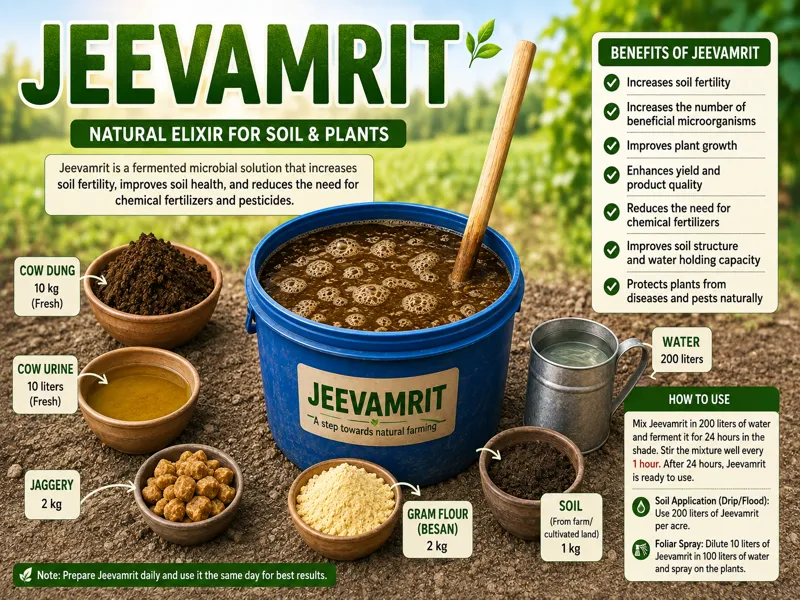
Jeevamrit is a liquid microbial culture, mainly prepared using the following ingredients:
- Fresh cow dung
- Cow urine
- Jaggery
- Pulse flour or gram flour (Besan)
- Chemical-free soil
- Water
These ingredients are mixed together and fermented under controlled conditions for a few days. During this process, the number of beneficial microorganisms increases, which helps promote biological activity in the soil.
Important: According to current scientific understanding, the primary role of Jeevamrit is not to provide direct nutrition to plants, but to improve the activity of beneficial soil microorganisms, which helps make nutrients more available to plants.
🌾 2. Why is Jeevamrit Used?
In natural farming, Jeevamrit is used for several purposes.
- To increase the population of beneficial microorganisms in the soil
- To improve the biological activity of the soil
- To enhance nutrient cycling
- To improve overall soil health
- To help reduce dependence on chemical fertilizers
However, it is not scientifically correct to claim that applying only Jeevamrit will definitely increase crop yield in every field. Crop production also depends on many other factors, such as:
- Soil type
- Rainfall
- Irrigation
- Crop variety
- Nutrient management
- Pest and disease management
Therefore, Jeevamrit is best used as one component of a complete natural farming system.
🧪 3. What Ingredients are Required to Prepare Jeevamrit?
According to the Government of India’s Natural Farming Training Module, the following ingredients are required to prepare 200 litres of Jeevamrit.
| Ingredient | Quantity |
|---|---|
| Fresh cow dung | 10 kg |
| Cow urine | 8–10 litres |
| Jaggery | 1.5–2 kg |
| Pulse flour / Gram flour (Besan) | 1.5–2 kg |
| Chemical-free soil | About 500 g |
| Water | About 180–200 litres |
Purpose of Each Ingredient
🐄 Cow Dung
Main source of beneficial microorganisms.
💧 Cow Urine
Supports the fermentation process.
🍯 Jaggery
Provides energy for microorganisms.
🌾 Pulse Flour
Supplies protein that helps microorganisms grow.
🌱 Soil
Source of local beneficial microorganisms.
💦 Water
Acts as the medium for mixing all ingredients and fermentation.
🪣 4. How to Prepare Jeevamrit
Preparing Jeevamrit is relatively simple, but it is important to follow the correct method.
Step 1
Take a clean plastic drum with a capacity of 200 litres.
Step 2
Fill it with about 180–200 litres of clean water.
Step 3
Now add:
- 10 kg fresh cow dung
- 8–10 litres cow urine
- 1.5–2 kg jaggery
- 1.5–2 kg pulse flour
- About 500 g chemical-free soil
Step 4
Mix the solution thoroughly using a wooden stick.
Step 5
Keep the drum in a shaded place and cover it with a jute sack or a similar cover that allows proper air circulation.
Step 6
Stir the mixture well with a wooden stick every morning and evening.
Step 7
Generally, Jeevamrit becomes ready for use after 2–3 days of fermentation. Some training manuals also mention 3–7 days of fermentation, depending on weather conditions.
Tip: Do not keep Jeevamrit under direct sunlight, as excessive heat may affect the fermentation process.
📅 5. When Should Jeevamrit be Applied?
Jeevamrit gives the best results when applied regularly to the soil or through irrigation. Its purpose is to maintain the activity of beneficial microorganisms in the soil.
According to the Government of India’s Natural Farming Training Module:
✅ First Application
Apply it along with the first irrigation after sowing or transplanting.
✅ After That
Apply it with irrigation approximately every 15 days (fortnightly interval).
Application at Different Crop Stages
| Crop Stage | Jeevamrit Application |
|---|---|
| After sowing/transplanting | Along with the first irrigation |
| Early growth stage | After 15 days |
| Active growth stage | Every 15 days |
| Fruit and vegetable crops | At regular intervals as required |
| Horticultural crops | Apply to the soil around the plants |
Tip: Instead of spraying during hot sunny hours, it is generally considered better to apply Jeevamrit in the morning or evening.
💧 6. What is the Recommended Dosage of Jeevamrit?
According to the Natural Farming Training Module:
With Irrigation
- Apply 200 litres of Jeevamrit per acre.
- Mix it with the irrigation water.
- Use it at an interval of about every 15 days.
Foliar Spray
The official training module mentions the following spray schedule:
| Spray | Mixture |
|---|---|
| First | 5 litres Jeevamrit + 100 litres water |
| Second | 7.5 litres Jeevamrit + 120 litres water |
| Third | 10 litres Jeevamrit + 150 litres water |
| Fourth | 15 litres Jeevamrit + 150 litres water |
Keep an interval of about 21 days between each spray.
Important: This schedule is not compulsory for all crops. The dosage may vary depending on the crop, weather conditions, and the advice of your local agricultural expert.
🌾 7. Which Crops Can Jeevamrit be Used For?
Jeevamrit is used in natural farming for most types of crops, such as:
- 🌾 Wheat
- 🌾 Paddy (Rice)
- 🌽 Maize
- 🌱 Pearl Millet (Bajra)
- 🌿 Pulses
- 🌻 Oilseed Crops
- 🥬 Vegetables
- 🍅 Tomato
- 🥒 Cucumber
- 🍆 Brinjal (Eggplant)
- 🌶️ Chilli
- 🥭 Mango
- 🍊 Orange
- 🍌 Banana
- 🍇 Grapes
- 🌾 Sugarcane
- 🧅 Onion
- 🥔 Potato
According to the official Natural Farming website, Jeevamrit can be applied to the soil, through irrigation, or as a foliar spray.
🪨 8. What is Ghan Jeevamrit?
Ghan Jeevamrit is the solid form of Jeevamrit.
When the same ingredients used for liquid Jeevamrit are prepared in a solid form, it is called Ghan Jeevamrit.
It is especially useful in areas where:
- Irrigation is limited.
- Preparing liquid Jeevamrit is difficult.
- Horticultural crops are grown.
- Organic inputs need to be applied directly near the plants.
The main purpose of Ghan Jeevamrit is also to increase the activity of beneficial microorganisms in the soil.
🧺 9. How to Prepare Ghan Jeevamrit
Several local methods of preparing Ghan Jeevamrit are in practice. Therefore, always follow the method recommended by your State Agriculture Department or Krishi Vigyan Kendra (KVK).
Ingredients
- Fresh cow dung
- Cow urine
- Jaggery
- Pulse flour
- Chemical-free soil
Preparation Method
Step 1
Mix all the ingredients thoroughly.
Step 2
Make the mixture thick.
Step 3
Prepare small balls or lumps from the mixture.
Step 4
Dry them in the shade.
Step 5
After they are completely dry, store them in a dry and well-ventilated place.
Note: The proportion of ingredients may vary according to different institutions. Therefore, it is better to follow the recommendations of your local agricultural authorities.
🌳 10. How to Use Ghan Jeevamrit?
Ghan Jeevamrit is generally applied:
- Near the roots of plants
- Around fruit trees
- At the time of transplanting
- Before the rainy season
- By mixing it into the soil
It helps gradually increase the biological activity of the soil over time.
⏳ 11. How Long Should Jeevamrit be Used?
It is generally considered better to use freshly prepared Jeevamrit as much as possible.
According to the National Natural Farming Portal, the prepared solution can be stored for about 15 days, but the activity of microorganisms may change over time. Therefore, preparing it fresh and using it is considered more suitable.
Similarly, the use of Jeevamrit during the crop season is not limited to a single application. In natural farming, it is applied regularly according to the crop’s requirement and the recommended interval.
🌱 12. Benefits of Jeevamrit
Jeevamrit is an important organic input in natural farming. Its main purpose is to activate beneficial soil microorganisms and improve the biological health of the soil. It should not be considered a “miracle fertilizer”, but rather as one part of a complete natural farming system.
🦠 12.1. Helps Increase the Activity of Beneficial Soil Microorganisms
Jeevamrit is considered a Microbial-rich Living Broth. It contains microorganisms that may:
- Help in Nitrogen Fixation.
- Help make phosphorus more available to plants.
- Promote the activity of microorganisms that improve potash availability.
- Produce certain bioactive substances related to plant growth.
🌾 12.2. Helps Improve Soil Health
Healthy soil is not made up of nutrients alone. It also depends on the bacteria, fungi, and earthworms living in it.
Regular use of Jeevamrit is considered helpful for:
- Increasing biological activity in the soil.
- Improving the decomposition of organic matter.
- Enhancing the natural process of Nutrient Cycling.
🪱 12.3. Helps Increase the Earthworm Population
In healthy soil, earthworms naturally decompose organic matter.
The NITI Aayog Training Module mentions that the use of Ghan Jeevamrit may help increase the earthworm population in the soil, which is beneficial for soil fertility.
🌿 12.4. Helps Improve Nutrient Availability
Jeevamrit is not a fertilizer that directly supplies large amounts of NPK nutrients.
Its primary role is to help make the nutrients already present in the soil more available to plants through the activity of beneficial microorganisms.
💰 12.5. Helps Reduce the Cost of Cultivation
The main objectives of natural farming are:
- Using resources available on the farm.
- Reducing dependence on external inputs.
- Lowering the cost of cultivation.
If farmers prepare Jeevamrit themselves, they may reduce their expenditure on chemical inputs.
🌍 12.6. A Better Option for the Environment
Natural farming does not use synthetic chemical fertilizers or pesticides.
As a result:
- The biological balance of the soil can be maintained.
- Environmental pressure may be reduced.
- The farming system can become more sustainable.
💧 12.7. Contributes to Water Conservation
In natural farming, along with Jeevamrit, techniques such as mulching, diversified cropping systems, and Whapasa are also used, which help in more efficient use of water.
It would not be correct to claim that Jeevamrit alone saves water.
⚠️ 13. Possible Disadvantages or Limitations of Jeevamrit
Jeevamrit has several potential benefits, but it also has some practical limitations.
⏳ 13.1. Results are Not Immediate
If a farmer has been practicing chemical farming for many years, it is not reasonable to expect an immediate increase in crop yield just after starting the use of Jeevamrit.
Improving the biological quality of the soil is a gradual process.
📍 13.2. Results May Vary from Place to Place
Every field is different.
The results may depend on factors such as:
- Soil type
- Rainfall
- Irrigation
- Temperature
- Crop
- Amount of organic matter
- Farm management
Therefore, it is not necessary that every farmer will get the same results.
🧪 13.3. It is Not Considered a Complete Replacement for Fertilizers
From a scientific point of view, Jeevamrit is considered a Microbial Inoculant or an organic input.
Claiming that Jeevamrit alone can meet all nutrient requirements is not supported by the available scientific evidence. Balanced nutrient management is still necessary.
🕒 13.4. Requires Regular Preparation
Liquid Jeevamrit needs to be prepared from time to time.
If it is stored for a very long period, the activity of microorganisms may decrease. Therefore, it is considered better to use it fresh.
🐄 13.5. Quality Ingredients are Essential
If:
- The cow dung is not fresh,
- The ingredients are contaminated,
- Or the preparation method is not followed correctly,
then the quality of Jeevamrit may be affected.
🛡️ 14. Precautions While Preparing Jeevamrit
For better results, keep the following points in mind:
- ✅ Use a clean drum.
- ✅ Do not use containers contaminated with chemicals.
- ✅ Use fresh cow dung and cow urine.
- ✅ Chlorine-free water is considered better.
- ✅ Stir the mixture every morning and evening with a wooden stick.
- ✅ Do not keep the drum in direct sunlight.
- ✅ Keep it in a shaded and well-ventilated place.
- ✅ Stir the solution well before use.
- ✅ Use the prepared solution as early as possible.
- ✅ Follow the advice of your local agricultural expert.
❌ 15. Common Mistakes While Preparing Jeevamrit
Many farmers unknowingly make mistakes that may affect the quality of Jeevamrit.
- Using old or dry cow dung.
- Using water contaminated with chemicals.
- Keeping the drum in direct sunlight.
- Not stirring the mixture every day.
- Storing the solution for too long.
- Mixing the ingredients in the wrong proportion.
- Using contaminated soil.
- Using a rusted iron drum instead of a plastic drum.
- Fermenting the mixture in extremely hot conditions.
- Filling the spray machine without filtering the solution, which may clog the spray nozzle.
🔬 16. Scientific Perspective
Several studies have been conducted on Jeevamrit, but the same results have not been observed across all crops, all soil types, and all climatic conditions.
1. Findings from the NITI Aayog Natural Farming Study
The Natural Farming Study published by NITI Aayog found that the improvement in farmers’ income after adopting natural farming was mainly due to reduced cultivation costs. In many cases, crop yield remained similar to conventional farming, while in some cases, higher yields were also recorded.
Therefore, it would not be scientifically correct to say that Jeevamrit always increases crop yield.
2. ICAR and NITI Aayog Training Programmes
Similarly, the training programmes conducted by ICAR and NITI Aayog present Jeevamrit as an input that helps improve:
- Soil biological quality
- Natural nutrient cycling
- Activity of beneficial microorganisms
It is not presented as a standalone solution.
⚖️ 17. What is the Difference Between Jeevamrit and Ghan Jeevamrit?
Both are used to promote the biological activity of the soil, but they differ in their form and method of application.
| Basis | Jeevamrit | Ghan Jeevamrit |
|---|---|---|
| Form | Liquid | Solid |
| Application | Through irrigation or foliar spray | Mixed into the soil |
| Preparation | Prepared with water | Prepared as a low-moisture mixture |
| Ease of Use | Easy in irrigated fields | Convenient for rainfed and horticultural areas |
| Storage | Limited storage period | Can be stored for a comparatively longer period |
Note: Which one is better depends on the farming conditions, irrigation facilities, and the convenience of the farmer.
🧪 18. Difference Between Jeevamrit and Chemical Fertilizers
| Point | Jeevamrit | Chemical Fertilizers |
|---|---|---|
| Main Function | Increases the activity of beneficial microorganisms | Directly supplies nutrients to plants |
| Source of Nutrition | Indirect | Direct |
| Effect on Soil | Promotes biological activity in the soil | Long-term unbalanced use may affect soil quality |
| Cost | Can be lower when prepared from local resources | Depends on market prices |
| Environmental Impact | Part of natural farming | Impact depends on the quantity and method of use |
Important: It is not advisable to stop using chemical fertilizers completely without scientific guidance. If farmers wish to adopt natural farming, they should seek advice from their local agricultural expert, Krishi Vigyan Kendra (KVK), or the Agriculture Department.
👨🌾 19. Expert Suggestions
If you are using Jeevamrit for the first time, keep the following points in mind:
- ✅ First, try it on a small area.
- ✅ Use freshly prepared Jeevamrit.
- ✅ Mix the ingredients only in the recommended proportions.
- ✅ Use it along with other natural farming practices such as Beejamrit, mulching, etc.
- ✅ Inspect your field regularly.
- ✅ If you notice any problem, consult an agricultural expert.
- ✅ Get your soil tested (Soil Testing) from time to time.
🚜 20. Useful Articles Related to Farming and Agriculture
- Natural Farming: Complete Guide to Sustainable Farming Success
- Carbon Farming in India: Benefits & Practices Guide
- Zero Budget Natural Farming
- Pests and Diseases in Crops: Definition, Significance & Impact
- Pest and Disease Control
- How to Do Organic Farming
- Benefits of Natural Farming
- How to Make Organic Vermicompost from Cow Dung in 30 Days
- Vermicompost Preparation Method
- Benefits of Drip Irrigation
- Pest and Disease Management
- Soil Health Card Scheme
❓21. Frequently Asked Questions (FAQs) About Jeevamrit
Q1. What is Jeevamrit?
Jeevamrit is a liquid organic microbial-rich solution used in natural farming to increase the biological activity of the soil. It is prepared using fresh cow dung, cow urine, jaggery, pulse flour (or gram flour), local soil, and water.
The main purpose of Jeevamrit is to increase the number and activity of beneficial microorganisms already present in the soil, helping the natural nutrient cycle work more effectively.
Q2. How Many Days Does It Take to Prepare Jeevamrit?
Under normal temperatures (about 25–35°C), Jeevamrit is usually ready in 2 to 3 days.
If the weather is cold, the fermentation process may be slower and it may take a little longer. During this period, the mixture should be stirred well every morning and evening using a wooden stick.
Q3. How Long Can Prepared Jeevamrit Be Used?
It is considered best to use Jeevamrit while it is fresh.
Although some natural farming guidelines mention that it can be used for about 15 days, the activity of microorganisms may change over time. Therefore, it is more suitable to prepare only the required quantity and use it as soon as possible.
Q4. When Should Jeevamrit Be Applied?
The first application of Jeevamrit can be made along with the first irrigation after sowing or transplanting.
After that, in natural farming, it is generally applied every 15 days. Local agricultural experts may recommend different schedules depending on the crop, soil, weather, and irrigation system.
Q5. What is the Recommended Dosage of Jeevamrit?
According to the Natural Farming Training Module, the general recommendation is:
- About 200 litres of Jeevamrit per acre
- Mix it with the irrigation water
- Apply it at an interval of about every 15 days
If using it as a foliar spray, mix Jeevamrit with water in the recommended proportion. The mixing ratio may vary depending on the crop.
Q6. Can Jeevamrit Be Used as a Foliar Spray?
Yes. Jeevamrit is also used as a foliar spray.
While spraying, keep the following points in mind:
- Spray during the morning or evening.
- Do not spray in strong sunlight.
- Filter the solution properly to prevent clogging of the spray nozzle.
- Mix water only in the recommended proportion.
Q7. Which Crops Can Jeevamrit Be Used For?
Jeevamrit can be used in most agricultural and horticultural crops, such as:
- Wheat
- Paddy (Rice)
- Maize
- Cotton
- Sugarcane
- Chickpea (Gram)
- Mustard
- Green Gram (Moong)
- Black Gram (Urad)
- Soybean
- Tomato
- Chilli
- Brinjal (Eggplant)
- Onion
- Potato
- Fruit Trees
However, the dosage and application interval may vary depending on the crop.
Q8. Is Jeevamrit a Fertilizer?
No. From a scientific point of view, Jeevamrit is not considered a traditional chemical fertilizer.
Its main function is to increase the activity of beneficial microorganisms in the soil, which helps improve the availability of nutrients.
Q9. Does Jeevamrit Increase Crop Yield?
There is no definite “Yes” or “No” answer to this question.
Crop production depends on many factors, including:
- Soil type
- Amount of organic matter
- Irrigation
- Weather
- Crop
- Nutrient management
- Pest and disease management
Some studies have reported positive results, while others found yields similar to conventional farming. Therefore, claiming that “Jeevamrit always increases crop yield” is not scientifically correct.
Q10. Can Chemical Fertilizers Be Completely Stopped by Using Jeevamrit?
This decision should not be taken without consulting an agricultural expert.
If farmers want to adopt natural farming, they should do so gradually under the guidance of the local Agriculture Department, Krishi Vigyan Kendra (KVK), or Agricultural University.
Q11. Can Jeevamrit Go Bad?
Yes. If it is stored for a long time or under unsuitable conditions, its quality and microbial activity may be affected.
Q12. What is Ghan Jeevamrit?
Ghan Jeevamrit is the solid form of Jeevamrit.
It is especially useful for farmers:
- Where irrigation is limited.
- Where preparing liquid Jeevamrit is difficult.
- In horticultural crops.
Q13. How Should Ghan Jeevamrit Be Used?
Ghan Jeevamrit is generally applied:
- Near the roots of plants
- Around fruit trees
- At the time of transplanting
- By mixing it into the soil
Q14. Should Only Indigenous (Desi) Cow Dung Be Used in Jeevamrit?
Most official natural farming training modules recommend using fresh dung and urine of indigenous (Desi) cows.
If your State Agriculture Department or Agricultural University has issued different recommendations, follow the local guidelines.
Q15. Can Jeevamrit Be Applied During the Rainy Season?
Yes, but it should be applied after considering the field condition and the intensity of rainfall.
If heavy rain is expected, most of the Jeevamrit may get washed away. Therefore, it is better to use it according to the weather conditions and local recommendations.
Q16. Can Jeevamrit Be Applied Through Drip Irrigation?
Yes. Many farmers also use Jeevamrit through drip irrigation systems.
Keep the following points in mind:
- Filter the solution properly.
- Keep the filters clean.
- Prevent the nozzles from getting clogged.
Q17. Can Jeevamrit Be Used in Organic Farming?
Yes. Jeevamrit is used not only in natural farming but also in many organic farming systems.
However, for Organic Certification, it is necessary to follow the relevant certification standards.
Q18. Does Jeevamrit Control Pests and Diseases?
The main purpose of Jeevamrit is to increase the biological activity of the soil.
It should not be considered a direct substitute for insecticides or fungicides. If pest or disease problems occur in the crop, appropriate organic or recommended management practices should be followed.
Q19. Can Jeevamrit Be Used in All Types of Soil?
Yes. Jeevamrit can be used in most types of soil.
However, the results may vary depending on soil fertility, organic carbon content, soil pH, and local conditions.
Q20. Can Jeevamrit Be Used Along with Other Organic Inputs?
Yes. In natural farming, Jeevamrit is often used together with:
- Beejamrit
- Mulching
- Whapasa
- Ghan Jeevamrit
- Other recommended organic inputs
The purpose of all these practices is to strengthen soil health and support the natural farming system.
🌱 Conclusion
Jeevamrit is an important organic input that is widely used in natural farming. Its main purpose is to increase the activity of beneficial microorganisms in the soil and improve overall soil health. When prepared correctly and applied at the recommended intervals, it can become an effective part of a natural farming system.
However, it is important to understand that Jeevamrit is not a “miracle solution.” The success of farming also depends on soil quality, irrigation, crop management, weather, balanced nutrition, and other agricultural practices. Therefore, using Jeevamrit with scientific guidance, local agricultural department recommendations, and regular soil testing is the best approach.