


Paddy Transplantation: Complete Guide to Better Rice Farming
🌾 What is Paddy Transplantation and Why is it Important?
Paddy is one of the most important food grain crops in India, and rice, the staple food of millions of people, is obtained from this crop. To achieve a good yield, using high-quality seeds alone is not enough. It is equally important to carry out paddy transplantation at the right time, with the right method, and by following scientific farming practices.
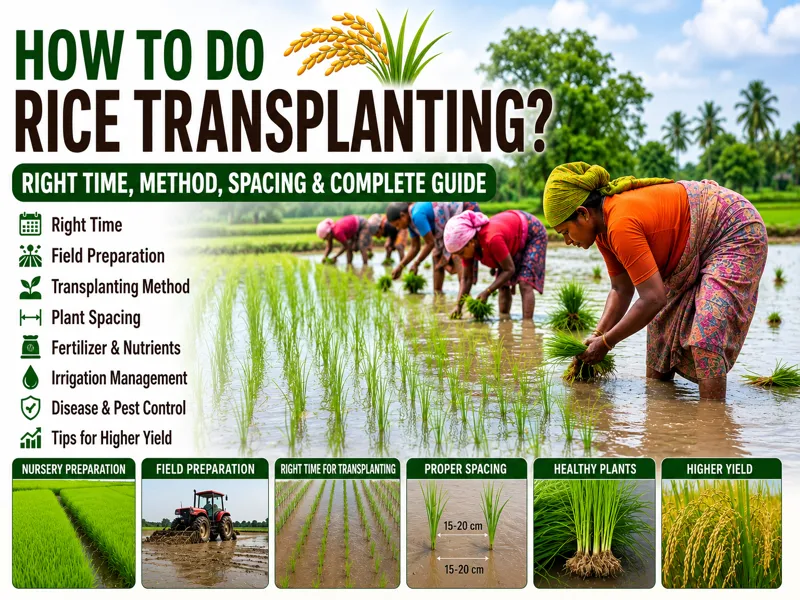
Paddy Transplantation (Rice Transplanting) is the process in which paddy seedlings raised in a nursery are transplanted into the main field at a recommended spacing. This is the most commonly adopted method in India because it promotes better plant growth, makes weed control easier, and increases crop productivity.
If transplantation is not done at the right time or proper attention is not given to seedling age, spacing, and field preparation, the crop yield may decrease by 20–40%. Therefore, every farmer should have knowledge of the scientific methods of paddy transplantation.
📅 1. Best Time for Paddy Transplantation
The most important question for getting a good paddy yield is: When should paddy transplantation be done? The answer depends on your region, monsoon, irrigation availability, and the paddy variety.
General Paddy Transplantation Time in India
| Region | Suitable Transplantation Time |
|---|---|
| North India (Uttar Pradesh, Bihar, Haryana, Punjab) | Last week of June to the third week of July |
| Central India (Madhya Pradesh, Chhattisgarh) | Last week of June to mid-July |
| Eastern India (West Bengal, Odisha, Jharkhand) | Mid-June to the end of July |
| South India (Andhra Pradesh, Telangana, Tamil Nadu, Karnataka) | Depends on monsoon and irrigation in different seasons |
Note: In rainfed farming, transplant only when the field has sufficient moisture and 2–5 cm standing water.
Disadvantages of Late Paddy Transplantation
If paddy transplantation is done too late, the following problems may occur:
- Plant growth becomes slow.
- Fewer tillers are produced.
- Flowering and grain formation are affected.
- Pest and disease infestation may increase.
- Final crop yield may reduce significantly.
Disadvantages of Early Paddy Transplantation
Very early transplantation can also create problems:
- Plants may suffer from water shortage if the monsoon is delayed.
- High temperatures may increase plant stress.
- Re-transplanting may be required if adequate soil moisture is not available.
Therefore, always decide the transplantation time by considering the local weather, irrigation facilities, and the recommendations of the Agriculture Department.
🌱 2. After How Many Days Should Paddy Be Transplanted?
After the nursery is ready, transplanting seedlings at the correct age is extremely important.
Generally:
- Short Duration varieties: 20–25-day-old seedlings
- Medium Duration varieties: 20–30-day-old seedlings
- Long Duration varieties: 25–35-day-old seedlings
Why is the Correct Seedling Age Important?
Young Seedlings:
- Establish quickly.
- Produce more tillers.
- Utilize nutrients more efficiently.
- Have the potential to give higher yields.
Older Seedlings (More than 35–40 Days):
- Root development may become slower.
- Fewer tillers are produced.
- Crop yield may be affected.
Seedling Preparation Before Transplantation
Before transplanting, keep the following points in mind:
- Select healthy and disease-free seedlings.
- Lightly irrigate the nursery before uprooting to minimize root damage.
- Do not leave seedling roots exposed to direct sunlight for a long time.
- It is better to transplant the seedlings immediately after uprooting.
🚜 3. How to Do Paddy Transplantation?
Paddy transplantation is not just about planting seedlings; it is a scientific process. If the correct method is followed, plant growth, nutrient utilization, and final yield all improve.
Step 1: Field Preparation
- Plough the field thoroughly.
- Level the soil using a leveller as required.
- Make proper arrangements to retain water in the field.
- Keep 2–5 cm of standing water during the final field preparation.
Step 2: Seedling Selection
- Select only healthy and green seedlings.
- Remove diseased or weak seedlings.
Step 3: Planting the Seedlings
- Generally, plant 2–3 seedlings at each planting spot.
- Do not plant the seedlings too deep.
- A planting depth of 2–3 cm is sufficient.
Step 4: Maintain Proper Spacing
In most situations, the following spacing is considered suitable:
- Row to Row: 20 cm
- Plant to Plant: 15 cm
However, this spacing may vary depending on the variety, soil type, and cultivation method. Always follow the recommended spacing for your region.
Common Mistakes During Paddy Transplantation
- Using over-aged seedlings.
- Planting seedlings too deep.
- Planting too many seedlings at one spot.
- Maintaining uneven spacing.
- Improper field leveling.
Avoiding these mistakes can result in a noticeable improvement in crop yield.
🌾 4. Paddy Transplantation Methods
For obtaining a good paddy yield, transplanting at the right time alone is not enough. Selecting the appropriate Paddy Transplantation Method (Rice Transplanting Method) is also very important. Farmers choose different methods depending on field conditions, water availability, labour, machinery, and farming budget.
The following methods are mainly adopted in India.
1. Traditional (Manual) Paddy Transplantation
This is the most common method in India. In this method, seedlings are first raised in a nursery and later transplanted manually into the main field by labourers.
How is it Done?
- Maintain 2–5 cm standing water in the field.
- Uproot healthy 20–30-day-old seedlings from the nursery.
- Generally, plant 2–3 seedlings at each planting spot.
- Transplant the seedlings in straight rows with proper spacing.
Advantages
- Suitable for all types of fields.
- Healthy seedlings can be selected easily.
- Suitable for small farmers.
- No machine is required.
Disadvantages
- Requires more labour.
- Takes more time.
- Labour cost is higher.
- Transplantation may be delayed if labour is unavailable.
2. Paddy Transplantation Using a Machine
Nowadays, agricultural mechanization is increasing rapidly. Farmers in many states are using Rice Transplanters.
In this method, mat nursery seedlings prepared in special seedling trays are used, and the machine transplants the seedlings at a fixed spacing.
Advantages
- Covers a larger area in less time.
- Reduces labour costs.
- Ensures uniform plant spacing.
- Promotes better plant growth.
- Timely transplantation may increase crop yield.
Limitations
- High initial machine cost.
- Mat nursery preparation is required.
- A trained operator may be needed.
- Its use may be limited in very small or irregularly shaped fields.
3. SRI (System of Rice Intensification) Method
The SRI (System of Rice Intensification) method is a scientific farming technique aimed at achieving higher yields with less water, fewer seeds, and better crop management.
Generally, in this method:
- Young seedlings (about 8–15 days old) are used.
- Only one seedling is planted at each spot.
- Wider spacing is maintained between plants.
- The field is not kept continuously flooded; irrigation is provided only when required.
Important: Before adopting the SRI method, it is beneficial to receive training from local agricultural experts or the Krishi Vigyan Kendra (KVK).
🚜 5. Paddy Transplantation Using a Tractor
Due to increasing labour costs and labour shortages, tractor-based paddy transplantation is becoming more popular.
In this system, a special Rice Transplanter is attached to the tractor, which transplants seedlings at a fixed spacing while moving through the field.
Major Advantages of Tractor-Based Paddy Transplantation
- Fast operation over large areas.
- Reduces dependence on labour.
- Maintains uniform plant spacing.
- Saves time.
- Lowers labour costs.
- Useful for large farmers and Custom Hiring Centres.
Suitable Fields for Tractor-Based Transplantation
- Levelled fields.
- Proper drainage facilities.
- Well-puddled fields.
- Large-sized fields.
If the fields are very small, uneven, or rough, the efficiency of the machine may be reduced.
🤖 6. Paddy Transplantation Machine
The machine used for paddy transplantation is commonly called a Rice Transplanter.
This machine transplants nursery-grown seedlings into the field at a fixed spacing and planting depth.
Main Types
1. Walk-Behind Rice Transplanter
In this machine, the operator walks behind the machine while operating it.
Suitable For:
- Small and medium farmers
- Small fields
- Limited budget
2. Riding Type Rice Transplanter
In this machine, the operator sits on the machine while operating it.
Suitable For:
- Large farmers
- Custom Hiring Centres
- Large agricultural enterprises
Things to Consider Before Choosing a Machine
- Field size
- Availability of local service
- Availability of spare parts
- Fuel consumption
- Company warranty
- Training and ease of operation
🚜 7. Tractor-Mounted Paddy Transplantation Machine
Many farmers use the term “Paddy Transplantation Machine Tractor” to refer to a tractor-operated Rice Transplanter.
These machines are especially useful for large agricultural fields.
Features
- High working efficiency
- Uniform transplantation
- Saves time
- Better productivity
- Suitable for large-scale farming
Beneficial For Which Farmers?
- Farmers with 10 acres or more of land
- Farmer Producer Organizations (FPOs)
- Agricultural Service Centres
- Custom Hiring Centres
For small farmers, renting such a machine may be more economical than purchasing one.
🔋 8. Paddy Transplantation Machine for Power Trolley
In some regions, paddy transplantation machines operated with a power trolley or a small power unit are also used.
These machines are mainly useful for farmers who do not have a tractor.
Advantages
- Suitable for small-sized fields
- Comparatively lower fuel consumption
- Easy to operate
- Useful for small and medium farmers
Limitations
- Working capacity may be lower than tractor-based machines.
- It may take more time to cover large areas.
- These machines are not equally available in all regions.
💰 9. Price of Paddy Transplantation Machine
The price of a paddy transplantation machine depends on several factors, such as:
- Type of machine
- Capacity
- Engine
- Brand
- Features
- Local dealer
- Government subsidy
Therefore, it is not appropriate to mention a single fixed price.
Major Factors Affecting the Price
- Whether the machine is a walk-behind or riding type.
- Engine capacity.
- Number of transplanting rows.
- Brand and model.
- Transportation and local taxes.
- Available government schemes.
Important Advice: Before purchasing a machine, always compare the latest prices, warranty, service, and spare parts availability from at least 2–3 authorized dealers. If your state offers subsidies under the Agricultural Mechanization Scheme, check the eligibility criteria and application process before making a purchase.
💡10. Is It Better to Buy or Rent a Machine?
Buying a machine is not necessary for every farmer.
Buy a Machine If:
- You have a large farming area.
- You grow paddy regularly every year.
- Custom hiring services are not available nearby.
- You also want to use the machine for commercial purposes.
Rent a Machine If:
- Your farming area is limited.
- You need to use it only once a year.
- You want to keep the initial investment low.
- A machine is available nearby for rent.
In many states, paddy transplantation machines are also available on rent through the Agriculture Department, Farmer Producer Organizations (FPOs), and Custom Hiring Centres.
🌿 11. Which Fertilizer Should Be Applied During Paddy Transplantation?
For getting a higher paddy yield, using a good variety and transplanting on time alone is not enough. Balanced Nutrient Management is equally important. If the field lacks essential nutrients, plant growth will be slow, fewer tillers will develop, and the final yield may be affected.
Important: Always get a Soil Test done before deciding the fertilizer dose. Applying fertilizers based on soil test results is the most scientific and beneficial approach.
🌾 Major Nutrients Required for Paddy Crop
The paddy crop mainly requires the following nutrients:
- Nitrogen (N): For plant growth, green leaves, and tiller development.
- Phosphorus (P): For root development and early plant growth.
- Potassium (K): For stronger plants, disease resistance, and better grain quality.
- Zinc (Zn): For healthy plant growth in zinc-deficient areas.
- Sulphur (S): Helps in protein formation and overall plant development.
🌱 Which Fertilizer Should Be Applied Before Transplantation?
During the final field preparation, the following fertilizers are generally applied according to the soil test report:
- Phosphorus fertilizers
- Potassium fertilizers
- Zinc (if deficiency is found)
- Well-decomposed farmyard manure (FYM) or compost
The use of organic matter improves soil structure, increases water-holding capacity, and supports beneficial soil microorganisms.
🌾 When Should Nitrogen Be Applied?
The entire dose of nitrogen should not be applied at one time in the paddy crop.
It is generally more beneficial to apply it in 2–3 splits, such as:
- First split – At the time of transplantation or immediately after transplantation.
- Second split – During the Active Tillering stage.
- Third split – During the Panicle Initiation stage (if recommended).
Caution: Excessive use of nitrogen may cause excessive vegetative growth, increase the chances of lodging, and make the crop more prone to pests and diseases.
🌾 12. Which Fertilizer Should Be Applied After Paddy Transplantation?
After transplantation, it is important to supply nutrients according to the crop’s growth stage.
1️⃣ Tillering Stage
This is one of the most important growth stages of the paddy crop.
During this stage:
- The next split of nitrogen can be applied.
- If zinc deficiency is observed, apply zinc as advised by an agricultural expert.
2️⃣ Panicle Initiation Stage
If required according to the soil test report and local recommendations, the final split of nitrogen can be applied at this stage.
This stage has a significant effect on the number of grains and the final crop yield.
3️⃣ Micronutrients
If the following symptoms appear in the field:
- Yellowing of leaves
- Stunted plant growth
- Abnormal development of new leaves
Then consult an agricultural expert or the Krishi Vigyan Kendra (KVK) before applying the required micronutrients.
💧 13. What Should Be Done After Paddy Transplantation?
The first 30–40 days after transplantation are very important for the paddy crop.
Proper crop care during this period can significantly improve the final yield.
1. Proper Irrigation Management
Immediately after transplantation, the field should not be filled with excessive water.
Generally:
- A shallow layer of water is sufficient during the initial days.
- Avoid unnecessary deep water.
- There is no need to keep the field continuously flooded with excess water.
According to modern agricultural research, need-based irrigation can help save water under many conditions.
2. Weed Management
Early weeds cause the maximum damage to the paddy crop.
For weed control:
- Carry out timely weeding and intercultural operations.
- If required, use a suitable herbicide as recommended by an agricultural expert.
- Do not allow weeds to remain in the field for a long time.
3. Regular Monitoring of Pests and Diseases
Inspect the field every week.
Pay attention to the following:
- Leaf colour
- Presence of insects
- Early symptoms of diseases
- Plant growth
Controlling problems at an early stage is easier and more cost-effective.
4. Drainage Management
If there is continuous heavy rainfall, arrange proper drainage to remove excess water from the field.
Long-term waterlogging may affect plant growth under certain conditions.
5. Identify Nutrient Deficiency
If the plants show:
- Yellow leaves
- Stunted growth
- Weak plant growth
Then consult an agricultural expert instead of applying extra fertilizer without proper diagnosis.
❌ 14. Common Mistakes Farmers Make During Paddy Transplantation
Many times, farmers get lower yields despite using a good variety and providing sufficient irrigation. The main reason is small mistakes made during cultivation.
Avoid the following mistakes:
- Transplanting over-aged seedlings.
- Not leveling the field properly.
- Not maintaining the recommended spacing.
- Applying excessive fertilizers without a soil test.
- Depending only on urea.
- Delaying weed control.
- Not regularly monitoring pests and diseases.
- Keeping excess water in the field unnecessarily.
📈 15. Expert Tips for Higher Paddy Yield
If you want to get higher production from your paddy crop, follow these recommendations:
✅ Select certified and high-quality seeds.
✅ Prepare the nursery on time.
✅ Transplant seedlings of the correct age.
✅ Level the field properly.
✅ Follow balanced nutrient management.
✅ Apply fertilizers according to the soil test report.
✅ Control weeds on time.
✅ Inspect the field regularly.
✅ Irrigate according to the crop’s requirement.
✅ Follow the recommendations of the Agriculture Department and Krishi Vigyan Kendra (KVK).
🚜 16. Useful Articles for Farmers
- Kodo Farming
- Foxtail Millet Farming Guide: Cultivation, Yield & Profit
- Oats Farming
- Finger Millet
- Sorghum Farming
- Barley Farming
- Paddy Farming In India
- Millet Farming
- Maize Farming in India: Guide for Maximum Profit
- Wheat Farming in India: Sowing to Profit Guide
- Carbon Farming in India: Benefits & Practices Guide
- Low Cost Irrigation Method
- Micro Irrigation System
- Plant a Tree with Just One Liter of Water
- How to Do Organic Farming
- Benefits of Natural Farming
- Vermicompost Preparation Method
- Benefits of Drip Irrigation
- Pest and Disease Management
- Soil Health Card Scheme
❓ 17. Paddy Transplantation: Frequently Asked Questions (FAQs)
Q1. What is the best time for paddy transplantation?
In most North Indian states, the period from the last week of June to the third week of July is considered suitable. However, the actual transplantation time depends on the local weather, monsoon, and paddy variety.
Q2. How old should the seedlings be for paddy transplantation?
Under most normal conditions, 20–30-day-old healthy seedlings are considered suitable. This period may vary depending on the variety and cultivation method.
Q3. Is manual paddy transplantation better than machine transplantation?
Manual transplantation can be practical for small fields, while machine transplantation is more suitable for large fields as it saves both time and labour.
Q4. Is applying only urea during paddy transplantation enough?
No. Along with nitrogen, the paddy crop also requires phosphorus, potassium, and other essential nutrients. Farmers should follow balanced nutrient management based on a soil test.
Q5. How much water should be maintained in the field after transplantation?
During the initial stage, a shallow layer of water is sufficient. Keeping the field continuously flooded with deep water is not necessary in every situation. Irrigation should be managed according to the soil type, weather, and crop growth stage.
📝 Conclusion
Successful paddy cultivation depends on timely transplantation, scientific methods, balanced nutrient management, and regular crop care. Whether you transplant manually or use modern machines, better yields can be achieved by properly preparing the field, using seedlings of the correct age, maintaining the recommended spacing, and managing irrigation and fertilizers efficiently.
The increasing use of agricultural machines is helping farmers reduce labour costs and complete transplantation on time. Similarly, applying fertilizers based on a soil test not only reduces cultivation costs but also helps maintain long-term soil fertility.
Finally, every farmer should make decisions according to the climate, soil conditions, and recommendations of the local Agriculture Department in their area. By adopting scientific farming practices, farmers can achieve both higher paddy yields and better profits.
Validation Note: This article intentionally does not include claims such as fixed NPK fertilizer doses, fixed machine prices, or a single fertilizer recommendation for all regions, because these vary according to the location, soil type, paddy variety, and state-specific agricultural recommendations.
This article has been prepared in accordance with the general scientific recommendations followed by Indian agricultural research institutions.
Need help or have a question? Get in touch with – our team