


Soil Health Card Scheme
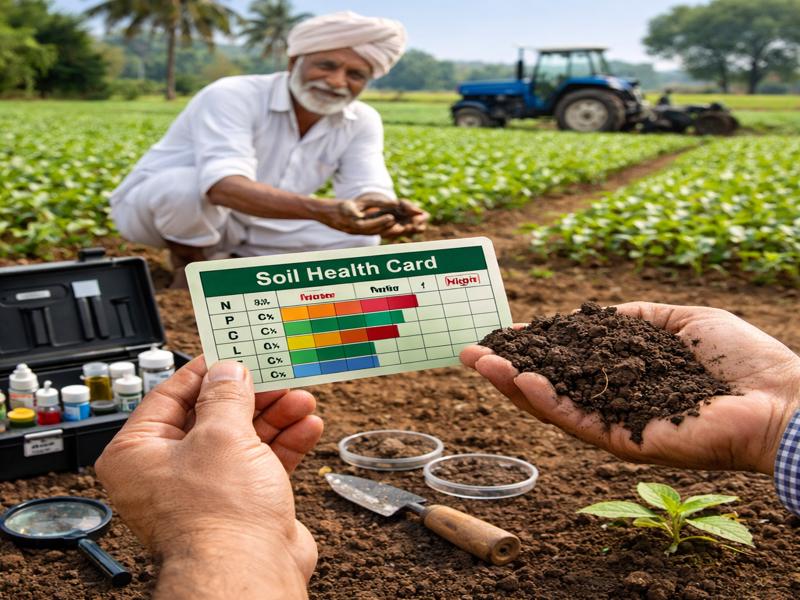
Soil Health Card Scheme – Detailed Information
Soil Health Card (SHC) scheme is an important agriculture initiative of the Government of India, which was started in February 2015 with the slogan “Healthy Soil, Green Field.” The objective of this scheme is to provide scientific information to farmers about the quality of their soil, fertility, and nutrient status, so that they can use fertilizers in the right quantity and make farming more profitable.
Under this scheme, farmers are provided a Soil Health Card every 2 years, which contains information about 12 important nutrients and properties of soil. This helps in reducing farming cost and increasing production.
1. What is Soil Health Card Scheme?
Soil Health Card is a type of scientific report card which gives complete details of the quality of a farmer’s land. It tells which nutrients are present in the soil, which nutrients are lacking, and what type of fertilizers should be used.
This card also provides crop-wise fertilizer recommendations, which makes farming more scientific and profitable.
2. Main Objectives of the Scheme
The main objectives of Soil Health Card Scheme are as follows:
- To scientifically evaluate soil nutrient status
- To promote balanced use of fertilizers
- To reduce farmers’ cost
- To improve crop production and quality
- To maintain long-term soil fertility
- To reduce environmental pollution
- To promote Sustainable Agriculture
3. 11 Parameters Included in Soil Testing
Under this scheme, soil samples are tested on 11 important parameters:
3.1. Macro Nutrients (Main Nutrients)
- Nitrogen (N)
- Phosphorus (P)
- Potassium (K)
3.2. Micronutrients
- Zinc (Zn)
- Iron (Fe)
- Copper (Cu)
- Manganese (Mn)
- Boron (B)
3.3. Physical and Chemical Properties of Soil
- pH (whether soil is acidic or alkaline)
- EC (Electrical Conductivity – salinity level)
- OC (Organic Carbon – amount of organic matter)
Based on all these parameters, farmers are given the correct fertilizer recommendation for their land.
4. How to Get Soil Health Card? (Step-by-Step Complete Guide)
The process of getting a Soil Health Card is designed in a systematic and scientific way by the government so that every farmer gets correct information according to their land.
4.1. Soil Sample Collection
- Trained agriculture staff or officers collect soil samples from farmers’ fields
- Sample is taken from different locations in the field (Zig-Zag Method)
- Usually soil is taken from 0–15 cm (top layer) and 15–30 cm (deep layer)
- One composite sample is prepared for one field
Note: Stones, grass, and other waste are removed while collecting samples.
4.2. Soil Testing in Laboratory
- Collected samples are sent to soil testing laboratories
- Scientific testing is done on 12 parameters (NPK, micronutrients, pH, EC, OC, etc.)
- Modern equipment and standard procedures are used
4.3. Soil Health Report Generation
- After testing, a detailed report is prepared
- It includes:
- Level of nutrients in soil
- Deficiency or excess of nutrients
- Crop-wise fertilizer recommendation
- Report is uploaded on the portal in digital format
4.4. Soil Health Card Preparation and Distribution
- Based on the report, Soil Health Card is prepared in farmer’s name
- It is distributed through:
- Agriculture department office
- Gram Panchayat / Agriculture center
- Camps
- In many states, it is also available in digital (PDF) form
4.5. Online Application Process
Farmers can also apply online:
Step-by-step:
- Go to official portal: soilhealth.dac.gov.in
- Select “Register” or “Farmer Login”
- Fill details (name, mobile, land details)
- Submit request for soil testing
- Nearby agriculture department/lab will collect sample
4.6. Offline Application Process
If farmers cannot apply online, they can:
- Visit nearby agriculture department office
- Contact Krishi Vigyan Kendra (KVK)
- Meet block or tehsil level agriculture officer
- Fill form and apply
4.7. Processing Time
- Usually takes 15 to 30 days from sample collection to card delivery
- Time may vary depending on lab availability
4.8. Required Documents
- Farmer’s name and mobile number
- Land details (Khasra/Khatauni)
- Identity proof (Aadhaar Card)
- Field location
4.9. Important Tips for Farmers
- Do soil testing every 2 years
- Use fertilizers as per report
- Avoid excessive nitrogen use
- Increase use of organic manure
- Take advice from agriculture experts
5. Major Benefits of the Scheme
5.1. Balanced Use of Fertilizers
Farmers use fertilizers as per need, saving unnecessary cost
5.2. Reduction in Farming Cost
Less fertilizer use reduces cost and increases profit
5.3. Increase in Production
Proper nutrition improves crop quality and yield
5.4. Improvement in Soil Health
Soil fertility is maintained for a long time
5.5. Environmental Protection
Less chemical use reduces water and soil pollution
6. Achievements and Data (Latest till 2025)
Soil Health Card Scheme has brought major changes in Indian agriculture from 2015 to 2025.
6.1. Total Distribution (Phase-wise)
- First Phase (2015–2017): Around 10.74 crore cards
- Second Phase (2017–2019): Around 11.69 crore cards
- Third Phase (2019–2023/24): Continuous distribution
Total: More than 29–30 crore Soil Health Cards distributed
6.2. Impact on Fertilizer Use and Production
- Chemical fertilizer use reduced by 8% to 10%
- Crop yield increased by 5% to 6%
- Balanced fertilizer use improved significantly
6.3. Development of Soil Testing Laboratories
- 429+ Static Labs
- 102+ Mobile Labs
- 8752+ Mini Labs
- 1562+ Village level labs
- 800+ labs strengthened
6.4. Impact on Farmers
- Crores of farmers got accurate soil information
- Scientific farming increased
- Cost reduced and income improved
- Long-term soil fertility improved
6.5. Employment and Rural Development
- Employment increased in soil labs
- Youth up to 40 years setting up labs with support
- SHGs and FPOs benefited
6.6. Model Village Pilot Project
- One model village selected in each block
- Field-based sample testing promoted
- 13.53 lakh cards distributed (pilot phase)
- Farmer participation increased
6.7. Progress towards Sustainable Agriculture
- Strengthened sustainable agriculture
- Reduced excessive chemical use
- Reduced soil and water pollution
- Promoted organic and balanced farming
7. Usefulness of Soil Health Card
7.1. Crop-wise Fertilizer Recommendation
Provides correct fertilizer amount for different crops
7.2. Identification of Nutrient Deficiency
Farmers can understand nutrient deficiency easily
7.3. Promotion of Scientific Farming
Transforms traditional farming into scientific farming
8. Contribution in Sustainable Agriculture
- Maintain soil quality
- Reduce chemical pollution
- Promote organic farming
- Conserve natural resources
9. Challenges
- Lack of awareness among farmers
- Lack of labs in some areas
- Delay in reports
- Not following recommendations
10. Solutions
- Training and awareness programs for farmers
- Increase number of laboratories
- Strengthen digital services
- Provide incentives to farmers
11. Important Points
11.1. Prelims:
- Start year: 2015
- Theme: Healthy Soil, Green Field
- Testing: 12 parameters
- Distribution: Every 2 years
11.2. Mains:
- Objective: Balanced fertilizer use
- Benefits: Cost reduction, increased production
- Importance: Sustainable agriculture and environmental protection
Conclusion
Soil Health Card Scheme is a revolutionary step for farmers. It not only improves soil quality but also plays an important role in increasing farmers’ income.
Through this scheme, farmers can know the real condition of their land and do scientific farming to get better production and profit. It is also very important for environmental protection and sustainable agriculture.
If you are a farmer, then make sure to get a Soil Health Card and make your farming modern and profitable.
👉 For more detailed information on government schemes, click here