


What Is Green Manure? A Natural Way to Make Soil Fertile
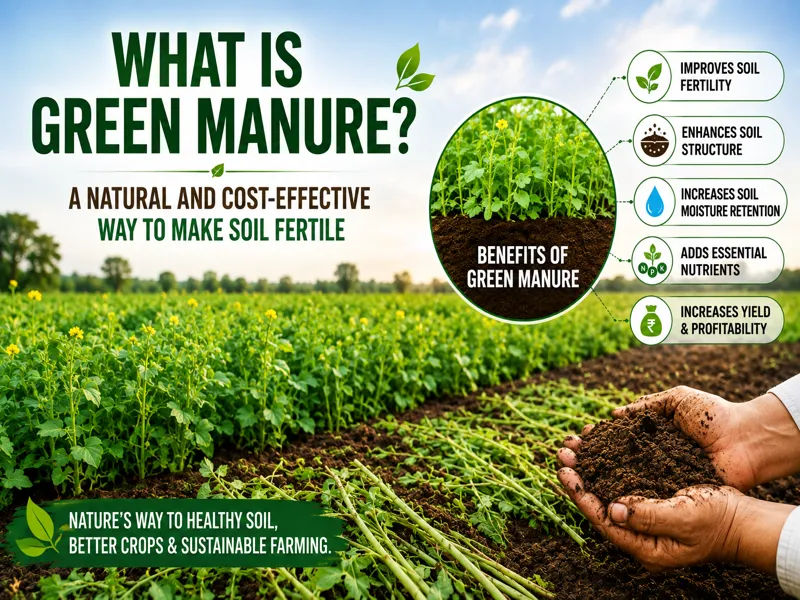
🌿 What Is Green Manure?
When a crop is ploughed into the soil while it is still green, before it fully matures, it is called green manure.
In simple words…
Green manure is a natural fertilizer that farmers grow in their own fields and later mix back into the same field to improve soil fertility.
When this crop decomposes in the soil, the nitrogen, organic matter, and other nutrients present in it get mixed into the soil. This makes the soil more fertile and healthier than before.
Nowadays, the continuous use of urea, DAP, and other chemical fertilizers is making the soil in many fields weak. In such a situation, green manure is a natural and sustainable way to restore soil health.
🌱 1. Why Do Farmers Call It a “Natural Tonic”?
Just as healthy food gives strength to our body, green manure works as a natural tonic for the soil.
By using green manure:
- Organic carbon in the soil increases.
- Beneficial microorganisms grow rapidly.
- The soil becomes loose and crumbly.
- Water-holding capacity improves.
- Roots of the next crop develop better.
- Plants can absorb nutrients more easily.
This is why agricultural scientists also recommend the use of green manure from time to time.
🌾 2. Why Is Green Manure Important?
Today, most farmers grow crops continuously in the same field every season. Whether it is paddy, wheat, sugarcane, cotton, or vegetables, every crop removes a large amount of nutrients from the soil.
If we keep applying only chemical fertilizers and do not return organic matter to the soil, the soil quality gradually starts declining.
As a result, several problems can occur, such as:
- Poor crop growth.
- Reduced crop yield.
- Hard soil.
- Soil loses moisture quickly even after irrigation.
- Reduced effectiveness of fertilizers.
- Poor root development.
In such situations, green manure helps restore the health of the soil.
🌍 3. Green Manure Is Not Just a Fertilizer, It Is a Soil Improvement Technique
Many farmers think that green manure is used only to supply nitrogen.
But this is not true.
Green manure:
✅ Improves soil structure.
✅ Increases organic matter in the soil.
✅ Increases the population of beneficial bacteria and earthworms.
✅ Helps retain nutrients in the soil for a longer time.
✅ Improves the movement of air and water in the soil.
This means green manure is not just a fertilizer but a natural technique to improve the overall health of the field.
✅ 4. Major Benefits of Green Manure
If green manure is used at the right time, it offers many important benefits.
🌱 4.1. Improves Soil Fertility
Green manure adds a large amount of organic matter to the soil.
As it decomposes, the soil becomes more fertile, and the next crop can absorb nutrients more easily.
💧 4.2. Helps Retain Soil Moisture for a Longer Time
Green manure is very useful in areas where water is limited.
It improves the water-holding capacity of the soil, allowing moisture to remain for a longer time after irrigation.
🌾 4.3. Makes Plant Roots Stronger
Loose and crumbly soil provides enough space for roots to spread properly.
Strong roots help plants absorb more water and nutrients.
🦠 4.4. Increases Beneficial Microorganisms
Green manure increases the population of beneficial microorganisms in the soil that help make nutrients available to plants.
It can also increase the number of earthworms, which further improves soil quality.
🌿 4.5. Supplies Nitrogen Naturally
Legume crops such as dhaincha, sunn hemp, moong, and urad absorb nitrogen from the air and store it in the soil.
This provides natural nitrogen to the next crop and may reduce the need for urea to some extent.
💰 4.6. Helps Reduce Farming Costs
When the soil is already fertile, the need for chemical fertilizers also decreases.
This can reduce the cost of cultivation and increase farmers’ savings in the long run.
🌍 4.7. Safe for the Environment
Green manure is completely natural.
Compared to chemical fertilizers, it has fewer harmful effects on the soil, water, and environment.
This is why it is highly important in organic and natural farming.
🚜 4.8. Maintains Soil Health for a Long Time
The biggest advantage of green manure is that its benefits are not limited to just one crop.
If farmers use it regularly, they can see continuous improvement in soil quality for many years.
🌾 5. Which Crops Are Best for Green Manure?
Many crops in India are used as green manure. Among them, legume crops are the most popular because they help increase nitrogen in the soil.
| 🌱 Crop | ⏳ Time to Mix into the Soil | ⭐ Special Feature |
|---|---|---|
| Dhaincha | 45–50 days | Most popular, grows very fast |
| Sunn Hemp | 45–55 days | Produces a large amount of organic matter |
| Moong | 40–45 days | Useful for increasing nitrogen |
| Urad | 40–50 days | Legume crop that improves soil |
| Cowpea | 45–50 days | Suitable for light soils |
| Berseem | As required | Useful in some regions |
⭐ 6. Why Are Dhaincha and Sunn Hemp the Most Preferred Green Manure Crops?
If you ask any farmer which crop is best for green manure, most farmers and agricultural experts will recommend Dhaincha (Sesbania) and Sunn Hemp (Sunhemp).
There are several reasons behind this:
- They grow very quickly.
- They produce a large amount of green biomass in a short time.
- They add plenty of organic matter to the soil.
- They help increase the availability of nitrogen in the soil.
- They can be easily grown before paddy, sugarcane, and other Kharif crops.
For this reason, these two crops are the most recommended green manure crops in most states of India.
💡 Farmer’s Advice
If your field is no longer giving the same yield as before, if you need to apply more fertilizers every year, or if your soil is becoming hard, then you should definitely grow Dhaincha or Sunn Hemp as green manure before your next main crop.
It is an investment that provides benefits not just for one season but for many years to come.
⭐ 7. Why Is Dhaincha Considered the Best Green Manure Crop?
If you ask an agricultural scientist or an experienced farmer which crop is best for green manure, most of them will recommend Dhaincha (Sesbania).
The biggest reason is that Dhaincha grows very quickly, produces a large amount of green biomass, and naturally helps increase nitrogen in the soil.
That is why farmers prefer growing Dhaincha before planting paddy, sugarcane, maize, and many other crops.
If you have only 45 to 50 days available before your main crop, Dhaincha is considered the best choice.
🌱 7.1. Main Features of Dhaincha
Dhaincha is not just a green manure crop but also a natural method to improve soil health.
Its major benefits are:
✅ Ready within 45–50 days.
✅ Produces a large amount of green biomass in a short time.
✅ Increases organic carbon in the soil.
✅ Helps fix nitrogen from the air into the soil.
✅ Can be easily grown in most soil types.
✅ Most commonly used before paddy transplantation.
✅ Makes the soil loose and more fertile.
✅ Supports better root development of the next crop.
🚜 7.2. In Which States Is Dhaincha Mostly Grown?
Farmers grow Dhaincha as green manure in many Indian states, including:
- Uttar Pradesh
- Haryana
- Punjab
- Rajasthan
- Madhya Pradesh
- Bihar
- Jharkhand
- Chhattisgarh
- Odisha
- West Bengal
- Telangana
- Andhra Pradesh
- Tamil Nadu
Dhaincha is more commonly used in areas where paddy and sugarcane are widely cultivated.
📅 8. Right Time for Sowing Green Manure
Green manure gives the best results only when it is sown at the right time.
Generally, farmers grow green manure during the vacant period before planting the main crop.
8.1. For Kharif Crops
If you are planning to grow Kharif crops such as paddy, maize, cotton, or soybean, you can sow Dhaincha or Sunn Hemp as soon as the monsoon begins.
8.2. In Paddy Cultivation
Sow Dhaincha about 45–50 days before paddy transplantation.
Later, plough it into the soil and allow it to decompose for 15–20 days, then transplant the paddy.
8.3. In Sugarcane Cultivation
Green manure is also used before planting sugarcane to improve soil fertility.
⏰ 9. When Should Green Manure Be Mixed into the Soil?
This is the most important question.
Many farmers either plough the crop too early or too late.
In both cases, they do not get the full benefit.
The best time is when the plants start flowering.
At this stage:
- The plants contain the highest amount of nutrients.
- The stems are not too hard.
- The plants decompose quickly.
- Nutrients mix into the soil faster.
If the plants become fully mature, they take more time to decompose.
🚜 10. Complete Method of Preparing Green Manure
Preparing green manure is very simple.
You only need to follow the right process at the right time.
The complete process is given below.
🔹 Step 1: Prepare the Field
First, carry out normal ploughing of the field.
If there are old weeds in the field, remove them.
Then level the field so that the seeds can germinate evenly.
🔹 Step 2: Sow the Seeds
Now sow the seeds of Dhaincha, Sunn Hemp, or any other green manure crop.
Do not sow the seeds too deep.
A depth of 2 to 4 cm is sufficient.
If it is raining, sowing becomes even easier.
🔹 Step 3: Irrigation
If there is enough rainfall, separate irrigation is not required.
However, if there is no rainfall, provide light irrigation.
Good initial soil moisture improves seed germination.
🔹 Step 4: Allow the Crop to Grow
Let the crop grow for about 45–50 days.
During this period, the plants grow rapidly and produce a large amount of green biomass.
This biomass later becomes a natural fertilizer for the soil.
🔹 Step 5: Plough the Crop into the Soil
When the plants start flowering, use any of the following:
- Tractor
- Rotavator
- Disc Harrow
- Plough
Mix the entire crop into the soil.
Make sure the complete green crop is properly buried inside the soil.
🔹 Step 6: Allow Time for Decomposition
After mixing the green manure into the soil, do not sow the next crop immediately.
Maintain sufficient soil moisture for about 15–20 days.
During this period, the plants gradually decompose, mix with the soil, and turn into natural manure.
After that, sow or transplant the main crop.
🌱 11. Seed Rate for Green Manure
Using the correct seed rate helps the crop grow well and produces enough green biomass.
| 🌿 Crop | 🌱 Seed Rate (kg/hectare) |
|---|---|
| Dhaincha | 25–30 |
| Sunn Hemp | 40–50 |
| Moong | 20–25 |
| Urad | 20–25 |
| Cowpea | 25–30 |
Note: The seed rate may vary slightly depending on the crop variety, soil type, and sowing method.
💧 12. How to Irrigate After Green Manure?
Many farmers make the mistake of leaving the field completely dry after ploughing the green manure into the soil.
This should not be done.
To ensure that the green manure decomposes quickly, the soil should have light moisture.
If there is no rainfall, provide light irrigation as required.
⚠️ 13. Common Mistakes While Using Green Manure
Farmers often make a few small mistakes that prevent them from getting the full benefits of green manure.
Avoid these mistakes:
❌ Ploughing the Crop Too Late
If the plants become fully mature, they take more time to decompose.
❌ Mixing the Crop into the Soil Too Early
If the plants are too young, they do not produce enough organic matter.
❌ Not Maintaining Soil Moisture
Plants do not decompose quickly in dry soil.
❌ Sowing the Next Crop Immediately After Mixing Green Manure
Always wait at least 15–20 days.
❌ Expecting Results After Using Green Manure Only Once
If green manure is used regularly every 2–3 years, continuous improvement in soil quality can be seen.
💡 Farmer’s Advice
If you grow paddy, sugarcane, maize, or vegetables, try growing Dhaincha once before planting your main crop.
Most farmers notice positive improvements in soil moisture, root growth, and crop performance in the very first year. With regular use, soil health continues to improve further.
🌾 14. Which Crops Benefit the Most from Green Manure?
Green manure can be used in almost all crops, but some crops show especially better results.
If Dhaincha, Sunn Hemp, or any other green manure crop is grown and mixed into the soil before sowing the main crop, the next crop gets more nutrients, better root development, and healthier soil.
Let us find out which crops benefit the most from green manure.
🌾 14.1. Paddy (Rice)
Green manure is most commonly used in paddy cultivation.
Dhaincha is sown about 45–50 days before paddy transplantation. It is ploughed into the field at the flowering stage, and paddy is transplanted 15–20 days later.
Major benefits in paddy cultivation:
✅ Increases the natural availability of nitrogen in the soil.
✅ Promotes better early crop growth.
✅ May reduce the need for chemical fertilizers to some extent.
✅ Helps retain soil moisture for a longer time.
🌽 14.2. Maize
Maize also requires a good amount of nutrients.
If green manure is used before sowing, the plant roots become stronger and the initial growth improves.
🍬 14.3. Sugarcane
Sugarcane is a long-duration crop, so good soil fertility is very important.
Using green manure:
- Keeps the soil more fertile.
- Increases organic matter.
- Improves water availability.
- Provides long-term benefits to the crop.
🌱 14.4. Wheat
If green manure is used during the Kharif season, the wheat crop grown in the Rabi season also benefits from it.
In healthy soil, wheat roots develop well, and plant growth remains balanced.
🌿 14.5. Vegetables
Green manure is also beneficial for growing tomatoes, chilli, brinjal, okra, cabbage, cauliflower, and other vegetables.
Loose and crumbly soil is very important for vegetable cultivation, and green manure plays a key role in achieving this.
🍎 14.6. Fruit Orchards
In mango, guava, lemon, pomegranate, papaya, and other fruit orchards, green manure crops can be grown in the vacant spaces and later mixed into the soil.
This helps maintain soil quality for a long time.
⚖️ 15. What Is the Difference Between Green Manure, Farmyard Manure, and Chemical Fertilizers?
Many farmers want to know which option is better.
In fact, all three have their own importance.
| Feature | 🌿 Green Manure | 🐄 Farmyard Manure | 🧪 Chemical Fertilizers |
| Source | Grown in the field | Made from animal dung | Manufactured in factories |
| Cost | Low | Depends on availability | Comparatively higher |
| Organic Matter | Excellent source | Good source | Not available |
| Nitrogen | Naturally available | Limited | Immediately available |
| Soil Structure | Improves soil structure | Improves soil structure | Does not improve soil structure |
| Environment | Safe | Safe | Excessive use may cause damage |
💡 What Is the Best Approach?
For balanced farming, the best approach is to use a combination of green manure + farmyard manure + chemical fertilizers based on soil test recommendations.
🌍 16. Why Is Green Manure Beneficial for the Environment?
Today, the whole world is focusing on sustainable farming.
Green manure is an important step in this direction.
Its use provides the following benefits:
🌱 Increases organic carbon in the soil.
💧 Improves water conservation.
🌾 Reduces soil erosion.
🦠 Increases the population of beneficial microorganisms.
🌍 May reduce dependence on chemical fertilizers.
♻️ Keeps the soil fertile for a longer period.
This means green manure not only benefits the current crop but also helps keep the soil healthy for future generations.
⚠️ 17. Important Precautions While Using Green Manure
For the best results, keep the following points in mind:
✅ Plough the crop into the soil at the beginning of the flowering stage.
✅ Maintain sufficient moisture in the field.
✅ Do not sow the main crop for 15–20 days after ploughing the green manure into the soil.
✅ Use good-quality seeds.
✅ If possible, get the soil tested and manage fertilizers accordingly.
✅ Even if not every year, use green manure at least once every 2–3 years.
💡 18. Special Advice for Farmers
If in your field:
- You need to apply more urea every year.
- The crop yield is not as good as before.
- The soil has become hard.
- Water dries up quickly.
- Crop roots remain weak.
These may be signs that the organic matter in the soil is decreasing.
In such a situation, make sure to use Dhaincha or Sunn Hemp as green manure before planting your next main crop.
It is an investment that provides benefits for many years.
🌱 19. Can Farming Be Done Using Only Green Manure?
This is a common question among farmers.
The answer is No.
Green manure is an important way to improve soil fertility, but the nutrient requirements of different crops are different.
Therefore, it is more beneficial to use a combination of:
- Green manure
- Organic manure (Farmyard Manure or Compost)
- Biofertilizers
- Balanced chemical fertilizers based on soil test recommendations
🚜 20. Useful Articles Related to Farming
- What Is Green Manure? A Natural Way to Make Soil Fertile
- How to Make Organic Vermicompost from Cow Dung in 30 Days
- Vermicompost: Uses, Benefits, Price & How to Make
- Organic Farming in India
- Pests and Diseases in Crops: Definition, Significance & Impact
- Pest and Disease Control
- How to Do Organic Farming
- Benefits of Natural Farming
- How to Make Organic Vermicompost from Cow Dung in 30 Days
- Vermicompost Preparation Method
- Benefits of Drip Irrigation
- Pest and Disease Management
- Soil Health Card Scheme
❓ 21. Frequently Asked Questions (FAQs) About Green Manure
Q1. What is Green Manure?
Green manure is a crop that is ploughed into the soil while it is still green, before it fully matures. After decomposing in the soil, it acts as a natural fertilizer and increases the amount of organic matter, nitrogen, and other nutrients in the soil. The main purpose of green manure is to improve soil fertility, enhance soil structure, and prepare a better environment for the next crop.
Q2. Which Is the Best Crop for Green Manure?
In India, Dhaincha (Sesbania) and Sunn Hemp (Sunhemp) are considered the best crops for green manure. Apart from these, crops like Moong, Urad, Cowpea, and Berseem are also used. Among them, Dhaincha is the most popular because it is ready in about 45–50 days, grows rapidly, and helps add a large amount of organic matter and natural nitrogen to the soil.
Q3. When Should Green Manure Be Mixed into the Soil?
The best time to mix green manure into the soil is when the crop reaches the beginning of the flowering stage. At this stage, the plants contain the highest amount of nutrients and decompose quickly in the soil. If the crop is ploughed too early, it does not produce enough organic matter. If it is ploughed too late, the plants become hard and take more time to decompose.
Q4. Can Green Manure Completely Eliminate the Need for Urea?
No. Green manure helps increase nitrogen naturally in the soil, which may reduce the need for urea to some extent. However, it is not correct to say that urea is no longer required after using green manure. The correct amount of fertilizers should always be decided based on a soil test and the nutrient requirements of the crop.
Q5. How Long Does Green Manure Take to Decompose in the Soil?
After ploughing green manure into the field, it should generally be allowed to decompose for 15–20 days.
During this period, the plants gradually decompose, mix with the soil, and release nutrients.
If the soil has sufficient moisture, the decomposition process becomes more effective.
Therefore, the main crop should not be sown immediately after incorporating green manure into the soil.
Q6. What Is the Biggest Benefit of Green Manure?
The biggest advantage of green manure is that it not only supplies nutrients to the soil but also improves its overall health.
It increases organic carbon, makes the soil loose and crumbly, improves water-holding capacity, and increases the population of beneficial microorganisms.
As a result, the roots of the next crop become stronger, and the chances of getting a better yield increase.
Q7. Can Green Manure Be Used in All Types of Soil?
Yes. Green manure can be used in almost all types of soils, such as loamy, sandy, clay, and medium black soils.
Only the crop should be selected according to the local climate and soil conditions.
Choosing the right crop at the right time can provide good results in every type of soil.
Q8. Is Green Manure Important in Organic Farming?
Yes. Green manure is very important in organic farming.
It naturally increases nutrients in the soil and helps reduce dependence on chemical fertilizers.
If green manure is used along with farmyard manure, compost, and biofertilizers, the soil quality remains good for a long time.
Q9. Does Green Manure Help Save Water?
Yes. Green manure increases organic matter in the soil, which improves its water-holding capacity.
As a result, the soil retains moisture for a longer time after irrigation, and the need for frequent watering may decrease.
This is especially beneficial for farmers in low-rainfall areas.
Q10. Should Green Manure Be Used Every Year?
If you have enough time and land available, using green manure every year before the main crop is the best option.
If this is not possible, you should use green manure at least once every 2–3 years.
Regular use continuously improves soil fertility and provides long-term benefits.
Q11. Does Green Manure Help Reduce Weeds?
Yes. Green manure crops such as Dhaincha and Sunn Hemp grow rapidly and cover the soil surface.
This prevents many weeds from getting enough sunlight and space, which may reduce their growth.
However, if the field already has a heavy weed infestation, additional weed management may also be required.
Q12. Is Green Manure Useful Only for Paddy Cultivation?
No. Green manure is not limited to paddy cultivation.
It is also successfully used in sugarcane, maize, wheat, cotton, vegetables, pulse crops, and fruit orchards.
Green manure can be grown in any field where there is enough vacant time before planting the main crop.
Q13. Can Green Manure Be Used Together with Compost or Farmyard Manure?
Yes, absolutely. Using green manure, farmyard manure, and compost together is even more beneficial for the soil.
Green manure adds fresh organic matter to the soil, while farmyard manure and compost provide nutrients over a longer period.
The balanced use of all three improves soil quality and helps increase crop productivity.
Q14. Can Small and Marginal Farmers Also Adopt Green Manure?
Yes. Green manure is a low-cost and simple farming practice, so small and marginal farmers can easily adopt it.
It does not require expensive equipment or high investment.
If farmers can spare 45–50 days before planting the main crop, they can improve soil fertility at a low cost.
Q15. What Is the Best Time to Adopt Green Manure?
The best time to sow green manure is about 45–60 days before sowing or transplanting the main crop.
Most farmers sow Dhaincha or Sunn Hemp at the beginning of the monsoon and plough the crop into the field at the flowering stage.
After that, they should wait about 15–20 days before sowing the main crop so that the green manure decomposes completely and provides maximum benefits.
🎯 Conclusion
Green manure is not just a fertilizer but a natural technique to keep the soil fertile for a long time. If farmers grow Dhaincha, Sunn Hemp, Moong, or other suitable green manure crops from time to time and mix them into the soil, they can significantly improve the soil’s organic strength, water-holding capacity, and nutrient availability.
Today, when farming costs are continuously increasing and maintaining soil health has become a major challenge, adopting green manure is a wise decision. It is beneficial not only for the current crop but also plays an important role in maintaining the productivity of the field for many years.
Remember: Healthy soil is the strongest foundation for a good crop.
🌾 Farmer’s Lesson
“The more you invest in your soil today, the better your harvest will be in the coming years. Adopt green manure, improve your soil health, and take a strong step towards sustainable farming.”