


Pumpkin Farming in India: Complete Guide to High Yield & Profit
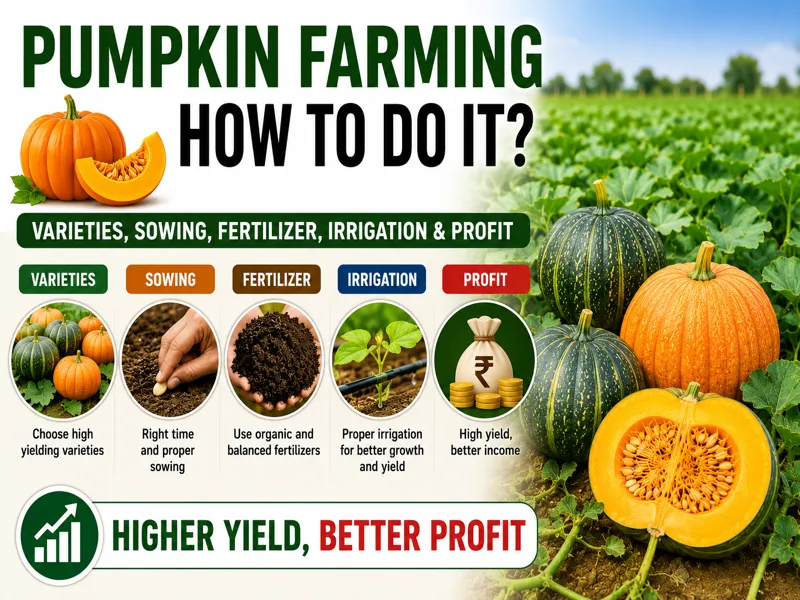
How to Grow Pumpkin? A Complete Guide for Farmers
If you are looking for a vegetable crop that offers high profits with low investment, pumpkin farming can be an excellent option. In India, pumpkins are cultivated almost throughout the year, and the demand remains steady in both rural and urban markets. This is why, in recent years, a large number of farmers have started adopting pumpkin cultivation along with traditional crops.
Pumpkin is a vegetable crop that is comparatively easy to cultivate. However, if farmers follow scientific farming methods, choose high-yielding varieties, apply balanced fertilizers, and manage pests and diseases on time, the yield per acre can increase significantly. Moreover, if good market prices are available, this crop can provide profits worth lakhs of rupees.
In this article, we will discuss every important aspect of pumpkin farming in detail so that both new and experienced farmers can benefit from it.
🌱 1. Introduction to Pumpkin
Pumpkin is one of the most popular vine vegetables grown in India. It belongs to the Cucurbitaceae family, which also includes bottle gourd, ridge gourd, cucumber, and bitter gourd.
One of the main advantages of pumpkin is that it is cultivated in almost every state of India. It can be successfully grown during summer, rainy, and winter seasons. Farmers can select the sowing time according to the local climate and earn a good income throughout the year.
Pumpkin fruits vary in shape, colour, and weight. Some varieties produce round fruits, while others have long or flat-shaped fruits. Modern hybrid varieties are known for higher yield, attractive colour, better quality, and longer shelf life.
Today, the demand for pumpkin is not limited to vegetable markets. It is also widely used in hotels, restaurants, food processing industries, sweet-making industries, and export markets. This has made pumpkin a profitable cash crop for farmers.
Why Should You Grow Pumpkin?
Pumpkin farming offers many advantages:
- Low cultivation cost.
- Good production in a short period.
- Suitable for year-round cultivation.
- Continuous market demand.
- Higher total yield due to heavier fruits.
- Can be successfully grown with less water.
- More profit with drip irrigation and mulching.
- Continuous income through multiple harvests.
If farmers follow scientific cultivation practices, they can earn several lakhs of rupees from one acre.
🌼 2. Health Benefits and Uses of Pumpkin
Pumpkin is not only a delicious vegetable but also an excellent source of nutrition. It contains various vitamins, minerals, and antioxidants that are highly beneficial for human health.
1. Good Source of Vitamin A
Pumpkin is rich in beta-carotene, which is converted into Vitamin A in the body. It helps improve eyesight and prevents problems like night blindness.
2. Boosts Immunity
The Vitamin C present in pumpkin strengthens the immune system and helps protect the body from infections.
3. Beneficial for Heart Health
Pumpkin contains fibre, potassium, and antioxidants that help keep the heart healthy.
4. Improves Digestion
The fibre present in pumpkin helps reduce constipation and improves the digestive system.
5. Helps in Weight Management
Due to its low calorie content and high fibre, pumpkin is considered suitable for people trying to lose weight.
6. Good for Skin and Hair
The Vitamins A and C found in pumpkin help maintain healthy skin and improve hair quality.
Uses of Pumpkin
Pumpkin is used in many different ways in India:
- For preparing vegetable dishes.
- For making sweets and halwa.
- For preparing soups.
- For making juice and puree.
- For making pickles.
- In the food processing industry.
- As animal feed.
- For extracting oil from its seeds.
Pumpkin seeds are also highly nutritious and are consumed like dry fruits.
🔬 3. Scientific Classification
| Description | Information |
|---|---|
| Common Name | Pumpkin |
| English Name | Pumpkin |
| Scientific Name | Cucurbita moschata / Cucurbita maxima |
| Family | Cucurbitaceae |
| Plant Type | Vine Vegetable |
| Life Cycle | Annual Crop |
🌦️ 4. Climate and Temperature
A warm and humid climate is considered most suitable for successful pumpkin cultivation. Although this crop can be grown in different seasons, excessive frost and waterlogging negatively affect plant growth.
Suitable Temperature
- Minimum Temperature: 15°C
- Ideal Temperature: 25°C–30°C
- Maximum Tolerable Temperature: 38°C
Within this temperature range, plant growth, flowering, and fruit development are better.
Right Time for Sowing
Summer Crop
Sowing from February to March gives good yields.
Kharif Crop
Sowing can be done from July to August after the onset of rainfall.
Rabi Crop
In many regions, pumpkin is also successfully cultivated between October and December.
If proper irrigation facilities are available, farmers can cultivate pumpkins throughout the year according to local conditions.
Protection from Frost
If there is a possibility of frost during winter:
- Use the low tunnel technique.
- Create smoke in the field.
- Provide light irrigation.
- Apply sulphur dusting.
These practices help reduce cold damage to the plants.
🌍 5. Soil Requirement
Pumpkin can be grown in almost all types of soils, but well-drained loamy or sandy loam soil is considered the most suitable.
Ideal Soil
- Loamy soil.
- Sandy loam soil.
- Soil rich in organic matter.
Soil pH
Soil with a pH of 6.0 to 7.5 is considered best.
Why is Proper Drainage Important?
If water remains stagnant in the field for a long time:
- Root rot problems increase.
- Plants start turning yellow.
- Fruit quality declines.
- Overall yield decreases.
Therefore, always ensure proper drainage in the field.
🌱 6. Seeds and Improved Varieties
The most important factor for getting a good yield is quality seeds. If farmers choose certified and improved hybrid varieties, both production and fruit quality can increase significantly.
Major Improved Varieties
1. Mahi (Mahyco)
A popular hybrid variety known for better fruit quality, attractive colour, and high yield.
2. Anuj (VNR)
Famous for uniform-sized fruits, strong vines, and high production.
3. Nakul F1
A fast-growing variety that is comparatively tolerant to diseases.
4. East-West ED-177
A variety suitable for commercial cultivation with excellent fruit quality.
5. Virat
Popular among farmers because of its large-sized fruits and better yield potential.
6. AD-1001
A modern hybrid variety with high yield potential, preferred by many farmers for commercial cultivation.
Points to Remember While Choosing an Improved Variety
- Buy seeds from a certified company.
- Select seeds with high germination capacity.
- Choose disease-resistant varieties.
- Select varieties according to market demand.
- Choose varieties suitable for the local climate.
🌾 7. Seed Rate
Generally, 500 to 700 grams of seed is sufficient for one acre of land.
However, the seed requirement depends on plant spacing, variety, and sowing method. If wider spacing is maintained between plants, the seed requirement may be lower.
Always purchase certified seeds with a high germination rate. Before sowing, treat the seeds with Trichoderma or the recommended fungicide. This improves germination and reduces the risk of early-stage diseases.
🚜 8. Field Preparation
Proper field preparation is very important for obtaining a higher yield in pumpkin cultivation. If the field is well prepared before sowing, plant growth becomes faster, roots become stronger, and the crop can withstand diseases more effectively.
Method of Field Preparation
- First, plough the field deeply using a mouldboard plough.
- Then, run a cultivator or harrow 2 to 3 times to make the soil loose and fine.
- Remove old weeds, stones, and crop residues completely from the field.
- Keep the field level so that irrigation is distributed evenly.
- Ensure proper drainage, as waterlogging is one of the biggest problems in pumpkin cultivation.
Use of Organic Manure
During the final ploughing, mix about 2 trolley loads of well-decomposed farmyard manure (FYM) per acre into the soil. This improves soil fertility, activates beneficial microorganisms, and promotes better plant growth.
Basal Fertilizer
Before sowing, the following fertilizers are considered beneficial:
- 50 kg Single Super Phosphate (SSP)
- 50 kg Gypsum
- Well-decomposed farmyard manure
These fertilizers help in root development, flowering, and improving fruit quality.
🌱 9. Sowing Method
When pumpkins are sown using the correct spacing and scientific methods, the plants receive enough sunlight, air, and nutrients, resulting in higher production.
Bed Method is the Best
- Bed Width: About 2.5 feet
- Bed Height: 1 foot
- Distance Between Beds: 6 feet
Plant Spacing
- Plant to Plant Distance: About 3 feet
- Sow 2 seeds at each spot.
- After germination, keep the healthy plant and remove the weaker one.
Seed Treatment
Before sowing, treat the seeds with Trichoderma (5–7 grams per kilogram of seed). This helps in:
- Better germination.
- Reducing root rot problems.
- Keeping plants healthy from the beginning.
Use of Mulching
If farmers are doing commercial cultivation, they should use 25-micron silver/black mulching sheets.
Benefits of mulching:
- Reduces weed growth.
- Retains soil moisture for a longer period.
- Prevents fruits from coming into direct contact with the soil.
- Improves fruit quality.
🌿 10. Manure and Fertilizer Management
Pumpkin is a high-yielding crop, so it requires balanced nutrition. Applying only urea does not increase production. A balanced application of phosphorus, potash, sulphur, and micronutrients is also essential.
First Top Dressing (30–35 Days)
- Urea: 20–25 kg
- Sulphur
- Humic Acid
Apply these fertilizers 5–6 inches away from the plant roots, followed by light irrigation.
Second Top Dressing (90–100 Days)
- Urea: About 40 kg
- Micronutrient mixture
- Seaweed granules
At this stage, flowering and fruit development increase rapidly, so the nutrient requirement also becomes higher.
Third Top Dressing (110–125 Days)
- Ferrous Sulphate
- Urea
- Biozyme
This helps in proper fruit filling and improves fruit quality during the final stage of crop growth.
Precautions While Applying Fertilizers
- Do not apply fertilizers directly near the plant stem.
- Lightly loosen the soil before applying fertilizers.
- Irrigate the field after fertilizer application.
- Avoid excessive use of nitrogen.
💧 11. Irrigation Management
Pumpkin roots grow deep into the soil, but continuous soil moisture should be maintained.
During Summer
Irrigate the crop at an interval of 7–8 days.
Drip Irrigation
If a drip irrigation system is installed, irrigating for about 2 hours every 2 days is generally sufficient.
During the Rainy Season
Remove excess water from the field immediately.
During Fruit Development
Do not allow a shortage of moisture at this stage; otherwise, the fruits may remain small.
🌾 12. Weed Management
Weeds compete with the crop for nutrients, water, and sunlight. Therefore, timely weed control is essential.
Weed Control Measures
- Carry out weeding and hoeing from time to time.
- Use mulching sheets.
- Keep the field clean.
- Destroy weeds before they start flowering.
🐛 13. Pest and Disease Management
Some pests and diseases in pumpkin can significantly affect crop production.
Major Pests
Fruit Fly
The fruit fly lays eggs inside the fruits, causing them to spoil.
Control Measures
- Install fruit fly traps.
- Destroy infected fruits.
Whitefly
Whitefly is the main carrier of the Yellow Mosaic Virus.
Thrips and Aphids
These pests suck the sap from the plants, causing the leaves to curl and plant growth to stop.
Major Diseases
Yellow Mosaic Virus
This is one of the most serious diseases in pumpkin.
Symptoms
- Yellowing of leaves.
- Stunted plant growth.
- Small-sized fruits.
Fungal Diseases
Under high moisture conditions, fungal infections may occur on leaves and stems.
Integrated Management
- Select disease-resistant varieties.
- Install yellow and blue sticky traps.
- Use neem-based organic products.
- Do not allow waterlogging in the field.
- If required, use the recommended insecticides and fungicides as advised by an agricultural expert.
⏳ 14. Crop Duration
Most hybrid pumpkin varieties are ready for harvesting in about 120 to 150 days.
This duration may vary slightly depending on the climate, variety, and cultivation practices.
✂️ 15. Harvesting
Harvest the fruits when they are fully developed, have a bright colour, and the fruit stalk starts becoming hard.
Points to Remember During Harvesting
- Use a sharp cutting tool.
- Leave a small portion of the stalk attached to the fruit.
- Keep the harvested fruits in a shaded place.
- Separate damaged fruits from the healthy ones.
🌸 16. Yield Per Acre
If farmers adopt scientific cultivation methods and use improved hybrid varieties, they can obtain a yield of about 300 to 400 quintals per acre.
The yield depends on the following factors:
- Seed quality
- Soil fertility
- Irrigation
- Fertilizer management
- Pest and disease control
- Weather
💰 17. Market Price and Profit
The biggest advantage of pumpkin farming is its good profit potential.
Estimated Cost
Approximately ₹25,000 to ₹40,000 per acre.
Market Price
Depending on the season and market demand, the price may range from ₹10 to ₹20 per kilogram, or even higher.
Estimated Net Profit
If the crop yield is good and market prices are favourable, farmers can earn a net profit of about ₹2.5 lakh to ₹5 lakh per acre.
Growing pumpkins during the off-season can further increase profits.
🏪 18. Storage
Proper storage after harvesting helps maintain the quality of the fruits for a longer period.
Storage Tips
- Store the fruits in a dry and cool place.
- Protect them from direct sunlight.
- Keep damaged and cut fruits separate.
- Grade the fruits before sending them to the market.
- Use strong packaging for transportation.
🏛️ 19. Government Schemes
Farmers can avail the benefits of various government schemes for pumpkin cultivation.
- Pradhan Mantri Krishi Sinchai Yojana (PMKSY)
- Mission for Integrated Development of Horticulture (MIDH)
- Kisan Credit Card (KCC)
- Soil Health Card Scheme
- Agricultural Mechanization Scheme
- Horticulture subsidy schemes offered by State Governments
🚜 20. Useful Farming Articles
- Pumpkin Farming in India: Complete Guide to High Yield & Profit
- Broccoli Farming 2026: Cost, Profit & Complete Guide
- Pointed Gourd Farming: Time, Medicine & Hybrid Guide
- Mushroom Farming Full Process at Home & Compost Making Guide
- Advanced Beans Farming: Earn Lakhs with Low Investment
- Top Summer Horticulture Crops & Better Crop Management
- Summer Vegetable Care and Management Guide
- Round Gourd Cultivation Guide for High Yield
- Arbi Farming & Recipes: Complete Guide
- Lotus Cucumber
- BeetRoot Farming
- Snake Cucumber Farming
- Cucumber Farming
- Sponge Gourd Farming
- Ladyfinger Farming
- Capsicum Farming
- Spinach Farming
- Bitter Gourd Farming
- How to Do Organic Farming
- Benefits of Natural Farming
- Vermicompost Preparation Method
- Benefits of Drip Irrigation
- Pest and Disease Management
- Soil Health Card Scheme
❓ 21. Important FAQs on Pumpkin Farming
Q1. Which soil is most suitable for pumpkin cultivation?
Well-drained loam or sandy loam soil is considered the most suitable for pumpkin cultivation. The soil pH should be between 6.0 and 7.5. Cultivating pumpkins in waterlogged fields increases the risk of root rot and fungal diseases. Therefore, proper drainage should always be maintained.
Q2. How much seed is required for one acre of pumpkin cultivation?
Generally, 500 to 700 grams of quality certified seed is sufficient for one acre. However, the seed requirement also depends on the selected variety, plant spacing, and sowing method. Treating the seeds with Trichoderma or the recommended fungicide before sowing is beneficial.
Q3. What is the right time for sowing pumpkin?
Pumpkin can be cultivated almost throughout the year in India. The recommended sowing time according to the season is:
- Summer Crop: February to March
- Kharif Crop: July to August
- Rabi Crop: October to December
Farmers can choose the appropriate sowing time according to the local climate and irrigation availability.
Q4. Which disease causes the maximum damage in pumpkin cultivation?
Yellow Mosaic Virus (YMV) is considered the most serious disease in pumpkin cultivation. It is mainly spread by whiteflies. It causes yellowing of leaves, stunted plant growth, and a significant reduction in yield. Timely pest control and selecting disease-resistant varieties are the most effective ways to prevent this disease.
Q5. How many days does the pumpkin crop take to become ready for harvesting?
Most improved and hybrid pumpkin varieties are ready for harvesting in 120 to 150 days. However, this duration may vary slightly depending on the variety, weather, soil, and cultivation practices.
Q6. How much pumpkin yield can be obtained per acre?
If farmers follow scientific cultivation methods, use improved seeds, and adopt balanced nutrition and proper disease management, they can obtain about 300 to 400 quintals per acre. The yield also depends on soil fertility, weather, and crop management.
Q7. Is drip irrigation beneficial for pumpkin cultivation?
Yes, drip irrigation is highly beneficial for pumpkin cultivation. It helps save 30–50% water, provides the required moisture to plants, improves fertilizer use efficiency, and reduces the chances of diseases. It also improves both yield and fruit quality.
Q8. How can farmers get higher yield and better profit from pumpkin cultivation?
To achieve higher production and better profits, farmers should pay special attention to the following points:
- Select certified and improved hybrid varieties.
- Carry out timely sowing and seed treatment.
- Ensure proper drainage in the field.
- Apply balanced organic and chemical fertilizers.
- Adopt modern techniques such as drip irrigation and mulching.
- Regularly monitor the crop and control pests and diseases on time.
- Harvest the crop at the right stage and sell it in the market at the appropriate time.
Q9. What is the cost and income per acre in pumpkin cultivation?
Generally, the cultivation cost is about ₹25,000 to ₹40,000 per acre. If the crop is properly managed and good market prices are available, farmers can earn a net profit of ₹2.5 lakh to ₹5 lakh per acre. Off-season cultivation can provide even higher profits.
Q10. Which improved pumpkin varieties give the highest profit?
For commercial cultivation, improved hybrid varieties such as Mahi (Mahyco), Anuj (VNR), Nakul F1, East-West ED-177, Virat, and AD-1001 are considered the best. These varieties are popular among farmers because of their high yield, attractive fruits, better quality, and good market demand.
🌼 22. Conclusion
Pumpkin is one of the most profitable vegetable crops that can be grown with low investment. If farmers select good varieties, prepare the field properly, apply balanced manures and fertilizers, irrigate on time, and manage pests and diseases effectively, they can achieve excellent yield per acre. By adopting modern technologies such as drip irrigation, mulching, seed treatment, and integrated pest management, pumpkin cultivation can become even more profitable.
If you want to start commercial pumpkin farming, begin with scientific guidance. With proper planning, improved cultivation techniques, and better market management, pumpkin farming can become a strong and sustainable source of income for farmers.