


Makhana Farming: Complete Guide to Cultivation, Cost, Yield and Profit
🌱 Makhana Farming
For generations, makhana (Euryale ferox) cultivation has been more than a farming activity- it has been a traditional livelihood system supporting thousands of rural families, particularly in eastern India. Often recognized as a healthy festive snack, makhana has a much deeper agricultural significance due to its ability to generate income from wetlands while promoting sustainable farming practices.
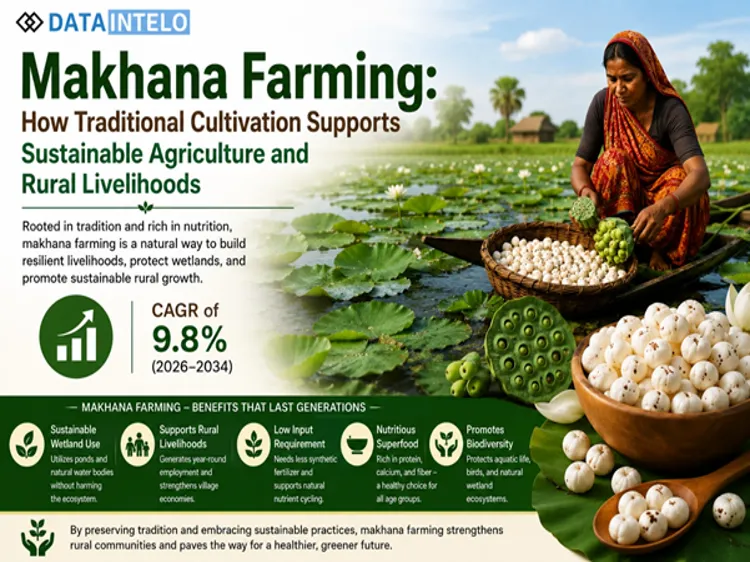
With increasing demand for nutritious, plant-based foods and climate-resilient agricultural systems, makhana farming is gaining attention among farmers, entrepreneurs, and food processors. According to DataIntelo research, the global makhana market was valued at $1.8 billion in 2025 and is projected to reach $4.2 billion by 2034, expanding at a CAGR of 9.8% from 2026 to 2034. Rising consumer preference for healthy snacks, expanding export opportunities, and growing demand for value-added food products are creating new economic possibilities for makhana growers.
Unlike many commercial crops that require large amounts of irrigation, fertilizers, and agricultural land, makhana grows in existing ponds, wetlands, and freshwater bodies. This makes it a resource-efficient crop that allows farmers to generate income while maintaining ecological balance.
📋 1. Quick Facts About Makhana Farming
| Parameter | Details |
|---|---|
| Scientific Name | Euryale ferox |
| Crop Family | Nymphaeaceae |
| Crop Type | Aquatic crop |
| Major Producing Region | Bihar, India |
| Other Producing States | Assam, West Bengal, Manipur, Madhya Pradesh, Uttar Pradesh |
| Ideal Water Depth | 0.6–1.5 meters |
| Suitable Temperature | 20°C–35°C |
| Cultivation Method | Seed-based propagation |
| Harvest Season | August–October |
| Main Uses | Snacks, cereals, sweets, nutrition products |
🌿 2. Why Makhana Is a Unique Agricultural Crop
Makhana belongs to the Nymphaeaceae family and naturally grows in shallow freshwater environments. India is the world’s largest producer of makhana, with Bihar contributing nearly 90% of national production, followed by regions such as Assam, West Bengal, Manipur, Madhya Pradesh, and eastern Uttar Pradesh.
Unlike conventional crops cultivated on open farmland, makhana grows in aquatic ecosystems where water availability remains consistent throughout the growing period. This allows farmers to utilize ponds, lakes, and wetlands that may have limited suitability for traditional crops.
The crop is particularly beneficial for small and marginal farmers because it provides income opportunities without competing with existing agricultural land. Farmers can also combine makhana cultivation with fish farming, creating multiple revenue streams from the same water resource.
🔬 3. Traditional Cultivation Meets Modern Agricultural Science
Traditional makhana cultivation has developed over centuries through farmers’ practical knowledge. The conventional process involves collecting mature seeds from pond bottoms, drying them, roasting them at controlled temperatures, and processing them into edible white kernels.
Modern agricultural research is helping farmers improve productivity without replacing traditional practices. Scientific improvements include:
- Better pond preparation techniques
- Improved seed selection
- Water depth management
- Weed control practices
- Disease monitoring
- Efficient harvesting methods
- Advanced roasting and processing technologies
These improvements help reduce post-harvest losses, improve product quality, and increase farmer profitability.
👨🌾 4. Step-by-Step Guide to Makhana Cultivation
4.1. Pond Preparation
Proper pond preparation plays an important role in successful makhana farming.
Farmers generally focus on:
- Removing excessive weeds
- Maintaining suitable soil conditions
- Ensuring proper water retention
- Preparing a nutrient-rich pond environment
Clay or clay-loam pond bottoms are considered suitable because they support better seed development.
4.2. Seed Selection and Sowing
Quality seeds directly influence crop productivity. Farmers select healthy seeds with good germination potential and introduce them into prepared ponds.
Proper seed management helps achieve:
- Better plant growth
- Higher seed formation
- Improved crop uniformity
4.3. Water Management
Water management is one of the most important factors affecting makhana production.
Recommended conditions include:
| Technical Parameter | Recommended Practice |
| Water Depth | 0.6–1.5 meters |
| Soil Type | Clay or clay-loam |
| Water Condition | Fresh, stagnant, or slow-moving |
| Temperature | 20°C–35°C |
| Propagation | Seed-based |
Maintaining suitable water levels throughout crop development improves flowering, seed formation, and final yield.
4.4. Harvesting and Processing
Harvesting usually takes place between August and October depending on regional conditions.
The post-harvest process includes:
- Seed collection
- Cleaning
- Drying
- Roasting
- Popping
- Sorting
- Packaging
Traditional roasting and popping require skilled labour, making makhana cultivation an important source of rural employment.
📅 5. Makhana Farming Calendar
| Farming Activity | Period |
| Pond Preparation | January–March |
| Seed Selection and Sowing | March–April |
| Crop Development | May–July |
| Harvesting | August–October |
| Processing and Packaging | September–November |
♻️ 6. Sustainable Agriculture Through Wetland Farming
One of the strongest advantages of makhana cultivation is its compatibility with sustainable agriculture.
Compared with many high-input crops, makhana farming generally requires:
- Lower synthetic fertilizer usage
- Limited pesticide application
- Natural nutrient recycling
- Efficient water utilization
- Long-term wetland productivity
- Protection of freshwater biodiversity
Makhana wetlands provide habitats for fish, aquatic insects, amphibians, and migratory birds. This creates an ecosystem where food production and biodiversity conservation can coexist.
Integrated fish farming with makhana cultivation is becoming increasingly popular because farmers can earn income from both aquatic crops and fisheries.
📈 7. Yield Potential and Production Information
Makhana productivity depends on several factors, including seed quality, pond conditions, water management, labour availability, and cultivation practices.
Indicative productivity levels include:
| Parameter | Average Range |
| Seed Productivity per Acre | Approximately 600–1,000 kg/acre |
| Seed Productivity per Hectare | Approximately 1.5–2.5 tonnes/hectare |
| Popped Makhana Recovery | Around 35–40% of seed weight |
| Crop Duration | Approximately 4–5 months |
Farmers adopting improved seeds, scientific cultivation methods, and efficient processing technologies can achieve better productivity compared with traditional methods.
💰 8. Cost and Profit Potential of Makhana Farming
Makhana farming profitability varies depending on location, labour availability, processing methods, and market prices.
Indicative cost structure:
| Expense Category | Estimated Cost |
| Pond Preparation | ₹18,000–25,000/hectare |
| Seed Cost | ₹12,000–18,000/hectare |
| Labour and Processing | ₹45,000–70,000/hectare |
| Total Investment | ₹90,000–1.4 lakh/hectare |
| Potential Revenue | Depends on yield and market price |
Farmers who add value through processing, packaging, and direct marketing can improve their earning potential compared with selling raw produce.
🥗 9. Nutritional Benefits Driving Makhana Demand
Growing awareness about healthy eating habits has increased demand for makhana among health-conscious consumers.
| Nutrient | Health Benefit |
| Protein | Supports muscle health |
| Dietary Fiber | Helps digestion |
| Calcium | Supports bone health |
| Magnesium | Supports metabolic functions |
| Potassium | Helps maintain electrolyte balance |
| Antioxidants | Helps protect cells from oxidative stress |
Because of its nutritional profile, makhana is increasingly positioned as a healthy alternative to processed snack foods.
👥 10. Economic Importance for Rural Livelihoods
Makhana cultivation creates employment opportunities throughout the agricultural value chain.
Major income-generating activities include:
- Pond preparation
- Seed collection
- Cleaning
- Drying
- Roasting
- Popping
- Sorting
- Packaging
- Trading
- Transportation
Since several activities require manual skills, makhana farming supports village-level employment rather than relying completely on mechanization.
Women also contribute significantly to post-harvest activities such as grading, processing, and packaging, helping improve household income opportunities.
📦 11. Growing Demand Is Creating New Opportunities
Changing consumer preferences are increasing demand for makhana products.
Makhana is gaining popularity because it is naturally:
- Gluten-free
- Low in fat
- Rich in protein
- High in dietary fiber
- A source of calcium
- A source of magnesium
- Rich in antioxidants
Growing demand from health-conscious consumers, supermarkets, food processors, and international markets is expanding opportunities for farmers.
Makhana is now used in:
- Healthy snacks
- Breakfast cereals
- Nutrition products
- Baby food
- Functional foods
- Traditional sweets
- Ready-to-eat products
This diversification is helping farmers move beyond traditional wholesale markets.
🧪 12. Scientific Improvements Supporting Farmers
Agricultural universities and research organizations are focusing on improving makhana production through:
- Better seed varieties
- Disease-resistant planting material
- Mechanized harvesting solutions
- Water quality monitoring
- Improved popping technology
- Better storage facilities
- Farmer training programs
These innovations aim to improve productivity while reducing labour requirements and post-harvest losses.
⚠️ 13. Challenges in Makhana Farming and Possible Solutions
| Challenge | Possible Solution |
| Limited access to quality seeds | Promote improved seed distribution systems |
| Labour-intensive harvesting | Develop suitable harvesting equipment |
| Traditional processing methods | Encourage modern processing facilities |
| Price fluctuations | Strengthen farmer cooperatives |
| Storage limitations | Establish rural storage infrastructure |
| Limited market access | Improve digital and export channels |
| High transportation costs | Develop local processing units |
🏛️ 14. Role of Government and Rural Development Programs
Government initiatives supporting agricultural development can help strengthen makhana farming through:
- Wetland development programs
- Farmer Producer Organizations (FPOs)
- Agricultural mechanization
- Rural infrastructure development
- Food processing support
- Skill development programs
- Crop diversification initiatives
Improved access to agricultural extension services can help farmers adopt better cultivation techniques while maintaining environmental sustainability.
🚜 15. Useful Articles Related to Farming and Agriculture
- Makhana Farming: Complete Guide to Cultivation, Cost, Yield and Profit
- Makhana Farming
- Pests and Diseases in Crops: Definition, Significance & Impact
- Pest and Disease Control
- How to Do Organic Farming
- Benefits of Natural Farming
- How to Make Organic Vermicompost from Cow Dung in 30 Days
- Vermicompost Preparation Method
- Benefits of Drip Irrigation
- Pest and Disease Management
- Soil Health Card Scheme
❓16. Frequently Asked Questions About Makhana Farming
Q1. Is makhana farming profitable?
Yes, makhana farming can provide good income opportunities when farmers adopt improved cultivation practices, efficient processing methods, and better market connections.
Q2. Which state produces the most makhana?
Bihar is the leading producer of makhana in India, contributing nearly 90% of national production.
Q3. How much water is required for makhana cultivation?
A water depth of approximately 0.6–1.5 meters is generally suitable for healthy crop development.
Q4. How long does makhana take to grow?
The crop generally requires around four to five months from sowing to harvesting.
Q5. Can makhana be cultivated outside Bihar?
Yes, suitable wetland areas in Assam, West Bengal, Manipur, Madhya Pradesh, and Uttar Pradesh can support makhana cultivation.
🚀 17. The Road Ahead for Makhana Farming
Makhana farming demonstrates how traditional agricultural systems can remain economically valuable in modern agriculture. By utilizing wetlands efficiently, supporting biodiversity, creating rural employment, and meeting rising demand for nutritious foods, makhana represents a strong example of sustainable farming.
With continued investment in research, farmer training, improved processing technologies, and stronger market connections, makhana cultivation can strengthen rural livelihoods while preserving one of India’s most valuable traditional farming practices.
As demand continues to expand at an expected 9.8% CAGR through 2034, farmers who combine traditional knowledge with scientific cultivation methods will be better positioned to benefit from this growing opportunity.