

Green Oat Fodder: Cultivation, Sowing, Irrigation & Production
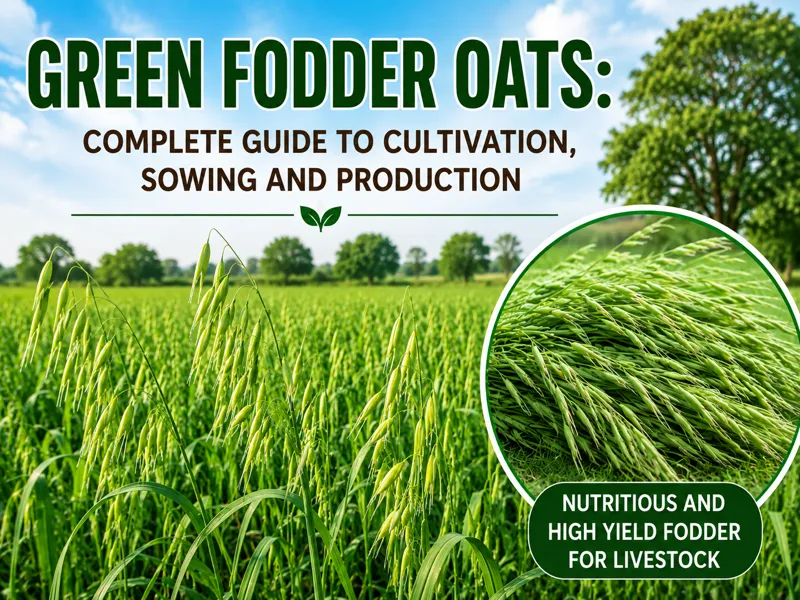
Oat Cultivation: Sowing, Varieties, Fertilizer, Irrigation and Yield
Oat cultivation is done in the winter season for green fodder. Green oat fodder is soft, tasty and easily digestible, so it is considered useful fodder for animals.
Oats contain about 10-12% crude protein and sufficient carbohydrates. Apart from green fodder, it can also be used as silage and dry hay (Hay).
For a good oat crop, cool climate and a temperature of 15-25°C are considered suitable. Excessively hot and dry weather can affect crop yield.
For good oat cultivation, it is important to pay attention to the right sowing time, selection of a good variety, proper seed rate, field preparation, manure and fertilizers, irrigation and timely harvesting. By understanding all these things, farmers can get better green fodder production.
🌱 Main Information About Oat Cultivation
| Topic | Information |
|---|---|
| Crop | Oat |
| Main Uses | Green fodder, silage, dry hay |
| Crude Protein | About 10-12% |
| Suitable Temperature | 15-25°C |
| Main Sowing Time | October-November |
| Best Sowing Time | 20 October-10 November |
| General Seed Rate | 75-80 kg/hectare |
| Row to Row Distance | 20-25 cm |
| Suitable Soil | Loam/Sandy loam, proper drainage |
| Harvesting | One or multiple times, depending on the variety |
🌱 1. Introduction to Oat Crop
Oat is an important green fodder crop grown in winter. Oat is considered soft and easily digestible for feeding animals.
Oats contain 10-12 percent crude protein. It also contains a sufficient amount of carbohydrates.
The main purpose of oat cultivation is to provide green fodder for animals. However, oats can be used not only as green fodder but also as silage and dry hay.
Main Uses of Oats
- As green fodder
- As silage
- As dry hay or Hay
- Mixed with berseem
In the northern and eastern plain areas, oats are mentioned to be fed to all animals alone or mixed with berseem in a 1:1 or 2:1 ratio. In these areas, oat cultivation is generally done after sorghum, pearl millet, maize or medium-duration paddy crops.
🌼 2. Health Benefits and Uses of Oats
Oats are used as a nutritious and easily digestible fodder for animals. It contains about 10-12% crude protein.
The chemical nutritional value of oats changes according to the harvesting stage. According to the given data, it contains:
- 10-11% crude protein
- 55-56% neutral detergent fibre
- 30-32% acid detergent fibre
- 22-23.5% cellulose
- 17-20% hemicellulose
How are Oats Used?
Green Fodder: Oats can be fed to animals as green fodder.
Silage: Oats can also be used as silage.
Dry Hay: Oats can also be used as dry hay, that is, Hay.
With Berseem: In the northern and eastern plain areas, oats are mentioned to be mixed with berseem in a 1:1 or 2:1 ratio.
🔬 3. Scientific Classification of Oats
The scientific name of oats is Avena sativa L.. It belongs to the Poaceae (grass family) and comes under the Avena genus.
| Classification | Information |
|---|---|
| Common Name | Oat (Oats) |
| Scientific Name | Avena sativa L. |
| Kingdom | Plantae |
| Order | Poales |
| Family | Poaceae |
| Genus | Avena |
| Species | Avena sativa |
In short: The common oat used in cultivation is known as Avena sativa. It is a species of the grass family Poaceae.
🌦️ 4. Climate and Temperature for Oat Cultivation
Cool climate is most suitable for oat cultivation. A temperature of 15 to 25°C is considered better for good crop growth. Excessively hot and dry weather can affect oat yield.
🌱 Right Time for Sowing Oats
The period from 20 October to 10 November is most suitable for sowing oats. Timely sowing helps the crop get the benefit of favourable weather.
- Timely Sowing: From the first fortnight of October to the first fortnight of November
- Best Sowing: 20 October to 10 November
- Late Sowing: Up to the last week of November
- For Continuous Green Fodder: In some areas, sowing can also be done from December to March.
Therefore, choosing the right sowing time for oat cultivation is important for good crop growth and better availability of green fodder.
🌍 5. Soil for Oat Cultivation
Loamy or sandy loam soil is considered good for oat cultivation. Oats can also be cultivated well in loamy or heavy loamy land, but proper drainage in the field is necessary.
🌱 Main Features of Good Soil for Oats
- Loamy soil
- Sandy loam soil
- Loamy or heavy loamy land
- Good drainage in the field
Oat cultivation is generally done after harvesting the Kharif crop. Prepare the field properly before sowing. The field can be prepared for sowing by doing the first ploughing with a soil-turning plough, followed by 2-3 ploughings with a cultivator, and then using a plank to level the field.
Note: To avoid waterlogging in the field, ensuring proper drainage in advance is important for a good oat crop.
🌱 6. Improved Varieties of Oats
In oat cultivation, farmers can choose single-cut, multi-cut or new improved varieties according to their needs. Some varieties are mainly useful for green fodder, while some varieties can also be used for seed production along with fodder.
🌾 Single-Cut Oat Varieties
The major varieties used for one-time harvesting are:
- HFO 11
- Kent
- Bundel Jai-99-1
- Bundel Jai-99-2
- 2001-3
- Bundel Jai-2004
- OS-6
- OS-7
- Bundel Jai-2009-1
- JO-3-93
- OS-3771
🌿 Two or Three-Cut Oat Varieties
If a farmer wants to take green fodder several times from the same field, the following multi-cut varieties are useful:
- JHO-851
- JHO-822
- Haryana Oat-8
- UPO-212
- UPO-921
⭐ New Improved Oat Varieties
In oat cultivation, HFO 917, HFO 1014 and HFO 915 are important improved varieties. HFO 917 and HFO 1014 can be used for seed production along with fodder, while HFO 915 is reported to be useful for repeated harvesting.
| Variety | Green Fodder | Dry Fodder | Seed Production | Protein |
|---|---|---|---|---|
| HFO 917 | 192 quintals/hectare | 28 quintals/hectare | 23.8 quintals/hectare | 14.4% / 9.38%* |
| HFO 1014 | 185 quintals/hectare | 28 quintals/hectare | 24.3 / 18 quintals/hectare* | 15.5%* |
| HFO 915 | 234 quintals/hectare | 50 quintals/hectare | 15.7 quintals/hectare | About 10% |
- Some figures for HFO 917 and HFO 1014 are different according to the region.
📍 Selection of New Varieties According to Region
HFO 917 and HFO 1014 are reported to be suitable for cultivation in Haryana, Punjab, Rajasthan, Terai areas of Uttarakhand, eastern Uttar Pradesh, Bihar, Jharkhand and Assam.
HFO 915 is considered suitable for hilly areas such as Himachal Pradesh and Jammu & Kashmir.
📌 Which Oat Variety Should You Choose?
If your main purpose is green fodder, consider the harvesting capacity of the variety and the local climate. If you also want seed production along with fodder, varieties like HFO 917 and HFO 1014 can be considered. For higher green fodder production capacity, the given data shows that HFO 915 has a yield of 234 quintals/hectare.
🌾 7. Seed Rate of Oats
The general seed rate in oat cultivation is kept at 75-80 kg per hectare. For varieties with large and thick grains, up to 100-125 kg seed per hectare may be required.
🌱 Sowing Oats in Furrows
| Sowing Time | Seed Rate |
| Timely Sowing | 75-80 kg/hectare |
| Late Sowing | 100-110 kg/hectare |
🌾 Sowing by Broadcasting Method
| Sowing Time | Seed Rate |
| Timely Sowing | 110-115 kg/hectare |
| Late Sowing | 120-125 kg/hectare |
Note: When sowing is done on time, the normal seed rate is sufficient, while late sowing may require more seed. Select the correct seed rate according to the variety and sowing method.
🚜 8. Field Preparation for Oat Cultivation
Information has been given about properly preparing the field for good oat cultivation.
The soil should be made loose by ploughing with a country plough, harrow or cultivator. This also helps to destroy weeds in the field.
Method of Field Preparation
- Do the first ploughing with a soil-turning plough.
- After this, do two-three ploughings with a cultivator.
- Use a plank in the field.
- Prepare the field for sowing.
The source also mentions preparing the field after giving pre-sowing irrigation.
🌱 9. How to Sow Oats?
Oats can be sown behind a plough or with a seed drill.
A row-to-row distance of 20-25 centimetres is mentioned.
For sowing in furrows, a row distance of 20 centimetres is mentioned.
After sowing, information is also given about dividing the field into long beds. This makes harvesting possible with bullock- or tractor-operated machines.
Right Time for Sowing Oats
- Best: 20 October to 10 November
- Timely: First fortnight of October to first fortnight of November
- Late: Up to the last week of November
- For Continuous Fodder: December to March in some areas
🌿 10. Manure and Fertilizer Management in Oats
Information has been given about the use of well-decomposed farmyard manure in oat cultivation.
It is mentioned to apply 10-15 tonnes/hectare of well-decomposed farmyard manure 10-15 days before sowing.
At the time of sowing, information is given about applying 80:40:40 kg NPK/hectare.
It is mentioned to apply 20 kg nitrogen/hectare after each harvesting.
Another recommendation includes:
- 60 kg nitrogen/hectare
- 40 kg phosphorus/hectare
The information is given to mix these into the soil at the time of the last ploughing.
After this, 20 kg nitrogen is mentioned to be given in two equal doses. The first dose is given 20-25 days after the first sowing after irrigation, and the second dose is given after the first harvesting.
In land where there is a sulfur deficiency, applying 20 kg sulfur is mentioned to give a good yield.
💧 11. When and How Much Irrigation is Required for Oats?
Under normal conditions, apart from irrigation before sowing, 4-5 irrigations are mentioned.
If the soil is dry, the first irrigation before preparing the seed bed is considered useful. Timely irrigation helps in good tillering.
Irrigation According to Variety
| Variety | Irrigation |
|---|---|
| Single-cut | 3-4 |
| Two/Multi-cut | 7-8 |
Another source mentions that after pre-sowing irrigation, further irrigations should be done at an interval of about one month.
Irrigation is considered necessary at the time of tillering and flowering.
🌾 12. Weed Control in Oats
For good growth and better production of oats, it is necessary to keep the field free from weeds. Proper ploughing of the field before sowing helps in controlling early-stage weeds.
When weeds are more, information is given about using Metasulfuron at 8 grams/hectare and doing one hand weeding with a hoe.
Timely weed control helps protect the oat crop from competition for nutrients, water and space.
🐛 13. Disease and Pest Management in Oats
Problems like root rot, leaf blotch, covered smut, aphids and termites can affect the growth and production of the oat crop. Timely seed treatment and proper crop management can help protect the crop from these problems.
🌱 Root Rot and Leaf Blotch
To protect against root rot and leaf blotch, treat the seeds before sowing with 3 grams of Thiram per kilogram of seed.
🐜 Aphid Control
In case of aphid infestation, Dimethoate 30 EC 0.05% can be sprayed.
🌾 Covered Smut Disease
Seed treatment is useful for protection against covered smut. For this:
- 3 grams of Thiram per kilogram of seed, or
- 2.5 grams of zinc manganese carbonate per kilogram of seed
can be used.
🐜 Termite Control
If there is a termite problem in the oat crop, Chlorpyrifos at 2-3 litres per hectare can be applied along with irrigation water.
📌 Important Points for Disease and Pest Management in Oats
Selection of healthy seed, seed treatment before sowing and timely control of pests and diseases are important for a good oat crop. While using any agricultural chemical, follow its current label, recommended dose and advice of the local agriculture expert.
⏳ 14. How Many Days Does the Oat Crop Take to Mature?
The duration of the oat crop depends on its variety and harvesting system.
For multi-cut oats, the first harvesting is mentioned to be done after about 50-55 days.
Another source mentions:
- First harvesting: 55 days
- Second harvesting: 45 days after the first harvesting
- Third harvesting: At the 50% flowering stage
It is mentioned that single-cut oats should be harvested at the 50% flowering stage.
✂️ 15. How to Harvest Oats?
Oats are harvested according to the variety and purpose.
Single-Cut Oats
Single-cut oats are mentioned to be harvested at the 50% flowering stage.
Multi-Cut Oats
In multi-cut varieties, the first harvesting is mentioned to be done:
50-55 days after sowing
Another source mentions that the second harvesting should be done 45 days after the first harvesting and the third harvesting at the 50% flowering stage.
Harvesting Height
It is mentioned that harvesting 8-10 centimetres above the ground helps in the growth of new tillers.
For seed production, it is mentioned to leave the crop after the first harvesting.
🌸 16. How Much Yield is Obtained from Oats?
The yield of oats is mainly given per hectare.
General Green Fodder Yield
| Variety/Harvesting | Yield |
|---|---|
| Single-cut | 30-45 tonnes/hectare |
| Two-time harvesting | 40-55 tonnes/hectare |
| Multi-cut | 45-60 tonnes/hectare |
Another source mentions green fodder yield of 50-55 tonnes/hectare.
In case of seed production, approximately:
- 25 tonnes/hectare green fodder
- 15-20 quintals/hectare seed
- 20-25 quintals/hectare straw
are mentioned to be obtained.
Yield of New Varieties
- HFO 917: 192 quintals/hectare green fodder
- HFO 1014: 185 quintals/hectare green fodder
- HFO 915: 234 quintals/hectare green fodder
💰 17. Market Price and Profit from Oats
To get a good estimate of earnings from oat cultivation, it is important to consider yield and local selling price together. The price of green fodder can change according to the region, demand and availability.
As per the available market reference on 28 July 2026, the average price of general green fodder was around ₹297 per quintal. This is the price of general green fodder, so it should not be considered the fixed market price of oats.
Among the high-yielding oat varieties, a figure of about 234 quintals/hectare green fodder is given for HFO 915. This shows that along with production capacity, the local selling price also plays an important role in the possible income from oats.
📌 How to Understand Earnings from Oats?
Total Income = Total Saleable Yield × Local Market Price
After this, subtracting the costs of seed, field preparation, manure, irrigation, labour and other farming expenses can help estimate the actual profit.
Note: The price of green fodder keeps changing in the local market, so it is better to get the current price information from your nearby market or buyer before selling.
🏪 18. Storage and Uses of Oat Fodder
Oats can be used not only as fresh green fodder, but also as silage and dry hay (Hay) for long-term use.
Main Uses of Oat Fodder
- 🌿 Green Fodder: The oat crop can be fed to animals as fresh green fodder.
- 🥬 Silage: Silage can be prepared from oats and used as fodder.
- 🌾 Dry Hay (Hay): Oats are also used as dry fodder.
Note: The available source does not provide the process of making silage from oats, storage duration, moisture level or detailed method of safely storing dry hay. Therefore, additional information on these topics has not been added to this article.
🏛️ 19. Government Schemes and Seed Subsidy for Oat Cultivation
For farmers cultivating oats, certified seeds and assistance from the Agriculture Department can be useful. The amount and eligibility for seed subsidy and agricultural assistance are decided according to different states and schemes.
In many states, seed subsidy is provided to make certified, foundation and other categories of seeds available to farmers. Therefore, before sowing oats, farmers can get information about the current scheme and available subsidy from their state’s Agriculture Department or authorised government seed centre.
🌱 Promotion of Improved Oat Varieties
The new improved oat varieties include HFO 917, HFO 1014 and HFO 915. HFO 917 and HFO 1014 are reported to be useful for both fodder and seed, while HFO 915 has been developed for more than one harvesting.
All three varieties have been approved by the Government of India and have been notified in the Gazette of India based on the recommendation of the Central Seed Committee.
📌 What Should Farmers Do?
Before purchasing seeds for oat cultivation, farmers should:
- Check the Agriculture Department scheme of their state.
- Get information about the availability of certified seeds.
- Find out the eligibility and application process for seed subsidy.
- Get information about the available varieties from an authorised government seed centre.
- Select a suitable oat variety according to the sowing area.
Important: Seed subsidy, eligibility and assistance amount may change according to time and state. Therefore, before applying, always get current information from the concerned Agriculture Department.
🚜 20. Useful Articles Related to Farming and Agriculture
- Maize Fodder & Hydroponic Maize Fodder Guide
- Sorghum Green Fodder: High-Yield Nutritious Feed Guide
- Berseem Fodder
- Pests and Diseases in Crops: Definition, Significance & Impact
- Pest and Disease Control
- How to Do Organic Farming
- Benefits of Natural Farming
- How to Make Organic Vermicompost from Cow Dung in 30 Days
- Vermicompost Preparation Method
- Benefits of Drip Irrigation
- Pest and Disease Management
- Soil Health Card Scheme
❓21. Frequently Asked Questions (FAQs) Related to Oat Cultivation
Q1. When should oats be sown?
The best time for oat cultivation is considered to be 20 October to 10 November. Timely sowing can be done from the first fortnight of October to the first fortnight of November.
Q2. How much seed is required per hectare for oat cultivation?
The normal seed rate for oats is 75-80 kg per hectare. For varieties with large and thick grains, the seed rate is mentioned as 100-125 kg per hectare.
Q3. Which soil is best for oat cultivation?
Loamy or sandy loam soil is considered good for oat cultivation. Proper drainage in the field is also necessary. Loamy or heavy loamy land is also mentioned, provided that drainage is good.
Q4. What temperature is suitable for oat cultivation?
A temperature of 15 to 25°C is considered best for oat cultivation. Hot and dry weather can have an adverse effect on oat yield.
Q5. After how many days should the first harvesting of oats be done?
In multi-cut oats, the first harvesting is generally mentioned to be done 50-55 days after sowing. Another recommendation mentions the first harvesting at 55 days.
Q6. At what height from the ground should oats be harvested?
Oats should be harvested about 8-10 centimetres above the ground. This helps in the growth of new tillers.
Q7. What are the new improved varieties of oats?
The new improved varieties of oats include HFO 917, HFO 1014 and HFO 915. HFO 917 and HFO 1014 are reported to be useful for both fodder and seed, while HFO 915 has been developed for more than one harvesting.
Q8. Which oat variety has been reported to give the highest green fodder yield?
According to the given data, HFO 915 has an average yield of about 234 quintals/hectare of green fodder.
Q9. How much irrigation should be given in oat cultivation?
Under normal conditions, 4-5 irrigations apart from irrigation before sowing are mentioned. 3-4 irrigations are mentioned for single-cut varieties, while 7-8 irrigations are mentioned for two or multi-cut varieties.
Q10. Which manure should be applied in oat cultivation?
It is mentioned to apply 10-15 tonnes/hectare of well-decomposed farmyard manure 10-15 days before sowing. Apart from this, different recommendations are also given for applying NPK and nitrogen in different quantities.
Q11. How much green fodder yield can be obtained from oat cultivation?
It is mentioned that 30-45 tonnes/hectare of green fodder can be obtained from single-cut oat varieties, 40-55 tonnes/hectare from two-cut varieties and 45-60 tonnes/hectare from multi-cut varieties.
Q12. How are oats used for animals?
Oats can be used as green fodder, silage and dry hay (Hay). In the northern and eastern plain areas, it is also mentioned to mix oats with berseem in a 1:1 or 2:1 ratio.
🌼 Conclusion
Oat cultivation is a good option for providing nutritious and easily digestible green fodder for animals. It contains about 10-12% crude protein and can be used as green fodder, silage and dry hay.
For oat cultivation, 15-25°C temperature, loamy or sandy loam soil and land with good drainage are suitable. The best sowing time is 20 October to 10 November, and the normal seed rate is 75-80 kg/hectare.
Different oat varieties can provide 30-60 tonnes/hectare of green fodder. The major new varieties include HFO 917, HFO 1014 and HFO 915, among which HFO 915 has an average green fodder yield of 234 quintals/hectare.
For good oat cultivation, pay special attention to selecting the right variety, timely sowing, proper manure and irrigation, and harvesting at the right stage.