


Zero Budget Natural Farming (ZBNF): Methods, Benefits & Cost
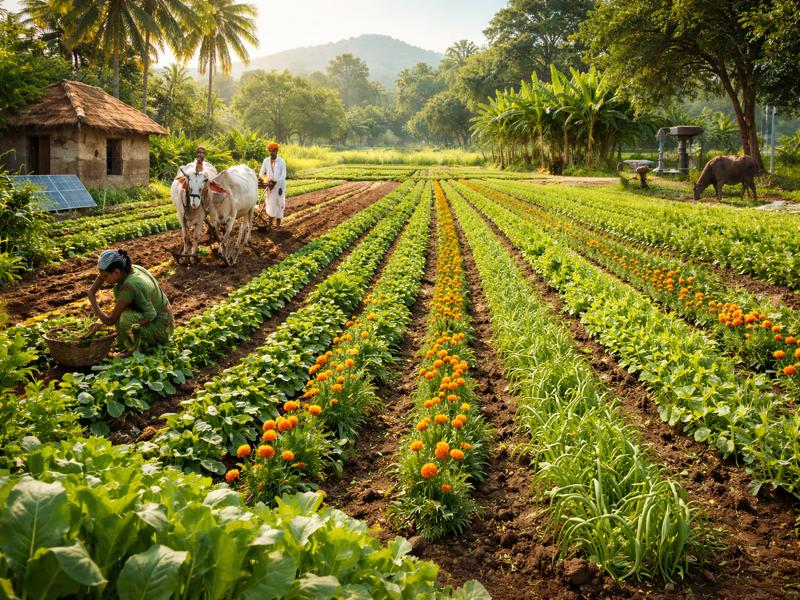
Zero Budget Natural Farming | Zero Budget Natural Farming (ZBNF) – Complete Information
With the increasing cost of farming in India, farmers are looking for ways to reduce spending on external agricultural inputs. In such a situation, farmers’ interest is increasing in low-external-input farming methods like Zero Budget Natural Farming (ZBNF).
ZBNF is a farming method that focuses on reducing dependence on external agricultural inputs, especially synthetic fertilizers and chemical pesticides. In this method, inputs prepared from resources available on the farm and at the local level, such as Beejamrit and Jeevamrit, are used. Its purpose is to reduce the cash expenditure on external inputs and maintain better soil biological activity and soil health. However, “Zero Budget” does not mean that all farming costs become completely zero.
In this article, we will understand in detail the main techniques, required materials, farming process, cost, possible benefits, crop management, and important precautions related to Zero Budget Natural Farming (ZBNF).
1. What is Zero Budget Natural Farming (ZBNF)?
Zero Budget Natural Farming (ZBNF) is a natural farming method that focuses on reducing dependence on synthetic fertilizers and chemical pesticides and using resources available on the farm and at the local level. This method was developed and promoted by Subhash Palekar in the 1990s as a specific natural farming method.
In this method, farmers can use inputs prepared from resources available on the farm and at the local level, such as Beejamrit and Jeevamrit, to reduce dependence on external agricultural inputs. Its purpose is to reduce the cash expenditure on external inputs in farming and make better use of natural resources.
Here, “Zero Budget” does not mean making all farming costs zero. A farmer may have to spend money on seeds, labour, irrigation, land preparation, machinery, harvesting and other activities. The main reference of this term is to reduce the expenditure on external agricultural inputs.
Main Objectives of Zero Budget Natural Farming
- Reduce dependence on synthetic fertilizers and chemical pesticides
- Make better use of local and farm-available resources
- Reduce cash expenditure on external agricultural inputs
- Try to improve and maintain soil biological activity and soil health
- Promote the conservation of natural resources
- Try to create a better economic balance between farming costs and production
2. 4 Main Techniques of Zero Budget Natural Farming
Four main practices are given special importance in ZBNF, which are commonly described as its “four wheels.” Their purpose is to focus on seed treatment, soil biological activity, moisture conservation, and a favourable soil environment for the crop.
1. Beejamrit
Beejamrit is used for seed treatment before sowing. Its purpose is to help protect seeds from the risk of early diseases and infections and create favourable conditions for healthy germination.
2. Jeevamrit
Jeevamrit is a fermented input prepared on the farm, which is used with the purpose of promoting biological and microbial activity in the soil. Its effect may depend on factors such as soil, crop and method of application.
3. Mulching / Acchadana
In mulching, the soil surface is covered with crop residues or other suitable organic materials. This can help in conserving soil moisture, maintaining balanced soil temperature and managing weeds.
4. Waaphasa
Waaphasa is a concept described in ZBNF that focuses on maintaining a suitable condition of air and moisture in the soil, so that a favourable environment remains around the roots of plants.
3. Farming Planning
In any farming system, including ZBNF, proper planning is important for a successful start. Before starting farming, assessing the soil, weather, water, crop and available resources can help farmers make better decisions.
Keep These Things in Mind While Planning:
- Test the soil – Understand the condition of soil pH, organic carbon and available nutrients.
- Choose the crop according to the weather and area – Consider the local climate, soil and availability of water.
- Consider mixed farming (Intercropping) – Suitable crops can be grown together to make better use of available resources.
- Decide the irrigation source and system – Make a plan according to the water requirement of the crop and available water sources.
- Select suitable seeds – Choose certified/suitable seeds according to the area and crop; locally well-adapted seeds can also be an option.
- Plan the cost and market – Estimate expenses on seeds, labour, irrigation, machinery and other costs, and keep information about the market for the possible sale of the crop.
With good planning, farmers can better manage crops, costs, irrigation and available resources and assess production and possible profit in a more systematic way.
4. Field Preparation
Field preparation is an important stage in any farming system, including natural farming. Its purpose is to prepare a suitable seedbed for the crop, arrange water drainage and irrigation, and avoid unnecessary soil disturbance while considering the condition of the soil.
Main Steps of Field Preparation:
- Do tillage as required — Choose a suitable tillage method according to the crop, soil and field condition.
- Make field bunds — Make bunds according to the size of the field and water requirement.
- Make channels for water drainage and irrigation — Arrange water management as required.
- Properly manage crop residues and organic materials — Plan to use available biomass in the field.
- Manage soil moisture — Use practices such as irrigation and mulching according to the needs of the crop.
Should Deep Tillage Be Done in ZBNF?
ZBNF emphasizes avoiding unnecessary and excessive tillage and keeping soil disturbance low. However, the need for tillage may vary according to the crop, soil, weeds and local field conditions. Therefore, one type of tillage should not be considered a compulsory rule for all crops.
5. Seed Selection
In natural farming, selecting good-quality seeds suitable for the area and crop is important. Local or traditional varieties can be useful in some conditions, but they cannot be considered the best option for every crop and every area.
Keep These Things in Mind While Selecting Seeds:
- Choose seeds suitable for the area — Select the variety according to the local climate, soil and farming conditions.
- Choose a variety with better tolerance to diseases and pests — Consider the major disease and pest problems in the local area.
- Use good-quality seeds — Give preference to seeds obtained from certified or reliable sources.
- Check germination capacity — Check seed germination and quality before sowing.
- Consider local/traditional varieties — If a local variety is well adapted to your area and crop, it can be used.
- Check seed purity and storage condition — Avoid infected, damaged or poorly stored seeds.
6. Seed Treatment with Beejamrit (Beejamrit Treatment)
In Zero Budget Natural Farming, Beejamrit is used for seed treatment before sowing. Its purpose is to help provide initial protection to seeds and help create favourable conditions for healthy germination. The effectiveness of Beejamrit may vary according to the crop, seed quality, preparation method and local conditions.
Main Purpose of Beejamrit
- Help create favourable conditions for healthy germination
- Help reduce the risk of some seed- and soil-related diseases during the early stage
- Help improve the early establishment of plants
Ingredients for Making Beejamrit
According to a common method described in ZBNF:
- 5 kg fresh desi cow dung
- 5 litres desi cow urine
- 50 grams lime
- One handful of fertile soil from the field
- 20 litres water
Note: The ingredients and quantities of Beejamrit may vary in different formulations. Before using it on a large area, it is better to take advice from a local agriculture expert or Krishi Vigyan Kendra (KVK).
Process of Making Beejamrit
- Take 20 litres of water in a clean container.
- Add cow dung and cow urine to it.
- After this, add lime and field soil.
- Mix the mixture properly.
- According to the traditional method, the mixture is kept for about 12–24 hours and then used for seed treatment.
Method of Seed Treatment
- Properly treat the seeds with Beejamrit.
- Keep the treatment duration according to the crop and type of seed.
- After treatment, properly dry the seeds in shade and sow them at the appropriate time.
- Instead of keeping treated seeds for a long time, sow them within the recommended time if possible.
Beejamrit is used with the purpose of helping healthy germination and reducing the risk of some diseases during the early stage. Its results may depend on seed quality, crop, weather and other crop management practices.
7. Making Jeevamrit (Jeevamrit Preparation)
Jeevamrit is one of the major farm-made inputs used in ZBNF. It is used with the purpose of promoting biological and microbial activity in the soil. Its effect may vary according to soil, crop, preparation method and conditions of use.
Possible Objectives Related to Jeevamrit
- Help promote biological activity in the soil
- Aim to support nutrient availability and nutrient cycling
- Help create favourable conditions for plant growth
- Make use of local resources available on the farm
Ingredients for Making Jeevamrit
According to a common formulation described in ZBNF:
- 10 kg desi cow dung
- 10 litres cow urine
- 2 kg jaggery
- 2 kg gram flour / pulse flour
- One handful of field soil
- 200 litres water
Note: The ingredients and quantities of Jeevamrit may vary in different formulations. Before using it on a large area, it is better to take advice from a local agriculture expert or Krishi Vigyan Kendra (KVK).
Process of Making Jeevamrit
- Take 200 litres of water in a clean drum.
- Add cow dung and cow urine to it.
- Add jaggery and gram flour/pulse flour and mix properly.
- After this, add field soil.
- According to the traditional ZBNF method, the mixture is kept for about 48 hours to ferment.
- During this period, the mixture can be stirred from time to time with a wooden stick or suitable clean equipment.
Use of Jeevamrit
The quantity, application method and frequency of Jeevamrit may vary according to the crop, soil, field condition and method of use. Therefore, one particular quantity or interval should not be considered a compulsory rule for all crops.
Before using it on a commercial scale, it is better to get an application recommendation according to your crop from the local Krishi Vigyan Kendra (KVK), Agriculture Department or agriculture expert.
8. Sowing
After seed treatment, the next important stage is sowing. The right time, proper seed rate, spacing and sowing method are important for the early establishment of the crop and further crop management.
Things to Keep in Mind While Sowing
- Choose the right time — Decide the sowing time according to the crop, local weather and area conditions.
- Use a suitable sowing method — Choose line sowing or another suitable method according to the crop and field condition.
- Maintain proper spacing — Maintain proper distance between plants and rows according to the crop variety and recommended plant spacing.
- Take care of the seed rate — Follow the recommended seed rate according to the crop and variety.
- Consider mixed farming (Intercropping) — Choose a suitable combination of crops according to the area, weather, crop duration, water and market conditions.
Some Examples of Intercropping
- Maize + Pigeon Pea
- Wheat + Gram
- Cotton + Green Gram
These are only examples. Before adopting any intercropping combination, local climate, soil, irrigation, crop duration and market conditions should be considered.
A suitable intercropping system can help make better use of available resources and, in some conditions, help reduce production risk because of crop diversification.
9. Mulching
Mulching means covering the soil surface with suitable material or plant cover. In ZBNF, mulching is considered one of the important practices and is also called Acchadana.
Main Types of Mulching
1. Crop Residue Mulching
Covering the soil surface with dry grass, leaves, crop residues or other suitable organic materials.
2. Living Mulch
Maintaining a suitable low-growing cover crop or living ground cover along with or between the main crop. While adopting this, competition with the main crop for water, nutrients and light should be considered.
3. Soil Covering
Some natural farming systems focus on covering the soil surface and keeping unnecessary soil disturbance low. The suitable method should be decided according to the crop and local conditions.
Possible Benefits of Mulching
- It helps in conserving soil moisture.
- It can help in weed management in some conditions.
- Decomposition of organic mulch can contribute to soil organic matter and nutrient cycling.
- It can help reduce excessive fluctuations in soil temperature.
- It can help protect the soil surface from erosion caused by heavy rain and wind.
10. Waaphasa
Waaphasa is an important concept related to ZBNF. It means maintaining a suitable condition of air and moisture in the soil, so that a favourable environment remains around the roots of plants.
The concept of Waaphasa focuses on avoiding excessive irrigation while keeping sufficient moisture and air available around the roots. However, the actual water requirement of a crop depends on its variety, growth stage, soil, weather and local conditions.
Ways to Maintain Waaphasa
- Avoid frequent irrigation without need and irrigate according to the water requirement of the crop.
- Maintain sufficient moisture in the soil according to the needs of the crop.
- Use mulching to help conserve soil moisture.
- Avoid excessive soil compaction and use proper soil management as required.
- Choose the irrigation method according to the crop and soil and deliver water to the root zone as required.
Possible Benefits of Waaphasa
- It may help maintain a proper balance of air and moisture around the roots.
- It may help create conditions suitable for biological activity in the soil.
- Proper irrigation management can help reduce unnecessary use of water.
- A favourable environment around the roots can support crop growth; the effect on production depends on the crop and local conditions.
11. Irrigation Management
In natural farming, proper irrigation management is important. In ZBNF also, the purpose of irrigation is to provide water according to the crop requirement, maintain proper moisture in the soil and avoid unnecessary irrigation.
Main Principles of Irrigation
- Give water according to the crop requirement — Consider the crop variety, growth stage, soil, weather and local conditions.
- Choose the right time for irrigation — Decide the irrigation time according to the weather, temperature, soil and irrigation system being used. During very hot weather and high evaporation conditions, it may be useful to avoid irrigation during the hottest time of the day.
- Avoid over-irrigation — Excessive water or waterlogging can reduce air-filled pores in the soil, which may affect the availability of oxygen to the roots.
- Use mulching — Suitable mulch can help in conserving soil moisture.
- Choose a suitable irrigation system — Drip, sprinkler or another suitable irrigation system can be used according to the crop and field conditions.
Possible Benefits of Irrigation Management
- Proper irrigation management can help reduce unnecessary use of water.
- It can help maintain proper moisture and air-water balance around the roots.
- It can help reduce the risk of some soil-related problems associated with excessive irrigation and waterlogging.
- Irrigating according to the water requirement of the crop can help in better management of water resources.
12. Natural Pest Control
Zero Budget Natural Farming focuses on reducing dependence on synthetic/chemical pesticides and giving priority to different natural, biological, mechanical and plant-based pest-management methods.
Some farm-made botanical formulations, such as Neemastra, Agniastra and Brahmastra, are used in traditional natural farming practices. Their effectiveness may vary according to the crop, pest species, formulation, weather and method of use. Therefore, they should not be considered a guaranteed treatment for any pest.
1. Neemastra
Neemastra is mainly used in natural farming to help manage some sucking pests and other insects.
According to a common formulation described in ZBNF:
- 5 kg neem leaves
- 5 litres cow urine
- 2 kg cow dung
- 100 litres water
Possible Uses:
- Help in managing some sucking pests
- Help reduce early pest pressure
2. Agniastra
Agniastra is a traditional botanical formulation used in some natural farming systems for managing different pests.
Important: Some formulations described for it include nicotine-containing substances such as tobacco. Therefore, before preparing or using it, follow the advice of a local agriculture expert/KVK and applicable safety and agricultural guidelines.
Possible Uses:
- Help in managing some chewing and other pests
- Use as a botanical pest-management option to reduce pest infestation
3. Brahmastra
Brahmastra is another botanical formulation commonly used in natural farming. Different formulations describe the use of plants such as neem, dhatura, castor and karanj.
It is used to help manage different pests. Its effectiveness may vary according to the crop, pest species, formulation and local conditions.
Do Not Depend Only on Spray for Pest Management
For pest management in natural farming, adopting an Integrated Pest Management (IPM) approach can be more useful. It includes:
- Regularly monitor the field (crop scouting).
- Identify early pest infestation.
- Remove infected plants or plant parts as required.
- Use pheromone traps and sticky traps in suitable crops.
- Protect beneficial insects and natural enemies.
- Consider crop rotation and suitable intercropping.
- In case of pest infestation, take proper management recommendations from the local Krishi Vigyan Kendra (KVK) or agriculture expert.
13. Crop Management
Regular crop monitoring and timely management can help maintain the condition, production and quality of the crop.
Main Crop Management Activities
- Regularly inspect the field — Monitor plant growth, pests, diseases, weeds and water conditions.
- Use Jeevamrit as required — Decide its quantity and application frequency according to the crop and field conditions.
- Manage weeds — Use weeding, mulching or other suitable weed-management methods as required.
- Maintain proper plant population — Where necessary, maintain proper plant number and spacing through thinning or gap filling.
- Monitor pests and diseases — When early symptoms appear, use suitable pest and disease management measures.
- Manage irrigation — Irrigate according to the crop requirement and soil moisture.
- Use natural/plant-based pest-management inputs when required and do not consider any formulation as a guaranteed treatment.
Importance of Crop Rotation
In crop rotation, different crops are grown in sequence in different seasons or years. Proper crop rotation can:
- Help in maintaining nutrient balance and nutrient cycling in the soil.
- Help break the cycle of some soil-borne pests and diseases.
- Help in crop diversification and better use of available resources.
- Reduce continuous dependence on a single crop in the field.
Crop rotation should be selected by considering soil, climate, irrigation, market and local pest/disease pressure.
14. Harvesting
When the crop reaches its specified harvesting maturity, it should be harvested at the proper time by considering the weather and crop condition. Harvesting at the right time can help maintain the quality and storage life of the produce.
Things to Keep in Mind During Harvesting
- Harvest at the right time — Decide the harvesting time according to crop maturity and local agricultural advice.
- Consider the weather — Check the weather forecast before harvesting.
- Avoid rain and excessive moisture — Where possible, do not harvest during rain or excessive moisture.
- Properly dry after harvesting — Dry grains and seeds to the safe storage moisture level according to the crop.
- Separate damaged or diseased produce — Remove damaged grains and infected material before storage.
Storage
- Keep the crop in a dry, clean and safe place.
- Prevent moisture and water from entering the storage area.
- Store grains only after drying them to the proper moisture level.
- Regularly inspect the storage area to protect against pests and rodents.
- Where necessary, keep grains in well-ventilated and suitable storage containers.
- Check stored grains from time to time and immediately manage any pest, fungal or moisture problem.
15. Main Benefits of Zero Budget Natural Farming
The main purpose of Zero Budget Natural Farming (ZBNF) is to reduce dependence on external agricultural inputs and make better use of local resources available on the farm. Its possible benefits may vary according to crop, soil, climate, management practices and local conditions.
Main Possible Benefits
- Help reduce external input costs — Using resources available on the farm and at the local level can help reduce spending on some external agricultural inputs.
- Attempt to reduce dependence on synthetic agricultural inputs — ZBNF focuses on reducing dependence on synthetic fertilizers and chemical pesticides.
- Help maintain soil health — Through organic matter, soil cover and other practices, an effort is made to support soil biological activity and structure.
- Help in water management — Mulching and proper irrigation management can help conserve soil moisture and reduce unnecessary use of water.
- Possibility of better balance between farming costs and profit — When external input costs are reduced, net returns may improve in some conditions.
- Help support biodiversity — Crop diversification, intercropping and some natural pest-management practices can promote diversity in the field.
- Contribute to soil and natural resource conservation — Practices such as soil cover, organic matter management and proper water management can help in resource conservation.
- Promote more sustainable farming practices — Better use of local resources and lower dependence on external inputs can help move towards a more sustainable farming system.
16. Which Crops Can Be Grown in Natural Farming?
In natural farming, many types of crops such as cereals, pulses, oilseeds, vegetables, spices, fruits and other crops can be grown. However, the yield, production cost and profitability of a crop depend on the area, soil, climate, irrigation, crop management, market demand and selling price.
Some Crops Grown in Natural Farming
For example, farmers can consider these crops according to their local conditions:
- Wheat
- Rice
- Gram
- Pigeon Pea
- Turmeric
- Ginger
- Tomato
- Chilli
- Sugarcane
- Banana
Note: The above list should not be understood as a “ranking of the most profitable crops”. Before choosing a crop, it is important to assess local agricultural conditions and the market situation.
What Things Should Be Considered While Choosing Crops for Natural Farming?
- Soil: Check the soil requirements of the crop.
- Climate: Consider local temperature, rainfall and weather conditions.
- Irrigation: Assess the available water and water requirement of the crop.
- Crop duration: Check how much time the crop will take to become ready.
- Pests and diseases: Consider common pest and disease pressure in the area.
- Production cost: Estimate the cost of seeds, labour, irrigation, machinery and other expenses.
- Market: Check local demand, possible selling price and access to the market.
- Storage and transportation: Check storage and transportation arrangements for perishable crops.
A farmer should not choose a crop only by looking at the possible market price. It is more useful to assess the possible profitability of a crop by considering expected yield, total cost and possible selling price together.
17. How to Do ZBNF-Based Farming on One Acre? (Practical Example)
Suppose a farmer has 1 acre of land and wants to start natural farming by adopting the main practices of ZBNF. The example given below is a general planning framework. The actual crop, seeds, irrigation, inputs and management practices should be changed according to soil, climate, availability of water and local agricultural advice.
Step 1: Plan the Farming
First, the farmer should prepare a crop plan according to the land and available resources.
For example, in 1 acre:
- 0.5 acre – Main crop
- 0.25 acre – Pulse crop
- 0.25 acre – Vegetable or other supporting crop
This is only an example. The actual area allocation should be decided according to the farmer’s soil, water, weather, market and available resources.
Suitable crop diversification and intercropping can help in better use of available resources and managing production risk.
Step 2: Field Preparation
Prepare the field according to the crop and soil condition.
Main activities:
- Do the required tillage according to the crop and soil condition.
- Arrange field bunds and water drainage/irrigation.
- Properly manage available crop residues and organic materials.
- Focus on avoiding unnecessary and excessive soil disturbance.
Step 3: Seed Treatment
In ZBNF, Beejamrit is used for seed treatment before sowing.
General process:
- Treat the seed with a suitable Beejamrit formulation.
- Keep the treatment duration according to the crop and type of seed.
- Dry the treated seed in shade.
- Sow at the proper time.
The purpose of Beejamrit is to help in healthy germination and reduce the risk of some diseases during the early stage. Its effect may vary according to seed quality, crop and local conditions.
Step 4: Sowing
Now sow according to the selected crop or intercropping system.
Examples:
- Maize + Green Gram
- Wheat + Gram
- Cotton + Groundnut
Before adopting these combinations, consider local climate, soil, irrigation and market conditions.
Proper intercropping can help in better use of resources and crop diversification.
Step 5: Use of Jeevamrit
Jeevamrit can be used according to the requirement of the crop and field.
Its:
- Quantity
- Application method
- Application frequency
may vary according to the crop, soil, formulation and local conditions.
Jeevamrit is used with the purpose of promoting biological and microbial activity in the soil. It should not be understood as a guarantee of a specific increase in production.
Step 6: Mulching
Mulching is one of the important practices in ZBNF.
Suitable available materials can be used:
- Dry grass
- Leaves
- Crop residues
- Other suitable organic materials
Mulching can help in conserving soil moisture, managing weeds and reducing excessive fluctuations in soil temperature.
Step 7: Irrigation and Waaphasa Management
In ZBNF, the purpose of irrigation is to maintain proper moisture according to the crop requirement and avoid unnecessary irrigation.
Keep these things in mind:
- Irrigate according to the water requirement of the crop.
- Regularly check soil moisture.
- Use mulching to help conserve moisture.
- Avoid waterlogging.
- Choose the irrigation method according to the crop and soil condition.
The concept of Waaphasa focuses on maintaining a suitable condition of air and moisture around the roots.
Step 8: Pest and Disease Management
Regularly monitor the crop and identify the early symptoms of pests or diseases.
As required, botanical formulations commonly used in natural farming, such as:
- Neemastra
- Agniastra
- Brahmastra
can be used.
Their effectiveness may vary according to the crop, pest, formulation and local conditions. In pest management, also focus on crop scouting, traps, protection of beneficial insects and other IPM practices.
Step 9: Crop Care
Throughout the crop cycle:
- Regularly inspect the field.
- Manage weeds.
- Monitor soil moisture and irrigation.
- Use Jeevamrit or other suitable inputs as required.
- Take proper management action when early symptoms of pests and diseases appear.
- Take advice from a local agriculture expert or KVK when required.
Step 10: Harvesting
When the crop reaches its specified harvesting maturity, harvest it by considering the weather and crop condition.
After harvesting:
- Dry the produce properly.
- Separate damaged or infected produce.
- Dry grains to the suitable moisture level and store them.
- Store them in a dry, clean and safe place.
How Much Production Can Be Expected from One Acre of ZBNF Farming?
No single fixed figure can be given for production from one acre. Production depends on these factors:
- Crop and variety
- Soil
- Weather
- Irrigation
- Seed quality
- Pest and disease pressure
- Crop management
- Local agricultural conditions
Therefore, the farmer should maintain a baseline record of current farming costs, production and sales and compare it with the results of the ZBNF-based plot.
How to Assess Profit from ZBNF?
Farmers should not make a decision only by looking at production. Keep the following records:
| Parameter | Record |
|---|---|
| Seed cost | Rupees |
| Fertilizer/input cost | Rupees |
| Pest management cost | Rupees |
| Labour cost | Rupees |
| Irrigation cost | Rupees |
| Other expenses | Rupees |
| Total Cost | Rupees |
| Total production | Quintal |
| Selling price | Rupees per quintal |
| Total Sales | Rupees |
| Net Profit | Rupees |
In this way, after adopting ZBNF-based practices on their farm, farmers can compare actual costs, production and financial results.
18. Useful Articles Related to Farming and Agriculture
- Natural Farming: Complete Guide to Sustainable Farming Success
- Carbon Farming in India: Benefits & Practices Guide
- Zero Budget Natural Farming
- Pests and Diseases in Crops: Definition, Significance & Impact
- Pest and Disease Control
- How to Do Organic Farming
- Benefits of Natural Farming
- How to Make Organic Vermicompost from Cow Dung in 30 Days
- Vermicompost Preparation Method
- Benefits of Drip Irrigation
- Pest and Disease Management
- Soil Health Card Scheme
- National Mission on Natural Farming (NMNF)
- Progress of Natural Farming in 2026
19. Zero Budget Natural Farming: Frequently Asked Questions (FAQs)
Q1. What is Zero Budget Natural Farming (ZBNF)?
Zero Budget Natural Farming (Zero Budget Natural Farming – ZBNF) is a specific natural farming method associated with Subhash Palekar. It focuses on reducing dependence on external agricultural inputs, especially synthetic fertilizers and chemical pesticides, and using local resources. Practices such as Beejamrit, Jeevamrit, Mulching (Acchadana) and Waaphasa are given special importance. “Zero Budget” does not mean that all farming costs become zero; its main reference is to reduce the cash expenditure on external inputs.
Q2. What are the four main principles of Zero Budget Natural Farming?
Four main practices are given special importance in ZBNF:
- Beejamrit
- Jeevamrit
- Mulching/Acchadana
- Waaphasa
The purpose of these practices is to help with seed treatment, soil biological activity, moisture conservation and maintaining suitable air-moisture conditions around the roots.
Q3. What is Jeevamrit in Zero Budget Natural Farming and how is it used?
Jeevamrit is a farm-made fermented input used in ZBNF. It is used with the purpose of promoting biological and microbial activity in the soil. It is generally prepared using ingredients such as cow dung, cow urine, jaggery, pulse flour and water.
The ingredients, quantity and application frequency of Jeevamrit may vary according to different formulations, crops and field conditions. Therefore, one particular quantity or interval should not be considered compulsory for all crops.
Q4. What is Beejamrit and what are its benefits?
Beejamrit is a seed treatment solution used in ZBNF. It is used for treating seeds before sowing.
Its purpose is:
- Help create favourable conditions for healthy germination
- Help reduce the risk of some seed- or soil-related diseases during the early stage
- Help improve the early establishment of plants
The effect of Beejamrit may vary according to seed quality, crop, treatment method and local conditions.
Q5. Why is Mulching done in Zero Budget Natural Farming?
In mulching, the soil surface is covered with dry grass, leaves, crop residues or other suitable materials. It can:
- Help conserve soil moisture
- Help in weed management in some conditions
- Help reduce excessive fluctuations in soil temperature
- Contribute to soil organic matter and nutrient cycling through decomposition of organic mulch
The effect of mulching depends on the material, crop, soil and local weather conditions.
Q6. What is Waaphasa and why is it important for plants?
Waaphasa is a concept related to ZBNF that focuses on maintaining suitable air and moisture conditions in the soil, so that a favourable environment remains around the roots.
Waaphasa does not mean that less water should be given to every crop. The actual water requirement of a crop depends on its variety, growth stage, soil, weather and local conditions.
Q7. What are the benefits of Zero Budget Natural Farming?
Possible benefits of ZBNF include:
- Help reduce expenditure on external agricultural inputs
- Better use of local resources
- Support soil biological activity and soil health
- Help in proper water management
- Promote crop diversification
- Help diversify production risk in some conditions
- Contribute to the conservation of natural resources
The actual results depend on the crop, soil, climate, irrigation and farm management practices.
Q8. Are chemical fertilizers and pesticides used in Zero Budget Natural Farming?
ZBNF focuses on reducing dependence on synthetic fertilizers and chemical pesticides. For this, methods such as Beejamrit, Jeevamrit, Mulching and some botanical pest-management practices are used.
However, ZBNF should not be presented as a system where “all farming costs are zero” or as a system that is “completely chemical-free” in every situation.
Q9. What natural pest-management methods are used in Zero Budget Natural Farming?
Some botanical pest-management formulations, such as Neemastra, Agniastra and Brahmastra, are used in natural farming.
Apart from these, crop scouting, suitable traps, protection of beneficial insects, crop rotation, intercropping and other Integrated Pest Management (IPM) practices can also be useful.
The effectiveness of these formulations may vary according to the crop, pest species, formulation and local conditions.
Q10. Which crops are most profitable for Zero Budget Natural Farming?
It would not be correct to say that one particular crop is the “most profitable” for all farmers. Natural farming practices can be adopted in wheat, rice, maize, gram, pigeon pea, turmeric, ginger, vegetables, fruits and many other crops.
While selecting a crop, consider:
- Soil
- Climate
- Irrigation
- Crop duration
- Production cost
- Expected yield
- Local market demand
- Selling price
Q11. Does Zero Budget Natural Farming reduce production?
There is no single universal answer. The effect of ZBNF on production may vary according to crop, soil, climate, irrigation and management practices.
In available studies, production has been found similar to conventional farming in some conditions, while differences may be seen in some other conditions. Therefore, it is useful for farmers to conduct a trial on a small area and compare the cost, production and sales records.
Q12. How to Start Zero Budget Natural Farming?
Before starting:
- Assess the condition of soil and water.
- Choose quality seeds suitable for the area.
- Conduct a trial of ZBNF-based practices on a small area.
- Treat seeds with Beejamrit as required.
- Plan farm-made inputs such as Jeevamrit.
- Adopt mulching and proper irrigation management.
- Regularly monitor the crop.
- Adopt suitable management practices according to pest and disease conditions.
- Keep records of costs, production and sales throughout the season.
Q13. Is Zero Budget Natural Farming Suitable for Small Farmers?
ZBNF can be a possible option for small and marginal farmers, especially where the required resources are available on the farm or at the local level and the farmer wants to reduce external input costs.
However, its suitability depends on the farmer’s crop, soil, water, labour, local resources and market conditions.
Q14. What is the Importance of Desi Cow in Zero Budget Natural Farming?
Traditional ZBNF formulations describe the use of cow dung and cow urine for preparing Jeevamrit, Beejamrit and other farm-made inputs.
However, whether keeping a desi cow is compulsory for a farmer in every situation or not depends on the formulation being used and local agricultural guidance. Therefore, it should not be presented as a compulsory condition for all farmers.
Q15. How Can Zero Budget Natural Farming Be Done on One Acre?
To start ZBNF-based farming on one acre, first assess the crop plan, soil and availability of water. After this, plan suitable seeds, seed treatment, crop management, mulching, irrigation management and pest monitoring.
No universal crop combination or input quantity can be fixed for one acre. The actual plan should be made according to crop, soil, climate, irrigation and market.
Q16. Does Zero Budget Natural Farming Require Less Irrigation?
The purpose of ZBNF is not only to reduce the amount of water but to do proper irrigation management according to the crop requirement.
Mulching can help conserve soil moisture, while the Waaphasa concept focuses on maintaining suitable air and moisture conditions around the roots.
The actual water requirement of the crop depends on its variety, growth stage, soil and weather.
Q17. What is the Difference Between Natural Farming and Organic Farming?
Natural farming is a broader approach that focuses on reducing dependence on external agricultural inputs and using local resources. ZBNF is a specific method of natural farming associated with Subhash Palekar.
On the other hand, organic farming may use approved organic inputs and fertilizers and may have its own certification and standards framework.
Therefore, ZBNF and certified organic farming should not be considered the same thing.
Q18. Is Zero Budget Natural Farming Beneficial for the Environment?
ZBNF and other natural-farming practices aim to reduce dependence on synthetic agricultural inputs and support soil, water and biodiversity conservation.
How much these practices change environmental impact depends on farm management, input use and local conditions. Therefore, it should not be presented as farming that causes “absolutely no harm to the environment.”
Q19. Why is Intercropping Adopted in Zero Budget Natural Farming?
Intercropping can help in better use of available land, water, nutrients and other resources. Suitable crop combinations can also help disrupt some pest and disease cycles and diversify production risk.
While selecting the right combination, consider local climate, soil, water, crop duration and market conditions.
Q20. Is Zero Budget Natural Farming Profitable?
ZBNF can be profitable in some conditions, but the result will not be the same for every farmer and crop.
When external input costs are reduced, there may be a possibility of improving net returns in some conditions. However, production, labour, irrigation, machinery, market price and other expenses also need to be considered.
Therefore, farmers should conduct a trial on a small area and maintain an actual record of total cost, production, sales and net profit compared with conventional farming.
Q21. Is It Necessary to Have a Desi Cow in ZBNF?
It cannot generally be said that keeping a desi cow is compulsory for every farmer. Some traditional ZBNF formulations use cow dung and cow urine, so the availability of these resources may be important for farmers adopting such formulations.
While making a practical decision, consider your available resources and the advice of a local agriculture expert.
Q22. What is the Difference Between ZBNF and Natural Farming?
Natural Farming is a broad farming approach that may focus on natural processes, local resources, soil health and lower dependence on external inputs.
ZBNF (Zero Budget Natural Farming) is a specific natural-farming approach associated with Subhash Palekar, in which practices such as Beejamrit, Jeevamrit, Mulching and Waaphasa are given special importance.
Therefore, the two terms should not be considered completely the same in every context.
Q23. What is the Difference Between ZBNF and Organic Farming?
ZBNF focuses on reducing dependence on external agricultural inputs and using farm/local resources.
Organic farming may use approved organic fertilizers, inputs and crop-protection products and may require following specified standards for certification.
Therefore, adopting ZBNF by itself is not proof of certified organic farming.
Q24. How Much Does It Cost to Start ZBNF?
Despite the name “Zero Budget”, it is not necessary that the total cost of farming becomes zero. A farmer may have to spend money on seeds, labour, irrigation, land preparation, machinery, harvesting, transportation and other activities.
The main purpose of ZBNF is to reduce the cash expenditure on external agricultural inputs. The actual cost will depend on the farmer’s crop, land, available resources and farming method.
Q25. Should a Farmer Convert the Entire Land to ZBNF at Once?
Not necessarily. Starting with a small-area trial can be a practical approach.
During the trial, keep a record of:
- Total input cost
- Labour
- Irrigation
- Production
- Pest and disease pressure
- Selling price
- Total sales
- Net profit
After this, compare the results with conventional farming and decide how much area should be brought under ZBNF-based practices.
20. Conclusion
Zero Budget Natural Farming (ZBNF) is a specific natural farming method associated with Subhash Palekar that focuses on reducing dependence on external agricultural inputs and making better use of farm and local resources.
The main practices given importance in this method are:
- Beejamrit
- Jeevamrit
- Mulching/Acchadana
- Waaphasa
Along with these, practices such as proper crop planning, seed selection, irrigation management, weed control, pest and disease management, crop rotation and intercropping are also important.
One major objective of ZBNF is to reduce expenditure on external agricultural inputs. However, “Zero Budget” does not mean that all farming costs become zero. A farmer may have to spend money on seeds, labour, irrigation, machinery, harvesting and other activities.
The results of ZBNF are not the same for every farmer and crop. Production, costs, soil condition, climate, irrigation, crop management and market conditions can affect its agricultural and economic results. Therefore, for farmers, conducting a trial on a small area and keeping actual records of cost, production, sales and net profit can be a practical approach.
With proper planning, selection of practices according to local conditions and continuous monitoring, ZBNF-based farming can be a possible option towards reducing external input dependency and developing a more resource-efficient farming system.