


Safflower Farming
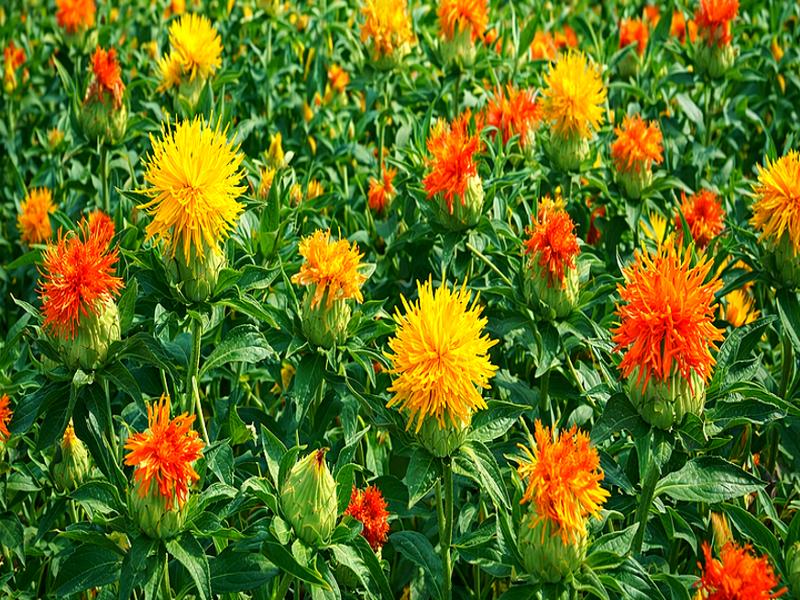
🌼 How to Earn More Profit with Low Cost from Kusum Farming
Kusum farming is an important oilseed crop that has been cultivated in India since ancient times. In many places it is also called Kusumbh. The seeds of Kusum contain about 24 to 36 percent oil, therefore it is considered a profitable cash crop for farmers. Kusum oil is widely used for cooking, industrial purposes, and medicinal uses.
In India, Kusum farming is mainly done in Maharashtra, Karnataka, Andhra Pradesh, Gujarat, and Madhya Pradesh. This crop is especially suitable for areas where water availability is low, because it can give good production even with less water.
Kusum oil is sometimes considered even better in quality than sunflower oil. Apart from this, natural color is also prepared from Kusum flowers which is used in clothes and food items.
Another big benefit of Kusum farming is that its oil cake is used as excellent animal feed. Therefore, farmers can get many types of benefits from a single crop.
If farmers do Kusum Ki Kheti | Kusum Farming with scientific methods, they can get good production at low cost and earn good profit.
Now ahead we will understand complete information related to Kusum farming in detail so that farmer brothers can grow this crop and get higher production.
1️⃣ Introduction of Kusum Farming
Kusum is a major Rabi season oilseed crop. Its sowing is generally done between October and November, and the crop becomes ready in about 150 to 180 days.
This crop is mainly grown for the oil obtained from its seeds. The oil obtained from Kusum seeds is used for the following purposes
✔ For cooking food
✔ In medicine making
✔ In soap and paint manufacturing
✔ In varnish and linoleum industry
✔ In natural color production
The Kusum plant is medium in height and its flowers are yellow, orange, or light red in color.
If farmers do Kusum Ki Kheti | Kusum Farming in the right way, then this crop can give good production even in dry areas and can become an extra source of income for farmers.
2️⃣ Health Benefits and Uses of Kusum
Kusum is not only beneficial from the farming point of view but it is also very useful for health. Its oil and flowers are used in many medicinal and nutritional works.
2.1 Health Benefits of Kusum Oil
✔ Reduces the risk of heart disease
✔ Helps in controlling cholesterol
✔ Improves blood circulation
✔ Helps in keeping the skin healthy
✔ Helpful in weight control
2.2 Industrial Uses
Kusum oil is used in many industries
✔ Soap industry
✔ Paint and varnish industry
✔ Food industry
✔ Medicine manufacturing
2.3 Other Uses
✔ Natural color is prepared from the flowers
✔ Seed oil cake is useful as animal feed
✔ Used in Ayurvedic medicines
In this way, Kusum farming is not limited only to agriculture but it is a crop connected with many industries.
3️⃣ Scientific Classification of Kusum
| Category | Description |
|---|---|
| Scientific Name | Carthamus tinctorius |
| Family | Asteraceae |
| Common Name | Kusum, Kusumbh |
| English Name | Safflower |
| Crop Type | Oilseed Crop |
The Kusum plant is thorny in nature and it can grow well even in dry environments.
4️⃣ Climate and Temperature
For Kusum farming, a climate with moderate temperature is considered most suitable.
4.1 Temperature
✔ Temperature for germination: 15 to 18 degree Celsius
✔ Temperature for plant growth: 15 to 20 degree Celsius
✔ Temperature at the time of harvesting: 32 to 35 degree Celsius
4.2 Rainfall
✔ 60 to 90 centimeters annual rainfall is sufficient
Kusum is a drought tolerant crop, therefore it can be successfully cultivated even in areas with low rainfall.
5️⃣ Soil Requirement
Kusum farming can be done in almost all types of soil, but selecting suitable soil is important for good production.
5.1 Suitable Soil
✔ Sandy loam soil
✔ Loam soil
✔ Soil with good drainage
5.2 Soil pH
✔ 6.0 to 7.5 pH is most suitable
5.3 Soil Characteristics
✔ The soil should have a good amount of organic matter
✔ There should be no waterlogging in the field
✔ The soil should be loose and fertile
If waterlogging occurs, the risk of root rot and other diseases increases.
6️⃣ Seeds and Improved Varieties
To get higher production in Kusum farming, selecting the right variety is very important. Good varieties are tolerant to diseases and also have higher oil content.
In India, many improved varieties have been developed which are suitable according to the climate of different states.
6.1 Major Improved Varieties
1. DSH 129
✔ It is an improved variety
✔ High drought tolerance capacity
✔ Good oil content
✔ Variety giving good production
2. MKH 11
✔ Suitable for Central India
✔ Tolerant to diseases
✔ Good quality seeds
3. Parbhani Kusuma PBNS 12
✔ Popular in Maharashtra region
✔ Variety giving good production
✔ High oil content in seeds
4. NARI NH 1
✔ Suitable for dry areas
✔ Good growth and production
5. NARI 6
✔ Popular variety among farmers
✔ Tolerant to diseases
6. Phule Kusum
✔ Developed in Maharashtra
✔ Variety giving good yield
6.2 Improved Hybrid Variety
NARI H 15
✔ Developed in the year 2005
✔ Suitable for irrigated areas
✔ Oil content about 28 percent
✔ Tolerant to aphid insect
✔ Suitable for cultivation across India
If farmers select improved varieties, then in Kusum Ki Kheti | Kusum Farming, both production and profit can increase.
7️⃣ Seed Rate
In Kusum farming, maintaining the proper seed rate is very important. Using too much or too little seed can affect plant growth.
✔ Seed quantity per acre is about 6 kilograms
If the seed rate is correct, plants will get enough space and the plants will become strong.
8️⃣ Seed Treatment
By doing seed treatment, the crop can be protected from early diseases and insects.
8.1 Method of Seed Treatment
✔ Captan 3 grams per kilogram of seed
or
✔ Thiram 3 grams per kilogram of seed
or
✔ Mancozeb 3 grams per kilogram of seed
By treating seeds with these medicines, protection from fungal diseases can be achieved.
8.2 Measures to Improve Germination
✔ Select healthy and clean seeds
✔ Seeds can be soaked in water overnight before sowing
This improves germination.
9️⃣ Land Preparation
In Kusum farming, proper preparation of the field is very important.
9.1 Ploughing
✔ Do the first ploughing with a soil turning plough
✔ After that do ploughing 2 to 3 times with a cultivator
✔ Finally use a plank to make the soil level and loose
9.2 Benefits of Field Preparation
✔ Weeds get destroyed
✔ Air circulation in the soil increases
✔ Seed germination becomes better
9.3 Drainage
Kusum crop cannot tolerate waterlogging, therefore proper drainage arrangement should be kept in the field.
🔟 Sowing Method
In Kusum farming, sowing at the right time and in the right way is very necessary.
10.1 Time of Sowing
✔ Last week of September
✔ First week of October
✔ In some areas from end of October to beginning of November
10.2 Spacing
✔ Row to row distance 45 cm
✔ Plant to plant distance 15 to 25 cm
10.3 Seed Depth
✔ Sowing the seed at a depth of 3 to 5 cm is suitable
10.4 Method of Sowing
✔ Sowing by drill machine is the best method
✔ With this, the distance between plants remains equal
1️⃣1️⃣ Fertilizer and Manure Management
For good production of Kusum, it is necessary to give balanced amounts of manure and fertilizers in the field.
11.1 Organic Manure
✔ About 6 tons of well decomposed cow dung manure per acre
This manure increases soil fertility and improves plant growth.
11.2 Chemical Fertilizers
Fertilizer quantity per acre
✔ Nitrogen 16 kilograms
✔ Urea about 35 kilograms
If there is a deficiency of nutrients in the soil then
✔ Phosphorus
✔ Potash
should also be given based on soil testing.
11.3 Time of Applying Fertilizer
✔ Half fertilizer at the time of sowing
✔ Remaining fertilizer after 35 to 45 days as top dressing
1️⃣2️⃣ Irrigation Management
Kusum crop can grow well even with less water.
12.1 Irrigation Requirement
✔ If soil moisture is low then irrigate before sowing
✔ One irrigation about 30 days after sowing
✔ Irrigation at the time of flowering is beneficial
12.2 Benefits of Irrigation
✔ Plant growth becomes better
✔ Grain filling becomes good
✔ Production increases
1️⃣3️⃣ Weed Control
Weeds take away nutrients of the crop, therefore timely control is necessary.
13.1 Weeding and Hoeing
✔ First weeding 25 to 30 days after sowing
✔ Second weeding after 45 days
13.2 Chemical Control
✔ Trifluralin 200 grams per acre before germination
✔ Atrazine 800 grams per acre after germination
With this, the weed problem can be controlled to a large extent.
1️⃣4️⃣ Pest Management
Some major insects can damage the Kusum crop.
14.1 Kusum Aphid
This insect sucks the sap of the plant and makes the plant weak.
Control
✔ Chlorpyrifos 20 EC
✔ Mix 100 ml medicine in 100 liters of water and spray
If needed, spray again after 15 days.
1️⃣5️⃣ Disease Management
Some major diseases are also seen in Kusum farming.
15.1 Wilt Disease
Symptoms
✔ Plants become yellow
✔ Slowly they dry up
Control
✔ Use disease free seeds
✔ Must do seed treatment
15.2 Alternaria Blight
Symptoms
✔ Brown spots appear on leaves
Control
✔ Spray Mancozeb 0.25 percent
✔ Spray again after 15 days
15.3 Mosaic Disease
This disease spreads through aphid insect.
Control
✔ Dimethoate 2 ml per liter of water
or
✔ Monocrotophos 1.5 ml per liter of water
1️⃣6️⃣ Crop Duration
The Kusum crop generally
✔ becomes mature and ready in 150 to 180 days
Some varieties also become ready in 130 to 140 days.
1️⃣7️⃣ Harvesting Method
Harvesting the Kusum crop at the right time is very important. If harvesting is done too early or too late, both production and oil quality can be affected.
17.1 Right Time for Harvesting
✔ When the flowers of the plant change from yellow to brown color
✔ Leaves of the plants start drying
✔ Seeds become fully hard
Generally, the Kusum crop becomes ready for harvesting about 150 to 180 days after sowing.
17.2 Harvesting Process
Kusum plants have thorns, therefore care should be taken during harvesting.
Main steps of harvesting
✔ Cut the plants with the help of a sickle
✔ Dry the cut plants in sunlight for 3 to 4 days
✔ After drying, separate the seeds by threshing
17.3 Threshing
For threshing, farmers can use the following methods
✔ Beating with sticks
✔ Threshing by tractor
✔ Threshing with thresher machine
After this, it is necessary to clean the seeds and dry them properly.
1️⃣8️⃣ Production Per Acre
The yield of Kusum depends on farming techniques, soil quality, and irrigation management.
18.1 Production in Rainfed Areas
✔ About 4 to 5 quintals per acre
18.2 Production in Irrigated Areas
✔ About 6 to 7 quintals per acre
18.3 Ways to Increase Production
If farmers take care of the following points, production can increase
✔ Selection of improved variety seeds
✔ Sowing at the right time
✔ Balanced fertilizer management
✔ Timely weed control
✔ Pest and disease management
By following these methods, farmers can get higher production in Kusum Ki Kheti | Kusum Farming.
1️⃣9️⃣ Market Price and Profit Per Acre
Kusum crop is a good cash crop because oil and many industrial products are made from its seeds.
19.1 Market Price
The market price of Kusum keeps changing according to region and time.
✔ Average market price
5000 to 7000 rupees per quintal
19.2 Income Per Acre
If production per acre is 6 quintals
✔ Total income
30000 to 42000 rupees
19.3 Cost Per Acre
Estimated expenses in Kusum farming
Seed cost
About 800 to 1200 rupees
Manure and fertilizers
About 2000 to 3000 rupees
Labour
About 4000 to 5000 rupees
Irrigation and other expenses
About 2000 to 3000 rupees
Total cost
About 10000 to 14000 rupees
19.4 Net Profit
✔ About 18000 to 28000 rupees per acre
If farmers use improved technology and good varieties, they can get even more profit.
2️⃣0️⃣ Storage
Proper storage is very important to keep Kusum seeds safe.
20.1 Precautions Before Storage
✔ Dry the seeds properly
✔ Keep moisture level low
✔ Separate broken and damaged seeds
20.2 Storage Method
✔ Fill the seeds in clean and dry bags
✔ Keep them in a moisture free warehouse
✔ There should be good air circulation in the warehouse
20.3 Benefits of Storage
✔ Seeds remain safe for a long time
✔ The crop can be stored safely until a good market price is available
2️⃣1️⃣ Government Schemes
The Government of India encourages farmers to cultivate oilseed crops. Farmers who do Kusum farming can get the benefit of many government schemes.
21.1 National Food Security Mission
Under this scheme, farmers are provided with
✔ Improved seeds
✔ Agricultural equipment
✔ Training
21.2 Pradhan Mantri Krishi Sinchai Yojana
✔ Assistance for irrigation
✔ Subsidy on drip and sprinkler systems
21.3 Oilseed Development Program
✔ Promotion of oilseed crop cultivation
✔ Seed and technical support
21.4 Agricultural Mechanization Scheme
✔ Subsidy on purchasing agricultural machinery
By taking advantage of these schemes, farmers can reduce the cost of farming and increase production.
2️⃣2️⃣ Important Questions Related to Kusum Farming
1. What is the right time for Kusum farming
The right time for sowing Kusum is from the last week of September to the first week of October. In some areas, sowing is also done from end of October to beginning of November.
2. Which soil is suitable for Kusum farming
Sandy loam soil and soil with good drainage are considered most suitable for Kusum farming.
3. What is the seed rate per acre in Kusum farming
About 6 kilograms of seed per acre is sufficient for Kusum farming.
4. In how many days does the Kusum crop become ready
Kusum crop generally becomes ready in 150 to 180 days.
5. How much irrigation should be done in Kusum farming
Usually 1 to 2 irrigations are sufficient, but irrigation at the time of flowering is very beneficial.
6. What is Kusum oil used for
Kusum oil is used for cooking, medicine manufacturing, soap making, and paint industry.
7. Which insects damage Kusum farming
Kusum aphid and green aphid are the main insects of this crop.
8. How much production is obtained per acre from Kusum farming
Generally 4 to 7 quintals per acre production is obtained.
9. Can Kusum farming be done with less water
Yes, Kusum is a drought tolerant crop and it can be cultivated even in areas with less water.
10. In which states Kusum farming is done more
In India, Kusum farming is done more in Maharashtra, Karnataka, Andhra Pradesh, and Gujarat.
Conclusion
Kusum Ki Kheti | Kusum Farming is a profitable oilseed crop for farmers. This crop has the ability to give good production even with less water, and the oil obtained from its seeds is used in many industries.
If farmers do sowing at the right time, select improved varieties, adopt balanced fertilizer management, and do timely pest and disease control, then they can get good production and profit per acre.
In today’s time, looking at the increasing demand for oil, Kusum farming can become a good economic opportunity for farmers. Therefore, farmer brothers can increase their income by adopting scientific methods of Kusum farming.
👉 Click here to read detailed information about other oilseed crops farming.