


Lotus Cucumber
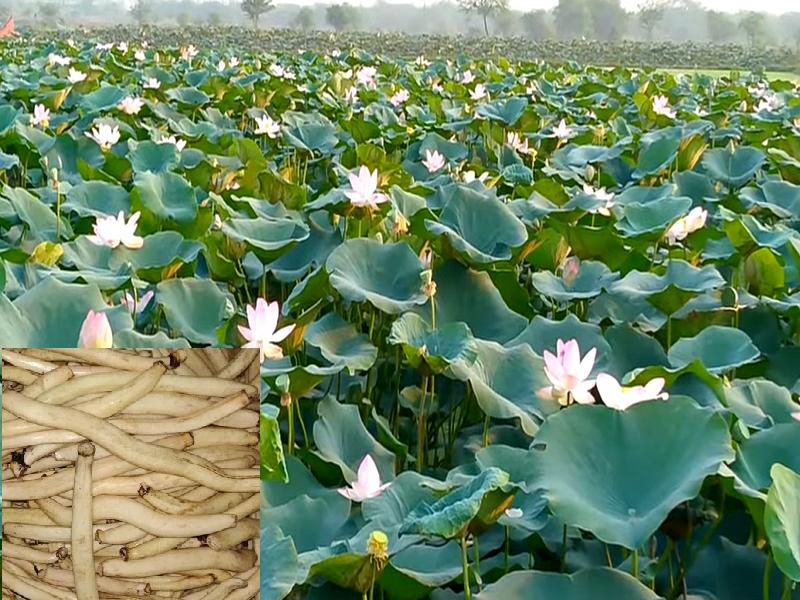
🌸 Lotus Cucumber: How to Earn More Profit from Lotus Root Farming
Kamal Kakdi, which is called Lotus Root or Lotus Cucumber in English, is a fast-growing and profitable crop in India. It is not only tasty but also rich in nutrition and has medicinal properties. For rural farmers, it is a low-cost and high-profit farming option, which gets ready in 3 to 4 months and gives good income.
👉 If proper techniques are used, farmers can easily produce up to 60 quintals per acre and earn ₹60,000 to ₹1,50,000 profit.
Now let us understand complete information about this crop in simple language.
1️⃣ Crop Introduction
Lotus is the national flower of India, and its root is called Kamal Kakdi. It is an aquatic plant (grows in water) which is cultivated in ponds, lakes, or marshy land.
Main Points:
✔ It is a perennial plant
✔ Root is cylindrical and brown in color
✔ Edible part is the root (kakdi)
✔ Seeds (Kamal Gatta) are also useful
📌 In India, it is known by different names:
· Nadru (Jammu & Kashmir)
· Murar (Bundelkhand)
2️⃣ Health Benefits and Uses
Kamal Kakdi is a storehouse of nutrients.
Main Nutrients:
- Calcium
- Iron
- Magnesium
- Potassium
- Vitamin B6, C, A
- Fiber
Health Benefits:
✔ Improves digestion
✔ Helps in weight loss
✔ Strengthens immune system
✔ Increases blood
✔ Good for skin and hair
✔ Reduces stress
Uses:
- Vegetable
- Pickle
- Pakoda
- Chips
- Medicine
3️⃣ Scientific Classification
| Category | Details |
|---|---|
| Scientific Name | Nelumbo nucifera |
| Family | Nelumbonaceae |
| Type | Aquatic Plant |
| Use | Food and Medicinal |
4️⃣ Climate & Temperature
✔ Temperature for germination: 20°C
✔ Temperature for growth: 25°C to 30°C
✔ Requires good sunlight
📌 This crop grows well in still or slow-moving water.
5️⃣ Soil Requirement
Soil is very important for Kamal Kakdi farming.
Suitable Soil:
✔ Black Soil
✔ Clay Soil
✔ Marshy Soil
Important Points:
· Soil should have water holding capacity
· Oxygen should be low (required for aquatic crop)
· pH: 6.5 to 7.5
6️⃣ Seed & Varieties
Types of Seeds:
· From seed
· From root (tuber)
👉 Farming with root gives faster production.
Main Varieties:
· Kumudni
· Utpal (Blue Lotus)
· Red Lotus
· White Lotus
7️⃣ Seed Rate
For successful farming, correct seed rate is very important.
Per Acre Requirement:
✔ By seed: 1 to 1.2 kg
✔ By root tuber: 300 to 400 kg root pieces
Important Points:
1️⃣ Farming from root (tuber) is more successful and fast
2️⃣ Select healthy and disease-free seeds or tubers
3️⃣ Prepare seeds before germination
8️⃣ Land Preparation
Since it is a water-based crop, pond or waterlogged area is required instead of field.
Pond Preparation Process:
1️⃣ Clean the pond properly
2️⃣ Spread stones and pebbles at the bottom
3️⃣ Add 20 to 30 cm thick clay soil layer
4️⃣ Add a light sand layer on top
Important Points:
✔ Water depth: 60 to 100 cm
✔ Water should be still or slow
✔ Ensure water availability in field
9️⃣ Sowing Method
Kamal Kakdi is sown in two ways.
1. By Seed:
✔ Keep seeds in lukewarm water for 3 to 5 days
✔ Change water daily
✔ After sprouting, press into soil
2. By Root Tuber:
✔ Cut tuber into 10 to 15 cm pieces
✔ Plant directly in pond soil
Spacing:
✔ Row to row: 150 to 200 cm
✔ Plant to plant: 50 to 60 cm
📌 Proper spacing increases production
🔟 Fertilizer & Manure Management
Balanced fertilizer is needed for good production.
Per Acre:
✔ Cow dung manure: 4 to 5 tons
✔ Nitrogen: 20 to 25 kg
✔ Phosphorus: 15 to 20 kg
✔ Potash: 10 to 15 kg
Method:
1️⃣ Apply cow dung during land preparation
2️⃣ Give chemical fertilizers in 2 parts
3️⃣ Use more organic fertilizers
1️⃣1️⃣ Irrigation Schedule
Kamal Kakdi is fully water-based crop, so irrigation is most important.
Key Points:
1️⃣ Water should always remain in pond/field
2️⃣ Maintain water depth 50 to 100 cm
3️⃣ Do not reduce water level in summer
4️⃣ Water should be clean and still
Advanced Tips:
✔ Use drip or controlled water management if possible
✔ Check water quality regularly
✔ Dirty water can damage crop
📌 Note: Lack of water stops root growth and reduces yield
1️⃣2️⃣ Weed Control
Weeds affect growth, so control is necessary.
Control Measures:
1️⃣ Keep pond surface clean
2️⃣ Remove weeds regularly
3️⃣ Use mulching
Advanced Technique:
✔ Plastic mulching reduces weeds
✔ Remove floating weeds immediately
📌 Clean environment helps faster growth
1️⃣3️⃣ Pest & Disease Management
Pests and diseases are less but care is needed.
Common Problems:
✔ Yellow leaves
✔ Root rot
✔ Leaf-eating insects
Control:
1️⃣ Remove infected leaves
2️⃣ Spray neem oil or organic pesticide
3️⃣ Keep water clean
Prevention:
✔ Use healthy seeds and tubers
✔ Maintain water level
✔ Regular inspection
1️⃣4️⃣ Crop Duration
It is a fast-growing crop.
Duration:
✔ From tuber: 70 to 90 days
✔ From seed: 5 to 6 months
Special Info:
👉 Planting in March → Harvest in May–June
👉 Use tuber method for early yield
1️⃣5️⃣ Harvesting Method
Harvesting at right time improves quality and price.
Signs:
✔ Root becomes thick and strong
✔ Leaves start turning light yellow
Process:
1️⃣ Reduce water level
2️⃣ Carefully remove roots
3️⃣ Clean soil
4️⃣ Grade by size
📌 Avoid breaking roots
1️⃣6️⃣ Yield per Acre
Normal Yield:
✔ 50 to 60 quintals per acre
With Advanced Techniques:
✔ 60 to 70 quintals per acre
Increase Yield:
✔ Select good variety
✔ Maintain spacing
✔ Regular care
1️⃣7️⃣ Market Price & Profit
High demand in market, especially in summer.
Cost:
✔ ₹25,000 to ₹30,000 per acre
Selling Price:
✔ ₹80 to ₹120 per kg
Total Income:
✔ ₹80,000 to ₹1,50,000 per acre
Net Profit:
✔ ₹60,000 to ₹1,20,000 per acre
Extra Income:
✔ Kamal Gatta
✔ Makhana
✔ Flowers
📌 Selling at right time gives more profit
1️⃣8️⃣ Storage
Proper storage reduces loss.
Methods:
1️⃣ Keep in cool and shaded place
2️⃣ Store in clean water
3️⃣ Remove dirt
Duration:
✔ Safe for 7 to 10 days
📌 Use cold storage for longer period
1️⃣9️⃣ Government Schemes
Many schemes are available for farmers.
Main Schemes:
1️⃣ PM Krishi Sinchai Yojana
2️⃣ National Horticulture Mission
3️⃣ Kisan Credit Card
Benefits:
✔ Subsidy on irrigation
✔ Seed support
✔ Training and guidance
✔ Easy loans
📌 Contact nearest agriculture office
2️⃣0️⃣ Extra Tips
Small improvements can increase income many times.
Advanced Tips:
1️⃣ Use mulching
✔ Reduces weeds
✔ Maintains moisture
✔ Increases yield by 15–25%
2️⃣ Select improved varieties
✔ High yield
✔ Disease resistant
3️⃣ Maintain spacing
✔ Better root growth
✔ Improves quality
4️⃣ Regular monitoring
✔ Check leaves and growth
✔ Solve problems early
5️⃣ Maintain water quality
✔ Clean water
✔ Avoid contamination
6️⃣ Use organic farming
✔ Low cost
✔ Better price
7️⃣ Market connection
✔ Connect with mandi, hotels
✔ Direct selling gives more profit
8️⃣ Crop diversification
✔ Sell makhana and seeds also
✔ Extra income
9️⃣ Take expert advice
✔ Consult agriculture experts
✔ Use new techniques
🔟 Timely harvesting and selling
✔ Gives better price
📌 Remember: Proper management is the key to success
2️⃣1️⃣ FAQs (Kamal Kakdi)
Q1. What is the best time for Kamal Kakdi farming?
👉 March to April is considered the most suitable time because temperature is favorable.
Q2. Can Kamal Kakdi farming be done everywhere?
👉 No, this crop grows well only where sufficient water is available like ponds or waterlogged areas.
Q3. Which method is better, seed or tuber?
👉 Farming from tuber (root) is better because it gives faster and higher production.
Q4. In how many days does the crop get ready?
👉 From tuber: 70 to 90 days and from seed: 5 to 6 months.
Q5. How much yield per acre can be obtained?
👉 Normally 50 to 60 quintals and with good techniques up to 60 to 70 quintals.
Q6. What is the cost of farming?
👉 Around ₹25,000 to ₹30,000 per acre.
Q7. Does this crop need more water?
👉 Yes, it is a fully water-based crop and requires 50 to 100 cm water.
Q8. Is Kamal Kakdi farming profitable?
👉 Yes, with proper management profit can be ₹60,000 to ₹1,20,000 per acre.
Q9. Are other parts of lotus also useful?
👉 Yes, flowers, seeds (Kamal Gatta) and makhana are also sold at good price in market.
Q10. How many days can Kamal Kakdi be stored?
👉 It can be safely stored for 7 to 10 days in normal conditions.
🎯 Conclusion
Kamal Kakdi farming is becoming a very good opportunity for farmers in today’s time. This crop gets ready in less time, gives high production at low cost, and its demand in market is continuously increasing.
👉 If farmers use proper techniques, good water management, balanced fertilizers, and timely care, then they can not only double but multiply their income.
👉 The special thing is that every part of lotus is useful, which gives extra income opportunities.
🌱 If you are looking for a new and profitable farming option, then definitely adopt Kamal Kakdi farming and make your future financially strong.
👉 For detailed and practical information on vegetable farming, click here