


When and How Is a Subsidy Received? 5 Common Mistakes to Avoid
When and How Is a Subsidy Received? 5 Common Mistakes and How to Avoid Them
Malvika Lal, Co-founder, Utkrishi
“ The government provides a 35% subsidy” is something you often hear in villages. But when it comes to applying, several questions arise: When will the money come? Whose bank account will receive it? Which documents are required? And what can cause the subsidy to get stuck? If the information is incomplete, even a good project can face delays.
In this article, we will first understand the steps involved in receiving a subsidy and then look at the five most common mistakes applicants make. All figures are taken from government model reports (sources are provided with each example and at the end of the article). Actual amounts may vary depending on prices in your district and the bank’s assessment.
Important Note (October 2026)
- PMFME: The scheme’s current period was until September 2026. The Ministry of Food Processing Industries has proposed extending it. Before applying, check the PMFME Portal to confirm whether new applications are open.
- PMEGP: Before applying, check the current year’s targets and rules on the KVIC PMEGP E-Portal.
1. First Understand: How Is a Subsidy Received?
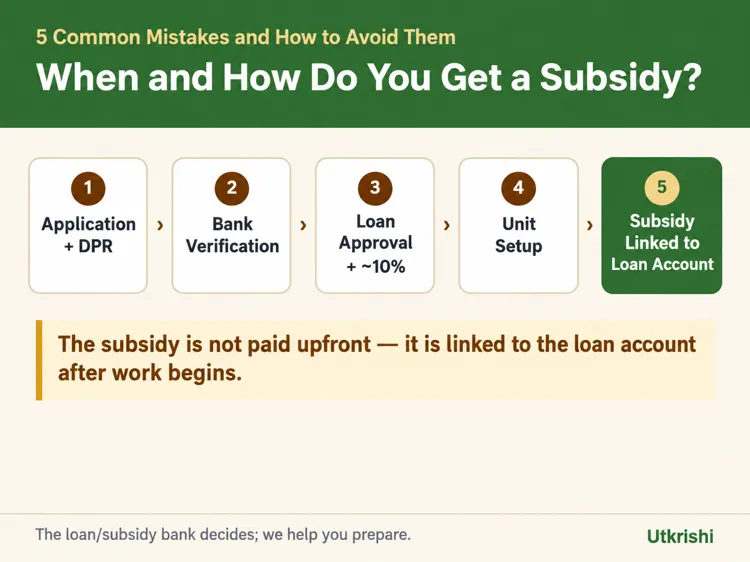
In most schemes, such as PMFME, PMEGP, MIDH/NHB, and PMMSY, the subsidy is linked to a bank loan. The process generally works as follows:
- Application: Apply through the scheme’s official portal or the concerned department, along with a Detailed Project Report (DPR).
- Bank Verification: The bank checks the DPR, eligibility, sales plan, and your ability to repay the loan instalments.
- Loan Approval and Your Contribution: Once the loan is approved, you deposit your own contribution, which is generally around 10% of the total project cost.
- Setting Up the Unit: Payments for machinery, sheds, or construction are mostly made directly to the suppliers.
- Verification and Subsidy: After the unit starts operating, the bank or department conducts an inspection. The subsidy is then credited to your loan account.
This means the subsidy is not cash that you receive directly in your hands. It reduces your loan burden and generally comes after the work has started.
2. 5 Common Mistakes
Mistake 1: Buying Machinery Before Approval
In their excitement, many people book machinery or build a shed first and apply later. Under most schemes, the subsidy is calculated on expenses included in the DPR and incurred through the bank after loan approval. Expenses paid in cash beforehand may sometimes not be considered at all.
Example: A chilli powder unit with a capacity of 400 kg per day costs approximately ₹14.7 lakh, for which the PMFME subsidy is around ₹3.5 lakh (Source: NIFTEM’s PMFME Model DPR). If you pay for the machinery from your own pocket before approval and that expense is not accepted in the application, you may lose a significant part of the subsidy.
How to Avoid It: Get quotations in advance, but make the payment only after the loan is approved.
Mistake 2: Not Checking Whether You Are Eligible for the Scheme
Every scheme has a different scope, and subsidy rates also vary.
- PMFME: For micro food processing units. Subsidy of 35% of the project cost, up to a maximum of ₹10 lakh. For example, a turmeric powder unit with a capacity of 200 kg per day costs approximately ₹15.6 lakh, with a subsidy of around ₹3.9 lakh (Source: PMFME Model DPR).
- PMEGP: For new micro-enterprises. Subsidy ranges from 15% to 35%, depending on the category and location. For example, a pickle and papad unit with a capacity of 400 kg per day costs approximately ₹6.8 lakh, with a subsidy of up to around ₹1.7 lakh (Source: KVIC/PMEGP Project Profile).
- MIDH / NHB: For horticulture-related activities. For example, a 30-tonne cold storage facility costs approximately ₹15 lakh, with a subsidy of up to around ₹5.3 lakh, or a 1,000-square-metre polyhouse costs approximately ₹13.5 lakh, with a subsidy of around ₹6.3 lakh (Source: NHB/MIDH Unit Costs).
- PMMSY: For fisheries and fish farming. The subsidy is 40%, and 60% for women and SC/ST beneficiaries. For example, a one-hectare fish pond costs approximately ₹11 lakh, with a subsidy of around ₹4.4 lakh (Source: PMMSY Unit Costs).
- AIF: It does not provide a capital subsidy. Instead, it offers a 3% annual interest subvention on loans up to ₹2 crore, along with a CGTMSE guarantee.
How to Avoid It: First, check which scheme directly covers your business activity. Then read the eligibility conditions yourself in the scheme’s official guidelines.
Mistake 3: Incomplete Documents or Mismatched Information
Many applications get delayed because names, addresses, or amounts differ across documents. The following documents are generally required:
- Aadhaar, PAN, and bank account details, including bank statements for the previous few months.
- Land documents or a rental agreement for the location where the unit will be set up.
- Machinery and construction quotations.
- A bank-ready Detailed Project Report (DPR).
- Udyam Registration, and an FSSAI licence or registration for food-related businesses.
- Category certificates for higher subsidy rates, and training certificates if required by the scheme.
How to Avoid It: Before applying, keep all documents together and check that the spelling of your name, address, and amounts are consistent everywhere.
Mistake 4: Not Including Actual Local Prices in the DPR
Many people download a report from the internet and prepare their application using the same figures. Bank officials are familiar with prices in their local areas. If the report shows an unrealistically high selling price or an unusually low raw material cost, its credibility decreases, and the approved loan amount may be reduced. If the loan amount is reduced, the linked subsidy may also decrease.
Example: A millet flour unit with a capacity of 500 kg per day costs approximately ₹18.5 lakh, with a PMFME subsidy of around ₹5.8 lakh. The model shows a profit of approximately ₹3.2 lakh in the first year (Source: PMFME Model DPR). This will be realistic only if sorghum and pearl millet are available at the same prices in your area and the flour can be sold at the assumed price.
How to Avoid It: Visit the local mandi and check the prices of raw materials and finished products yourself. Prepare the DPR using those prices. Also, keep the names of two or three confirmed buyers ready.
Mistake 5: Forgetting the Conditions That Apply After Receiving the Subsidy
Your responsibilities do not end even after the subsidy is credited to your account. Most schemes require you to keep the unit operational for a specified period, pay loan instalments regularly, and cooperate during inspections. If the unit closes, machinery is sold, or instalments remain unpaid for a long time, the subsidy may be recovered.
How to Avoid It: Read the conditions in the sanction letter carefully and keep a written record of them. Preserve sales records, electricity bills, and purchase invoices.
3. A Short Checklist Before Applying
- Which scheme does my business come under, and does it provide a subsidy or only an interest concession?
- What is the subsidy rate for my category, and are applications currently open under the scheme?
- Have I arranged my own contribution of approximately 10% and the initial working capital?
- Do all my documents and DPR match each other?
- Have I made any payment before approval?
4. Frequently Asked Questions (FAQ)
Q1. Is the subsidy received as cash directly in hand?
No. In most schemes, the subsidy is linked to the loan and is credited to your loan account after the unit starts operating.
Q2. How much money do I need to invest from my own pocket?
In government model projects, your own contribution is generally around 10% of the total cost, while the remaining amount comes through a bank loan. Also, keep enough working capital ready for the initial months.
Q3. Is a 35% subsidy also available under AIF?
No. Under AIF, loans up to ₹2 crore are eligible for a 3% annual interest concession and a credit guarantee. It does not provide a capital subsidy.
Q4. Will I get a subsidy for machinery purchased before approval?
Usually, no. The safest approach is to make the payment through the bank after the loan has been approved.
Q5. Do women and SC/ST applicants receive higher subsidies?
Yes, under some schemes. For example, under PMMSY, the subsidy is 60% instead of 40%, while PMEGP offers higher rates for special categories. Check the guidelines of your scheme.
Q6. Can the subsidy also be recovered?
Yes. The subsidy may be recovered if the unit closes before the specified period, the machinery is sold, or the approval conditions are not followed.
5. One Honest Point
The loan/subsidy bank makes the decision; we help you prepare. No consultant can guarantee a subsidy. Applicants can control only a few things: choosing the right scheme, following the correct process, and approaching the bank with a complete and truthful application file.
Sources of Data
- Chilli powder, turmeric powder, and millet flour: PMFME Model DPR (Ministry of Food Processing Industries; NIFTEM)
- Pickle and papad: KVIC/PMEGP Project Profile
- 30-tonne cold storage and 1,000-square-metre polyhouse: NHB/MIDH Unit Costs
- One-hectare fish pond: PMMSY Unit Costs
- Scheme rates: Official guidelines of the respective schemes
The Utkrishi team cross-checked all figures against model reports in October 2026. These are initial estimates; actual results may vary depending on prices in your district.
Author Introduction: Malvika Lal is the Co-founder of Utkrishi (Aldew Digital Private Limited, Pune). This startup is incubated at Pusa Krishi (ICAR-IARI) under RKVY-RAFTAAR. Utkrishi provides free information on the costs, subsidies, loans, and earnings of 40+ agri-businesses in Hindi, Marathi, and English: www.utkrishi.com, Hindi guides to government schemes: Utkrishi