


Flower Farming Success: Inspiring Story of Bundi Farmers
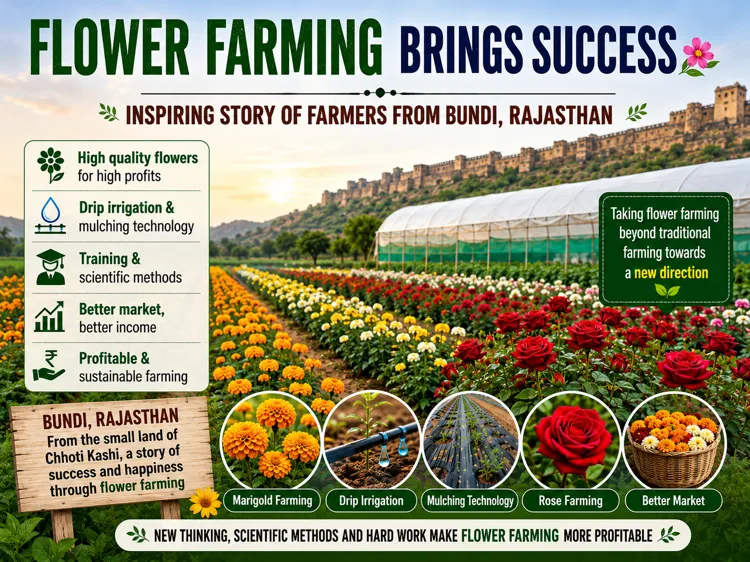
🌸 From Traditional Farming to Flower Farming: Anil and Manish of Bundi Show a New Path to Success
Rajasthan’s Bundi district is known for its historic stepwells, rich cultural heritage, ancient temples and fertile land. Because of its religious and cultural identity, Bundi is also called Chhoti Kashi. For a long time, crops like maize, bajra and jowar have been an important part of farming here. But with time, farmers are also moving towards new farming options.
One such inspiring story is that of Anil Kumar and Manish Kumar from Peda village in Bundi district. They moved beyond traditional farming and adopted flower farming. Their initiative was not limited to growing a new crop. Slowly, they turned farming into a successful business. Their hard work and willingness to try new methods are also showing a new path to nearby farmers. 🌱🌸
Anil says that he has been doing marigold farming for many years. Along with marigold, he has also started growing roses. He started rose farming in 2025. Earlier, he mainly grew marigold, but now rose farming has also become a part of his farm. This change shows his farming experience and his willingness to explore new opportunities.
🌸 Growing Demand for Flowers Changed the Direction of Farming
Today, the flower market is continuously expanding. Whether in villages or cities, flowers are needed for worship, weddings and different types of events. Because of this growing demand, flower farming is emerging as a cash crop that can give farmers good income.
Anil and Manish understood this opportunity and did not keep flower farming limited to just a crop. They turned it into a successful business. 🌸💰
According to Anil, marigold farming gives more profit than wheat farming. He says that the market rate of marigold is currently around ₹70 to ₹80. There is also a market for roses. He has started using drip irrigation and mulching, and gradually he is getting good profit from it. At the same time, the problem of water shortage is also reduced.
With drip irrigation, the plant can be given only as much water as it needs. Fertilizer can also be given through drip directly to the roots of the plant. This helps save water. After mulching is laid, the work of removing weeds is also reduced. In this way, Anil and Manish have adopted scientific techniques to make flower farming more effective. 💧🌱
🌼 From a Small Experiment to a Successful Business
Anil and Manish started flower farming as a small experiment with marigold. When the first crop gave them better income than they expected, their confidence in flower farming became stronger. After this, they expanded the number of flower varieties on their farm.
They included white Godavari, Jafri, marigold and rose in their farming. Rose, in particular, helped them maintain regular income because its harvesting continues for a long time. Choosing different varieties and following a strategy of continuous production helped turn their small experiment into a successful business. 🌹
Anil says that he has also planted Kalkatta variety and during winter he grows white Bijli flowers. These white flowers have higher demand in winter and are used for making garlands. There are also many varieties of chrysanthemum. He has not planted it yet, but because of the rain, he plans to plant it in winter, when it also gets a good market rate.
This story shows that instead of depending on only one crop, farmers can choose different varieties of flowers and work towards continuous production. The journey of Anil and Manish shows how a small experiment can slowly become a successful business. 🌸💪
👨🌾 Training Gave Scientific Support to Their Farming
To understand flower farming better, Anil and Manish took training from the Krishi Vigyan Kendra. There they learned about scientific methods of flower farming, proper distance between plants and the right time for planting. They were also given detailed information about subsidies and government schemes available through the agriculture department.
They used the knowledge gained during the training on their farm and made flower farming more organised and profitable through scientific methods.
Anil says that he keeps a distance of two feet from plant to plant and three feet in width between plants. This makes it easier to move around the field and harvest the flowers. He also uses drip irrigation in marigold farming and received a government subsidy for it. Along with this, water is also saved.
It takes around three months from planting the seedlings to the arrival of flowers. During this period, if the plants are properly cared for and the required management is done on time, better flower production can be achieved.
The plants are regularly taken care of and given fertilizer and water according to their needs. This helps healthy plants grow and gives good-quality flowers. 🌱🌼
Anil says that he transplanted the crop on 20 May. Harvesting starts within three to four days, and harvesting is done once every four days. At that time, the market rate was ₹70 to ₹80.
💧 Saving Water Through Drip Irrigation and Mulching
The use of drip irrigation and mulching is an important part of Anil and Manish’s farming method. Through drip irrigation, plants can receive water according to their requirement. Fertilizer can also reach the roots directly through the drip system. This helps save water.
Mulching also reduces the work of removing weeds.
For a farmer, saving water and making farm work easier are important. Anil and Manish adopted these techniques based on their experience and training and tried to make flower farming more effective. Their approach shows how traditional farming experience can be combined with scientific training and technology. 🌱💧
👨👦 Father’s Farming Tradition, Sons’ New Thinking
Manish’s family has been doing traditional farming for generations. Earlier, the family used to grow wheat, maize and bajra. Manish says that when he used to go to school, his father worked in the fields and he helped him.
Gradually, he lost interest in studies and started working in the fields. He also went outside to earn money, but he could not get good earnings there. After that, he returned to the fields and started getting better money from farming.
Another experience also became important in Manish’s journey. He went to Ajmer with his maternal grandfather. There he saw how farming was done and tried to understand the farming system.
Later, he went to the Krishi Vigyan Kendra in Bundi. There he learned how flower farming should be done and how it could be taken forward. After learning these methods, he started growing marigold and rose. 🌸👨🌾
For every father, one of the proudest moments is when his children carry forward the family tradition while also creating their own identity.
For Lalchand ji, this is also a moment of pride and happiness. His sons Anil and Manish continued the family’s farming tradition while adopting flower farming and giving a new direction to the family’s farming. ❤️🌱
Lalchand ji says that he has two children and both have completed ITI. He does farming of rose flowers and other crops. The story of this family reflects the combination of traditional farming, family support, willingness to learn and the courage to choose a new direction.
🚜 From Bundi Fields to Kota Market
The flower business has a large market from villages to towns and big cities. Demand for flowers continues to remain. Anil and Manish take their flower produce not only to Bundi but also to the big Kota mandi, where they get a better market for their produce.
Anil says that after harvesting the flowers, they take them to Kota mandi. There, they can easily get a rate of around ₹50. The training received from the Krishi Vigyan Kendra also continues to help them.
Whenever they face any problem, they can call the Krishi Vigyan Kendra in Bundi and discuss the problem to get a solution. 📞🌸
One of the biggest advantages of flower farming is its better market and continuously available demand. Flowers are needed for weddings, religious functions and decoration. This is why farmers are increasingly adopting flower farming as a good income option.
🏫 Role of Agricultural University and Krishi Vigyan Kendra
The role of the agricultural university is also important in understanding the possibilities of flower farming. The agricultural university works at several levels, including research, development and promotion of new technologies, and training, keeping farmers’ needs in mind. The purpose is to make farming more modern and profitable.
The Agricultural University, Kota mainly works in three areas.
The first is quality education, where different degree programmes are run and attention is given to skill-development-based education for students.
The second area is research. Scientists conduct different types of research, and this research directly benefits farmers. Work is being done on integrated farming systems, organic farming, natural farming, modern research, improved seed production, water management and soil health.
The third area is extension education. Whatever research is being done and whatever students learn is taken to villages so that farmers can adopt these technologies.
This is described through the idea of Lab to Land—the research done in laboratories and the technologies developed there are explained to farmers and taken to farming fields. 🔬➡️🌾
🌾 Farmers of Bundi Are Moving Towards Innovation
The role of the district administration in making farmers progressive is also described as important. Efforts by the District Collector have helped increase farmers’ income in the district. On the instructions of the District Collector, scientists from the Krishi Vigyan Kendra are also promoting innovation among farmers in rice and vegetable farming.
According to the District Collector, during field visits it was felt that farmers in Bundi are very progressive and believe in innovation.
The Krishi Vigyan Kendra and its officers are working to promote agricultural technologies as much as possible, take them to the fields and organise training programmes.
The result of these efforts is that the entire farming system of Bundi district has seen major changes during the last ten years.
The Krishi Vigyan Kendra explained a good innovative method of rice cultivation to farmers. After this, the area under rice cultivation also increased.
Farmers in Bundi are not limited to innovation alone. They are also adopting scientific farming and moving towards protected cultivation.
Through polyhouses, farmers are looking for better production and good income opportunities despite weather challenges. Around 125 polyhouses have been built in the district. The cucumber, gourd and tomato production from these polyhouses is going directly from here to Delhi and Mumbai. In some cases, farmers have even taken their innovation and progress towards exports. 🌱🏠
🌿 Natural and Organic Methods in Flower Farming
The Krishi Vigyan Kendra provides technical guidance to farmers from training to the field to help increase their income. Along with information about new technologies, farmers also receive support in preparing for farming.
Senior scientist of the Krishi Vigyan Kendra, Dr Mahesh Chaudhary, also shared important information about Anil Kumar’s preparation for flower farming.
Anil passed Class 12 and then completed an ITI course. He also tried working in private companies, but he could not find success there. After that, he moved towards his traditional family work—farming.
Initially, he grew the main crops around Bundi and Talera, especially maize, jowar and bajra. But he was not getting much profit from them.
Because of this, young people were also becoming less interested in farming, as they were not getting enough benefit from it.
But when Anil took technical advice and training from the Krishi Vigyan Kendra, he moved towards scientific farming. After that, he first started marigold farming.
He grew French and African marigold varieties. During the summer season, he planted the Kalkatta variety of marigold. During the month of Shravan, the demand for flowers is quite high for religious activities.
As everyone knows, whether it is flower garlands or flowers to be offered at temples and mosques, flowers are in high demand. 🌼🙏
Adopting natural methods in flower farming helps maintain the good health of plants and improves flower quality. With proper care, the flowers remain attractive and their freshness also stays for a longer time.
🐄 Cow Dung Manure and Soil Health
The importance of animal husbandry in organic and natural farming is also explained. Using cow dung manure in flower farming improves soil structure.
Cow dung manure contains essential nutrients such as nitrogen, phosphorus and potash, which are released slowly into the soil.
Cow dung manure makes the soil loose and improves its water-holding capacity. It can also increase the water-holding capacity of sandy soil. Along with this, the activity of microorganisms increases.
Its use also helps farmers get some relief from chemical inputs. The effect of cow dung manure remains for a longer time because its nutrients are released slowly into the soil. It also increases the amount of carbon in the soil. 🌱🐄
With this natural method, flowers can have a good size, good fragrance, shine and quality. Flowers grown through natural methods help maintain soil health, and with proper care their freshness also remains for a longer time. 🌸✨
❤️ A Story of Hard Work, Learning and a New Direction
The story of Anil and Manish is not only a story about growing flowers. It is a story of moving beyond traditional farming, looking for new opportunities, taking training, adopting scientific methods and seeing farming as a business.
On one side is the family’s generations-old farming tradition, and on the other side is a new way of thinking.
Earlier, the family grew wheat, maize, bajra and jowar. When these traditional crops did not provide the expected benefit, Anil and Manish started looking for new farming options.
They tried earning money outside farming, but did not find success there. They returned to the fields and started getting better money from flower farming. 🌾➡️🌸
They did not depend only on their own experience. They took training from the Krishi Vigyan Kendra, visited the fields of several farmers and collected information.
After getting complete information and preparing themselves, they decided to start flower farming. They also received the benefit of a subsidy.
Then came the beginning with marigold. Rose became a part of their farming. Different flower varieties were adopted. Drip irrigation and mulching were used. Their produce was taken from Bundi to Kota mandi.
Regular harvesting and the demand for flowers helped turn this effort into a business. 🌹💰
🌸 A Success Story from Bundi
The story of Anil Kumar and Manish Kumar’s flower farming shows that farmers can move towards new options along with traditional farming.
Growing demand for flowers, better markets, training, scientific technology, drip irrigation, mulching, natural farming and different flower varieties gave their farming a new direction.
Their story has the hard work of a farmer, the support of family, the willingness to learn and the confidence to move forward.
The better-than-expected income from their first crop increased their confidence, and their small experiment slowly became a successful business. 🌸😊
The training and technical guidance received from the Krishi Vigyan Kendra also played an important role in this journey. Whenever they face a problem, they can take a solution over the phone and apply the techniques they have learned on their farm.
Flower farming has continuous demand because flowers are needed for weddings, religious functions and decoration. By taking their produce from Bundi to Kota mandi, they are also benefiting from a bigger market.
The most emotional part of this story is seeing sons carry forward the family’s farming tradition while creating their own identity. For Lalchand ji, watching his sons Anil and Manish move forward in farming is a moment of pride and happiness. ❤️
And this is the most beautiful part of their story—they did not see farming only as a way to earn income. They turned it into a successful enterprise and, through their success, created an example for the new generation. 🌾🌸
The flower farming story of Anil and Manish shows that when traditional farming experience is combined with new thinking, training and scientific methods, farming can get a new direction.
On the fertile land of Bundi, the fragrance of these flowers is not limited to the fields. It is also showing a new path to nearby farmers. 🌸🌱
By adopting flower farming along with traditional crops, farmers can also achieve success in this field like Anil and Manish. Their story is an inspiring example of trying new things in farming, continuously learning and moving forward.
📌 Source and References
The information for this article has been taken from DD Kisan’s programme “Safal Kisan: How Flower Farming Changed the Farmers’ Picture”.
Source: DD Kisan – Safal Kisan: How Flower Farming Changed the Farmers’ Picture
Video: Watch the video on YouTube