


Gladiolus Flower Farming: Complete Guide
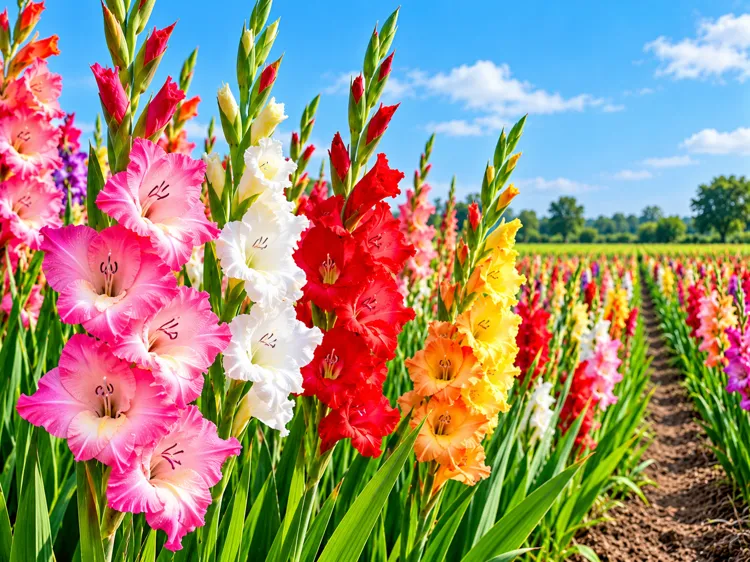
🌺 How to Grow Gladiolus Flowers? Complete Guide to Improved Varieties, Planting Time, Fertilizers, Irrigation and Profit
In India, farming is not just a way of growing food grains; it is the hope, hard work, and livelihood of millions of families. Our farmers work day and night in their fields, but sometimes the income from traditional crops does not match their hard work. In such situations, adopting new farming options has become the need of the hour.
One such attractive and useful option is Gladiolus Flower Farming.
Gladiolus is a beautiful flower that produces several colourful blooms on a long flower spike. Its beauty in pink, yellow, white, red, orange, and purple colours attracts people. It is widely used for decoration, flower bouquets, and various functions and celebrations.
If farmers choose the right varieties, prepare their fields properly, and understand market demand, Gladiolus farming can become a good alternative along with their traditional farming activities.
In this article, we will provide complete information about Gladiolus farming in simple English so that you can understand all the important details before starting its cultivation.
🌼 1. What Is Gladiolus and Why Should You Grow It?
Gladiolus is a perennial flowering plant. Its leaves are sword-shaped, and its flowers bloom one after another on long flower spikes.
Its biggest attraction is its different colours and beautiful flowers. This is why it holds an important place in ornamental flower cultivation.
In India, Gladiolus is cultivated in states such as Punjab, Haryana, Uttar Pradesh, Maharashtra, and Andhra Pradesh.
Gladiolus flowers generally bloom between October and March.
Major Benefits of Gladiolus Farming for Farmers:
- Flowers of different colours can be produced.
- Flower spikes can be cut and sold in the market.
- Underground corms can provide planting material for the next crop.
- Flower farming can be adopted as an alternative business along with traditional farming.
- Different varieties make it possible to plan production according to market preferences.
However, before starting Gladiolus farming, make sure to gather information about the local market, flower demand, and availability of corms.
🌱 2. Suitable Climate for Gladiolus Farming
A suitable climate is very important for the healthy growth of Gladiolus plants and proper flower development.
A temperature of around 25°C to 30°C is considered suitable for this crop.
Farmers should keep the following points in mind while cultivating Gladiolus:
- The field should receive sufficient sunlight.
- Adequate moisture should be maintained in the soil.
- Water should not accumulate in the field.
- Irrigation should be provided according to the weather and soil conditions during plant growth.
Avoiding waterlogging is especially important in Gladiolus farming because excess water can increase the risk of underground corms rotting.
🏡 3. Which Type of Soil Is Suitable for Gladiolus Farming?
Fertile loamy soil with good drainage is considered the most suitable for Gladiolus farming.
In such soil, plant roots develop properly, and corm growth can also be better.
Major Soil Requirements:
- The soil should be fertile.
- Proper drainage facilities should be available.
- The soil pH should be around 7.
- Avoid heavy, sticky, and acidic soils.
- Water should not accumulate in the field.
Getting your field soil tested will be useful. It will help farmers understand the actual condition of their soil and prepare a proper fertiliser management plan.
🌸 4. Improved Varieties of Gladiolus
Choosing the right variety is very important in Gladiolus farming. Different varieties have different flower colours, flower spike lengths, numbers of flowers, and maturity periods.
According to the available agricultural information, some major Gladiolus varieties are listed below.
🌺 White Prosperity
This variety becomes ready in approximately 110 to 120 days.
- Around 17 flowers develop on one flower spike.
- The flower spike is approximately 75 cm long.
- The flowers are white in colour.
🌼 Nova Lux
This variety produces attractive yellow-coloured flowers.
- The crop becomes ready in approximately 110 to 120 days.
- The flower spike is approximately 79 cm long.
- Around 47 corms can be obtained from one plant.
🌹 Eurovision
This variety produces red-coloured flowers.
- The crop takes approximately 110 to 120 days to mature.
- Around 16 flowers develop on one flower spike.
- The flower spike is approximately 84 cm long.
🌻 Golden Melody
This variety produces light yellow-coloured flowers.
- It becomes ready in approximately 90 to 100 days.
- The flower spike is approximately 87 cm long.
- Around 15 flowers develop on one spike.
- Around 67 corms can be obtained from one plant.
❄️ Snow Princess
This variety produces white-coloured flowers.
- It becomes ready in approximately 80 to 90 days.
- Around 11 to 14 flowers develop on one flower spike.
- The flower spike is approximately 65 cm long.
- Around 15 corms can be obtained from one plant.
🌞 Sylvia
This variety produces golden yellow-coloured flowers.
- It becomes ready in approximately 120 days.
- Around 13 to 15 flowers develop on one spike.
- The flower spike is approximately 75 cm long.
- Around 15 corms can be obtained from one plant.
🤍 Sansare
This variety produces white-coloured flowers.
- It becomes ready in approximately 120 days.
- Around 15 to 17 flowers develop on one spike.
- The flower spike is approximately 75.5 cm long.
- Around 91 corms can be obtained from one plant.
🌸 Suchitra
This variety produces pink-coloured flowers.
- It becomes ready in approximately 90 to 95 days.
- Around 15 to 16 flowers develop on one spike.
- The flower spike is approximately 83 cm long.
- Around 85 corms can be obtained from one plant.
💜 Mayur
This variety produces purple-coloured flowers.
- It becomes ready in approximately 100 to 110 days.
- Around 14 to 16 flowers develop on one spike.
- The flower spike is approximately 76.6 cm long.
- Around 88 corms can be obtained from one plant.
🌷 Punjab Pink Elegance
This variety produces light pink-coloured flowers.
- It becomes ready in approximately 86 days.
- Its flower spikes are useful for decoration.
- Around 39 small corms can be obtained from one plant.
- Its flower spikes are long.
❤️ Punjab Flame
This variety produces pinkish-red flowers with a red centre.
- It becomes ready in approximately 114 days.
- Around 60 small corms can be obtained from one plant.
- Its flower spikes are used for decoration.
🧡 Punjab Glance
This variety produces orange-coloured flowers.
- It becomes ready in approximately 78 days.
- Around 14 small corms can be obtained from one plant.
- Its flower spikes are long.
🍋 Punjab Lemon Delight
This variety produces light yellow-coloured flowers.
- It becomes ready in approximately 80 days.
- Around 11 small corms can be obtained from one plant.
- Its flower spikes are used for decoration.
🌺 Punjab Glad-1
This variety produces orange-coloured flowers.
- It becomes ready in approximately 90 to 100 days.
- Around 15 flowers develop on one flower spike.
- The flower spike is approximately 84 cm long.
- Around 44 corms can be obtained from one plant.
Keep in Mind Before Selecting a Variety: Choose a variety based on the climate of your region, the flower colours preferred in the market, and the availability of certified planting material.
🚜 5. Field Preparation for Gladiolus Farming
Good production starts with proper field preparation.
Before planting Gladiolus, the field soil should be made well-tilled and loose.
Follow the steps below for field preparation:
- Plough the field properly.
- Make the soil loose and level.
- Remove weeds and crop residues from the field.
- Mix well-decomposed farmyard manure thoroughly into the soil.
- Prepare beds, ridges, and drainage channels for proper water drainage.
- Arrange the rows for planting.
According to the available agricultural information, approximately 20 to 25 tonnes of farmyard manure per acre is recommended to be mixed into the soil.
While deciding the quantity of manure, give priority to soil testing and advice from local agricultural experts.
📅 6. Right Time for Gladiolus Planting
Planting time is very important in Gladiolus farming.
The period from September to mid-November is recommended for planting Gladiolus.
During this period, farmers can plan planting according to the local climate and soil conditions.
Important Information Related to Planting:
- Planting time: September to mid-November.
- Row-to-row distance: 30 cm.
- Corm-to-corm distance: 20 cm.
- Planting depth: Approximately 7 cm.
The corms are planted directly in the field soil in rows, keeping the proper distance between them.
Keep in mind that planting corms too deep or too shallow can affect plant growth.
🧅 7. Use of Corms Instead of Seeds in Gladiolus Farming
Gladiolus is not grown from regular seeds but from underground corms.
These corms are used for growing a new crop.
Approximately 62,500 to 67,000 corms are required per acre.
Keep the following points in mind while selecting corms for planting:
- Corms should be healthy.
- They should not show any signs of rotting.
- Keep diseased corms separate.
- Try to select corms of uniform size.
- Purchase planting material from a reliable source.
Corm Treatment
According to the available agricultural information, it is mentioned that corms should be dipped in a 0.2% Bavistin solution for half an hour before planting.
Before using any chemical treatment, always check the product’s current registration, approved use on the crop, dosage, safety instructions, and advice from a local agricultural expert.
🌿 8. Manure and Fertilizer Management in Gladiolus Farming
Balanced nutrition is necessary for good plant growth and better flower development.
According to the available agricultural information, the following fertilizer quantities are recommended per acre:
| Fertilizer | Quantity per Acre |
|---|---|
| Urea | 250 kg |
| Single Super Phosphate | 250 kg |
| Muriate of Potash | 66 kg |
According to this information, the nutrient quantities are:
- Nitrogen: 115 kg.
- Phosphorus: 40 kg.
- Potash: 40 kg.
It is mentioned that farmyard manure should be mixed into the field soil approximately 20 days before planting.
It is recommended to apply the nitrogen quantity in two equal doses.
First Dose: When the plants develop 2 to 3 leaves.
Second Dose: When the plants develop 5 to 6 leaves.
Important Note: The quantities given above are agricultural recommendations mentioned in the source. Do not consider them final quantities for every field without testing. Decide the quantity according to soil testing, recommendations from the local agricultural university, and the actual composition of the fertilizers.
💧 9. How to Irrigate Gladiolus Farming?
Irrigation should be managed according to soil and weather conditions.
Moisture is necessary for the Gladiolus crop, but excess water can be harmful.
Keep the following points in mind while irrigating:
- Maintain sufficient moisture in the field soil.
- Do not apply excess water.
- Do not allow waterlogging in the field.
- Monitor soil moisture during plant growth.
- Recheck the need for irrigation after rainfall.
In sandy soil, irrigation may be required at intervals of approximately 7 to 10 days.
However, this interval may change depending on weather, temperature, and soil moisture conditions.
🌾 10. Weed Management in Gladiolus Farming
Weeds compete with crops for nutrients, water, and space.
If weeds increase in the field, plant growth may be affected.
Therefore, timely weed management is important.
According to the available agricultural information, approximately 4 to 5 rounds of manual weeding are mentioned for the crop.
Be careful while removing weeds so that the plant roots and underground corms are not damaged.
🍃 11. Symptoms of Nutrient Deficiency in Gladiolus
When nutrients are deficient in the crop, changes may be seen in the leaves and plant growth.
The available information mentions iron deficiency.
Symptoms of Iron Deficiency:
- Leaves start turning yellow.
- Normal plant growth may be affected.
The source mentions spraying 0.2% ferrous sulphate when plants have 3 to 6 leaves.
However, yellowing of leaves is not always caused by iron deficiency. Excess or insufficient water, root problems, and deficiencies of other nutrients can also be responsible.
Therefore, it is important to identify the actual deficiency before spraying.
🦠 12. Major Diseases in Gladiolus Farming and Their Management
Timely identification of diseases is very important in Gladiolus farming.
If farmers identify the early symptoms, it can help reduce crop damage.
Corm Rot Disease
In this disease, the leaves of plants start turning yellow before time.
Other symptoms include:
- The stem may become weak and fall over.
- Dry reddish-brown rot may appear on the corms.
It is important to prevent waterlogging in the field and use healthy corms.
The available source mentions the use of Zineb 75 WP or M-45 when infection appears. Before any spraying, confirm the current approval and follow the product label instructions.
Hard Rot Disease
This disease is caused by a fungus.
Its major symptoms are:
- Dark brown or black spots on the corms.
- Sunken lesions on the corms.
- A decline in corm quality.
Diseased corms should be kept separate from healthy corms.
Root-Knot Nematode
In this problem, knots may appear on the roots of plants.
Its major symptoms include:
- Stunted plant growth.
- Yellowing of leaves.
- Wilting of plants.
- Formation of knots on the roots.
Get the affected field tested and manage the problem with the advice of an agricultural expert.
Mosaic Viral Disease
In this disease, unusual colour changes and spots may appear on plant leaves.
Its major symptoms include:
- Yellowing of leaves.
- Stunted plant growth.
- Mottling on leaves.
- Appearance of circular spots.
It is useful to identify infected plants, keep them separate from healthy plants, and monitor insects that spread the disease.
🐛 13. Major Insect Pests in Gladiolus Farming
Some insect pests can damage the leaves and flowers of Gladiolus plants.
Aphids
Aphids suck sap from the soft parts of plants.
Due to this:
- New leaves may get affected.
- Plant growth may become weak.
- Flower quality may be affected.
Thrips
Thrips suck sap from leaves and flowers.
Due to their attack, damage may appear on flowers and leaves.
Important Precautions for Pest Management:
- Inspect plants regularly.
- Identify affected plants.
- Keep the field clean.
- Monitor the number of pests and the damage caused by them.
- If required, use approved insecticides after consulting a local agricultural expert.
Always use any chemical according to its current approval, the crop and pest for which it is approved, and the dosage mentioned on the product label.
✂️ 14. When and How to Harvest Gladiolus Flowers?
The Gladiolus crop generally becomes ready for harvesting approximately 90 to 120 days after planting.
Do not cut all the leaves of the plant while harvesting flowers.
According to the available agricultural information, at least 4 to 5 basal leaves should be left on the plant for proper corm development.
Keep the following points in mind while harvesting flowers:
- Harvest according to the flower stage.
- Use clean and sharp tools.
- Cut the flower spikes carefully.
- Leave sufficient leaves on the plant.
- Protect harvested flowers from direct sunlight and damage.
Harvesting at the right time helps maintain flower quality.
📦 15. Storage and Marketing After Flower Harvesting
It is important to handle Gladiolus flowers properly after harvesting.
According to the available agricultural information, freshly harvested flowers are packed in cardboard boxes and sent to nearby markets or flower sellers.
Farmers should keep the following points in mind before selling their flowers:
- Pack flowers carefully.
- Protect flower spikes from breaking.
- Maintain flower quality during transportation.
- Plan harvesting according to market demand.
- Contact local flower sellers in advance.
Flowers can spoil quickly, so unnecessary delays between harvesting and selling should be avoided.
🧅 16. Digging and Storage of Gladiolus Corms
Corm management is also an important part of Gladiolus farming.
Corms and small corms can be dug out approximately 6 to 8 weeks after flower harvesting.
According to the available information:
- Stop irrigation approximately 2 to 3 weeks before digging out the corms.
- After digging, dry the corms in the air.
- Remove leaves and extra plant residues from the corms.
- Separate healthy and damaged corms.
- Dry the corms in the shade for approximately 2 to 3 weeks.
- Cold storage at a temperature of approximately 4°C is mentioned for storing the corms.
Proper maintenance of corms can help preserve planting material for the next crop.
💰 17. How Much Profit Can You Earn from Gladiolus Farming?
The most important question in the minds of farmers is: How much can they earn from Gladiolus farming?
This question cannot be answered only by looking at the number of flowers produced. Actual income depends on several factors.
These include:
- Purchase cost of corms.
- Field preparation cost.
- Cost of manure and fertilizers.
- Labour and irrigation expenses.
- Quality of flowers.
- Market demand for flowers.
- Selling price received at the time of sale.
- Transportation and packaging costs.
Along with flowers, corms can also be obtained from this crop. Therefore, farmers should prepare their financial plans by considering the possible sale and use of both flowers and corms.
Available Information on Production Per Acre:
- Flower spikes: Approximately 40,000 to 1,25,000.
- Corms: Approximately 7,500 to 8,000.
These are the average production figures given in the source. Actual production may vary depending on the variety, weather, field conditions, and crop management.
If a news headline mentions the possibility of earning three times the investment, it should not be considered guaranteed profit for every farmer. Calculate your profit based on your actual farming costs and local market prices.
📊 18. Important Advice for Farmers Before Starting Gladiolus Farming
If you are planning to start Gladiolus farming for the first time, it would be wise to first gain experience by cultivating it on a small area instead of starting on your entire land at once.
Before starting, check the following points:
First: Understand the demand for flowers in your area.
Second: Contact local flower sellers and traders.
Third: Purchase good-quality corms.
Fourth: Get your field soil tested.
Fifth: Prepare a record of all farming expenses in advance.
Sixth: Arrange a market for selling flowers beforehand.
Seventh: Get information about varieties and fertilizer management from a local agricultural expert.
Remember, successful farming is not only about growing a good crop but also about delivering the produce to the right market at the right time.
🌻 19. Why Can Gladiolus Farming Be a Good Option for Farmers?
Today, crop diversification is becoming increasingly important in farming. Instead of depending on only one crop, farmers can consider growing different crops according to their land, climate, and market demand.
Gladiolus farming is one such option.
Its long flower spikes, attractive colours, and the possibility of obtaining planting material again from corms make it useful for ornamental flower cultivation.
However, three things are most important for success:
- Good-quality planting material.
- Scientific crop management.
- A market-based selling plan.
Farmers should not invest only because of claims of higher earnings without understanding the market.
❓ 20. Frequently Asked Questions About Gladiolus Farming
Q1. When should Gladiolus be planted?
It can be planted from September to mid-November.
Q2. Which type of soil is best for Gladiolus?
Fertile loamy soil with good drainage is considered suitable.
Q3. What temperature is suitable for Gladiolus farming?
A temperature of approximately 25°C to 30°C is considered suitable.
Q4. At what depth should Gladiolus be planted?
The corms should be planted at a depth of approximately 7 cm.
Q5. What should be the distance between rows?
Approximately 30 cm.
Q6. What should be the distance between two corms?
Approximately 20 cm.
Q7. How many corms are required per acre?
Approximately 62,500 to 67,000 corms are mentioned as the requirement per acre.
Q8. How many days does the Gladiolus crop take to mature?
Depending on the variety, flowers may be ready in approximately 78 to 120 days.
Q9. How often should Gladiolus be irrigated?
In sandy soil, irrigation may be required at intervals of approximately 7 to 10 days. The actual interval depends on soil moisture and weather conditions.
Q10. When are Gladiolus flowers harvested?
Generally, harvesting can be done approximately 90 to 120 days after planting.
Q11. How many leaves should be left after harvesting flowers?
At least 4 to 5 basal leaves should be left for proper corm development.
Q12. How long after flower harvesting can corms be dug out?
Corms can be dug out approximately 6 to 8 weeks after flower harvesting.
Q13. Where can Gladiolus flowers be sold?
They can be sold to local flower sellers and nearby markets.
Q14. Can Gladiolus corms be reused?
Healthy corms can be properly stored and used as planting material for the next crop.
Q15. Does Gladiolus farming definitely provide three times the profit?
No. Profit depends on market prices, production, farming costs, and the selling arrangement. Three times the profit should not be considered a guaranteed result.
❤️ Message: Giving a New Identity to Farmers’ Hard Work
Dear farmers, bringing changes to farming is not an easy task. Every new crop comes with some risks, new knowledge, and new responsibilities.
But if farmers take steps with the right information, new opportunities can also be created in farming.
Gladiolus farming is one such option, where along with growing beautiful flowers, there is also a possibility of obtaining corms for the next crop.
Our aim is not just to provide you with information about a new crop but also to help you make the right decisions related to farming.
Before starting any new type of farming on a large scale, try it on a small area, gather information about the local market, and always take advice from an agricultural expert.
Because a farmer’s real success is not just about producing more, but also about getting the right value for their hard work.
If you found this information useful, please share it with other farmers so that more farmers can learn about new crops and better farming techniques.
Prosperous Farmers, Strong Agriculture, and a Happy India are our goals.
📚 References
- Ministry of Agriculture & Farmers Welfare, Government of India – Guidance related to crop production, plant protection, and agriculture.
- Indian Council of Agricultural Research (ICAR) – Information related to agricultural research, crop management, and pest and disease management.
- National Horticulture Board (NHB) – Information related to production and plant protection of horticultural crops.
- Vikaspedia – Multilingual knowledge portal of the Government of India.
- Apni Kheti – Information about Gladiolus farming.
- News18 Hindi – The provided reference to a news report about Gladiolus farming in Kannauj