


7 Reasons Orthosilicic Acid Isn’t Showing Results: How to Fix It
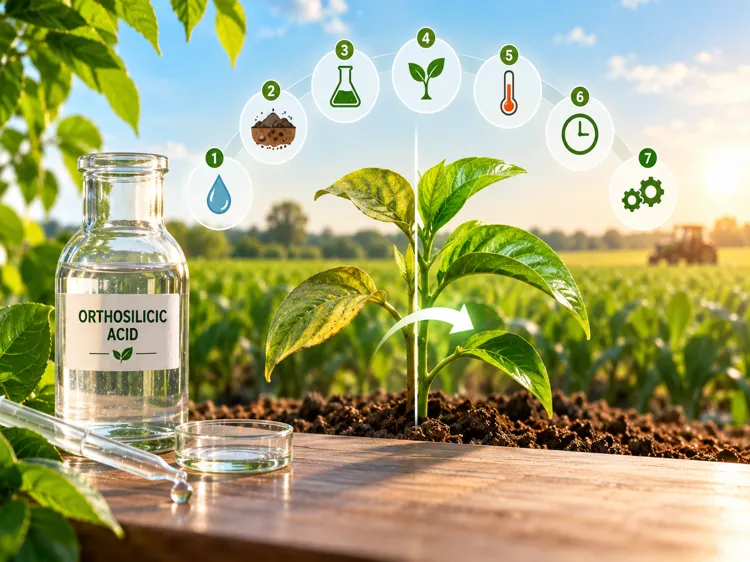
🌾 7 Reasons Orthosilicic Acid Isn’t Showing Results:
Your paddy field has looked stressed for weeks. Someone at the shop suggests an orthosilicic acid spray, so you buy it, follow the dosage on the label, and spray it on schedule.
But a month later, the crop looks exactly the same.
At this point, most farmers assume the product itself has failed. And that’s wrong- it almost never has.
When an OSA (Orthosilicic Acid) spray isn’t showing results, the real problem usually lies somewhere in how the spray was used, not in the bottle.
Quick answer: If your OSA spray isn’t showing results, check these seven things: timing of your check, product stability, spray coverage, wetting agent use, growth stage, weather timing, and spray interval. Each one is explained below.
🔍 Why Is Orthosilicic Acid Not Working?
Before blaming the product, understand what actually determines whether an OSA spray delivers results.
Why is OSA not effective? It usually comes down to three major factors: timing, technique, and consistency, not the product sitting in the tank.
Here are the seven reasons farmers run into most often.
⏱️ 1. You’re Checking Results Too Early
Silicon doesn’t work like nitrogen. It won’t give you a growth spurt in a few days.
It builds slowly into the plant’s structure, which is a common reason behind OSA no visible results complaints when farmers check too soon after spraying.
Real results take time, and the speed depends on the crop. In one tomato trial, weekly sprays over 10 weeks showed benefits building up slowly.
Leaves generally feel firmer and look a shade greener within two to three weeks. Bigger changes—drought tolerance, fewer disease problems, and fuller grain—show up closer to four to six weeks.
So, give the spray the full window before deciding it hasn’t worked.
🧪 2. The Formulation May Not Have Been Stable to Begin With
Here’s something most farmers don’t know: the OSA on the label may not be the same OSA actually in the bottle by the time it’s used.
Yes, the usable form of silicon doesn’t stay stable on its own. Over time, it turns back into a form the plant can’t use, and research on silicic acid chemistry shows this happens faster with heat and time on the shelf.
A poorly made product sitting in a warm store can lose real orthosilicic acid effectiveness before a farmer opens the bottle.
A properly made one should publish its own tested numbers—orthosilicic acid percentage, plant-available silicon percentage, and pH—on its technical data sheet, so you can check them against whatever’s in your own tank rather than relying on the label alone.
💧 3. Poor Leaf Coverage Can Reduce Silicon Uptake
In most crops, more of the leaf’s breathing pores, called stomata, sit on the underside rather than the top, a pattern supported by research on stomatal distribution.
That’s usually where most of the silicon gets absorbed. It isn’t true for every crop—some cereals and grasses differ—but it holds for most.
Moving fast through a field with a knapsack or power sprayer, it’s natural to just spray straight down onto the top of the leaf. That’s a common orthosilicic acid application mistake, and it can waste a real share of every tank without anyone noticing.
Left uncorrected, it’s one of the more overlooked plant silicon uptake issues growers run into.
The fix doesn’t take much: aim the nozzle up toward the underside of the leaves, not just down from above.
🧴 4. Skipping a Wetting Agent Can Cut Absorption
Think of rain falling on a freshly waxed car. That’s close to what happens on many crop leaves, thanks to their natural waxy coating.
The droplet just sits there, rounds up, and rolls off before the plant gets a real chance to absorb it.
A wetting agent stops this, usually a non-ionic surfactant that reduces surface tension so the droplet spreads instead of beading up. Research on wheat found a surfactant clearly improved how much spray got absorbed.
Skip it and nothing looks wrong at first—the leaf looks wet—but a share of the silicon may never get in.
A good number of foliar silicon spray problems can trace back to exactly this, though not all of them.
🌱 5. Application Happened at the Wrong Growth Stage
Older, hardened leaves don’t let much through. Spraying a mature crop and expecting the same result as a young one is where a lot of disappointment starts.
Research on leaf development shows new leaves are thinner and still developing, so they absorb sprays better than older, hardened ones.
Start early, while the plant is young or new leaves are forming, rather than waiting until the crop looks stressed.
Spraying late isn’t wasted—it just won’t close the gap that early spraying does.
☀️ 6. Spraying Happened Under the Wrong Conditions
Weather and timing matter more than most spray schedules account for.
Midday heat dries the solution out before the plant can absorb it.
Wind causes uneven coverage and drift. Rain within a few hours can wash the whole spray away before it does any good.
University extension guidance points to early morning or evening as the safest window, the same reason many farmers avoid spraying once the hot afternoon heat starts up in peak summer.
The leaf stays cooler and the spray stays wet longer.
🔄 7. The Interval Between Sprays Was Off
One spray, even a perfect one, isn’t a full program. Silicon builds up with repeated spraying.
A review of foliar silicon studies across multiple crops found a common pattern of three to four sprays spaced 10 to 20 days apart, though the exact interval depends heavily on the crop and on the specific product’s own label instructions.
Sugarcane and fruit trees often run on a longer cycle than short-duration vegetables.
Too big a gap and the benefit drops off. Too often, and it won’t speed up results—it will just use more product than needed.
✅ What to Check Before Switching Products
Before deciding the product itself is the problem, go through this list:
- Does the label’s OSA percentage, plant-available silicon, and pH match what’s actually in the product?
- Are you spraying both sides of the leaf, at the right growth stage, with a wetting agent?
- Is your interval right for your crop and product label, generally somewhere in the 10 to 20 day range, sprayed morning or evening, with no rain expected for a few hours?
- Is your water clean? Hard or dirty water stops even spreading.
- Was the product stored away from direct heat and sunlight before use?
- Are you using a fine, even spray, not large droplets that just roll off or a fine mist that drifts away in the wind?
If you’re planning to tank-mix OSA with another pesticide or fertilizer, a simple jar test catches most physical problems before they reach the full tank. University of Florida extension guidance recommends filling a jar with the same water you’ll use in the tank, adding each product in the same ratio and order you’d use in the field, then letting it sit for 15 to 30 minutes.
Layering, clumping, or heavy foaming means the mix likely isn’t compatible and shouldn’t go in the tank as is.
A lot of silicon fertilizer troubleshooting gets resolved right here, well before switching products becomes necessary.
Changing brands without checking these first often just means facing the same problem again, with a new label on the bottle.
❓ FAQs About Orthosilicic Acid Spray
Q1. What’s the right dose for orthosilicic acid foliar spray?
Most OSA products are used somewhere around 1 to 2 ml per litre of water, but always check your specific product’s own label, since strength and recommended rate vary between formulations.
Q2. How often should OSA be sprayed?
Research across several crops points to roughly three to four sprays, spaced 10 to 20 days apart, as a common pattern, but the right interval depends on the crop and on your specific product’s own label.
Sugarcane and fruit trees often need a longer gap than short-duration vegetables. A single spray rarely shows a real result on its own.
Q3. Can OSA be mixed with other fertilizers or pesticides?
Usually, yes, but do a quick jar test before mixing a full tank. It takes a few minutes and catches most compatibility problems early.
Q4. Why is silicon fertilizer not working for me?
Most often, it comes down to timing—checked too early or sprayed at the wrong growth stage—followed by poor coverage or an unstable product. Work through these before assuming the product has failed.
🌾 The Real Fix Usually Isn’t a New Product
If orthosilicic acid isn’t showing results, it’s almost never a dead end.
It’s a sign to check one thing at a time: timing, technique, formulation, and consistency, in that order.
Most problems get solved once the cause is found.
For farmers using Fenosil, the technical data sheet and dosage guide has the numbers referenced in this article.
If unsure about your spray program, it’s worth getting a second opinion before assuming the product itself is at fault.
Written by Lara Wilson– Guest Author (www.fentonchemical.com)