

Summer Vegetable Care and Management Guide
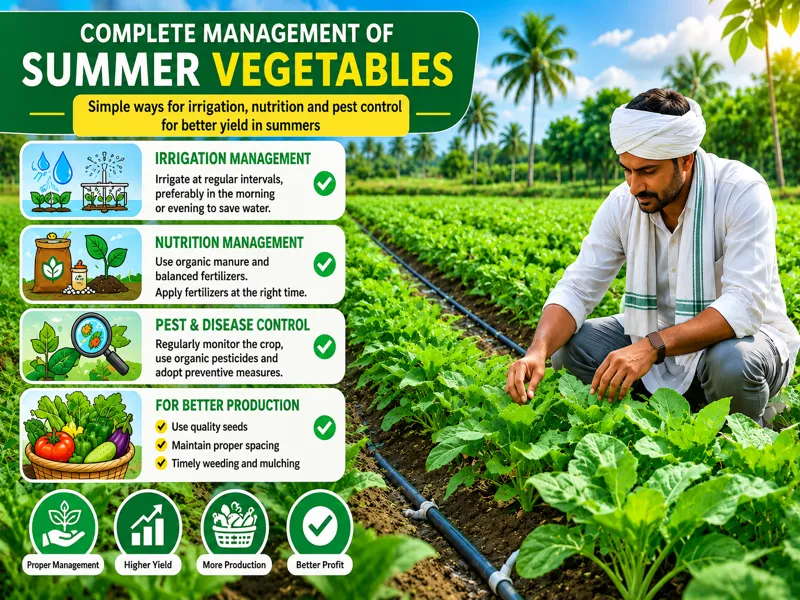
🌞 Summer Vegetable Management | Irrigation, Fertilizer and Disease Control
Summer season is considered very challenging for vegetable farmers. Increasing temperature, low moisture in soil, strong sunlight and effect of insects and diseases directly affect crop production. At such time, if farmers do proper management and care of summer vegetables, then better production with good quality can be achieved.
Nowadays, due to climate change, temperature is continuously increasing. Its effect is especially seen on the growth, fruiting and quality of vegetables. In many vegetables, fruit setting decreases because of high temperature and disease attack increases.
1. 🌡️ Effect of Increasing Temperature on Vegetables in Summer
In summer season, temperature increases very fast. Its effect is seen on the growth and fruiting of vegetables. In many vegetables, night temperature is also very important.
According to experts:
- In tomato, if night temperature becomes more than 22 to 24 degree, fruit setting may stop.
- In high temperature, red color of tomato gets affected.
- If temperature goes above 40 degree, lycopene gets affected and fruits start looking yellow or spotted.
- In summer, insect and disease attack increases very fast.
- In dry weather, problems like mites are seen more.
- In summer, soil moisture decreases quickly, due to which plant growth gets affected.
2. 🥒 Vegetables Grown in Summer Season
In summer season, some vegetables can be grown very well. Especially vine vegetables have more demand in this season because they contain 90 to 95 percent water.
🌿 Main Vine Vegetables
- Bottle Gourd
- Cucumber
- Kakdi
- Ridge Gourd
- Bitter Gourd
- Muskmelon
- Watermelon
- Pumpkin
🌱 Other Vegetables
- Okra
- Cowpea
- Chaulai
These vegetables have high demand in the market and farmers can get good profit.
3. 💧 Proper Irrigation Management
In proper management and care of summer vegetables, irrigation is considered the most important part.
⏰ When to Do Irrigation
According to experts:
- Do irrigation early morning
- Or do irrigation in evening time
- Avoid irrigation in afternoon
If water inside the pipe becomes very hot, then irrigation should not be done immediately. First, let the water cool down.
🚿 Light and Frequent Irrigation
In summer, crops need light irrigation.
Keep in Mind:
- Do not allow water to stay in the field for a long time
- Do irrigation according to requirement
- Irrigation may be needed every third or fourth day
Giving too much water affects root respiration of plants and plants start drying.
4. 🌾 Farming by Ridge and Furrow Method
In summer vegetables, farming by making ridges and furrows is considered beneficial.
🌱 Its Benefits
- Irrigation with less water
- Proper moisture reaches roots
- Water saving
- Less rotting of fruits
- Good plant growth
In vine vegetables, farmers make furrows so that fruits do not get spoiled after coming in contact with water.
5. 🌾 Mulching and Moisture Conservation
To maintain soil moisture in summer, mulching is very useful.
🌿 Benefits of Mulching
- Soil moisture remains maintained
- Helps in weed control
- Fruits do not come in contact with soil
- Fruit quality remains good
🟢 What Farmers Can Use
- Dry grass
- Broad leaves
- Weed mat
- Black plastic sheet
Mulching reduces evaporation from soil.
6. 🏡 Use of Shade Net and Polyhouse
To protect crops from extreme heat, shade net and polyhouse are considered useful options.
🌤️ Benefits of Shade Net
- Protection from strong sunlight
- Better quality crop
- Higher production
🏠 Benefits of Polyhouse
- Controlled environment
- Good quality
- Higher yield
- Better protection from heat
Some farmers use poly tunnel technology to get early production and receive higher prices in the market.
7. 🌱 Seed Treatment and Nursery Management
It is considered important to do seed treatment before sowing seeds.
🧪 How to Do Seed Treatment
According to experts:
- Trichoderma can be used
- Use of 4 gram Trichoderma per kilogram seed is suggested
✅ Benefits
- Good germination
- Healthy plants
- Protection from diseases
🌞 Soil Solarization Method
Soil solarization is considered a useful method for making nursery safe.
Its Process:
- Dig the soil
- Do irrigation
- Cover with white polythene
- Keep it covered for 15 days to 1 month
Its Benefits:
- Fungus and bacteria get reduced
- Weeds get destroyed
- Safe nursery gets prepared
8. 🐛 Insect and Disease Control
In summer season, risk of insects and diseases remains high.
⚠️ Main Problems
- Mites
- Thrips
- Downy Mildew
🛡️ Prevention Measures
- Spray neem oil
- Install yellow and blue sticky traps
- Use medicine when required
After rainfall, if yellow and brown spots are seen in vine vegetables, then immediate attention should be given.
9. 🚜 Drip Irrigation and Fertigation
According to experts, drip irrigation saves a lot of water.
💧 Benefits of Drip Irrigation
- Saving of 40 to 60 percent water
- Moisture according to plant requirement
- Increase in production
🌿 Benefits of Fertigation
In fertigation, fertilizer is given along with water.
Benefits from This:
- Saving of fertilizer
- Direct nutrition to plant roots
- Water saving
- Better production
According to experts, fertilizer saving through this method can be 40 to 50 percent.
10. 🌿 Natural and Integrated Nutrient Management
Experts have advised adopting integrated nutrient management.
🌱 Ways to Increase Soil Fertility
- Growing Dhaincha
- Growing Sunn Hemp
- Mixing moong crop residue in soil
- Using organic fertilizers
Due to This:
- Soil fertility increases
- Organic carbon increases
- Dependence on chemical fertilizers decreases
11. ♻️ Crop Residue Management
Proper management of crop residues is considered necessary.
⚠️ Important Things to Keep in Mind
- Separate virus affected plants
- Do not leave infected plants in the field
- Use them in compost
- Properly manage strong stems
If residues are not managed properly, then termite and other problems may increase.
12. 👨🌾 Important Suggestions for Farmer Brothers
✅ Important Points
- Avoid planting new crop in extreme heat
- Plant vine vegetables after first rainfall
- Adopt drip irrigation
- Definitely do mulching
- Do disease control on time
- Do irrigation according to requirement
- Maintain moisture in the field
- Use shade net
13. ❌ Common Mistakes
Many farmers unknowingly make some mistakes due to which losses increase.
🚫 Avoid These Mistakes
- Doing irrigation in afternoon
- Giving more water than required
- Sowing untreated seeds
- Planting new crop in extreme heat
- Allowing water to remain collected in the field
- Leaving diseased plants in the field
14. ❓ FAQs
1️⃣ Which vegetables can be grown in summer?
In summer, vegetables like bottle gourd, cucumber, kakdi, ridge gourd, bitter gourd, watermelon, muskmelon, okra and cowpea can be grown.
2️⃣ When should irrigation be done in summer?
Doing light irrigation early morning or in evening time is considered better.
3️⃣ Why is mulching important?
Mulching helps in maintaining soil moisture and controlling weeds.
4️⃣ Why is seed treatment important?
Seed treatment improves seed germination and keeps plants protected from diseases.
5️⃣ What are the benefits of drip irrigation?
Drip irrigation saves water and provides moisture to plants according to their requirement.
✅ Conclusion
By adopting proper management and care of summer vegetables, farmers can get better production even in summer season. By using techniques like proper irrigation, mulching, drip irrigation, shade net, seed treatment and disease control, crops can be kept safe.
If farmers do proper management according to time, then good quality vegetable production is possible even with less water and better profit can be achieved in the market.
👉 For detailed information on vegetable farming: click here