


Pomegranate Farming
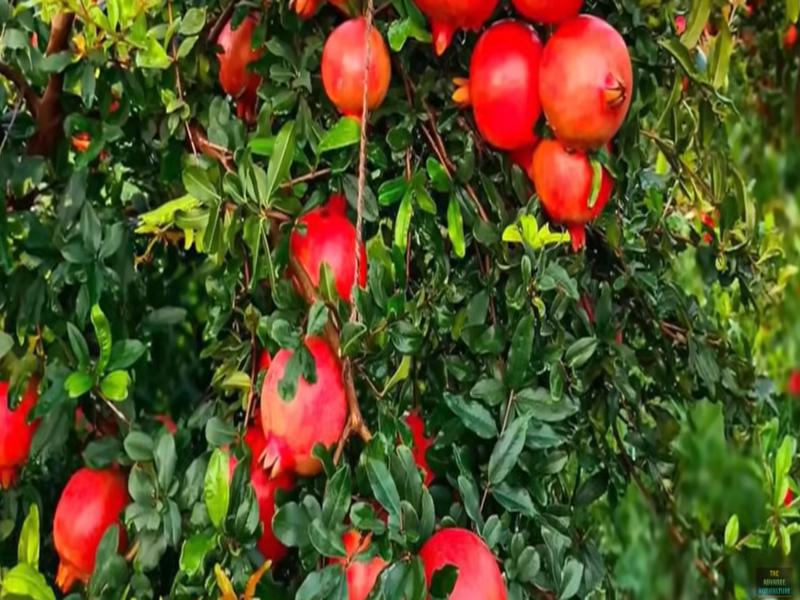
🌿 Complete Guide to Pomegranate Farming in India: Varieties, Cultivation, and Profits
Pomegranate farming in India is no longer limited to Maharashtra. With modern techniques and proper management, farmers from Rajasthan, Uttar Pradesh, Andhra Pradesh, Haryana, Punjab, Karnataka, and Gujarat are also earning good profits from pomegranate cultivation.
Pomegranate fruit is sweet, nutritious, and full of medicinal properties.
As per statistics (2012–13), India has about 113.2 thousand hectares under pomegranate cultivation, producing 745 thousand metric tons of fruit with an average productivity of 6.6 metric tons per hectare.
🌤️ Climate for Pomegranate Farming
Pomegranate is a subtropical fruit and thrives best in semi-arid climates.
- Warm and dry climate is essential during fruit development and ripening.
- Long periods of high temperature increase fruit sweetness.
- Humid conditions affect fruit quality and increase fungal diseases.
- Cultivation can be done up to 500 meters above sea level.
🌱 Soil Requirement
Pomegranate can grow in various types of soils, but the best results are obtained in:
- Sandy loam soil with good drainage.
- Fruits grown in light soil have better color and quality than those in heavy soils.
- Pomegranate can tolerate soil salinity up to 9.00 E.C./ml and alkalinity up to 6.78 ESP.
🍎 Popular Varieties of Pomegranate
India produces several high-yielding and commercial varieties of pomegranate:
1. Ganesh
- Developed in 1936 at Pune by Dr. G.S. Cheema.
- Medium-sized fruits with soft, pink seeds.
- Popular variety in Maharashtra.
2. Jyoti
- Developed by crossing Basin × Dholka varieties.
- Fruits are large, smooth, and reddish-yellow.
- Yield: 8–10 kg per plant.
- Taste: Very sweet and soft seeds.
3. Mridula
- Developed at Mahatma Phule Agricultural University, Rahuri.
- Fruits: Medium-sized, deep red with soft seeds.
- Average weight: 250–300 grams.
4. Bhagwa
- Most popular and export-quality variety.
- Large, glossy saffron-colored fruits.
- Yield: Around 30 kg per plant under good management.
5. Arakta
- High-yielding variety developed at Rahuri.
- Fruits: Large, sweet, soft-seeded, and red-colored skin.
- Yield: 25–30 kg per plant.
🌿 Propagation Methods
🌱 1. By Cuttings
- Use one-year-old branches (20–30 cm long).
- Treat with IBA 3000 ppm before planting in a nursery for quick root development.
🌾 2. By Air Layering (Gootee Method)
- Conduct during July–August using healthy branches.
- Remove bark in a 3 cm ring and apply IBA 10,000 ppm paste.
- Wrap with moist sphagnum moss and cover with polythene.
- Once roots appear, cut the branch and plant it in the field or pot.
🌳 Planting Method
- Recommended spacing: 4–5 meters between plants.
- Dig pits of 60×60×60 cm size one month before planting.
- Fill each pit with:
- 20 kg of farmyard manure (FYM)
- 1 kg of single super phosphate
- 50 g chlorpyrifos powder
- Irrigate immediately after planting.
🧪 Fertilizer Management
Apply fertilizers according to plant age and soil testing results.
| Plant Age | FYM (kg) | Urea (g) | Super Phosphate (g) | MOP (g) |
|---|---|---|---|---|
| 1 year | 10 | 200 | 150 | 100 |
| 2 years | 20 | 400 | 300 | 200 |
| 3 years | 30 | 600 | 450 | 300 |
| 4 years | 40 | 800 | 600 | 400 |
| 5 years+ | 50 | 1000 | 750 | 500 |
💧 Apply the full dose of phosphorus during the first irrigation.
💧 Split nitrogen and potash into three equal doses.
💧 Add micronutrients such as zinc, iron, manganese, and boron based on leaf and soil analysis.
💧 Irrigation Management
Pomegranate plants are drought-tolerant, but for higher yields, regular irrigation is essential.
- For Mriga Bahar crop, start irrigation from May until the onset of monsoon.
- Post-monsoon, irrigate every 10–12 days for better fruit growth.
- Drip irrigation is the best method:
- Saves up to 43% water
- Increases yield by 30–35%
✂️ Training and Pruning
Proper training and pruning are vital for good yield.
1️⃣ Multi-stem Method
- Keep 3–4 main stems and remove others.
- Ensures better sunlight and air circulation.
2️⃣ Single-stem Method
- Keep only one stem; not recommended for commercial farming.
After pruning:
- Apply 1% Bordeaux paste on cut ends.
- Burn infected branches to prevent disease spread.
🌸 Flowering Season Management (Bahar Control)
Pomegranate flowers three times a year:
- Mriga Bahar – June–July
- Hasta Bahar – September–October
- Ambe Bahar – January–February
👉 Commercial farmers usually take only one crop per year based on water availability and market demand.
👉 Stop irrigation two months before flowering to synchronize bloom.
🍈 Harvesting and Yield
- Fruits mature 120–130 days after fruit set.
- Ripe fruits turn reddish with a yellow tinge.
- Commercial yield starts after 4–5 years of planting.
- Each tree produces 60–80 fruits annually and continues for 25–30 years.
📦 Storage and Grading
Fruits are graded based on size, color, and appearance:
| Grade | Weight | Description |
|---|---|---|
| Super Size | 750+ g | Bright red, spotless fruits |
| King Size | 500–750 g | Attractive red color |
| Queen Size | 400–500 g | Glossy, spotless red fruits |
| Prince Size | 300–400 g | Fully ripened red fruits |
At 5°C temperature, pomegranates can be stored for up to 2 months.
🐛 Pest and Disease Management
🦋 1. Pomegranate Fruit Borer (Deudorix isocrates)
- Lays eggs on flowers and young fruits; larvae feed inside fruits.
Control: - Destroy infected fruits.
- Spray Spinosad 0.5 g/L or Indoxacarb 1 ml/L during flowering.
🪲 2. Stem Borer (Xyloborus spp.)
- Makes holes in branches, causing wilting.
Control: - Remove and destroy affected branches.
- Drench soil with Chlorpyrifos 2.5 ml/L solution.
🧫 3. Aphids, Mites & Mealybugs
- Suck sap from leaves and fruits.
Control: - Spray Dimethoate 2 ml/L or Imidacloprid 0.3 ml/L as needed.
🍂 Major Diseases and Management
| Disease | Cause | Control |
|---|---|---|
| Fruit Spot | Cercospora fungus | Spray Mancozeb 2.5 g/L every 15 days |
| Fruit Rot | Aspergillus foetidus | Spray Carbendazim 1 g/L |
| Bacterial Blight | Xanthomonas axonopodis | Bordeaux mixture (1%) or Streptocycline + Copper oxychloride spray |
| Wilt Disease | Fusarium or Ceratocystis | Remove affected plants, drench soil with Tridemorph 1 ml/L |
🍉 Fruit Cracking Problem
A common issue in dry regions.
Causes:
- Boron deficiency
- Uneven soil moisture
Prevention:
- Maintain consistent irrigation.
- Spray GA3 (15 ppm) and Boron 0.2% during fruit development.
💰 Profit from Pomegranate Farming
In one hectare, around 400–500 plants can be grown.
Each plant yields about 25 kg, giving a total of 10–12 tons per hectare.
💵 Average Market Price: ₹100–₹150 per kg
👉 Total Income: ₹10–15 lakhs per year (approx.) under good management.
❓ FAQs (Frequently Asked Questions)
1. Which state produces the most pomegranates in India?
➡️ Maharashtra, especially Solapur district.
2. Which pomegranate variety is best?
➡️ Bhagwa variety is most preferred for export and high yield.
3. When does a pomegranate plant start bearing fruit?
➡️ After 2–3 years of planting.
4. What type of soil is best for pomegranate?
➡️ Well-drained sandy loam soil.
5. Why do pomegranate fruits crack?
➡️ Due to uneven watering and boron deficiency.
6. How many kilos of fruit per tree?
➡️ 25–30 kg per tree annually.
7. What are the common diseases in pomegranate?
➡️ Fruit spot, fruit rot, bacterial blight, and wilt.
8. Which irrigation method is best?
➡️ Drip irrigation saves water and increases yield.
9. What is the market price of pomegranate?
➡️ ₹100–₹150 per kg depending on quality.
10. Can small farmers grow pomegranates profitably?
➡️ Yes, with proper irrigation and pest control, small farmers can earn good profits.
🌾 Conclusion
Pomegranate farming is a profitable and long-term investment for Indian farmers.
It has huge domestic and export demand, making it a golden fruit crop.
With the right knowledge of climate, irrigation, fertilizers, and pest management, farmers can achieve excellent yields and secure income for years.
💬 Motivational Message:
“Every seed sown with care can turn into gold. Keep learning, stay patient, and success in farming will surely follow.” 🌿
👉 Explore detailed guides on other fruits farming – click here to read more.