


Snake Cucumber Farming
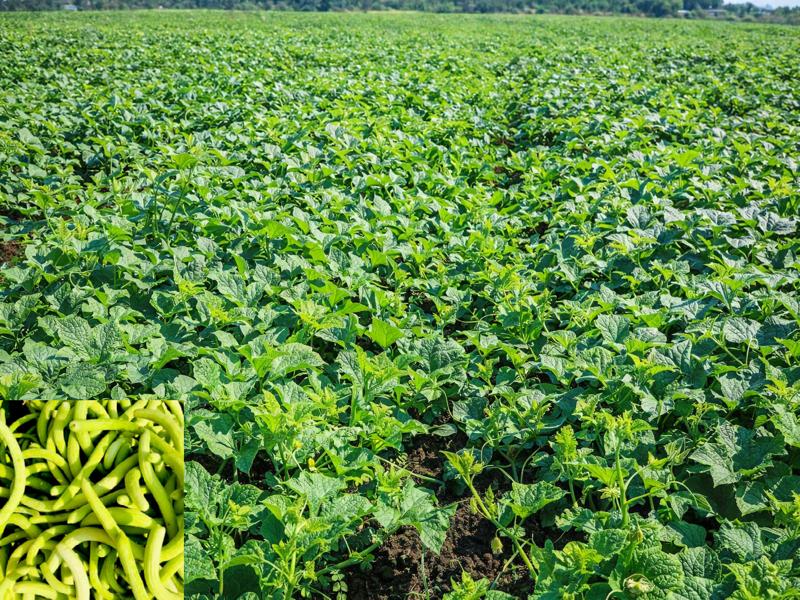
🌱 Snake Cucumber Farming Guide for High Yield Profit
Kakdi farming in India is an important summer vegetable crop which gives low cost and high profit. It is mainly sown in the Rabi and February–March season and becomes ready in about 60 to 70 days.
Nowadays, Desi Kakdi farming, Hybrid Kakdi farming, Tar Kakdi farming and Ret Kakdi farming have become a good source of income for farmers. Many farmers want to know when Kakdi is sown, when to start Kakdi farming, and how to do Kakdi farming properly.
In this article, we will give complete scientific and practical information on per acre basis, so that rural farmer brothers can easily understand and take good production.
Now let us understand the complete information step by step.
🌿 1️⃣ Crop Introduction
Kakdi is an important vegetable crop of the Cucurbitaceae family. Its botanical name is Cucumis melo. India is considered its origin place, so Desi Kakdi farming has been done here since ancient times.
It is light green in color. Its outer skin is soft and the inner flesh is white, juicy and cooling in nature. In summer, it helps to keep the body cool, so there is very high demand in the market.
📌 Main Features of Kakdi Farming
- Short duration crop
- Good income with low investment
- Heat tolerant crop
- Mostly used as salad
- Continuous demand in local markets
Cucumber and Kakdi farming is done with almost the same technique, so farmers can grow both crops together.
📌 When is Kakdi Farming Done?
- February to March is the main sowing time
- In some areas, sowing starts from end of January
- Frost-free and light warm climate is suitable
When to start Kakdi farming depends on your area temperature. When temperature becomes stable above 20°C, that is the best time for sowing.
💚 2️⃣ Health Benefits and Uses
Kakdi is not only a vegetable but also very beneficial for health. That is why its demand increases fast in summer season.
🥗 Health Benefits
- Keeps body cool
- Removes water deficiency
- Improves digestion
- Reduces stomach burning
- Improves skin glow
- Helps in weight control
🍽️ Uses
- Salad
- Raita
- Juice
- Pickle
- Seed production
Tar Kakdi farming is specially done in hot areas because it helps in keeping the body cool.
🔬 3️⃣ Scientific Classification
To understand Kakdi farming properly, it is important to know its scientific base.
📖 Classification
- Family: Cucurbitaceae
- Botanical Name: Cucumis melo
- Class: Dicotyledon
- Nature: Vine crop
In Hybrid Kakdi farming, advanced scientific techniques are used, which give higher production and better quality.
Foot Kakdi farming and Desi Kakdi farming are done with traditional varieties, while modern farmers are using hybrid seeds for better yield.
🌡️ 4️⃣ Climate and Temperature Requirement
Kakdi is a warm climate crop and grows well in medium to high temperature.
☀️ Ideal Temperature
- For germination: 20°C to 25°C
- For growth: 25°C to 35°C
- Can tolerate up to 40°C if irrigation is proper
🌦️ Climate Conditions
- Does not tolerate frost
- Light humidity is suitable
- Protection from strong winds is necessary
Ret Kakdi farming is often successful in sandy soil near river areas where temperature is high but drainage is good.
The first rule of cucumber and Kakdi farming is that temperature should be suitable and water should not stay in the field.
🌾 5️⃣ Soil Requirement
Kakdi farming can be done in almost all types of soils, but for good production, proper soil selection is very important.
🏞️ Suitable Soil Types
- Sandy loam soil
- Light loamy soil
- Heavy soil with good drainage
- River side land
Ret Kakdi farming is especially successful in light sandy soil because water drainage is good.
⚖️ pH Level
- Between 5.8 to 7.5
If soil is too acidic or alkaline, production may reduce. So soil testing before sowing is beneficial.
🌱 Important Soil Conditions
- No water stagnation
- Field should be levelled
- Enough organic matter
- Soil should be loose and soft
In Tar Kakdi farming, it is important that soil has enough moisture but water should not remain standing.
🌱 6️⃣ Seed & Varieties
In Kakdi farming, selecting the right seed is the key to higher production. Whether you do Desi Kakdi farming, Hybrid Kakdi farming, or Tar Kakdi farming, always use certified and pure seeds.
🌾 Major Improved Varieties
🥒 Punjab Longmelon 1
- Developed in 1995
- Early maturing variety
- Long and strong vine
- Fruits are light green, long and thin
- Average yield around 86 quintals per acre
🥒 Karnal Selection
- High yielding variety
- Fruits are light green and long
- Flesh is crunchy and tasty
- Good demand in market
🥒 Arka Sheetal
- Developed by agricultural scientists
- Medium size green fruits
- Ready in 90 to 100 days
- Excellent taste and quality
🌿 Desi Kakdi Farming
- Grown from local seeds
- Low cost
- Good demand in local markets
🌿 Hybrid Kakdi Farming
- Higher production capacity
- Better disease resistance
- Uniform fruit size and color
- Suitable for export and big markets
🌿 Foot Kakdi Farming
- Traditional variety
- Can grow in low water conditions
- Successful in dry land
🌿 Tar Kakdi Farming
- More juicy fruits
- Suitable for hot regions
The first step in learning how to do Kakdi farming is selecting the right variety.
🌾 7️⃣ Seed Rate
Using too much or too little seed in Kakdi farming can affect production.
📌 Seed Quantity per Acre
- 1 kilogram seed is sufficient per acre
If you are using hybrid seeds, seed rate may be slightly less because germination percentage is higher.
🧪 Seed Treatment
Seed treatment is necessary to protect seeds from soil-borne diseases.
- Bavistin or Benlate @ 2.5 grams per kilogram of seed
- Carbendazim @ 2 grams per kilogram of seed
This improves germination and keeps plants healthy.
🚜 8️⃣ Land Preparation
Proper land preparation is very important for Kakdi farming.
🏞️ Method of Land Preparation
- Do deep ploughing 2 to 3 times
- Make soil loose with harrow or rotavator
- Level the field
- Remove all weeds completely
🌱 Use of Organic Manure
- 8 to 10 tons well-decomposed cow dung manure per acre
- Mix it at the time of last ploughing
In well-prepared loose soil, plant roots spread quickly.
In Ret Kakdi farming, land should be more loose so that drainage remains proper.
🌾 9️⃣ Sowing Method
The correct answer to when Kakdi farming is done is February to March.
📅 Time of Kakdi Farming
- Main sowing: February–March
- In some areas: End of January
📏 Spacing
- 200 to 250 cm between rows
- 60 to 90 cm between plants on ridges
🌱 Seed Depth
- 2.5 to 4 cm deep
🌿 Method of Sowing
- Direct sowing on beds or ridges
- Put 2 seeds at each place
- After germination, keep only healthy plant
The main base of cucumber and Kakdi farming is proper spacing and sowing at the correct time.
🌿 🔟 Fertilizer & Manure Management
For high production, balanced nutrition is very important.
📊 Fertilizer Quantity per Acre
- Nitrogen: 40 kg
- Phosphorus: 20 kg
- Potash: 20 kg
🧂 In Fertilizer Form
- Urea: Around 90 kg
- SSP: Around 125 kg
- MOP: Around 35 kg
📌 Method of Application
- Full phosphorus and potash at the time of sowing
- One-third nitrogen at sowing
- Remaining nitrogen after one month
🌱 Organic Options
- Vermicompost: 2 to 3 tons per acre
- Neem cake: 100 kg per acre
In Tar Kakdi farming, balanced fertilizer makes fruits more juicy and tasty.
💧 1️⃣1️⃣ Irrigation Schedule
Maintaining moisture balance is very important in Kakdi farming.
🚿 Irrigation Program
- First irrigation immediately after sowing
- Light irrigation at germination stage
- 4 to 5 irrigations in summer
- During rainy season, as per requirement
⚠️ Important Points
- Do not allow water to collect in the field
- No moisture stress at flowering stage
- Drip irrigation is best method
In Ret Kakdi farming, give light but regular irrigation.
🌾 1️⃣2️⃣ Weed Control
Weeds affect crop growth.
🌿 Control Measures
- Light hoeing before vines spread
- 2 to 3 weedings
- Remove weeds manually
🌱 Chemical Control
If weeds are more, take advice from agriculture expert before using chemicals.
Timely weed control can increase Kakdi production by 10 to 15 percent.
🐛 1️⃣3️⃣ Pest & Disease Management
For getting good production in Kakdi farming, pest and disease control is very important. If pests and diseases are identified on time and treated properly, production remains safe.
🐜 Major Pests and Their Control
🟢 Aphids and Thrips
Symptoms
- Suck sap from leaves
- Leaves turn yellow and curl
- Leaves bend upward like a cup
Control
- Spray Thiamethoxam 5 grams in 15 liters of water
- Repeat after 7 to 10 days if required
🟢 Beetle (Bhundi)
Symptoms
- Damages flowers, leaves and stem
- Plant becomes weak
Control
- Malathion 2 ml per liter of water
OR - Carbaryl 4 grams per liter of water and spray
🟢 Fruit Fly
This is the most serious pest in Kakdi farming.
Symptoms
- Eggs laid under the outer skin of fruit
- Pulp gets damaged from inside
- Fruit rots and falls
Control
- Spray 3% Neem oil solution
- Remove affected fruits immediately from the field
🦠 Major Diseases and Their Control
⚪ White Fungus
Symptoms
- White spots on leaves
- Leaves dry and fall
- Fruits may drop
Control
- Spray soluble sulfur 20 grams in 10 liters of water
- 2 to 3 sprays at 10 days interval
⚫ Anthracnose
Symptoms
- Leaves look burnt
Control
- Seed treatment with Carbendazim 2 grams per kg seed
- Spray Mancozeb 2 grams per liter of water
🟣 Downy Leaf Spots
Symptoms
- Purple colored spots on lower side of leaves
Control
- Spray Dithane M-45 or Dithane Z-78
🟤 Wilt Disease
Symptoms
- Plant suddenly wilts
Control
- Spray Captan 0.2 to 0.3 percent solution
🌿 Cucurbit Phyllody
Symptoms
- Plant growth stops
- Fruits do not develop
Control
- Apply Furadan 5 kg per acre at the time of sowing
- Spray Dimicron 0.05 percent
Timely disease control can increase production in Kakdi farming by up to 20 percent.
⏳ 1️⃣4️⃣ Crop Duration
Kakdi is an early maturing crop.
⏱ Duration
- Harvesting starts 60 to 70 days after sowing
- Some varieties are ready in 55 days
In Hybrid Kakdi farming, fruits come early and are uniform in size.
🧺 1️⃣5️⃣ Harvesting Method
📌 Right Time of Harvest
- Fruit should be fully developed
- Outer skin should be soft
- Fruits should look green and fresh
✂️ Method of Harvesting
- Harvest at 3 to 4 days interval
- Cut with sharp knife or scissors
- Do not let fruits fall on ground
Timely harvesting gives better price in the market.
📊 1️⃣6️⃣ Yield per Acre
Production depends on variety and crop care.
📈 Average Yield
- 80 to 100 quintals per acre
🌟 With Improved Technology
- Up to 110 to 120 quintals per acre
In Desi Kakdi farming, production is slightly less but cost is also low.
In Hybrid Kakdi farming, production and profit are higher.
💰 1️⃣7️⃣ Market Price & Profit per Acre
📌 Average Market Price
- 10 to 25 rupees per kilogram
- Higher price at the beginning of season
📊 Estimated Calculation
If production is 90 quintals (9000 kg) and average price is 15 rupees per kg:
9000 × 15 = 1,35,000 rupees total income
💸 Estimated Cost
- Seeds: 3,000 to 6,000 rupees
- Manure and fertilizers: 10,000 to 15,000 rupees
- Labour: 12,000 to 15,000 rupees
- Irrigation and other expenses: 8,000 to 12,000 rupees
Total cost around 45,000 to 50,000 rupees
💵 Net Profit
- Around 70,000 to 85,000 rupees per acre
If good price is received in early season, profit can reach up to 1 lakh rupees.
🏬 1️⃣8️⃣ Storage
Kakdi is a perishable crop, so proper storage is necessary.
❄️ Storage Conditions
- Cool and shaded place
- Temperature 10 to 12°C
- Humidity 85 to 90 percent
📦 Precautions
- Keep damaged fruits separate
- Use plastic crates
- Do not store for many days
With proper storage, freshness can remain for 4 to 5 days.
🏛️ 1️⃣9️⃣ Government Schemes
Government is running many schemes to promote Kakdi farming.
🌱 National Horticulture Mission
- Subsidy on seeds and planting material
- Subsidy on drip irrigation
- Training facilities
💧 Pradhan Mantri Krishi Sinchai Yojana
- Subsidy on micro irrigation
- Promotion of water conservation
💳 Kisan Credit Card
- Loan at low interest rate
- Easy finance for crop expenses
🌾 State Agriculture Department Schemes
- Distribution of improved seeds
- Crop insurance scheme
- Training and guidance
Farmer brothers can contact their nearest agriculture department office to take benefit of these schemes.
❓ Important FAQ Kakdi Farming
1️⃣ When is Kakdi Farming Done?
Kakdi farming is mainly done in the months of February to March. When the temperature becomes stable above 20°C and frost is over, that time is most suitable for sowing.
In some hot regions, sowing can also start from the end of January. If you want to know when to do Kakdi farming, always consider the weather and temperature of your area.
2️⃣ How to Do Kakdi Farming?
To understand how to do Kakdi farming, follow these steps:
- Select well-drained loamy soil
- Choose certified seeds
- Use 1 kilogram seed per acre
- Do sowing in February–March
- Follow balanced fertilizer management
- Do timely irrigation and weeding
- Take proper pest and disease control measures
By using the right technique, you can get 80 to 120 quintals per acre production.
3️⃣ Is Desi Kakdi Farming Profitable?
Yes, Desi Kakdi farming can be done at low cost. Local seeds are available at cheaper rates and there is good demand in local markets.
Although production may be slightly less than hybrid, the net profit remains good because the cost is low.
4️⃣ Why Should We Do Hybrid Kakdi Farming?
By doing Hybrid Kakdi farming:
- Higher production is obtained
- Fruits are uniform in size
- Good market price is received
- Better disease resistance
If you want to do farming at commercial level, hybrid varieties may be more profitable.
5️⃣ How to Do Tar Kakdi Farming?
For Tar Kakdi farming:
- Select light sandy or sandy loam soil
- Do regular but light irrigation
- Avoid water stagnation
- Use balanced fertilizers
This variety is more juicy and gives good yield in hot regions.
6️⃣ Where is Ret Kakdi Farming Successful?
Ret Kakdi farming is successful in sandy soil near river areas. In such soil, drainage is good and roots spread quickly.
If organic manure is mixed in soil, production becomes even better.
7️⃣ What is the Best Time for Kakdi Farming?
The best time for Kakdi farming is at the end of Rabi season and beginning of summer.
Main Sowing Months
- February
- March
Timely sowing helps in getting better price in early market season.
8️⃣ What is Foot Kakdi Farming?
Foot Kakdi farming is done with traditional varieties. This variety can grow even in low water conditions and is suitable for dry land.
It is popular in rural areas and has steady demand in local markets.
9️⃣ Where to Get Kakdi Farming PDF Guide?
If you want Kakdi farming PDF guide:
- Contact your nearest Krishi Vigyan Kendra
- Visit State Agriculture Department website
- Take guidance from Agriculture University
From these sources, you can get advanced and scientific information.
🔟 How Much Profit is There in Kakdi Farming per Acre?
On average:
- Production: 80 to 100 quintals
- Market price: 10 to 25 rupees per kg
- Total income: Around 1,20,000 to 1,80,000 rupees
After deducting cost, net profit can be 70,000 to 1,00,000 rupees per acre.
If you sell in early season, profit can be even higher.
🎯 Conclusion | Conclusion
Kakdi farming is a simple, low-cost and high-profit vegetable crop. If farmer brothers do sowing at the right time, follow balanced fertilizer management, do timely irrigation and pest control, they can get excellent production per acre.
Whether it is:
- Desi Kakdi farming
- Hybrid Kakdi farming
- Tar Kakdi farming
- Ret Kakdi farming
The main success mantra is:
- Right time
- Right seed
- Balanced nutrition
- Regular monitoring
Agriculture is not only hard work but also correct knowledge. If you follow scientific methods, you can earn stable and good profit from Kakdi farming.
You also start Kakdi farming this season and make your field a strong source of income. 🌱🚜💚
👉 For more detailed and practical information on vegetable farming, click here.
Reference Source:
- Indian Institute of Horticultural Research
- Krishi Vigyan Kendra Portal
- Soil Health Card Scheme