


Precision Farming
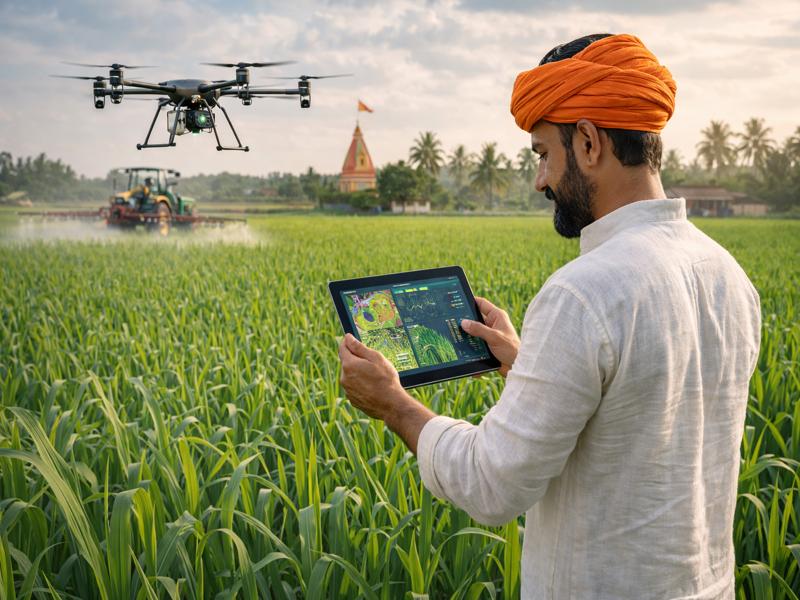
🌾 Precision Farming – Smart, Technology and Future of Farming
Today’s agriculture is not only based on hard work. It is a combination of science, technology, and proper management. Increasing population, decreasing water resources, costly fertilizers, climate change, and small land holdings – all these challenges are standing in front of Indian agriculture.
At such a time, Precision Farming is coming as a modern and effective solution.
The simple meaning of precision farming is – give the field and crop exactly what they need, in the right quantity and at the right time. Instead of applying the same fertilizer, water, or pesticide in the whole field, farmers understand the different needs of each part of the field and manage accordingly.
The main aim is – reduce cost, increase production, and avoid wastage of resources.
🌱 What is Precision Farming?
Precision farming is a farming method in which Information Technology (IT) and modern tools are used to analyze soil, water, nutrients, and crop condition. Based on this analysis, fertilizers, irrigation, and pesticides are applied properly.
It is not a single technology. It is a group of different technologies that work together for scientific farm management. It is also called Site-Specific Management (SSM).
⚙️ Soft and Hard Precision Farming
To understand precision farming better, it is divided into two main parts:
- Soft Precision Farming
- Hard Precision Farming
Both have the same goal – to provide the right amount of resources to crops – but their working style is different.
🌿 1️⃣ Soft Precision Farming
Soft precision farming is a method where farmers take decisions based on their experience, observation, and traditional knowledge. It does not require expensive equipment.
Farmers go to the field and check soil moisture, plant color, leaf structure, and disease symptoms. Based on this, they decide when and how much fertilizer or water to apply.
✅ Main Features
Experience-Based Decisions
Decisions are taken based on personal farming experience.
Low Cost
No need for costly machines or advanced tools.
Simple and Practical
Easy to use in day-to-day farming.
Suitable for Small Farmers
Very helpful for farmers with small land and low investment capacity.
📌 Examples
Understanding Nitrogen Need from Leaf Color
By seeing yellow leaves, farmers understand that nitrogen is required.
Extra Irrigation in Dry Areas
If some part of the field looks dry, extra water is given there.
Deciding Fertilizer by Plant Height
Short plant growth may indicate need for nutrients.
This method is useful for farmers who have less money for modern equipment but have strong farming experience.
🚜 2️⃣ Hard Precision Farming
Hard precision farming uses modern technology and scientific equipment. Decisions are taken based on data, sensors, and computer-based analysis.
In this method, exact measurement of field condition is done, and resources are used accordingly.
✅ Main Features
Technology-Based Decisions
Decisions are based on collected data and analysis.
Use of GPS, GIS, Sensors and Drones
Modern tools are used for accurate monitoring.
High Accuracy
Very precise in applying inputs like water and fertilizer.
Suitable for Large and Commercial Farmers
Best for big farms and commercial agriculture.
📌 Examples
Using GPS for Straight Tractor Movement
GPS helps tractor move in proper straight lines.
Irrigation Based on Soil Moisture Sensors
Sensors measure soil moisture and irrigation is done only when needed.
Variable Rate Technology
Different amounts of fertilizer are applied in different parts of the field.
Remote Sensing for Disease Detection
Crop diseases can be identified early through remote sensing technology.
Although the starting cost is high, in the long run it increases production and saves resources, giving more profit.
🔎 Difference Between Soft and Hard Precision Farming
| Point | Soft Precision Farming | Hard Precision Farming |
|---|---|---|
| Base | Experience and observation | Data and technology |
| Cost | Low | High |
| Equipment | Limited or none | Modern machines |
| Suitable For | Small farmers | Large/commercial farmers |
| Accuracy | Medium | Very high |
🛠️ Main Technologies of Precision Farming
📍 1️⃣ GPS (Satellite Positioning System)
GPS helps in getting the exact location and position of the field. With this, tractors and other machines move in the correct direction and overlapping is reduced. This saves time, fuel, and inputs.
🗺️ 2️⃣ GIS (Geographic Information System)
GIS technology analyzes data related to soil, water, and crops. It helps in understanding the relationship between different factors of the field. Based on this analysis, better decisions can be taken.
🌿 3️⃣ Optical Sensors
Optical sensors measure soil moisture, nutrients, and plant condition. With the help of these sensors, farmers can apply the correct amount of fertilizer and water.
🧪 4️⃣ Grid Soil Sampling
In this method, the field is divided into small sections and soil testing is done separately for each part. This helps in understanding the different needs of each area of the field.
🛰️ 5️⃣ Remote Sensing
With the help of satellites or drones, crop condition is monitored. It helps in identifying disease, water shortage, or nutrient deficiency at an early stage.
⚡ 6️⃣ Variable Rate Technology (VRT)
With this technology, fertilizers, seeds, and pesticides are applied in different quantities in different parts of the field according to need.
🔆 7️⃣ Laser Land Leveler
This technology is used to level the field properly. Due to proper leveling, water spreads equally and irrigation efficiency increases.
📊 8️⃣ Customized Leaf Color Chart (CLCC)
In paddy crops, nitrogen requirement is checked based on leaf color. It is a low-cost and useful technology for farmers.
💧 9️⃣ Micro Irrigation (Drip and Sprinkler)
In drip and sprinkler systems, water is supplied directly to the roots of plants. This helps in saving around 30–70% water.
🇮🇳 Status of Precision Farming in India
In India, precision farming is still in the early stage. At present, it is mainly used to improve:
- Nutrient Use Efficiency
- Water Use Efficiency
Around 9.2 million hectares area has adopted micro irrigation systems, including drip and sprinkler methods. States like Tamil Nadu, Karnataka, Maharashtra, Punjab, and Haryana are using it more actively.
The government is promoting it through Micro Irrigation Mission and other schemes. There are also 22 Precision Farming Development Centers working in the country.
🌾 Major Crops
Precision farming is mainly used in high-value crops such as:
- Fruits (grapes, mango, pomegranate)
- Vegetables
- Spices
- Flowers
- Medicinal and aromatic plants
Its use in cereal crops is limited, but technologies like CLCC are proving useful in paddy and wheat.
💰 Economic Impact
📈 1️⃣ Increase in Production
Tamil Nadu Precision Farming Project
Production increased from 30% to 200%.
Micro Irrigation
Yield increase of 10% to 60% has been observed.
N-Sensor in Wheat
About 3% increase in production.
Laser Land Leveling
Around 3–6% additional cultivable land became available.
💵 2️⃣ Increase in Income
Initial Cost
In the beginning, cost may increase by 30–100%.
Long-Term Profit
Due to higher production, overall net income becomes higher.
Low-Cost Technology
CLCC (around ₹110) is beneficial for farmers.
Still, due to low income and fear of risk, small farmers are slow in adopting these technologies.
👨👩👧 Social Impact
The impact of precision farming is not limited to production and income. It also affects society, family, and rural life. Although limited research is available, some important points have come forward.
🏥 1️⃣ Human Health
Till now, no clear and direct proof links precision farming directly to human health.
But indirectly:
- Balanced use of fertilizers and pesticides may reduce chemical residues.
- Proper use of nitrogen and chemicals may reduce water pollution.
- Reduced chemical use may lower health risks for farmers and laborers.
However, more long-term research is required to fully prove these benefits.
👩🌾 2️⃣ Gender Impact
Women’s participation in precision farming is an important social issue.
Some studies found that in parts of Haryana and Punjab, women are not able to directly contact machine service providers (like laser land leveler operators).
Social Barriers
- Women often contact through male relatives or children.
- Their direct access to new technology remains limited.
This shows that social traditions can become a barrier in adopting technology.
🌸 Positive Example – Women Empowerment
In the Nashik region of Maharashtra, use of drip irrigation among grape farmers has increased women’s participation.
Key Positive Points
- Women are involved in farm management and decision-making.
- Equal wage policy for equal work is adopted.
- Many women are connected with permanent and seasonal employment.
This shows that with proper policies and support, precision farming can become a tool for economic and social empowerment of women.
👥 3️⃣ Impact on Rural Society
Need for Training
Adoption of new technology increases the need for learning and training.
Skill Development
It promotes technical awareness and skill development in rural areas.
Youth Interest
Young generation starts seeing farming as a modern and attractive profession.
Risk of Inequality
High cost of technology may leave small and marginal farmers behind, which can increase social inequality.
🌍 Environmental Impact
🌱 1️⃣ Soil and Nutrients
Nitrogen Saving
It is possible to save around 10–20 kg per hectare of nitrogen.
Pesticide Saving
Up to 50–75% saving in pesticide use is possible.
Urea Saving through CLCC
By using Customized Leaf Color Chart (CLCC), 18–27% urea saving can be achieved.
Reduced Nitrate Leaching
Precision farming helps in reducing nitrate leaching into soil and water.
💧 2️⃣ Water
Drip Irrigation
Drip system can save 30–70% water.
Sprinkler Irrigation
Sprinkler system can save 35–60% water.
Laser Land Leveling
Better leveling improves water distribution in the field.
⚡ 3️⃣ Energy
Energy Saving
Around 15–20% energy saving is possible.
Electricity Saving
Laser land leveling can save about 755 kWh electricity per hectare in paddy-wheat system.
🌫️ 4️⃣ Greenhouse Gas Emission
Overall Reduction
Greenhouse gas (GHG) emissions can be reduced by 25–30%.
N₂O Emission Reduction
With CLCC, nitrous oxide (N₂O) emission can reduce by 13–21%.
🐝 5️⃣ Biodiversity
At present, sufficient research is not available on the impact of precision farming on biodiversity.
⚠️ Challenges
- High initial cost
- Small and scattered land holdings
- Lack of technical knowledge
- Hesitation in taking risk
- Lack of long-term research
🚀 Future Possibilities
In a country like India, where most farmers are small and marginal, there is a need for low-cost precision technologies.
If government, agricultural universities, Farmer Producer Organizations (FPOs), and private companies work together, precision farming can be adopted on a large scale.
Under Digital India and smart farming movement, this is an important step. In future, drones, Artificial Intelligence (AI), and mobile-based apps will take this sector forward.
🌾 Major Government Schemes
🌐 1️⃣ Digital Agriculture Mission
This mission aims to make agriculture smarter through digital technologies. The main objective is to provide farmers with data-based decisions, digital services, and modern tools so that correct inputs can be given to every part of the field.
Precision farming is also included in this mission.
🤖 2️⃣ Namo Drone Didi Scheme
Under this central scheme, 15,000 drones are being provided to women Self-Help Groups (SHGs).
Objectives
- Increase use of advanced technology
- Increase agricultural production
- Increase income of farmers and SHGs
Drones can be used as service providers for crop monitoring, disease detection, and precise spraying.
🚜 3️⃣ Sub-Mission on Agricultural Mechanization (SMAM)
This scheme is part of Rashtriya Krishi Vikas Yojana (RKVY). Under this scheme, government provides financial support for new machinery like:
Supported Equipment
- Drones
- Automatic irrigation systems
- Precision farming tools and sensors
- Custom hiring centers for machines
This helps small farmers to use costly technologies.
💧 4️⃣ Pradhan Mantri Krishi Sinchayee Yojana (PMKSY)
This scheme promotes water use efficiency and precise irrigation.
Key Components
- Micro-irrigation (drip and sprinkler)
- Precision water management technologies
- Data-based irrigation advice
It helps in better control of water use in precision farming.
🛠️ 5️⃣ Agriculture Infrastructure Fund (AIF)
This is a large fund that provides financial support for technology investment in agriculture.
Key Benefits
- Loans to groups, FPOs, and SHGs
- Subsidy for technology-based solutions
- Support for drones, sensing equipment, blockchain, AI and IoT technologies
Farmers can purchase precision farming tools at lower interest rates.
📈 6️⃣ Smart Precision Horticulture Program
Under this program, from 2024–25 to 2028–29, smart precision horticulture will be implemented on 15,000 acres of land. Around 60,000 farmers are expected to benefit.
This program is specially designed for horticulture crops.
🧠 7️⃣ ICAR-NePPA (ICAR Network Program on Precision Agriculture)
The Indian Council of Agricultural Research (ICAR) has started a network program at 16 locations to develop and spread precision agriculture technologies.
Objectives
- Develop data-based agriculture solutions
- Train farmers
- Reduce input requirement
- Increase agricultural production
💡 Additional Initiatives
🛰️ AI, Drones and Data in Agriculture
The Department of Agriculture & Farmers Welfare (DA&FW) is working on adopting AI, drones, climate-smart agriculture, smart sensors, and other technologies.
The aim is to provide fast and accurate agricultural advice to farmers.
📌 Main Benefits of These Schemes
- Precision farming technology reaches farmers
- Saving in cost and inputs
- Increase in production
- Saving of water and energy
- Support for data-based decision making
- Science-based farming through drones and machinery
🏁 Conclusion
Precision farming is not just a technology, but a change in thinking. It focuses not only on “more production” but also on “right production.”
It can increase farmers’ income, reduce cost, and protect the environment.
Although it is still in the early stage in India, technologies like micro-irrigation, laser land leveling, and leaf color chart are showing positive results. With proper policy, training, and awareness, it can bring a new revolution in agriculture.
Precision farming is the path towards sustainable, profitable, and environment-friendly farming of the future.
👉 For more detailed and practical information on technical farming, click here.