


Organic Farming in India
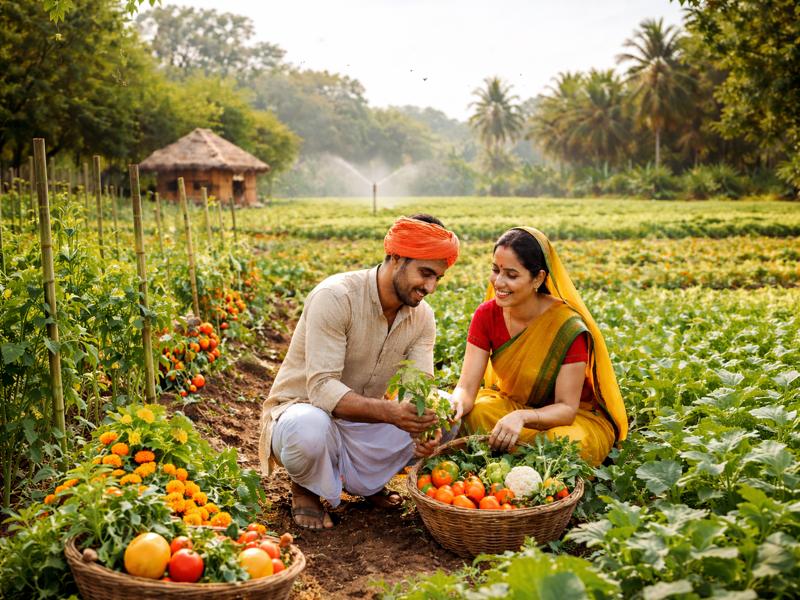
🌱 What is Organic Farming? Full Information, Benefits, Method, Certification and Future
Today, every person wants to live a healthy life. But because of increasing use of chemical fertilizers, pesticides, and pollution, both farming and food are getting affected. In this situation, Organic Farming has come as a safe, sustainable, and profitable option.
This article is prepared in mobile-friendly and easy Indian English with full information, so that farmers, students, and common people can easily understand what organic farming is, how to do it, what are its benefits, and what is its future.
📌 What is Organic Farming?
Organic farming is an agricultural method in which chemical fertilizers, pesticides, herbicides, and genetically modified (GM) seeds are not used.
In this method, natural resources are used, such as:
- Cow dung manure
- Compost
- Vermicompost
- Green manure
- Bio-fertilizers
- Neem-based pesticides
👉 In simple words:
Farming done in a natural way, without using chemicals, is called organic farming.
🌾 Main Objectives of Organic Farming
The goal of organic farming is not only to grow crops, but also:
- To increase soil fertility
- To protect the environment
- To increase farmers’ income
- To provide chemical-free food
- To reduce water and air pollution
🌍 Four Principles of Organic Farming
Organic farming is not only about not using chemicals. It is a complete farming philosophy. It is based on four main principles:
1️⃣ Principle of Health
Organic farming gives priority to the health of soil, plants, animals, and humans.
Healthy soil = Healthy crop
Healthy crop = Healthy food
Healthy food = Healthy family
In chemical farming, pesticide residues can remain in food. But in organic farming, this risk is very low.
👉 Objective: “Health from soil to plate”
2️⃣ Principle of Ecology
Organic farming follows the rules of nature.
- Natural nutrient cycle
- Rainwater conservation
- Biodiversity
- Natural pest control
This method focuses on doing farming in balance with nature.
3️⃣ Principle of Fairness
This principle means:
- Farmers should get fair price
- Consumers should get pure food
- Environment should not get damaged
Organic farming helps in maintaining social and economic balance.
4️⃣ Principle of Care
This principle talks about farming by keeping future generations in mind.
- Soil quality should remain safe
- Water sources should not get polluted
- Natural resources should not be overused
👉 Meaning: “Today’s farming, tomorrow’s safety”
🌾 Organic Farming Techniques
In organic farming, many natural techniques are used:
🔄 1. Crop Rotation
Growing different crops every year in the same field.
✔ Soil fertility increases
✔ Pests and diseases reduce
✔ Nutrients remain balanced
Example:
First year wheat → Second year pulses → Third year vegetables
🌿 2. Mixed Cropping
Growing two or more crops together at the same time.
✔ Risk is less
✔ Income sources increase
✔ Pest control becomes easier
🌱 3. Green Manure
Crops like dhaincha and sunhemp are grown and then mixed into the soil.
✔ Nitrogen increases
✔ Soil structure improves
🐛 4. Organic Pest Control
Instead of chemical pesticides, these are used:
- Neem oil
- Cow urine solution
- Jeevamrit
- Trichoderma
🌾 5. Mulching
Covering the soil with leaves, straw, or plastic sheet.
✔ Moisture remains in soil
✔ Weeds grow less
✔ Water is saved
🌟 Detailed Benefits of Organic Farming
✅ 1. Improvement in Soil Health
Organic manure increases micro-organisms in the soil.
✅ 2. Water Conservation
Because there is no chemical pollution, groundwater remains safe.
✅ 3. Better Nutrition
Organic fruits and vegetables contain more antioxidants.
✅ 4. Long-Term Production
Soil quality remains good for many years.
✅ 5. Increase in Farmers’ Income
Organic products can sell in the market at 20%–50% higher price.
✅ 6. Export Opportunities
There is heavy demand for organic products in foreign countries.
⚠️ Challenges of Organic Farming
Although organic farming is beneficial, there are some challenges also:
🔸 Low Production in the Beginning
In the first 2–3 years, production may decrease.
🔸 Complex Certification Process
Getting certificate takes time and money.
🔸 Lack of Market Information
Many farmers are not able to reach customers directly.
🔸 More Labour Required
Organic farming needs more monitoring and care.
But with proper training and government support, these challenges can be reduced.
🇮🇳 Present Situation of Organic Farming in India (2026 Update)
India is included among the leading organic producing countries in the world.
✔ Organic farming is done on lakhs of hectares of land
✔ Thousands of certified producer groups
✔ Export of spices, tea, coffee, pulses, and grains
Many states are rapidly adopting organic farming.
🏛️ Government Schemes and Support
The government is running many schemes to encourage farmers:
✔️ Paramparagat Krishi Vikas Yojana (PKVY)
✔️ National Programme for Organic Production (NPOP)
✔️ Mission Organic Value Chain Development
Under these schemes, farmers are given:
- Training
- Financial assistance
- Help in certification fees
- Market link support
📝 Detailed Process to Start Organic Farming
If you want to start organic farming, just stopping chemicals is not enough. Proper planning, patience, and scientific methods are necessary. The full process is given below in simple language:
🔹 Step 1: Soil Testing
Start organic farming by testing your soil.
✔ Check the quantity of nitrogen, phosphorus, and potash in the soil
✔ Test the pH level
✔ Understand the status of organic carbon
👉 Soil testing helps you know which crop is suitable for your field.
🔹 Step 2: Conversion Period
If chemical farming was done earlier, you will not get organic certification immediately.
✔ Stop chemical fertilizers and pesticides completely for 2–3 years
✔ Use only organic manure during this period
✔ Follow crop rotation
This time is called the “Conversion Period”.
🔹 Step 3: Prepare Organic Manure
In organic farming, making manure yourself is most beneficial.
Useful Manure:
- Cow dung manure
- Vermicompost
- Compost manure
- Green manure
✔ Prepare manure by making a pit near the field
✔ You can start vermiculture (earthworm farming)
This will reduce cost and make the soil strong.
🔹 Step 4: Organic Pest and Disease Management
Instead of chemical spray, use natural methods.
✔ Neem oil spray
✔ Jeevamrit
✔ Cow urine-based solution
✔ Pheromone trap
👉 Regular monitoring is very important.
🔹 Step 5: Crop Selection and Crop Rotation
✔ Use local and desi seeds
✔ Include pulse crops
✔ Do not grow the same crop again and again
Example:
Wheat → Gram → Vegetables → Maize
🔹 Step 6: Maintain Records
Records are necessary for organic certification:
✔ When manure was added
✔ Which spray was used
✔ Source of seeds
✔ Production details
🔹 Step 7: Apply for Organic Certification
If you want to sell organic products commercially:
✔ Contact a certification agency
✔ Submit application
✔ Complete inspection process
You can use the “Organic” label only after getting the certificate.
📜 Organic Certification Process in India
In India, organic certification is done under two main systems:
1️⃣ Participatory Guarantee System (PGS)
✔ For small farmers
✔ Low cost
✔ Suitable for local market
2️⃣ National Programme for Organic Production (NPOP)
✔ Required for export
✔ International recognition
✔ Detailed inspection process
Certification Steps:
- Application
- Field inspection
- Document verification
- Conversion period
- Issue of certificate
💰 How to Earn More from Organic Farming?
Organic farming becomes profitable only when proper market strategy is followed.
✔️ 1. Direct Selling to Customers (Direct Marketing)
- Farmer markets
- Local mandi
- Selling in housing societies
✔️ 2. Online Platforms
- Social media
- WhatsApp groups
- E-commerce platforms
✔️ 3. Join FPO (Farmer Producer Organization)
✔ Collective selling
✔ Better price
✔ Lower transport cost
✔️ 4. Do Value Addition
✔ Sell wheat after making flour
✔ Pack and sell spices
✔ Do branding of organic pulses
📊 Cost and Profit Analysis of Organic Farming
| Aspect | Initial Stage | After 3–5 Years |
|---|---|---|
| Production | Slightly less | Stable |
| Cost | Medium | Low |
| Soil Fertility | Improvement starts | Much better |
| Market Price | Higher | Higher |
| Profit | Slowly increasing | Stable |
🔮 Future of Organic Farming in India
The demand for organic products in India is increasing rapidly.
✔ Health awareness is increasing
✔ Export opportunities are increasing
✔ Government promotion schemes are increasing
✔ Direct selling is possible through digital marketing
In the coming years, organic farming can play an important role in increasing farmers’ income.
🌎 Organic Farming and Climate Change
Organic farming:
✔ Increases carbon storage in soil
✔ Conserves water
✔ Reduces chemical pollution
✔ Increases biodiversity
Therefore, it helps in fighting climate change.
📌 Frequently Asked Questions (FAQ)
1. Is organic farming possible on every type of land?
Yes, but soil testing is necessary.
2. Are pesticides completely stopped in organic farming?
Chemical pesticides are stopped, natural methods are used.
3. How much time does organic farming take to become successful?
In 2–3 years, the soil becomes stable.
4. Do organic products sell at higher prices?
Yes, they can get 20–50% higher price than normal products.
🏁 Conclusion
Organic farming is a long-term, sustainable, and profitable farming system.
It not only protects soil and environment, but also keeps farmers’ income and consumers’ health safe.
If proper planning, training, and market strategy are followed, organic farming can become the strongest farming method of the future.
🌱 Final Message
Adopt organic farming today, get a safe future tomorrow.
Healthy soil – Healthy crop – Healthy family – Healthy India 🇮🇳
👉 For more detailed information on technical farming, click here.