


Aloe Vera Farming
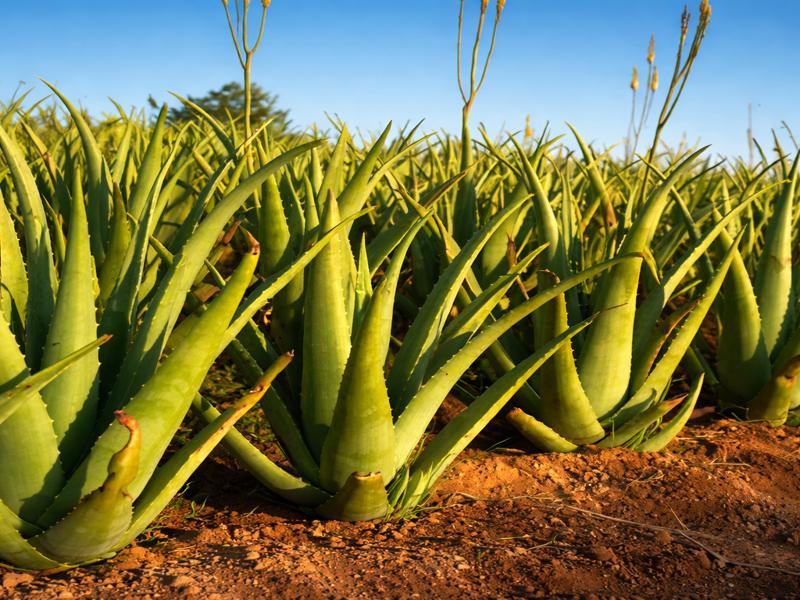
🌿 Aloe Vera Farming: More Profit in Less Cost
Aloe vera farming has become a very profitable and low-risk farming for farmers in today’s time. It is a medicinal crop whose demand is continuously increasing in companies making medicines, cosmetics, health drinks, juice, cream, shampoo and Ayurvedic products.
If you want to earn more profit in less cost and want to grow a crop which gives good production even with less water, less care and less fertilizer, then Aloe Vera Ki Kheti | Aloe Vera Farming is a very good option for you.
This crop gives continuous production for 4 to 5 years, due to which there is no need to spend money on sowing every year. The special thing is that this crop can tolerate drought and can be successfully grown even in less fertile land.
Now below we will understand complete information about aloe vera farming step by step and in detail, so that farmer brothers can follow each step properly and get more profit.
1️⃣ Crop Introduction
The name of Aloe Vera is taken from the Arabic word “Alloeh”, which means shiny bitter substance. The gel and latex part inside its leaves are used in making medicines.
🌱 Main Features
• Plant without stem
• Average height 24 to 39 centimeters
• Thick and fleshy leaves
• Leaf length up to around 50 centimeters
• Fully mature in 18 to 24 months
🌍 Major Producing States in India
• Punjab
• Haryana
• Rajasthan
• Gujarat
• Madhya Pradesh
• Maharashtra
• Uttarakhand
• Andhra Pradesh
Aloe vera farming is mainly done in Kharif season, but if irrigation facility is available, it can be cultivated throughout the year also.
2️⃣ Health Benefits and Uses
Aloe vera is called the king of medicinal plants.
🧴 Health Benefits
• Beneficial in burns and sunburn
• Useful in skin diseases like eczema, psoriasis, acne
• Makes digestive system strong
• Increases immunity power
• Removes toxic elements from the body
• Beneficial in hair fall
🧪 Nutrients Found in It
• Vitamin A
• Vitamin B1, B2, B6, B12
• Folic Acid
• Niacin
🏭 Use Areas
• Ayurvedic medicines
• Cosmetic industry
• Health drink
• Skin gel
• Shampoo and soap
3️⃣ Scientific Classification
• Family: Liliaceae
• Genus: Aloe
• Species: Around 150
🌿 Main Species
• Aloe barbedensis
• Aloe chinensis
• Aloe vulgaris
• Aloe indica
• Aloe littoralis
4️⃣ Climate & Temperature
🌡 Temperature
• Ideal temperature 25 to 40 degree Celsius
• Sowing temperature 30 to 35 degree
• Harvesting temperature 25 to 35 degree
🌧 Rainfall
• 35 to 40 centimeter rainfall is sufficient
This crop grows well in hot and dry climate. It does not tolerate waterlogging at all.
5️⃣ Soil Requirement
🧱 Suitable Soil
• Sandy loam
• Loam
• Light sandy soil
⚖ pH Value
• 7 to 8.5
⚠ Keep in Mind
• Drainage should be good
• Water should not stagnate
6️⃣ Seed & Varieties
Aloe vera farming is mainly done by suckers. Preparing plants from seed is not considered profitable at commercial level, because plants grown from seed have less uniformity and production also remains uneven.
🌱 How to Select Planting Material
• Select 3 to 4 months old suckers
• Each sucker should have 4 to 5 healthy leaves
• Plant should be free from disease and pests
• Roots should be strong and white in color
• Take plants from local nursery or certified source
🌿 Main Improved Varieties
🔹 IC111271
🔹 IC111269
🔹 IC111280
🔹 IC111273
🔹 IC111279
🔹 IC111267
In these varieties, the quantity of aloin is found more, due to which medicinal value increases.
🔹 AL 1
This variety has been developed by Central Institute of Medicinal and Aromatic Plants, Lucknow. It has more gel content and is suitable for commercial farming.
📌 Points to Remember While Selecting Variety
• Choose variety according to the company with whom you have selling contract
• Varieties with more gel content have more demand in market
• Select variety according to local climate
7️⃣ Seed Rate
For one acre aloe vera farming, around 22000 suckers are required.
📏 Plant Number According to Spacing
• At 45 x 40 centimeter spacing around 22000 plants
• At 60 x 30 centimeter spacing also around 22000 plants
🌱 Preparation Before Planting
• Dry the suckers in shade for 24 hours
• If there is possibility of fungus in root, treat with organic fungicide
• Do not use very big or very small suckers
8️⃣ Land Preparation
Aloe vera roots go up to 20 to 30 centimeter depth, so proper ploughing of land is necessary.
🚜 Ploughing Process
• Do deep ploughing 2 to 3 times
• Make the soil loose and level
• Remove weeds completely
🐄 Farmyard Manure
• At the time of last ploughing, mix 60 to 80 quintal well rotten cow dung manure per acre
🌾 Making Beds and Drains
• Make beds for proper drainage
• Keep distance between beds 45 or 60 centimeter
• Drains are necessary for water outlet
9️⃣ Sowing Method
📅 Sowing Time
• July to August is best
• If irrigation facility is available, can do whole year
• Avoid planting in winter
📌 Planting Method
• Make 15 centimeter deep pit
• Plant the sucker in straight position
• Press the soil and give light irrigation
🌿 After Planting
• Give first irrigation immediately
• Slowly make the plants habitual to direct sunlight
🔟 Fertilizer & Manure Management
Aloe vera gives good production even with less fertilizer, but balanced nutrition increases yield.
🐄 Organic Manure
• 60 to 80 quintal cow dung manure per acre
🧪 Chemical Fertilizer Per Acre
• Urea 44 kg
• Single Super Phosphate 125 kg
• Muriate of Potash 34 kg
🌱 Nutrient Quantity
• Nitrogen 20 kg
• Phosphorus 20 kg
• Potash 20 kg
📌 Method of Applying Fertilizer
• Mix full quantity at the time of land preparation
• In organic farming, can use vermicompost and jeevamrit
1️⃣1️⃣ Irrigation Schedule
Aloe vera can tolerate drought, but regular irrigation increases production.
💧 Irrigation Interval
• First irrigation immediately after planting
• In summer every 15 days
• In rainy season not required
• In winter 25 to 30 days interval
⚠ Keep in Mind
• Do not allow water to collect in field
• Let the field dry before next irrigation
• Drip irrigation is best
1️⃣2️⃣ Weed Control
Weeds compete for nutrients, so control is necessary.
🌾 Weeding and Hoeing
• At least 2 times in a year
• First weeding 30 days after planting
• Second weeding 60 to 90 days after
🌿 Earthing Up
• Put soil near the plant
• This makes the root strong
1️⃣3️⃣ Pest & Disease Management
🐛 Mealy Bug
Symptoms
• Leaves turning yellow
• Plant becoming weak
Treatment
• Spray 10 ml Methyl Parathion mixed in 10 liter water
• As organic option use neem oil
🍂 Black Brown Spot Disease
Symptoms
• Red brown round spots
• Leaves drying
Treatment
• Remove infected leaves
• Do not allow waterlogging in field
🌿 Anthracnose
Symptoms
• Leaves burning
• Stem rotting
Treatment
• Spray 70 percent neem oil
1️⃣4️⃣ Crop Duration
• Fully mature in 18 to 24 months
• 3 to 4 harvest in a year
• Production up to 4 to 5 years
1️⃣5️⃣ Harvesting Method
✂ Harvesting Time
• Morning or evening
• Select mature thick leaves
🌿 Harvesting Process
• Cut lower 3 to 4 leaves
• Do not damage the plant
1️⃣6️⃣ Yield per Acre
In aloe vera farming, production depends on many factors like variety, number of plants, fertilizer management, irrigation, and harvesting method. With proper management, this crop gives good yield continuously for many years.
🌿 Average Yield
• First year around 150 to 180 quintal leaves
• From second year 200 to 250 quintal leaves
• With good care and improved variety up to 280 quintal production possible
📅 Annual Harvesting Cycle
• 3 to 4 harvest in a year
• In each harvest 3 to 4 leaves per plant
• More gel quantity from mature plant
📊 Factors Affecting Yield
• Healthy and uniform suckers
• Proper drainage system
• Balanced fertilizer and nutrients
• Timely weeding and hoeing
• Disease and pest control
If around 22000 plants are planted per acre and each plant gives on average 1 kg leaves in a year, then total production can be 20000 to 22000 kg, that is 200 to 220 quintal.
1️⃣7️⃣ Market Price & Profit per Acre
The market price of aloe vera depends on location, demand and buyer. If farmers connect directly with processing company or Ayurvedic industry, they can get better price.
💰 Possible Market Price
• Fresh leaves 4 to 8 rupees per kg
• In contract farming 7 to 10 rupees per kg
• For processing, gel price can be decided separately
📈 Example of Possible Income
Suppose production is 220 quintal that is 22000 kg
Average rate 7 rupees per kg
22000 × 7 = 154000 rupees total gross income
💵 Estimated Cost per Acre
• Sucker purchase 30000 to 35000 rupees
• Land preparation and labour 15000 to 20000 rupees
• Manure and fertilizer 10000 to 15000 rupees
• Irrigation and other expenses 10000 rupees
Total cost around 65000 to 70000 rupees
🟢 Net Profit
If total income is 154000 rupees and cost is 70000 rupees
Then net profit around 84000 rupees per acre per year
In second year there is no cost of sucker, so profit increases more.
1️⃣8️⃣ Storage & Post Harvest Management
After harvesting, proper management is very necessary, because aloe vera leaves can spoil quickly.
🌿 Precautions After Harvest
• After cutting, keep leaves in shade for 24 to 72 hours
• Protect from direct sunlight
• Keep away from excess moisture
• Store in clean and dry place
🏢 Before Transportation
• Keep leaves in clean bags or crates
• Protect from pressure
• Send to market as soon as possible
If leaves need to be stored for long time, then keep in cool and ventilated place.
1️⃣9️⃣ Government Schemes
Government is running many schemes to promote medicinal crops.
🏛 Major Schemes
• Subsidy by National Medicinal Plants Board
• Subsidy on drip irrigation
• State agriculture department medicinal crop scheme
• Kisan Credit Card facility
• Support under Atmanirbhar Bharat scheme
Farmer brothers can contact their district agriculture officer or Krishi Vigyan Kendra. In many states, 30 to 50 percent subsidy is given on medicinal plants.
2️⃣0️⃣ Frequently Asked Questions
1 एलोवेरा की खेती कितने साल तक चलती है
After planting once, production is available for 4 to 5 years.
2 प्रति एकड़ कितनी आय संभव है
With proper management, net profit of 80000 to 100000 rupees is possible.
3 क्या एलोवेरा की खेती कम पानी में हो सकती है
Yes, it is a drought tolerant crop, but balanced irrigation increases production.
4 प्रति एकड़ कितने पौधे लगते हैं
Around 22000 plants.
5 पहली कटाई कब होती है
First harvesting can start 8 to 10 months after planting.
6 क्या जैविक खेती संभव है
Yes, aloe vera is very suitable for organic farming.
7 कौन सी मिट्टी सर्वोत्तम है
Loam or sandy loam soil with good drainage.
8 बाजार कहां मिलेगा
Ayurvedic companies, herbal industry, local mandi and processing unit.
9 क्या अनुबंध खेती लाभकारी है
Yes, it gives fixed market and better price.
10 क्या छोटे किसान भी यह खेती कर सकते हैं
Yes, due to low cost and low risk, small farmers can also start easily.
🎯 Conclusion
Aloe Vera Ki Kheti | Aloe Vera Farming is a stable and profitable medicinal farming option in today’s time. It is a low water, low cost and low risk crop which gives continuous production for 4 to 5 years.
If farmer brothers select the right variety, give balanced fertilizer, take care of drainage and connect directly with market or processing unit, then they can get good income per acre.
Seeing the increasing demand of medicinal crops, aloe vera farming can be considered as a safe and profitable farming for the future.
You work hard, follow correct information and you will surely get success 🌿
👉 For more detailed information on medicinal farming, click here.