


Minimum Support Price (MSP)
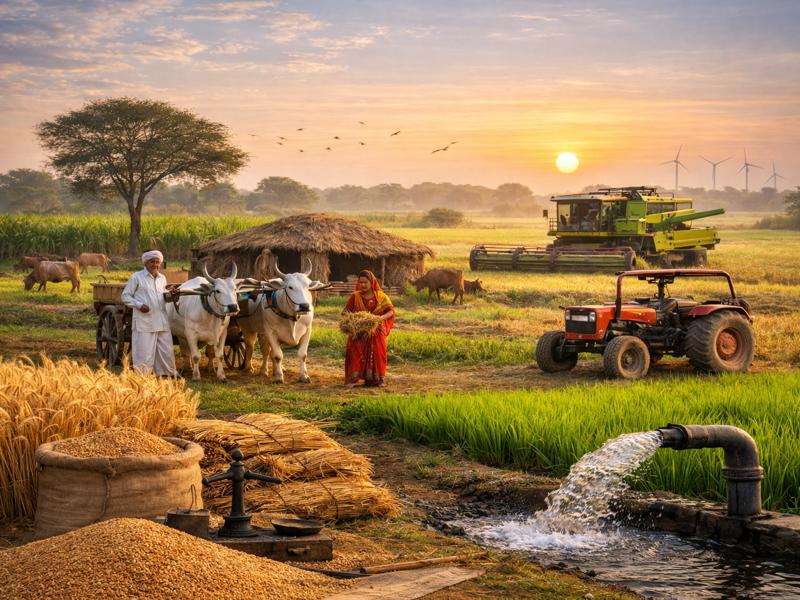
🌾 Government has fixed MSP for 22 crops
What will change for farmers? Full details in simple English
India is an agriculture-based country. Even today, a large population of our country depends on farming. But farming is not only hard work, it is also a risky business. Sometimes there is bad weather, sometimes market prices fall. All this directly affects farmers’ income.
To reduce this risk and to give farmers a minimum safe price for their crops, the Government of India fixes Minimum Support Price (MSP) every year.
Recently, the Government of India has fixed MSP for 22 notified agricultural crops. This decision has been taken based on the recommendations of the Commission for Agricultural Costs and Prices (CACP), after discussions with state governments and related central ministries.
In this blog, we will understand 👇
✔ What is MSP and why it is important
✔ How MSP is decided
✔ Categories of 22 crops
✔ MSP of Kharif and Rabi crops
✔ Government procurement process
✔ Benefits of MSP for farmers
🌱 What is MSP? (Minimum Support Price)
MSP is the minimum price at which the government guarantees to buy crops from farmers
👉 If market prices fall below MSP, the government buys the crop at MSP to protect farmers from loss.
Why is MSP important?
✔ To protect farmers from losses
✔ To ensure recovery of production cost
✔ To protect from market price fluctuations
✔ To make farming profitable
✔ To strengthen the rural economy
🏛 Who decides MSP?
The responsibility of fixing MSP lies with:
👉 Commission for Agricultural Costs and Prices (CACP)
CACP considers the following points:
- Cost of seeds, fertilizers, and pesticides
- Labour and irrigation expenses
- Diesel and electricity prices
- Profit margin for farmers
- Opinions of state governments and ministries
Based on all these factors, CACP sends its recommendations to the central government. The final decision is taken by the Union Cabinet.
🌾 Crop Categories under MSP (Category-wise)
MSP is fixed for 22 notified crops, divided into four main categories.
🌾 Cereals (7 crops)
These crops are the backbone of food security and have maximum government procurement.
- Paddy
- Wheat
- Maize
- Jowar
- Bajra
- Barley
- Ragi
👉 These crops are mainly procured by Food Corporation of India (FCI) and state agencies.
🌱 Pulses (5 crops)
Pulses are very important for nutrition and farmers’ income.
- Gram (Chana)
- Tur / Arhar
- Moong
- Urad
- Masur
👉 Pulses are procured under PM-AASHA scheme when market price falls below MSP.
🌻 Oilseeds (7 crops)
Oilseeds play an important role in edible oil production and income growth.
- Groundnut
- Mustard / Rapeseed
- Soybean (Yellow)
- Sesamum
- Sunflower
- Safflower
- Nigerseed
👉 Oilseeds are also procured under PM-AASHA scheme by NAFED and NCCF.
🧵 Commercial Crops (3 crops)
These crops are linked with industry and exports.
- Copra (Coconut – Milling)
- Cotton
- Raw Jute
👉
- Cotton procurement → Cotton Corporation of India (CCI)
- Jute procurement → Jute Corporation of India (JCI)
- No maximum procurement limit for these crops
📊 Major MSP Rates (₹ per quintal)
🔹 Kharif Crops (2024–25)
- Paddy → ₹2300
- Maize → ₹2225
- Jowar → ₹3371
- Bajra → ₹2625
- Ragi → ₹4290
- Tur → ₹7550
- Moong → ₹8682
- Urad → ₹7400
- Groundnut → ₹6783
- Soybean → ₹4892
- Sesamum → ₹9267
- Sunflower → ₹7280
- Nigerseed → ₹8717
- Cotton → ₹7121
🔹 Rabi Crops (2025–26)
- Wheat → ₹2425
- Barley → ₹1980
- Gram → ₹5650
- Masur → ₹6700
- Mustard → ₹5950
- Safflower → ₹5940
🔹 Raw Jute (2025–26) MSP → ₹5650
🔹 Copra MSP (2025) → ₹11582
👉 Copra MSP is especially beneficial for coastal and South Indian farmers.
🛒 How does government procurement at MSP work?
🌾 Cereals
Agencies: FCI and State Agencies
🌱 Pulses, Oilseeds & Copra
Scheme: PM-AASHA
Agencies: NAFED and NCCF
Procurement only when market price falls below MSP
🧵 Cotton and Jute
No procurement limit
📌 Procurement Limit
- Most crops → Up to 25% of total production
- Cotton and Jute → No limit
🌟 Benefits of MSP for Farmers
✔ Guaranteed minimum income
✔ Protection from market risk
✔ Confidence in farming
✔ Encourages crop diversification
✔ Stronger rural economy
❓ Important MSP FAQs
1️⃣ What is MSP?
MSP is the minimum price at which the government guarantees crop purchase to protect farmers from price fall.
2️⃣ Is MSP a legal guarantee?
No. MSP is not a legal right. It is a government policy for procurement of selected crops.
3️⃣ For how many crops is MSP fixed?
Currently, MSP is fixed for 22 notified crops including cereals, pulses, oilseeds, and commercial crops.
4️⃣ Who decides MSP and how?
MSP is decided based on CACP recommendations considering cost of production, farmer profit, market conditions, and state government opinions. Final decision is taken by the central government.
5️⃣ When is MSP announced?
- Kharif crops → Before sowing
- Rabi crops → Before sowing
This helps farmers in advance planning.
6️⃣ Who procures crops at MSP?
- Cereals → FCI and State Agencies
- Pulses, Oilseeds, Copra → NAFED & NCCF under PM-AASHA
- Cotton → CCI
- Jute → JCI
7️⃣ Does the government buy all produce at MSP?
No. For most crops, procurement is limited to maximum 25% of total production.
👉 This limit does not apply to cotton and jute.
8️⃣ What if market price is higher than MSP?
Farmers can sell in the open market. MSP is only a minimum safety price.
9️⃣ How soon is MSP payment made?
Generally, payment is made to the farmer’s bank account within 3 to 10 working days.
🔟 Is farming really profitable due to MSP?
Yes. MSP provides:
- Minimum income guarantee
- Protection from market risk
- Confidence in farming
However, full benefit is received only when government procurement works properly.
🌾 Conclusion
The increase in MSP for Kharif crops for the sales year 2025–26 shows the government’s commitment towards farmers. This decision will not only provide financial security to farmers but will also help in making Indian agriculture stronger, balanced, and sustainable.
When farmers are happy, the nation becomes prosperous.
Strong Farmer – Strong India 🇮🇳
👉 For more detailed farmer-related news, click here and read full information.