


Cauliflower Farming
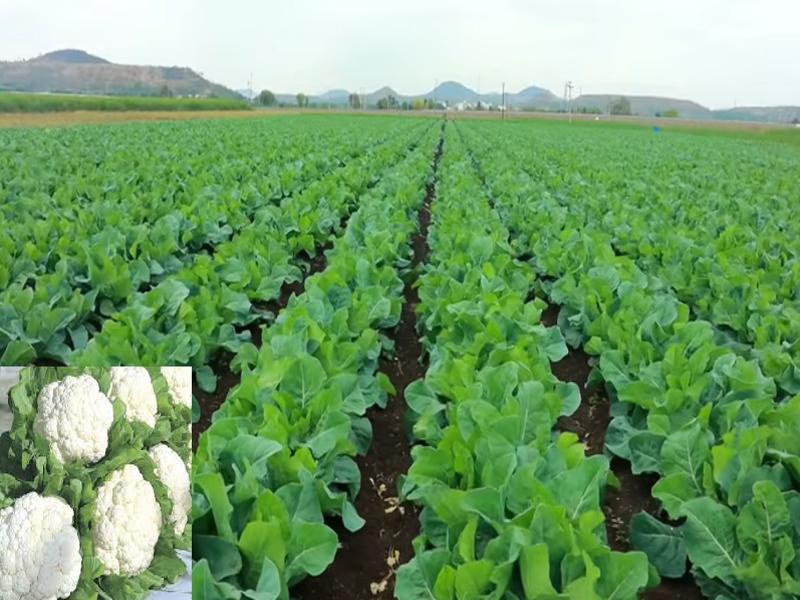
Why Cauliflower Farming is Profitable
Cauliflower (Phool Gobhi) is one of the most popular vegetables grown in India. It belongs to the cruciferous family and is considered very beneficial for health. Cruciferous vegetables like cauliflower and cabbage are known to help in cancer prevention, strengthen the heart and help reduce bad cholesterol in the body.
For Indian farmers, especially in rural areas, cauliflower farming can be a very profitable cash crop, because demand remains high almost throughout the year. It is used in vegetables, soups, pickles, salads, biryani, pakoras and in hotels and restaurants.
Cauliflower is extensively grown in Bihar, Uttar Pradesh, Odisha, West Bengal, Assam, Haryana and Maharashtra, along with many other states. If you choose the right variety, correct season, proper fertilizers, irrigation and pest management, you can get very good yield per acre and earn better income.
General Information and Nutritional Importance
The edible part of cauliflower is the white, compact curd (immature flower head).
- It is a good source of protein, calcium, vitamin A and vitamin C.
- It helps improve digestion due to its high fiber content.
- It is low in calories and rich in micronutrients, making it a healthy vegetable.
Because of its nutritional value and taste, cauliflower has strong demand in both local and distant markets, giving farmers a stable source of income.
Suitable Climate for Cauliflower Farming
Cauliflower is a cool-season crop which prefers cool and humid climate, but the exact temperature requirement depends on the variety.
Temperature and Season
- Overall suitable temperature range: about 12°C to 30°C
- Ideal temperature for good curd formation: around 15–20°C
- Temperature for nursery/seed sowing: about 25–30°C
- Temperature during curd formation and harvesting: around 12–18°C
- Average rainfall requirement: about 120–125 mm
Excessive cold and frost can damage the curds, causing them to turn brown or black.
If the temperature remains too low during vegetative growth (leaf and plant growth), the curds remain small.
So it is very important to select the proper variety and correct sowing time according to your local climate.
Soil Requirements and pH
Cauliflower can be grown in a wide range of soils, but for best yield some points should be followed:
- Ideal soil type:
- Well-drained loam or sandy loam soil
- High organic matter content
- Soil pH: around 6.0 to 7.0 (slightly acidic to neutral)
- Drainage:
- There should be no water stagnation in the field, otherwise root rot and other diseases may occur.
If the soil is too acidic, lime can be added to raise the pH towards neutral.
- For late varieties, heavier clay loam soils are preferred.
- For early varieties, sandy loam soils are more suitable.
Improved Varieties and Grouping
Cauliflower varieties are generally classified based on their maturity period into three groups:
- Early (Ageti) varieties
- Mid-season (Medium) varieties
- Late (Pichheti) varieties
It is very important to sow:
- Early varieties in the early season, and
- Late varieties in the late season.
If you sow an early variety late or a late variety too early, the plants become too leafy, curds remain small and flowering becomes delayed.
Early Varieties
These varieties mature quickly and fetch better prices because they reach the market earlier.
- Early Kunwari
- Early maturing variety
- Popular in Punjab, Haryana and Delhi region
- Average yield about 32 quintals per acre
- Pusa Katki, Pusa Dipali, Summer King, Pawas, Improved Japanese
- All belong to the early group.
- Pusa Dipali: Developed by IARI, early maturing, medium sized white curds, around 48 quintals per acre yield.
Mid-Season Varieties
- Pant Subhra / Pant Shubhra
- Early–mid group variety, popular in North India
- White curds, average yield about 80 quintals per acre
- Pusa Subhra, Pusa Synthetic, Pusa Snowball K-1, Pusa Aghani, Sagnani, Hisar No.-1
- Produce good quality curds.
- Pusa Snowball K-1
- Slightly later than Pusa Snowball-1
- Snow-white curds, average yield around 90 quintals per acre
Late Varieties
- Pusa Snowball-1
- Crop becomes ready in about 100 days
- Outer leaves are upright and slightly curved
- Hard white curds, yield about 90 quintals per acre
- Pusa Snowball-2, Snowball-16
- Snowball-16: Late maturing variety, small but attractive, compact curds
- Yield about 100–125 quintals per acre
With proper variety selection, timely sowing and good management, you can obtain 70–120 quintals per acre or even more.
Field Preparation
Good cultivation starts with good land preparation.
- Plough the field 3–4 times thoroughly.
- After each ploughing, use a plank to make the soil fine and level.
- During the last ploughing, mix 20–25 tonnes per hectare (about 8–10 tons per acre) of well-decomposed farmyard manure/compost into the soil.
- If possible, prepare raised beds, which improve drainage and reduce root rot.
Seed Rate, Sowing Time and Nursery Management
Cauliflower seeds are usually not sown directly in the field. Seedlings are first raised in nursery and later transplanted.
Seed Rate
- Early varieties:
- About 500 g per acre or 600–700 g per hectare
- Mid and late varieties:
- About 250 g per acre or 350–400 g per hectare
Sowing and Transplanting Time
Note: Time may vary slightly according to state and altitude.
- Early varieties
- Nursery sowing: June–July or from last week of August to 15th September
- Transplanting: Seedlings are transplanted after 3–4 weeks, when they are about 25–30 days old
- Mid and late varieties
- Nursery sowing: Mid-September to October
- In many regions, late varieties are transplanted from August to mid-September, and sometimes from October to first week of November, depending on temperature.
Nursery Raising
- Around 75–100 m² nursery area is enough to raise seedlings for 1 hectare of land.
- Make the nursery soil fine and well-pulverized; mix sufficient FYM/compost.
- Sow seeds in lines at 1–2 cm depth.
- Give light irrigation and protect the nursery with net or straw if needed.
- Seedlings become ready for transplanting in 25–30 days (3–4 week old healthy plants).
Seed Treatment
Seed treatment reduces the chance of seed-borne and soil-borne diseases:
- Hot water treatment:
- Soak seeds in hot water at 50°C for about 30 minutes.
- Or
- Soak seeds in Streptocycline solution (0.01 g per litre water) for 2 hours.
- Dry in shade and then sow in the nursery.
- For controlling black fungus and other diseases:
- Treat seeds with mercury chloride 1 g per litre of water for 30 minutes, then dry in shade before sowing.
- For preventing stem rot, especially in sandy soils:
- Treat seeds with Carbendazim 50% WP at 3 g per kg seed.
Spacing of Plants
Proper spacing is very important for better yield and good-sized curds:
- Early varieties:
- Row to row: 40–45 cm
- Plant to plant: 30–45 cm
- Mid and late varieties:
- Row to row: 45–60 cm
- Plant to plant: 45 cm
On an average, you can have 10,000–12,000 plants per acre depending on spacing.
Manures and Fertilizers
For high yield, the soil must have a good amount of organic matter and balanced use of chemical fertilizers.
Organic Manure
- 20–40 tonnes per hectare of well-decomposed farmyard manure or compost
- That is around 8–16 tonnes per acre, depending on soil fertility
Chemical Fertilizers (Per Acre)
As per given recommendations:
- Nitrogen (N): 50 kg (about 110 kg urea)
- Phosphorus (P₂O₅): 25 kg (about 155 kg single super phosphate)
- Potash (K₂O): 25 kg (about 40 kg muriate of potash)
Application method:
- Apply the entire FYM, full dose of SSP, full MOP and half of the urea at the time of final land preparation.
- Apply the remaining half of urea as top dressing about 4 weeks after transplanting.
Water-Soluble Fertilizers
To improve curd size and number:
- Spray 5–7 g of 19:19:19 water soluble fertilizer per litre of water on the crop.
About 40 days after transplanting:
- Spray a mixture of:
- 4–5 g 12:16:0 (N:P)
- 2.5–3 g micronutrient mixture
- 1 g boron per litre of water.
For better curd quality:
- Spray 8–10 g of 13:0:45 water soluble fertilizer per litre of water.
Importance of Micronutrients and Deficiency Symptoms
Boron Deficiency
- Edible part (curd) remains small.
- Small spots and patches appear on the curd.
- Later the curd becomes light pink, yellow or brown and tastes bitter.
- Stem becomes hollow and cracked.
Control:
- Apply Borax 10–15 kg per hectare (about 4–6 kg per acre) along with other fertilizers.
- Foliar spray of boron can also be given if symptoms appear.
Magnesium Deficiency
- Leaves lose green colour, especially older leaves show yellowing.
Control:
- Around 30–35 days after transplanting, spray 5 g magnesium sulphate per litre of water.
Calcium Deficiency
- Plants become weak, top part shows symptoms like deformation and poor growth.
Control:
- Spray Calcium nitrate 5 g per litre of water around 30–35 days after transplanting.
Molybdenum Deficiency
- Leaves become dark green with whitish margins; later they wilt and fall.
- Curds fail to develop properly.
Control:
- Apply 1–1.5 kg molybdenum per hectare in the soil.
Curds should be harvested when they are compact, white, bright and fully formed.
If you delay harvesting, the curds begin to turn yellow and crack, which reduces market value.
Weed Control, Intercultural Operations and Earthing-Up
Till curd formation, 2–3 timely weedings and hoeings are usually sufficient to control weeds.
- During rainy season, if soil gets washed away from around the roots, do earthing-up (heap soil around the base).
- This supports the plants and helps them bear the weight of curds without lodging.
Chemical Weed Control
- Fluchloralin (Basalin) @ 800 ml mixed in 150 litres of water can be sprayed before transplanting and then incorporated into the soil with light hoeing.
- Pendimethalin 1 litre per acre can be sprayed a day before transplanting.
- For commercial farming, Stamp (Pendimethalin) 3.0 litres in 1000 litres of water per hectare is effective.
Irrigation Management
- Give the first irrigation immediately after transplanting.
- Later:
- In summer, irrigate at an interval of 7–8 days.
- In winter, irrigate at 10–15 day intervals, depending on soil and weather.
Avoid heavy and frequent irrigations:
- Excess water causes root rot, wilt and nutrient imbalance.
- Light but timely irrigation keeps curd quality high.
Plant Care and Insect-Pest Management
1. Sap-Sucking Insects (Aphids, Jassids, Thrips)
These insects suck sap from leaves, making them yellow and curled.
- If aphids, jassids or other sucking pests appear:
- Spray Imidacloprid 17.8 SL @ 60 ml in 150 litres of water per acre.
- If thrips attack:
- Spray Triazophos + Deltamethrin 20 ml
- or 25% Cypermethrin 5 ml in 10 litres of water.
2. Diamondback Moth and Similar Caterpillars
This is a serious pest; the adult lays eggs on the underside of leaves.
Green caterpillars feed on leaves, making holes and causing up to 80–90% loss if not controlled.
- In early stages:
- Spray neem seed extract 40 g per litre of water at early curd formation stage.
- Repeat spray after 10–15 days.
- Avoid spraying chemicals on fully developed curds.
- Spray BT (Bacillus thuringiensis) 200 g per acre at 35 and 50 days after transplanting.
- If infestation is heavy:
- Spray Spinosad 2.5% SC @ 80 ml in 150 litres of water per acre.
3. Leaf-Eating Caterpillars (Spodoptera, etc.)
- Common during rainy season.
- If more than two caterpillars are seen per plant:
- Spray BT 10 g per 10 litres of water in the evening.
- Follow up with neem extract 40 g per litre of water.
- If damage is severe:
- Spray Thiodicarb 75 WP @ 40 g per 15 litres of water.
- For leaf-eating caterpillars also use Spinosad 2.5% EC or Emamectin Benzoate 5 SG (100 g per 150 litres of water) per acre.
Other Pests: Aphids, Cabbage Fly, Tobacco Caterpillar, etc.
- As soon as attack is noticed, spray a suitable insecticide like Endosulfan, Nuvacron, Rogor, Thiodan, etc.,
at about 1.5 ml per litre of water as per local recommendation and label instructions.
Always read and follow the instructions on the pesticide label and use only recommended dose.
Diseases and Their Management
1. Wilt / Root Rot
- Plants turn yellow, leaves fall and the whole plant may die.
- Often caused by fungal infection and waterlogging.
Control:
- Ensure proper drainage, avoid water stagnation.
- Apply Trichoderma bio-fungus 2.5 kg in 500 litres of water around the root zone.
- Use Ridomil Gold 2.5 g per litre of water at the root zone if needed.
- Avoid heavy irrigation.
2. Downy Mildew / Leaf Spot (Spots under Leaves)
- White or brownish patches appear on the underside of leaves.
- In severe cases, leaves dry up.
Control:
- Keep the field clean, follow crop rotation.
- On appearance, spray Metalaxyl + Mancozeb 2 g per litre of water.
- Give three sprays at 10-day intervals.
3. Leaf Spot and Blight
- Yellow to brown spots appear on leaves; later leaves dry and fall (blight).
Control:
- Spray Copper oxychloride or Mancozeb 300 g + 20 ml sticker in 150 litres of water.
4. Alternaria Leaf Spot
- Brown to black concentric spots appear on leaves and curds.
Control:
- In the morning, remove and destroy infected leaves.
- Spray Tebuconazole 50% + Trifloxystrobin 25% @ 120 g per acre.
- Or spray Mancozeb 2 g or Carbendazim 1 g per litre of water.
5. Black Rot and Other Bacterial Diseases
- “V” shaped yellow lesions appear on leaf margins moving inward.
- Caused by bacteria and can be highly damaging.
Control:
- Before transplanting, treat seedlings with Streptomycin or Plantomycin solution (half gram in 1 litre water) by dipping.
- Uproot and destroy infected plants.
- Maintain field hygiene.
For other fungal diseases, spray Indofil M-45 (Mancozeb) 2 g or Blitox 3 g per litre of water as needed.
Harvesting, Grading and Storage
Harvesting
- Harvest when curds are:
- Fully developed
- Compact, white and bright
- Neither too small nor over-mature
- Best time for cutting is early morning when temperature is low.
- Cut the curd with a sharp knife, leaving a short stalk and 2–3 protective outer leaves to prevent damage.
Post-Harvest Handling
- Sort and grade curds according to size – large, medium and small.
- Keep them in shade or cool area, never in direct sunlight.
- For marketing, pack carefully in baskets or crates so that curds do not break.
Proper grading, packing and timely marketing help in getting better prices.
Market and Profit Tips
- Plant early varieties to reach the market before peak season and get higher prices.
- Late varieties help you supply fresh curds towards end of winter and early spring when prices may improve again.
- For high quality:
- Apply balanced fertilizers,
- Give timely irrigation,
- And manage pests and diseases effectively.
You can increase profit by making direct linkages with:
- Local vegetable markets (mandis)
- Hotels and restaurants
- Retail vegetable vendors
For more details on vegetable cultivation and other crops, you can visit:
https://subsistencefarming.in/en/vegetable-farming/
Frequently Asked Questions (FAQs)
1. What is the best season for cauliflower farming?
Cauliflower is a cool-season crop. Generally, early varieties are sown in nurseries during June–July or late August to mid-September, and mid and late varieties are sown from mid-September to October. Exact time may vary with region, so always cross-check with local agriculture experts.
2. Which soil is best for cauliflower cultivation?
Well-drained loam or sandy loam soil with good organic matter is ideal for cauliflower. The soil pH should be 6–7. Waterlogging should be avoided to prevent root diseases.
3. How much yield can we get per acre from cauliflower?
With proper variety selection, timely sowing, balanced fertilizers and good management, you can get 70 to 120 quintals per acre. Some improved varieties like Snowball-16 can yield up to 100–125 quintals per acre under good management.
4. What is the difference between early and late cauliflower varieties?
- Early varieties mature quickly; curds may be slightly smaller but fetch good price because they reach the market early.
- Late varieties mature later; curds are usually bigger, more compact and can tolerate lower temperatures better.
5. Why is seed treatment important for cauliflower nursery?
Seed treatment helps to control seed-borne and soil-borne diseases, improves germination and ensures healthy seedlings. Hot water treatment, Streptocycline, Carbendazim, mercury chloride, etc., are used in recommended doses for seed treatment.
6. Which major insect pests attack cauliflower?
The main insect pests are aphids, jassids, thrips, diamondback moth, Spodoptera, cabbage fly and tobacco caterpillar. They suck sap or eat leaves and curds. You can manage them by using neem extract, BT, Imidacloprid, Spinosad, Emamectin Benzoate, etc., in recommended doses.
7. How can we control wilt and root rot in cauliflower?
Ensure good drainage, avoid over-irrigation and waterlogging. Use Trichoderma bio-fungus around roots and apply Ridomil Gold solution near the root zone if needed. Healthy seedlings and crop rotation also help prevent these diseases.
8. Why do cauliflower curds turn brown or yellow?
Curds may turn brown or yellow due to:
- Boron deficiency,
- Fungal diseases like Alternaria leaf spot,
- Excess sunlight or delayed harvesting,
- Nutrient imbalance.
Use Borax, micronutrient sprays and recommended fungicides, and harvest curds at the right stage.
9. When and how should boron and molybdenum be applied?
- Boron (Borax):
- Apply 10–15 kg per hectare mixed with other fertilizers in the soil.
- Foliar spray of boron can also be done if deficiency appears.
- Molybdenum:
- Apply 1–1.5 kg per hectare in the soil.
Both improve curd quality and overall yield.
10. How to know the right time for harvesting cauliflower?
Harvest when curds are:
- Compact,
- White and bright,
- Fully formed but not cracked or yellow.
If kept too long in the field, curds turn yellow and split, reducing market value, so harvest at the proper stage.
11. Is cauliflower farming profitable for small farmers?
Yes, cauliflower farming can be very profitable even for small and marginal farmers, if:
- Correct variety is chosen,
- Proper season,
- Balanced fertilizers and irrigation,
- And timely pest and disease control are followed.
By planning early and late crops, farmers can earn income for a longer period in the year.
Motivational Message for Indian Farmers
In short, cauliflower farming (Phool Gobhi ki Kheti), when done with scientific methods, can become a highly profitable and sustainable crop for Indian farmers. It not only increases productivity of your land but also improves nutrition for your family and strengthens the village economy.
Dear farmer brothers and sisters,
- Stay in touch with your nearest Krishi Vigyan Kendra (KVK),
- Horticulture Department,
- And research institutes like the Indian Institute of Horticultural Research for latest guidance.
With a little technical knowledge, proper planning and hard work, you can also become a successful cauliflower grower in your village and earn better income.
May your fields remain green, your yields be high, and your income grow every season – best wishes for your successful cauliflower farming! 🌱🇮🇳
👉 Click here to read complete and detailed information about other vegetables cultivation.
Reference Websites
- Agriculture and Horticulture Content
- HP Agriculture Department
- Indian Institute of Horticultural Research
- Krishi Vigyan Kendra Portal