


Cumin Farming
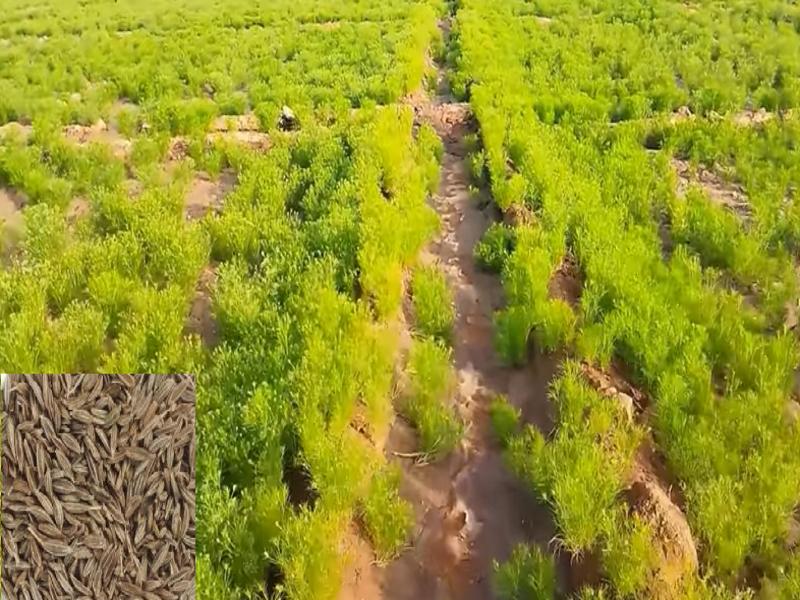
🌾Cumin Farming Guide: Method, Timing & Full Details
Cumin is one of the most important spice seed crops grown in India. More than 80% of the total cumin production of the country comes from Gujarat and Rajasthan. Rajasthan alone contributes about 28% of India’s total production, but its average yield (380 kg/ha) is still lower than that of Gujarat (550 kg/ha).
With the use of improved farming techniques, cumin yield can be increased by 25–50%.
This blog provides:
✔ Complete cumin farming information
✔ Method of cumin cultivation
✔ Best sowing time
✔ Where cumin is grown
✔ How to sow cumin
✔ Soil, seed rate, irrigation, fertilizers
✔ Disease & pest control
✔ Yield & profit calculation
Everything is written in simple English so farmers can easily understand.
Where is Cumin Grown in India?
Cumin (Jeera) is majorly cultivated in:
- Gujarat – 55% to 60% of India’s total production
- Rajasthan – around 28% of total production
- Western Rajasthan alone produces nearly 80% of the state’s cumin
It is also grown in small quantities in Haryana, Madhya Pradesh, and Uttar Pradesh.
What is Cumin? Characteristics of the Plant
Cumin (Cuminum cyminum) is a fragrant spice crop.
Plant features:
- Height: 20–50 cm
- Branching stem
- Pinkish-white flowers
- Long, light brown aromatic seeds
- Naturally improves digestion (hence called “Jeerak” in Sanskrit)
The plant looks similar to fennel but has a different aroma and taste.
Nutritional Facts About Cumin
Cumin seeds contain:
- Iron
- Zinc
- Fiber
- Calcium
- Magnesium
- Vitamin A, C, E
- B-Complex vitamins
It is an excellent antioxidant and helps in digestion and immunity.
Improved Cumin Varieties
1. RZ–19
- Duration: 120–125 days
- Yield: 9–11 quintals/ha
- Resistant to wilt, powdery mildew & blight
2. RZ–209
- Duration: 120–125 days
- Yield: 7–8 quintals/ha
- Bold seeds
- Less affected by powdery mildew & blight
3. GC–4
- Duration: 105–110 days
- Yield: 7–9 quintals/ha
- Large seeds
- Tolerant to wilt
4. RZ–223
- Duration: 110–115 days
- Yield: 6–8 quintals/ha
- Resistant to wilt
- Seeds contain 3.25% oil
Important Things to Know Before Cumin Farming
✔ Best sowing time: 1st to 25th November
✔ Dry and cool climate is ideal
✔ Temperature below 10°C and above 30°C affects germination
✔ High moisture areas are unsuitable because of diseases
✔ Cumin grows best in sandy-loam & loamy soils with good drainage
✔ Sprinkler irrigation is ideal for cumin
✔ Never irrigate at seed-maturity stage
✔ Avoid sowing cumin in the same field every year to prevent diseases
Soil Selection and Field Preparation
Ideal soil:
- Light, friable
- Sandy loam or loamy
- Good drainage
- Rich in organic matter
Field preparation:
- One deep ploughing with moldboard plow
- Two cross harrowings
- Level the soil with plank
- One final cultivation with cultivator
Seed and Sowing (How to Sow Cumin)
Ideal temperature: 24–28°C
Sowing time: 1–25 November
Row sowing at 30 cm spacing is best instead of broadcasting.
- Seed rate: 12 kg/ha
- Sowing depth: Not more than 1.5 cm
- Seed treatment: Use Carbendazim or Trichoderma
Fertilizer Management
- Add 5 tons of farmyard manure before final ploughing
- Apply at sowing:
- 65 kg DAP
- 9 kg Urea
- First irrigation:
- 33 kg Urea
If the previous crop received FYM, fertilizer requirement reduces.
Irrigation Schedule (Water Management)
1️⃣ First irrigation: Immediately after sowing
2️⃣ Second irrigation: After 6–7 days
3️⃣ Later irrigations: Light irrigation every 8–10 days if required
4️⃣ Till grain formation: 3 irrigations at 20–20 days interval
5️⃣ Do NOT irrigate at seed maturity stage (Makes seeds lightweight)
Sprinkler irrigation is the best method.
Weed Management
Because cumin grows slowly at early stages, weeds grow faster.
- Within 2 days after sowing:
Pendimethalin (Stomp) – 3.3 liters/ha in 500 liters of water - After 25–30 days:
One hoeing is necessary - If labor is not available:
Oxy-diarzyl (Raft) – 750 ml in 500 liters of water
Crop Rotation
Never grow cumin in the same field for 3 consecutive years.
It increases the risk of wilt disease.
Recommended rotation:
Bajra → Cumin → Moong → Wheat → Bajra → Cumin
Pest & Disease Management
1. Aphids
- Suck plant sap
- Control:
- Imidacloprid 0.5 ml/litre
- Malathion 50 EC – 1 litre/ha
2. Termites
- Damage roots
- Control:
- Chlorpyrifos 20–25 kg/ha
- Treat seeds before sowing
3. Wilt
- Plants wilt suddenly
- Control:
- Trichoderma – 4 gm/kg seed
- Or Bavistin – 2 gm/kg seed
4. Blight
- Brown spots on leaves and stems
- Control:
- Mancozeb – 2 gm/litre
5. Powdery Mildew
- White powder on plant
- Control:
- Sulphur dust – 25 kg/ha
- Or Karathane – 1 litre/ha
Spray Schedule
1️⃣ First spray:
30–35 days after sowing
- Mancozeb 2 gm/litre
2️⃣ Second spray:
45–50 days after sowing
- Mancozeb
- Imidacloprid
- Soluble sulphur
3️⃣ Third spray:
60–70 days after sowing
- Mancozeb + Imidacloprid + Sulphur
Seed Production Method
- Choose fields where cumin has not been grown for the last 2 years
- Ensure no cumin crop within 10–20 meters around the field
- Remove off-type plants before flowering
- Dry seeds properly to maintain 8–9% moisture
- Store in clean bags or metal bins
Harvesting and Threshing
- Harvest when plant and seeds turn brown
- Dry the plants and separate seeds using a thresher
- Dry the seeds again and store in clean bags
Yield and Profit Calculation
- Average yield: 7–8 quintals/ha
- Cost of cultivation: ₹30,000–₹35,000/ha
- Net profit: ₹40,000–₹45,000/ha (at ₹100/kg price)
With scientific practices, farmers can significantly increase income.
FAQs – Frequently Asked Questions
1. When is cumin sown?
From 1st to 25th November.
2. Which states produce the most cumin?
Gujarat and Rajasthan.
3. What is the sowing depth for cumin?
Not more than 1.5 cm.
4. How much seed is required per hectare?
12 kg/ha.
5. Which are the best cumin varieties?
RZ-19, RZ-209, GC-4, RZ-223.
6. How often should we irrigate cumin?
After sowing, after 6–7 days, then light irrigations as needed.
7. What diseases affect cumin?
Wilt, blight, powdery mildew, aphids, termites.
8. Why avoid irrigation at maturity?
It produces lightweight seeds.
9. What is the average yield?
7–8 quintals per hectare.
10. What profit can a farmer earn?
₹40,000–₹45,000 per hectare.
A Motivational Message for Farmers
Cumin is a profitable and low-maintenance cash crop for Indian farmers.
By using improved varieties, timely sowing, proper irrigation, and disease management, farmers can easily increase yield by up to 50%.
Knowledge and modern farming methods can transform a farmer’s income.
Adopt improved cumin farming and bring prosperity to your fields.
👉 Explore detailed guides on other spices farming – click here to read more