


Zero Budget Natural Farming
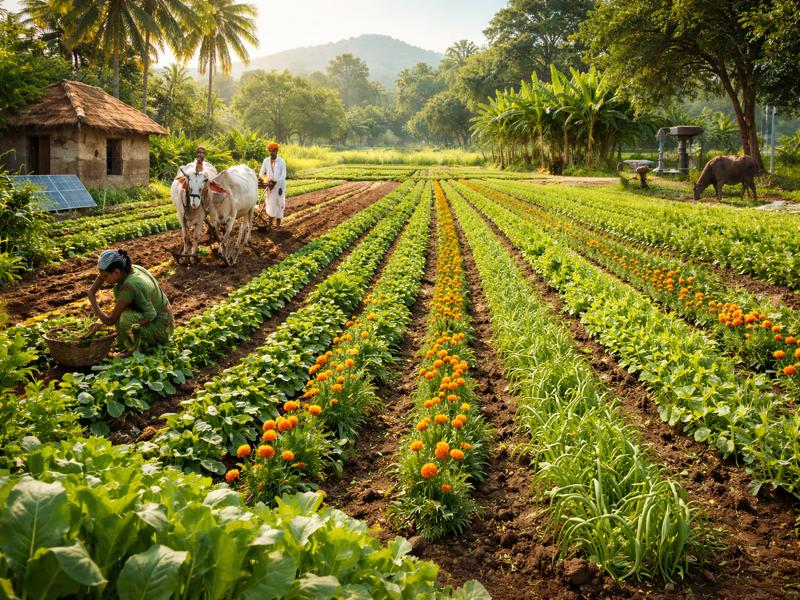
Zero Budget Natural Farming (ZBNF) – Complete Information
The cost of farming in India is continuously increasing. Due to expensive seeds, chemical fertilizers, and pesticides, farmers’ expenses increase and profit becomes less. In such a situation, Zero Budget Natural Farming (ZBNF) has emerged as a very good option for farmers.
It is a farming method in which chemical fertilizers, pesticides, and external inputs are not used. Instead, natural resources like cow dung, cow urine, jaggery, and pulse flour are used to prepare organic solutions.
Because of this, the cost of farming becomes almost zero and soil fertility also remains maintained.
In this article, we will understand the complete process of Zero Budget Natural Farming from start to crop harvesting.
1. What is Zero Budget Natural Farming
Zero Budget Natural Farming is a chemical-free farming system developed by Indian agricultural scientist Subhash Palekar in the 1990s.
Its main objective is to reduce farming cost and promote farming based on natural resources.
In this method, farmers do not need to buy fertilizers or pesticides from outside. Fertilizers and pest control solutions are prepared from natural resources available on the farm itself. That is why it is called “Zero Budget” farming.
Main Objectives
- Reduce the damage caused by chemical farming
- Increase soil fertility
- Produce more yield at low cost
- Increase farmers’ income
- Protect the environment
2. Four Main Techniques of Zero Budget Natural Farming
Zero Budget Natural Farming is based on four main principles which are also called the four wheels of ZBNF.
1. Beejamrit
Seeds are treated with a natural solution to protect them from diseases.
2. Jeevamrit
It is a natural organic solution that increases the number of microorganisms in the soil.
3. Mulching (Acchadana)
Covering the soil to maintain moisture and prevent weeds.
4. Waaphasa
Maintaining balance of air and moisture in the soil.
3. Planning the Farming
In Zero Budget Natural Farming, the most important step is proper planning.
Things to consider while planning
- Check the soil condition
- Choose crops according to weather and region
- Adopt intercropping
- Decide irrigation source
- Select local seeds
Farming according to proper planning increases both production and profit.
4. Field Preparation
Field preparation is an important stage in natural farming.
Main Steps
- Do light ploughing
- Make field boundaries
- Create drainage channels for water
- Increase organic matter in the field
- Maintain soil moisture
In Zero Budget Natural Farming, deep ploughing is avoided because it can destroy useful microorganisms in the soil.
5. Seed Selection
In natural farming, using local seeds (desi seeds) is considered best.
While selecting seeds
- Choose seeds suitable for the region
- Select disease-resistant seeds
- Use certified seeds or seeds obtained from farmers
- Traditional local seeds are more suitable
6. Beejamrit Seed Treatment
In Zero Budget Natural Farming, Beejamrit is used to protect seeds from diseases. It is a natural seed treatment solution that protects seeds from fungus, bacteria, and other diseases.
Main Purpose of Beejamrit
- Increase seed germination capacity
- Protect crops from early diseases
- Strengthen early plant growth
Ingredients for Beejamrit
- 5 kg fresh dung of desi cow
- 5 liters cow urine of desi cow
- 50 grams lime
- A handful of fertile soil from the field
- 20 liters water
Process of Preparing Beejamrit
- First take 20 liters water in a big container.
- Add cow dung and cow urine.
- Now add lime and field soil.
- Mix the solution well and keep it for 12–24 hours.
Method of Seed Treatment
- Soak seeds in this solution for 20–30 minutes
- Dry the seeds in shade
- Then do sowing
This process makes the beginning of the crop healthy and reduces disease risk.
7. Jeevamrit Preparation
Jeevamrit is one of the most important techniques of ZBNF. It is an organic solution that increases beneficial microorganisms in the soil.
Benefits
- Increases soil fertility
- Provides natural nutrition to plants
- Helps plants grow faster
Ingredients for Jeevamrit
- 10 kg desi cow dung
- 10 liters cow urine
- 2 kg jaggery
- 2 kg gram flour / pulse flour
- A handful of field soil
- 200 liters water
Process of Preparing Jeevamrit
- Fill 200 liters water in a big drum.
- Add cow dung and cow urine.
- Now add jaggery and gram flour.
- Add field soil and mix well.
- Allow this solution to ferment for 48 hours.
- Stir the mixture with a wooden stick 2–3 times daily.
Method of Use
- 200 liters Jeevamrit can be used for 1 acre field.
- It is beneficial to apply it every 15 days.
8. Sowing
After seed treatment, the next important stage is sowing.
Things to keep in mind while sowing
- Choose the correct time according to crop
- Do sowing in rows
- Maintain proper distance between plants
- Adopt intercropping
Example
- Maize + Pigeon pea
- Wheat + Gram
- Cotton + Moong
This maintains soil fertility and reduces risk.
9. Mulching
Mulching means covering the soil. It is one of the main techniques of ZBNF.
Types of Mulching
- Soil Mulching – leaving soil loose after ploughing
- Crop Residue Mulching – covering soil with dry grass or leaves
- Live Mulching – growing cover crops in the field
Benefits of Mulching
- Maintains soil moisture
- Reduces weeds
- Increases soil fertility
- Maintains temperature balance
10. Waaphasa
Waaphasa is an important technique of Zero Budget Natural Farming. It means maintaining a balanced mixture of air and moisture in the soil.
According to natural farming, plants do not require too much water. Plant roots actually need moisture and air (oxygen) present in the soil.
When this balance is maintained, plant growth becomes faster.
Ways to Maintain Waaphasa
- Avoid frequent irrigation
- Keep soil slightly moist
- Use mulching
- Do not allow soil to become too hard
- Give water slightly away from the plant stem
Benefits of Waaphasa
- Roots get sufficient oxygen
- Microorganisms remain active in soil
- Saves water
- Improves plant growth and production
11. Irrigation Management
In natural farming, irrigation management is very important. In ZBNF, water is used less but in a proper way.
Main Principles of Irrigation
- Give water only according to plant requirement
- Irrigation in morning or evening is better
- Excess water can reduce oxygen in roots
- Mulching maintains moisture for long time
- Drip irrigation or sprinkler system is useful
Benefits of Proper Irrigation
- Water saving
- Better nutrition for plant roots
- Soil structure remains safe
12. Natural Pest Control
In Zero Budget Natural Farming, chemical pesticides are not used. Instead, natural methods are adopted.
Main Natural Pesticides
1. Neemastra
Ingredients
- 5 kg neem leaves
- 5 liters cow urine
- 2 kg cow dung
- 100 liters water
Benefits
- Controls sucking pests
- Prevents small harmful insects
2. Agniastra
Ingredients
- 1 kg garlic
- 1 kg green chili
- 500 grams tobacco
- 10 liters cow urine
Benefits
- Controls stem borer and other harmful insects
3. Brahmastra
It is prepared using leaves of different plants such as:
- Neem
- Datura
- Castor
- Karanj
It helps control many types of insects.
13. Crop Management
Regular crop care improves both production and quality.
Main Activities
- Regular field inspection
- Use Jeevamrit from time to time
- Control weeds
- Maintain proper plant distance
- Use natural pesticides when required
Importance of Crop Rotation
Crop rotation helps to:
- Increase soil fertility
- Reduce diseases and pests
- Improve production
14. Harvesting
When the crop becomes fully mature, harvesting is done.
Things to consider during harvesting
- Harvest at the correct time
- Keep weather conditions in mind
- Avoid harvesting during rain
- Dry the crop properly after harvesting
Storage
- Store crop in a dry and clean place
- Protect from insects
- Keep grains in a ventilated place
15. Main Benefits of Zero Budget Natural Farming
Zero Budget Natural Farming is beneficial for farmers in many ways.
Major Benefits
- Farming cost becomes very low
- Chemical-free and healthy food is produced
- Soil fertility remains for a long time
- No harm to environment
- Water saving
- Increase in farmers’ income
- Increase in biodiversity
- Farming becomes sustainable
16. Top 10 Profitable Crops for Natural Farming
Many crops give good production and market value in natural farming.
Profitable Crops
- Wheat
- Paddy
- Gram
- Pigeon pea
- Turmeric
- Ginger
- Tomato
- Chili
- Sugarcane
- Banana
Natural farming of these crops gives high quality produce and better market value.
17. How to Do Complete ZBNF Farming in One Acre (Example)
Suppose a farmer has 1 acre of land and wants to do complete Zero Budget Natural Farming. Below is a practical example of how farming can be done during the whole season.
Step 1: Planning the Farming
The farmer should first prepare a crop plan.
Example (1 Acre Field)
- 0.5 acre – main crop (wheat / paddy / maize)
- 0.25 acre – pulse crop (gram / moong / pigeon pea)
- 0.25 acre – vegetable or spice crop
Benefits of mixed cropping:
- Soil fertility remains maintained
- Risk becomes less
- Multiple income sources are created
Step 2: Field Preparation
First prepare the field.
Main Work
- Light ploughing
- Create field boundaries
- Arrange water drainage
- Leave organic matter (crop residue) in field
Excessive ploughing should be avoided because it affects soil microorganisms.
Step 3: Seed Treatment
Before sowing, all seeds must be treated with Beejamrit.
Process
- Soak seeds in Beejamrit solution for 20–30 minutes
- Dry them in shade
- Then sow them
This protects seeds from diseases and improves germination.
Step 4: Sowing
Now sow the seeds in the field.
Example (1 Acre Field)
- 60% area – main crop
- 20% area – pulse crop
- 20% area – supporting crop
Example
- Maize + Moong
- Wheat + Gram
- Cotton + Groundnut
This maintains nutrient balance in the field.
Step 5: Use of Jeevamrit
After 10–15 days of sowing, Jeevamrit is applied.
Method
- 200 liters Jeevamrit
- Enough for 1 acre field
It can be applied:
- With irrigation water
- Or directly in soil
Jeevamrit increases microorganisms in soil.
Step 6: Mulching
After sowing, mulching is very important.
Materials for Mulching
- Dry grass
- Leaves
- Crop residue
Benefits
- Maintains soil moisture
- Reduces weeds
- Maintains soil temperature
Step 7: Irrigation and Waaphasa Management
In ZBNF, irrigation is done less but properly.
Important Points
- Give water slightly away from plant stem
- Avoid frequent irrigation
- Maintain moisture through mulching
This maintains Waaphasa (balance of air and moisture) in soil.
Step 8: Pest and Disease Control
If pests or diseases appear, use natural pesticides.
Example
- Neemastra
- Agniastra
- Brahmastra
These protect crops and do not harm the environment.
Step 9: Crop Care
During the entire crop cycle:
- Use Jeevamrit every 15 days
- Control weeds
- Monitor plants regularly
- Use natural pesticides when required
Step 10: Harvesting
When the crop becomes fully mature, harvesting is done.
During Harvesting
- Weather should be clear
- Dry crop properly
- Store safely
Possible Production from One Acre Natural Farming
Production may vary according to crop.
Example
| Crop | Possible Production |
|---|---|
| Wheat | 12–15 quintals |
| Gram | 3–4 quintals |
| Maize | 10–12 quintals |
Production may be slightly less or equal, but profit becomes higher because farming cost is very low.
18. Summary
Zero Budget Natural Farming is a natural, low-cost, and sustainable farming system which is beneficial for farmers both economically and environmentally.
Main Techniques
- Beejamrit
- Jeevamrit
- Mulching
- Waaphasa
If farmers follow these techniques correctly:
- Farming cost reduces
- Soil fertility increases
- Chemical-free and safe food is produced
- Farmers’ income increases
Today, Zero Budget Natural Farming is becoming an important and sustainable solution for Indian agriculture.
👉 For more detailed information on technical farming, click here